
- Education
- Engagement Rings & Settings
- Best Settings for Asscher Diamonds: How to Set a High Quality Asscher Diamond
Engagement Rings & Settings
Best Settings for Asscher Diamonds: How to Set a High Quality Asscher Diamond
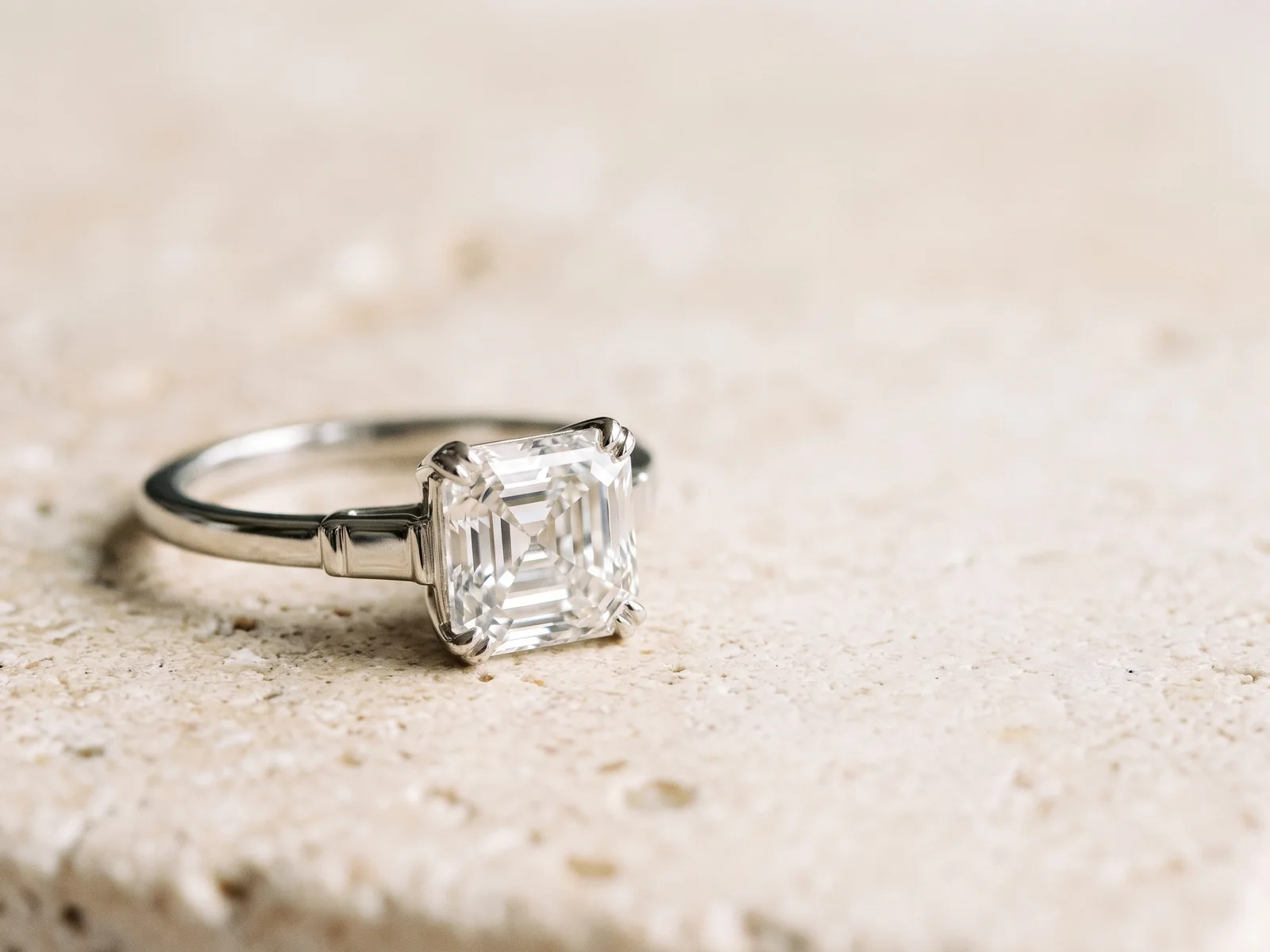
An Asscher's square step facets and windmill pattern only show well if the setting lets light in and protects the cut corners. Here is how to set a high quality Asscher diamond, from claw placement and halos to the wedding band beside it.
 Reviewed by Raj Sood, Graduate Gemologist (GIA), AJP (GIA)Master jeweller and Graduate Gemologist (GIA) · reviewed 4 November 2026
Quick answer
The best settings for an Asscher diamond are a four-claw solitaire with claws on the cut corners, a double-claw (eight-claw) setting for more security, a bezel for active hands, or an octagonal halo for more face-up size. Keep the stone open underneath so light reaches its step facets, and pair it with a straight band that sits flush.
What setting suits a high quality Asscher diamond?
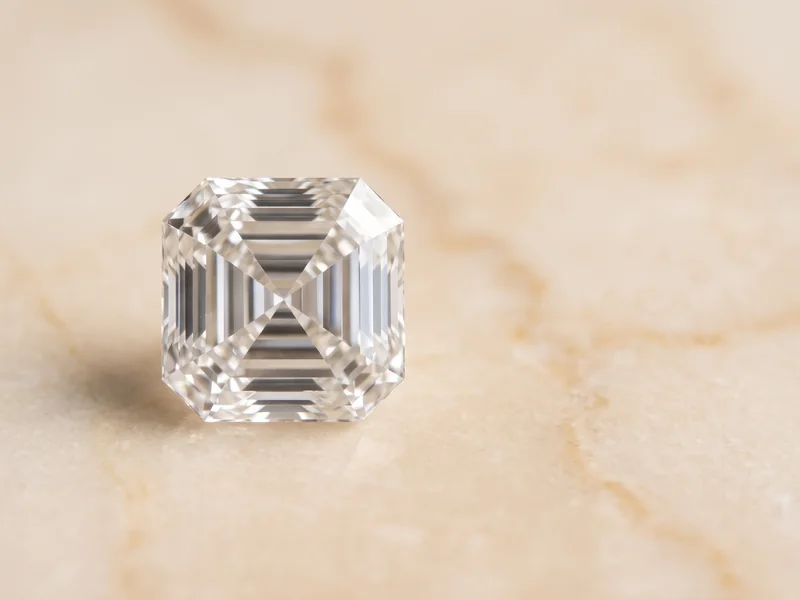
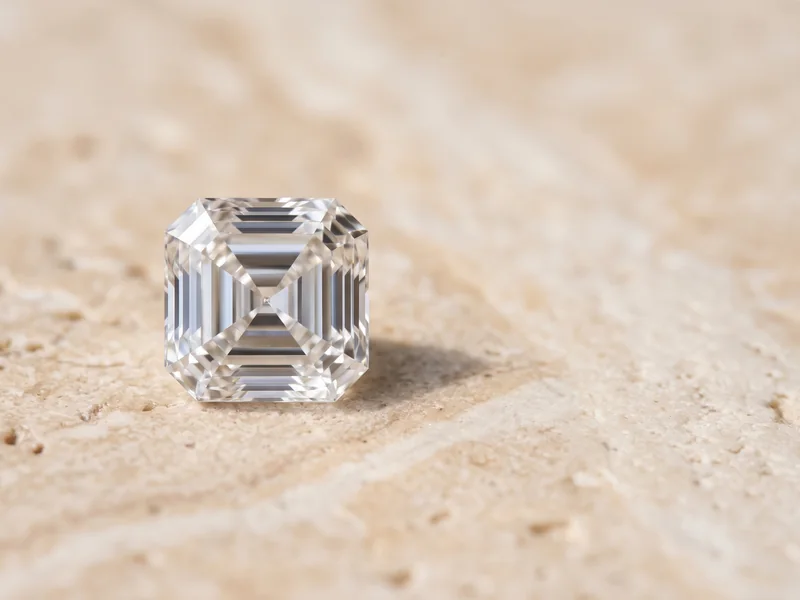
An Asscher is a square step cut: instead of the triangular and kite-shaped facets of a brilliant, it has long, flat facets stacked like steps around the stone. Its four corners are cropped (cut off), so the outline is really an octagon with four long sides and four short ones. Our full guide to Asscher cut diamonds covers its history and grading, and it sits within the step cut family, from emerald to carré.
Look down into a well-cut Asscher and you see concentric squares that seem to fold into the centre, with four bright lines running from the corners. That is the windmill pattern, and it is the main reason people choose this shape. If you want to know how the windmill pattern forms and what spoils it, start there. A setting for a high quality Asscher diamond has three jobs:
- Protect the corners. The cropped corners are stronger than a princess cut's sharp points, but they are still where the girdle (the thin outer edge) is most exposed.
- Keep the outline crisp. Step cuts depend on clean geometry, so metal that follows the straight lines looks deliberate; metal that interrupts them looks clumsy.
- Let light in. Step facets reflect like a hall of mirrors. Light entering from the sides and from below keeps the windmill bright, so open galleries (the metal structure under the stone) work better than enclosed cups.
Diamond is 10 on the Mohs hardness scale, with a refractive index of about 2.42, so the stone itself rarely scratches. Toughness is a different matter: a hard knock on a thin edge can chip along a cleavage plane. Every recommendation on this page comes back to that. Any unfamiliar term is explained in our plain-English jewellery glossary.
Where should the claws go on an Asscher diamond?
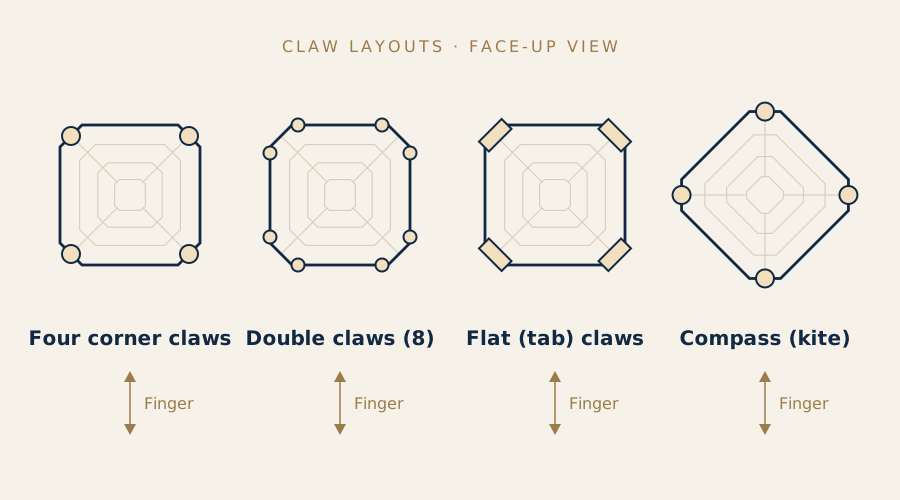
On an Asscher the claws go on the cropped corners, one per corner. Each claw sits across the short corner facet and holds the stone at its girdle. Because the corner is already cut off, there is no fragile point to wrap, which is why an Asscher does not strictly need the V-claws that are essential for a princess. Compare why princess cuts need a V-claw on every corner and how pear settings protect a single point to see the difference.
| Claw layout | Where the claws sit | Why choose it | Watch for |
|---|---|---|---|
| Four corner claws | One on each cropped corner | Shows the most outline; classic and clean | Each claw carries more load; check them every 12 months |
| Double claws (8) | A pair either side of each corner | If one claw wears or bends, the other still holds | Busier look; covers a little more of each corner |
| Flat (tab) claws | A flat claw folded over each corner facet | Echoes the straight lines; suits Art Deco styles | Uses more metal, so slightly less of the girdle shows |
| Compass (kite) set | Claws at north, south, east and west, with the stone turned 45° | Reads as a diamond shape and looks longer on the finger | Sits wider across the finger; corners point at knocks |
Claw size matters as much as position. For a 1 carat Asscher, a claw tip of roughly 1.0–1.3 mm wide is typical: thick enough to wear for years, thin enough not to cover the corner facets. Rounded claw tips are smoother on clothing; pointed or tab claws look sharper but catch a little more.
Is a solitaire setting right for an Asscher cut?
For many people, yes. A four-claw solitaire is the setting that lets the Asscher's geometry speak with nothing competing for attention. It also shows the most light entering from the sides. The style choices within a solitaire are mostly about height and the shape of the gallery, and our guide to every engagement ring setting style compares them across all shapes.
- Low-set basket: the stone sits about 5–6 mm above the finger. Less to knock, and a flat band sits close underneath.
- Cathedral setting: the shoulders of the band arch up to meet the head, lifting the stone to about 7–8 mm. It looks taller and lets in more light, but catches more on gloves and knitwear.
- Hidden halo: a row of small diamonds around the girdle under the stone, visible only from the side. It adds sparkle in profile without changing the clean face-up outline.
- Open gallery: keep the metal under the stone minimal. Step cuts lose brightness quickly if light from below is blocked.
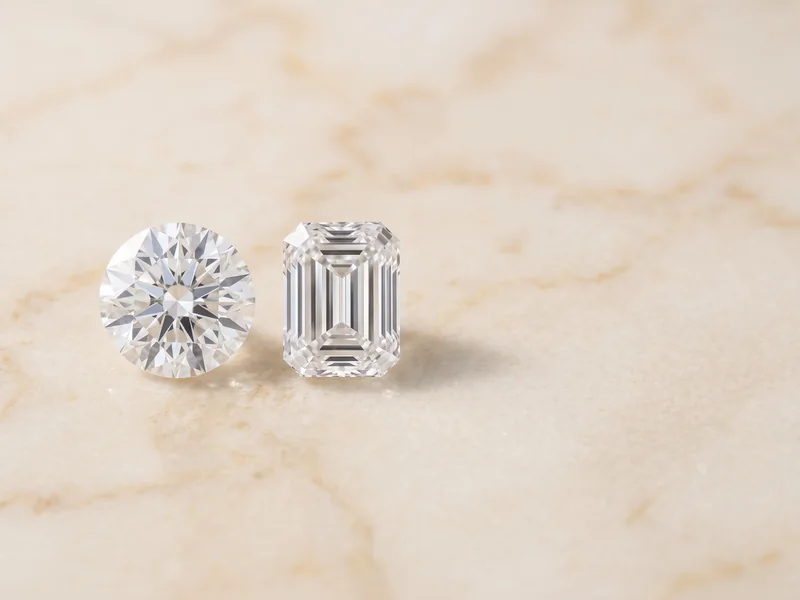
Asschers are usually cut fairly deep, often around 60–70% total depth, so a 1 carat stone measures only about 5.5–5.8 mm across. That is smaller face-up than a 1 carat round (about 6.4 mm). A solitaire is honest about that size; if you want the stone to look bigger, a halo or side stones change the picture.
| Carat weight | Typical Asscher size (mm) | Round of same weight (mm) |
|---|---|---|
| 0.50 ct | about 4.5–4.7 | about 5.1 |
| 0.75 ct | about 5.1–5.3 | about 5.8 |
| 1.00 ct | about 5.5–5.8 | about 6.4 |
| 1.50 ct | about 6.3–6.6 | about 7.3 |
| 2.00 ct | about 7.0–7.3 | about 8.1 |
Should an Asscher diamond have a halo?
A halo is a frame of small diamonds, usually about 1.0–1.3 mm each, set around the centre stone. Around an Asscher it adds roughly 2–3 mm to the face-up width, so a 1 carat stone of about 5.7 mm reads closer to 8 mm across. It also shields the girdle, which is a real practical benefit.
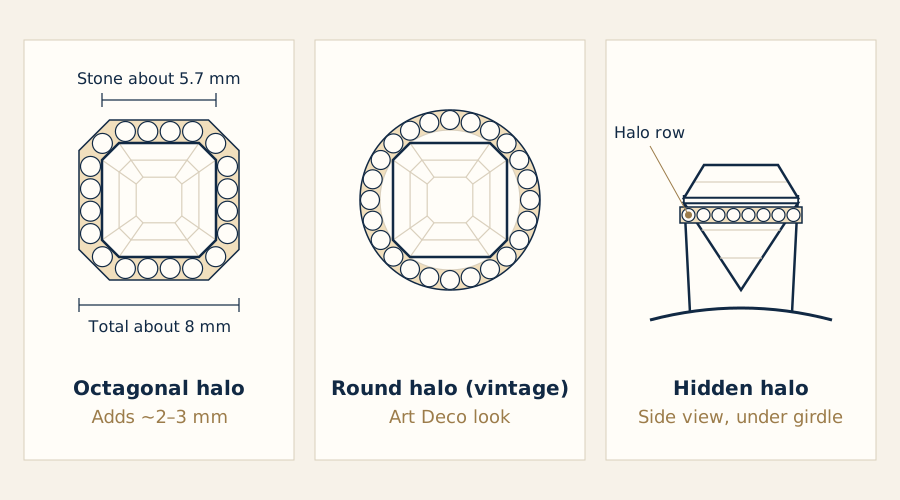
- Octagonal halo: follows the cropped corners exactly. It keeps the step-cut look and is the most common choice.
- Round halo: softens the square into a vintage, Art Deco look. The contrast between round frame and square stone is deliberate, not a mismatch.
- Double halo: two rows. Big presence, but the brilliant sparkle of the halo can start to overpower the calm step facets of the centre.
The gemmologist's view: a halo suits an Asscher when you want more size or more sparkle, but it changes the character of the ring. The Asscher's appeal is clarity and order; a halo adds lots of small flashes around it. If you love the windmill, a hidden halo or a slim octagonal frame is a good middle path. Halos are popular with other square and soft shapes too, and how cushion settings handle halos shows the same trade-off on a brilliant-faceted stone.
Related guideEmerald vs Asscher Cut DiamondsNot sure which one is right?
Send us the stones you are looking at and our gemologist will tell you which to choose and why.
Is a bezel setting good for an Asscher diamond?
A bezel is a thin rim of metal that runs right around the stone's edge. On an Asscher it follows the octagon, which looks very architectural and suits the straight lines. It is also the most protective setting available: no claws to bend or snag, and every corner is covered.
The trade-offs are honest ones. A bezel covers about 0.2–0.5 mm of the outer edge, so the stone looks slightly smaller, and it blocks light from the sides, so the windmill can look a touch less bright. A half-bezel (metal on two opposite sides only) keeps most of the protection while letting more light in. For nurses, chefs, tradies, gardeners and anyone who uses their hands hard, see our guide to low-profile settings for people who work with their hands.
What side stones go with an Asscher cut engagement ring?
Because the Asscher is a step cut, step-cut side stones match it best. Their long facets flash in the same broad way, so the ring reads as one design rather than two styles side by side. The usual choices for a three-stone Asscher ring:
- Tapered baguettes: narrow rectangles that slim towards the band. Clean and Art Deco.
- Trapezoids: wider at the centre stone, narrower at the outside. They extend the outline and add width.
- Smaller Asschers or square step cuts: a classic trilogy, usually with side stones at about a third to half the centre's width each.
- Half-moons or bullets: curved or pointed shapes that add contrast. Check the side stones' outer edges are protected too.
Round brilliant side stones and pavé bands can also work, especially in a vintage design with milgrain (tiny beaded metal edges). They add sparkle, but the contrast is stronger. Asschers were popular in the 1920s and 30s, so Art Deco detailing such as filigree, milgrain and geometric shoulders sits naturally with the shape. If you are still deciding between the two big step cuts, the emerald vs Asscher comparison sets out how each suits side stones.
Which metal and diamond grades suit an Asscher setting?
Step cuts show body colour and inclusions more than brilliants, because their large, open facets do not break up the view. That affects both the metal and the diamond you choose.
- White gold or platinum: most people are comfortable from G or H colour. White claws next to a warmer stone make the tint easier to see.
- Yellow or rose gold: I or J colour can look white, because the metal warms everything near it. Yellow gold also suits the vintage look.
- Two-tone: a white head (the claws) on a yellow band keeps the stone looking whiter while giving you a warm band.
- Clarity: aim for an eye-clean stone (no inclusions visible without magnification), which in an Asscher usually means VS2 or better. See our Asscher clarity grades that stay eye-clean before you commit.
Platinum (Mohs about 4–4.5) is dense and holds claws well; it develops a soft satin patina over time. 18 carat white gold is harder at first but is usually rhodium plated, which wears and needs re-plating every year or two. Either is suitable for an Asscher; the choice is mostly about colour and how you feel about maintenance.
Which wedding band suits an Asscher engagement ring?
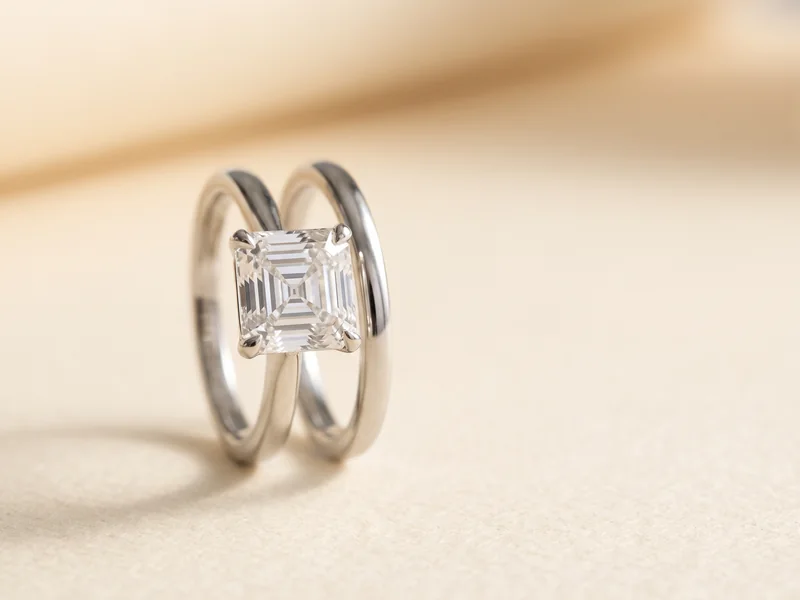
Asschers are compact and square, so unlike a pear or a marquise they rarely need a curved or notched band. A straight band usually sits flush, as long as the engagement ring head is high enough or the gallery is shaped to clear it. Check three things:
- Head height: a low basket can stop a straight band sitting flat. A slightly higher head or a notched gallery solves it.
- Width: bands of about 1.8–2.5 mm suit most Asscher solitaires; wider bands can make a 1 carat Asscher look smaller.
- Matching style: a channel-set baguette band or a plain band with square edges echoes the step cut; round pavé adds sparkle.
If the engagement ring has a halo, measure how far the halo overhangs the shank, because that decides whether a straight band touches it. Our guide to wedding bands that sit flush beside an Asscher shows pairings for solitaire, halo and three-stone designs.
How much does an Asscher engagement ring cost, natural or lab-grown?
The ring has two costs: the setting and the diamond. Settings vary mostly with metal, the number of small diamonds and how much handwork is involved.
| Setting | Security | How much stone shows | Snag risk | Approx setting price (AUD, 18ct gold) |
|---|---|---|---|---|
| Four-claw solitaire | Good | Most | Low to moderate | about $1,500–$3,000 |
| Double-claw solitaire | Very good | High | Moderate | about $1,800–$3,300 |
| Bezel or half-bezel | Excellent | Slightly less | Very low | about $1,800–$3,500 |
| Octagonal halo | Very good | High, looks larger | Moderate | about $2,500–$5,500 |
| Three-stone | Good | High | Moderate | about $3,000–$8,000 incl. side stones |
Asschers are cut from both natural and laboratory-grown diamond, and the two look identical to the eye. Lab-grown diamonds are real diamond grown in a laboratory rather than mined; they cost much less and are easier to find above 1.5 carats. Both should come with an independent grading report from a lab such as GIA or IGI that states whether the stone is natural or lab-grown.
| 1 ct Asscher, G–H, VS | Approximate price range (AUD) |
|---|---|
| Lab-grown | about $1,000–$3,000 |
| Natural | about $6,000–$13,000 |
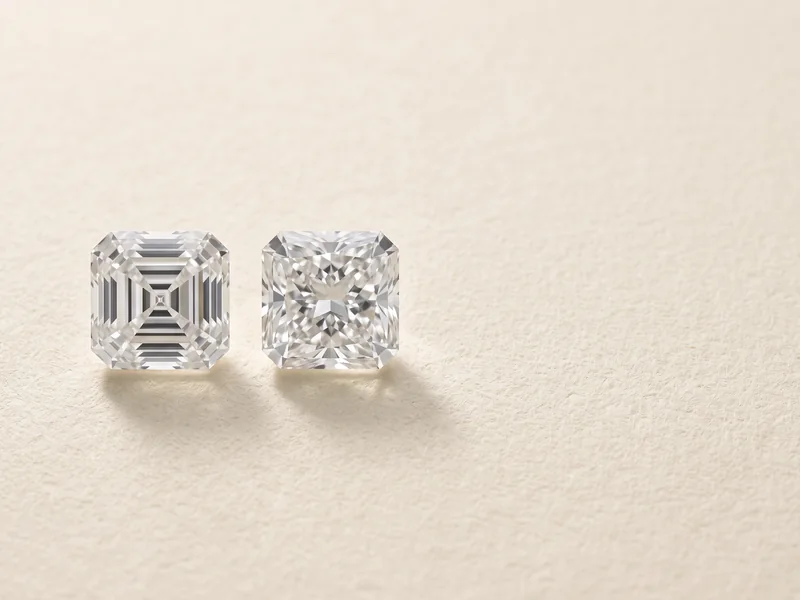
These are broad ranges and move with the market. If you are still weighing the shape itself, compare princess vs Asscher, side by side, the softer cushion alternative to an Asscher and the square radiant, which sparkles like a brilliant. If you end up with a round, the rules change again; see settings that suit a round brilliant.
Browse Asscher diamonds: natural and lab-grown
How do you choose a setting for a high quality Asscher diamond? Step by step
- Choose the stone first. Check the report for a ratio of 1.00–1.05, colour and clarity, and whether it is natural or lab-grown.
- Decide on the look. Clean solitaire, framed halo, protective bezel or three-stone; each changes how big and how busy the ring looks.
- Place the claws on the corners. Four for the most outline, eight for extra security, or tab claws for an Art Deco finish.
- Pick the metal colour. White metal for G–H stones, yellow or rose gold if you are choosing I–J.
- Check the height and gallery. An open gallery keeps the windmill bright; make sure a wedding band can sit flush.
- Look at it face-up. The four corner lines should meet cleanly in the centre, with no grey patch from metal underneath.
- Plan maintenance. Have the claws checked every 12 months and re-tipped when they thin.
Free consultation
Talk to a gemologist
Compare stones in person or online with Raj Sood, Graduate Gemologist (GIA), AJP (GIA).
Book a consultationFAQ
Common questions
What is the most secure setting for an Asscher diamond?
A full bezel is the most secure, because metal covers the whole edge, including the corners. A double-claw setting with two claws on each corner is the most secure claw option.
Do Asscher diamonds need V-claws?
Usually not. The corners of an Asscher are cropped, so there is no sharp point to wrap; a standard or flat claw across each corner facet holds it well. V-claws are needed on princess cuts, which have sharp corners.
Does a halo make an Asscher diamond look bigger?
Yes. A halo of small diamonds adds about 2–3 mm to the face-up width, so a 1 carat Asscher can read closer to 8 mm across. It also protects the girdle.
Why does my Asscher look smaller than a round of the same carat?
Asschers are cut deep, so more weight sits below the girdle. A 1 carat Asscher is about 5.5–5.8 mm across, compared with about 6.4 mm for a 1 carat round.
Can a straight wedding band sit next to an Asscher engagement ring?
In most cases, yes. The square shape does not overhang much, so a straight band sits flush if the head is high enough or the gallery is notched to clear it.
Can you get a lab-grown Asscher diamond?
Yes. Lab-grown Asschers are widely available, cost considerably less than natural stones and are graded by labs such as IGI on the same colour and clarity scales as natural stones; GIA now uses simpler quality descriptors for lab-grown diamonds.

Ask a gemologist
Not sure which diamond to choose?
Raj Sood is a Graduate Gemologist (GIA) and master jeweller. Bring the stones you are considering, or send the reports, and he will tell you honestly which one is better and why.
Keep learning
Related guides
 Diamond ShapesAsscher Cut Diamonds
 Wedding Bands & EternityBest Wedding Band for Asscher Engagement RingsEngagement Rings & SettingsEngagement Ring Setting Styles Guide
 Diamond ShapesAsscher-Cut Diamond Windmill Pattern
 Diamond ShapesPrincess vs Asscher Cut DiamondsDiamond ShapesAsscher-Cut Diamond Clarity Guide
 Diamond ShapesEmerald vs Asscher Cut DiamondsDiamond ShapesAsscher vs Cushion Cut Diamonds
Explore more
More guides on this topic
Education