
- Education
- Engagement Rings & Settings
- Double Halo Engagement Rings: Anatomy, History and How to Choose One
Engagement Rings & Settings
Double Halo Engagement Rings: Anatomy, History and How to Choose One
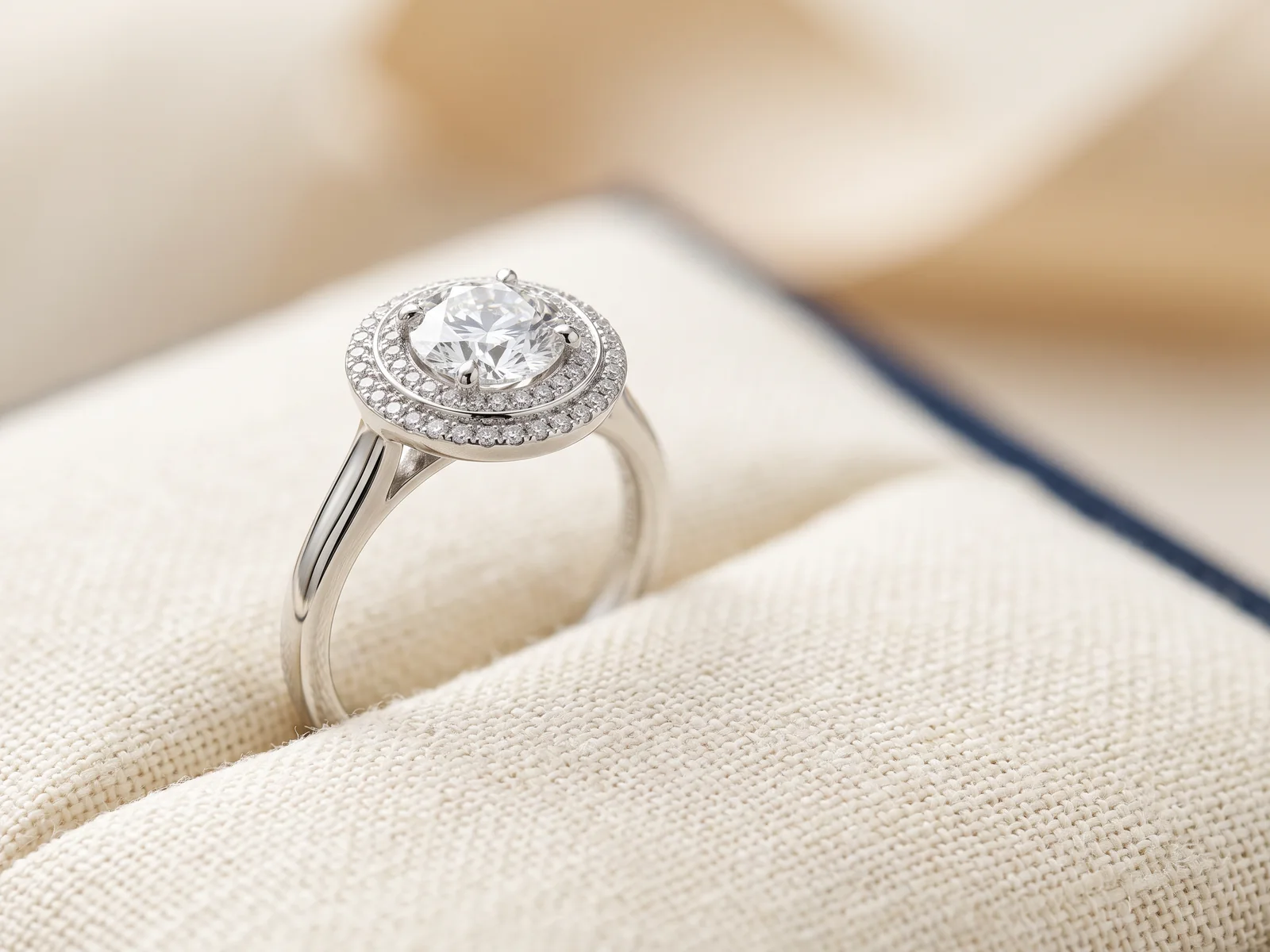
A double halo engagement ring gives more spread and sparkle than almost any other setting you can build around a single centre stone, and it is some of the most detailed setting work in jewellery. Here is how one is built, where the style came from and what to check before you choose.
 Reviewed by Raj Sood, Graduate Gemologist (GIA), AJP (GIA)Master jeweller and Graduate Gemologist (GIA) · reviewed 4 November 2026
Quick answer
A double halo engagement ring surrounds the centre diamond with two concentric rows of small diamonds, called melee. The extra row makes a 1 carat round look roughly 11–12 mm wide, almost twice its own diameter, and adds strong sparkle. Expect more upkeep than a solitaire: around 40–60 tiny stones need checking every 6–12 months.
What is a double halo engagement ring?
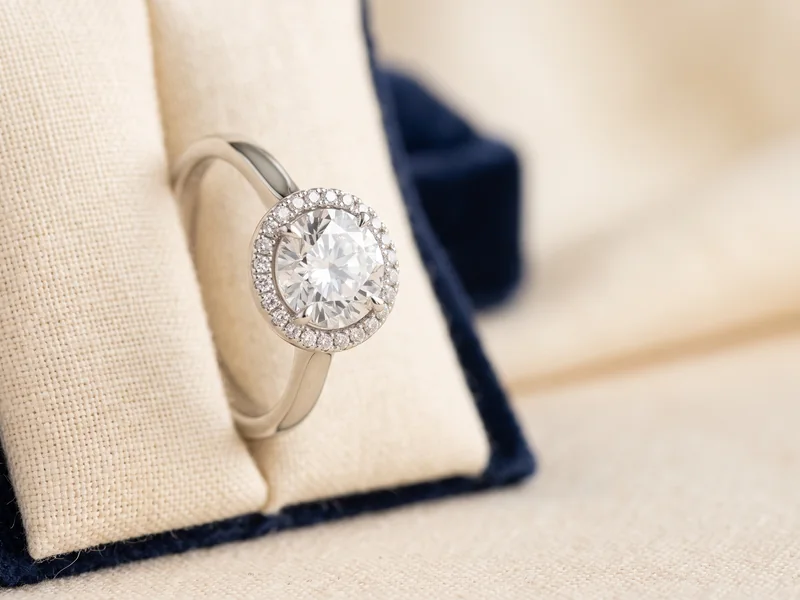
A halo is a ring of small diamonds set tight around a centre stone. A double halo engagement ring simply adds a second row outside the first, so the centre diamond sits inside two concentric frames. The small stones are called melee (say 'mel-ay'), a trade word for diamonds under about 0.18 carat. In halos they are usually much smaller than that, about 1.0–1.5 mm across and roughly 0.005–0.015 carat each. If you are new to the single version, our guide to how a single halo ring works is a good starting point.
The two rows do three jobs. They make the centre look larger, because your eye reads the whole bright outline as one stone. They add a lot of sparkle, because dozens of small facets flash at slightly different angles as your hand moves. And they change the ring's character: a double halo reads as more ornate and more vintage than a single halo, closer to an heirloom cluster than a clean modern solitaire. Where it sits among the other styles is set out in our overview of engagement ring setting styles.
Within the style there is plenty of room to vary. The two rows can use the same size melee, or the inner row can be a little smaller than the outer, which is called a graduated halo. The halos can follow the centre's outline (round inside round) or contrast with it (a round centre inside a cushion-shaped frame). The outer row can even be a coloured gem such as sapphire. Any term here you have not met before is explained in our plain-English jewellery glossary.
How is a double halo engagement ring built?
From the top down, a double halo ring is a stack of separate parts that are designed together, usually in CAD (computer-aided design) so every seat for every small stone lines up. Here is what each part is called and what it does.
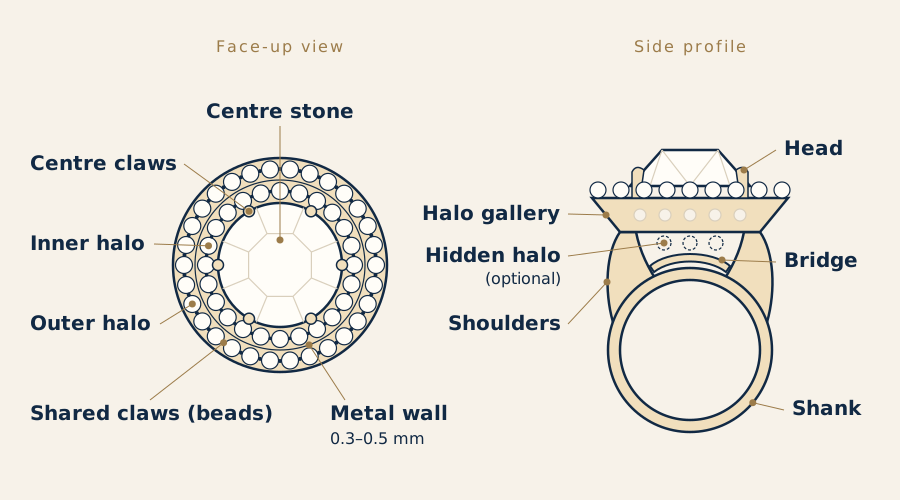
- Centre stone and head: the main diamond, held by four or six claws in its own head. The head is the cluster of claws and the small cup or basket under it.
- Inner halo: the first row of melee, set as close to the centre's girdle (its outer edge) as possible so there is no visible gap.
- Outer halo: the second row, separated from the inner row by a very thin wall of metal, often 0.3–0.5 mm, or by a fine milgrain edge.
- Halo gallery: the metal frame underneath that holds both rows. Seen from the side, it often shows a pierced pattern or a line of small stones.
- Bridge: the curved metal under the head that joins the halo to the shoulders and sits against the top of the finger.
- Shoulders and shank: the shoulders are where the band rises to meet the head; the shank is the rest of the band. A double halo ring with pavé band carries more small diamonds down the shoulders.
The melee in each halo is usually held by shared claws: tiny beads of metal raised between stones, each one gripping the edges of two neighbours. This is often called micro-pavé when the stones are under about 1.3 mm and the beads are raised under magnification. It lets the rows sit close together with little metal showing, but each bead is small, which is why halo rings need regular checks.
The centre stone sits in its own head above the halos. That head can use round, tab or double claws; our guide to round, eagle, tab, V and double claws shows how each grips the stone. Some makers set the centre in a basket, others in a trellis of crossing wires, and the differences are explained in how basket, trellis and peg heads compare. What you see from the side, under the halos, is the area covered in our page on decorative details under the gallery.
Where did the double halo style come from?
The modern double halo is a recent design, but the idea of framing one stone with rows of smaller ones is old. In the workshop we regularly take apart and remake antique rings, and the way each era built its frames is easy to tell once you know what to look for.
| Era | Approximate dates | How the frame looked | Details seen at the bench |
|---|---|---|---|
| Georgian and Victorian | about 1714–1901 | Cluster rings: a centre with one or more rows of old mine or rose cut diamonds | Silver-topped gold settings, closed backs, stones that vary in size around the row |
| Edwardian | about 1901–1915 | Lacy single and double frames in platinum | Fine milgrain edges, pierced filigree galleries, old European cut diamonds |
| Art Deco | about 1920–1935 | Geometric frames, sometimes two rows or a row of coloured stones around white | Platinum, calibré-cut sapphires or rubies, step cuts, crisp straight lines |
| Modern | about 2000s onward | Concentric double and triple halos in micro-pavé | CAD-designed seats, laser-cut galleries, uniform machine-matched melee |
The older multi-row rings are usually called cluster rings, and they are the direct ancestors of the double halo; our guide to cluster engagement rings and their history goes further back. What changed in the modern era is precision. Computer design, casting and laser work made it possible to cut 40 or more identical seats in a frame only a few millimetres wide, and well-matched melee became easy to source. That is why a modern halo looks smooth and even, while a Victorian cluster has a softer, hand-made irregularity.
If you want a vintage double halo ring, era details are what make it read as period rather than modern. Milgrain (a row of tiny metal beads along an edge), open filigree under the halo and an old European cut centre point to Edwardian. Straight lines, step cuts and a coloured outer row point to Art Deco. A new ring can be made with those details, but they need to be designed in from the start.
How big does a double halo make a diamond look?
Each row of 1.1 mm melee, plus its metal walls, adds about 1.2–1.5 mm to every side of the outline. A single halo therefore adds roughly 2.5–3 mm to the face-up width (the size you see from above), and a double halo adds roughly 5–5.5 mm. The table shows typical figures for a round centre with 1.1 mm melee in both rows.
| Round centre | Centre diameter | With a single halo | With a double halo | Approximate melee in both halos |
|---|---|---|---|---|
| 0.50 ct | about 5.1 mm | about 8 mm | about 10.5 mm | 35–45 stones |
| 0.75 ct | about 5.8 mm | about 8.8 mm | about 11 mm | 38–48 stones |
| 1.00 ct | about 6.4 mm | about 9.4 mm | about 11.8 mm | 40–50 stones |
| 1.50 ct | about 7.4 mm | about 10.4 mm | about 12.8 mm | 45–55 stones |
| 2.00 ct | about 8.1 mm | about 11 mm | about 13.5 mm | 48–60 stones |
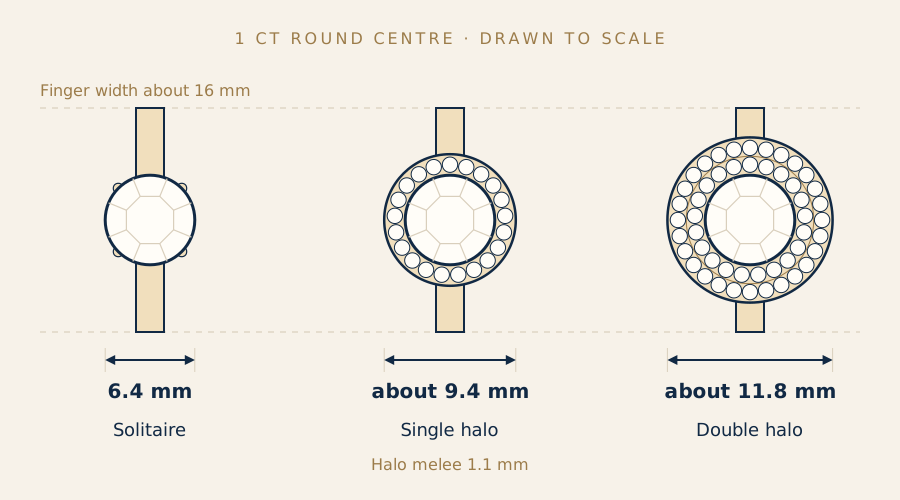
To put that in context, a 1 carat round in a double halo has a bright outline about as wide as a 5–6 carat round on its own. It does not look identical, though. Up close you can see the line between centre and halo, and the small stones sparkle with quick pin-points of light while the centre gives broader flashes. From across a room, the effect is a large, very bright stone.
The extra width also matters on the hand. A head 12–13 mm across covers most of the width of an average finger, so on small hands a double halo around a 0.50–0.75 ct centre often looks balanced, while a 2 ct centre makes a very large ring. Many people choose a smaller centre and let the halos supply the size, which is where the cost savings of the style come from.
The melee itself can be natural or laboratory-grown. Lab-grown melee is now well matched in colour and clarity and costs less, and it must always be disclosed. Our guide to using lab-grown melee in pavé and halo work explains how it is graded, sorted and matched.
Not sure which one is right?
Send us the stones you are looking at and our gemologist will tell you which to choose and why.
Which diamond shapes suit a double halo?
Almost any centre shape can take a double halo, but the halo either follows the stone's outline or deliberately changes it. Here is how the main shapes behave.
- Round: the classic. Two round rows give an even target effect and the most sparkle. The halos hide very little of the round's own light return.
- Oval: an oval double halo engagement ring stretches the outline and slims the look of the finger. Watch for a dark bow-tie (a dark band across the middle); the halos do not hide it.
- Cushion: a cushion double halo ring is the most vintage-looking option, close to Edwardian frames. A round centre inside a cushion halo gives a similar look while keeping a round's sparkle.
- Pear: the halo protects the fragile point, and the outer row needs a neat V where it meets the tip.
- Emerald and radiant: straight-sided halos suit Art Deco designs. Step cuts show inclusions more, so the bright frame does not disguise a poor stone.
- Princess: the halo shields the four sharp corners, which is a real practical benefit for this shape.
Matching the halo to the shape is a design decision in itself, and how round, cushion and shaped halos change a ring covers the options. An elongated centre can also be turned sideways inside its halos, as described in our guide to setting a stone east-west across the finger. Designs with two centre stones can each take a small halo too; see two-stone toi et moi rings for how that works.
Colour matching matters more in a double halo than in a solitaire. If the melee is bright white (around E–G) and the centre is warmer (I–J), the contrast can make the centre look more tinted. Most makers match the melee to within a grade or two of the centre, or set the ring in yellow or rose gold where warmth blends in.
Double halo vs single halo vs hidden halo: what is the difference?
| Solitaire | Single halo | Double halo | Hidden halo | |
|---|---|---|---|---|
| Rows of melee around centre | None | One, face-up | Two, face-up | One, under the centre, seen from the side |
| Extra face-up width (1 ct round) | None | about 2.5–3 mm | about 5–5.5 mm | None |
| Look | Clean, modern | Bright, classic | Ornate, vintage-leaning | Clean from above, sparkle from the side |
| Melee to check | None | about 16–22 | about 40–50 | about 15–20 |
| Upkeep | Lowest | Moderate | Highest | Moderate |
| Fit against a straight band | Usually flush | Often a small gap | Often a gap; may need a curved band | Usually flush |
The choice comes down to how much you want the frame to show. A hidden halo keeps the clean top view of a solitaire and saves its sparkle for the side profile; our page on how hidden halos are set under the stone explains how it works, and single halo vs hidden halo, compared weighs the two side by side. Some designs combine them: two visible halos plus a hidden row under the gallery, sometimes sold as a triple halo.
Related guideHalo vs Hidden Halo Engagement RingsIf you like the floating look but want less metal and fewer small stones, look at settings that grip the centre in other ways, such as tension and suspended settings. At the opposite end, a flush or gypsy setting sinks the stone into the band for a very low, smooth profile. A double halo is the most decorated of all these options, and it is a deliberate style choice rather than a default.
Is a double halo engagement ring practical for everyday wear?
Yes, with sensible expectations. Diamond is 10 on the Mohs scale, so the melee is very hard to scratch in normal wear, though a sharp knock can still chip a small stone. The weak point is the metal. Each shared claw is a bead perhaps 0.3–0.5 mm across, and the outer row is the first thing to touch a doorframe, a car door or a gym bar. Over years, beads wear and a small stone can work loose.
- Have it checked every 6–12 months. A jeweller looks at every bead under magnification and tightens or re-beads any that have worn.
- Clean it often. Soap and skin oils fill the gaps between melee and dull them quickly. Warm water, a drop of dishwashing liquid and a soft toothbrush are enough at home.
- Take it off for heavy work. Gardening, weights and rock climbing are hard on halo edges.
- Think before resizing. Heavy resizing of a ring with a pavé band can loosen the stones in the shoulders, so getting the size right first time matters more.
The width of a double halo also affects the wedding band. The outer halo often overhangs the shank, so a straight band may sit with a small gap or rub against the melee. A contoured (curved) band or a halo designed to sit high enough for a straight band to slide under solves this. Our guide to wedding bands that sit neatly beside a halo shows the common fits.
How much does a double halo engagement ring cost in Australia?
A double halo engagement ring has two cost parts: the centre stone and the setting. The setting costs more than a solitaire because of the extra metal, the 40-plus small diamonds and, above all, the hours of skilled setting work under a microscope. The ranges below are broad and depend on the metal, melee quality and centre grades.
| Item | Approximate price range (AUD) |
|---|---|
| Double halo setting, 18ct gold, lab-grown melee (centre not included) | about $2,000–$4,000 |
| Double halo setting, 18ct gold, natural melee (centre not included) | about $2,500–$5,500 |
| Platinum instead of 18ct gold | add about $500–$1,500 |
| Complete ring with a 1 ct lab-grown centre, G–H, VS | about $3,500–$7,000 |
| Complete ring with a 1 ct natural round centre, G–H, VS | about $10,000–$22,000 |
Because the halos add so much visible size, a double halo lets you choose a smaller centre for the same face-up effect. A 0.70 ct natural centre in a double halo can face up wider than a 1.50 ct solitaire, at a very different price. Lab-grown diamonds are real diamond, grown in a laboratory rather than mined; they cost much less than natural diamonds of the same size and grade, and a lab-grown double halo engagement ring can use lab-grown melee as well as a lab-grown centre. Natural diamonds are rarer. Both types should come with an independent grading report for the centre, and the type of melee should be stated in writing.
Design a double halo ring: settings and centre stones
How do you choose a double halo engagement ring? Step by step
- Decide on the look first. Round-in-round, a cushion frame or a straight-sided Art Deco frame each change the character more than any single grade does.
- Choose the centre size against the finished width. Use the millimetre table: aim for a finished head that suits your finger, often 10–12 mm for an average hand.
- Match the melee to the centre. Ask for the colour and clarity of the halo stones, and whether they are natural or lab-grown, in writing.
- Check the setting work under magnification. Rows should be even, beads round and similar in size, and no stone should sit higher or tilted.
- Look at the side profile. Check the gallery, the bridge and how high the head sits, and whether the outer halo is protected.
- Plan the wedding band now. Try a band against the ring, or have both designed together so they sit flush.
- Book the maintenance. Put a claw and stone check in your calendar every 6–12 months and keep the ring clean between visits.
Free consultation
Talk to a gemologist
Compare stones in person or online with Raj Sood, Graduate Gemologist (GIA), AJP (GIA).
Book a consultationShop this shape
FAQ
Common questions
What is the difference between a halo and a double halo?
A halo has one row of small diamonds around the centre stone; a double halo has two concentric rows. The second row adds about another 2.5 mm to the face-up width and gives a more ornate, vintage look.
Does a double halo make a diamond look bigger?
Yes. With 1.1 mm melee, a 1 carat round about 6.4 mm across reads as an outline of roughly 11–12 mm, close to the width of a 5–6 carat round. Up close you can still see where the centre ends and the halo begins.
Are double halo rings hard to maintain?
They need more care than a solitaire because there are 40 or more small stones held by tiny beads of metal. Regular cleaning and a jeweller's check every 6–12 months keep them secure.
Can a straight wedding band sit next to a double halo?
Sometimes, but the outer halo often overhangs the band and leaves a gap. A contoured band, or a halo designed to sit high enough for a straight band to slip underneath, usually gives a neater fit.
Is a double halo engagement ring old-fashioned?
It draws on Edwardian and Art Deco frame designs, so it reads as vintage-leaning, but the precise micro-pavé double halo is a modern style. Clean lines and a slim shank make it look current; milgrain and filigree make it look period.
Can I have lab-grown diamonds in a double halo?
Yes. Lab-grown melee and lab-grown centre stones are both widely used and are real diamond. They must be disclosed as lab-grown, and the centre should come with its own grading report.
Terms in this guide

Ask a gemologist
Not sure which diamond to choose?
Raj Sood is a Graduate Gemologist (GIA) and master jeweller. Bring the stones you are considering, or send the reports, and he will tell you honestly which one is better and why.
Keep learning
Related guides
 Engagement Rings & SettingsHalo Engagement Rings
 Engagement Rings & SettingsHalo vs Hidden Halo Engagement Rings
 Engagement Rings & SettingsHidden Halo Engagement Rings
 Wedding Bands & EternityBest Wedding Band for Halo Engagement RingsEngagement Rings & SettingsEngagement Ring Setting Styles Guide
 Engagement Rings & SettingsHalo Shapes Explained
 Lab-Grown DiamondsLab-Grown Diamond Melee in Pavé and Halo SettingsEngagement Rings & SettingsClaw Types: Round, Eagle, Tab, V-Prong, Double
Explore more
More guides on this topic
Education