
- Education
- Engagement Rings & Settings
- Under Gallery Details Guide: Hidden Halos, Bridges, Filigree and Peekaboo Stones
Engagement rings & settings
Under Gallery Details Guide: Hidden Halos, Bridges, Filigree and Peekaboo Stones
Turn an engagement ring side-on and the under gallery details are what you see. Here is how hidden halos, bridges, filigree and peekaboo stones are built, how they wear over the years, and how to make them work with your stone and wedding band.
 Reviewed by Raj Sood, Graduate Gemologist (GIA), AJP (GIA)Master jeweller and Graduate Gemologist (GIA) · reviewed 4 November 2026
Quick answer
Under gallery details are the decorative and structural features beneath an engagement ring's centre stone, seen mainly from the side: hidden halos, bridges, filigree, peekaboo stones and engraving. They add character without changing the face-up look. Choose solid metalwork, hard accent stones set securely, and a profile that lets your wedding band sit flush if you want one.
What are under gallery details on an engagement ring?
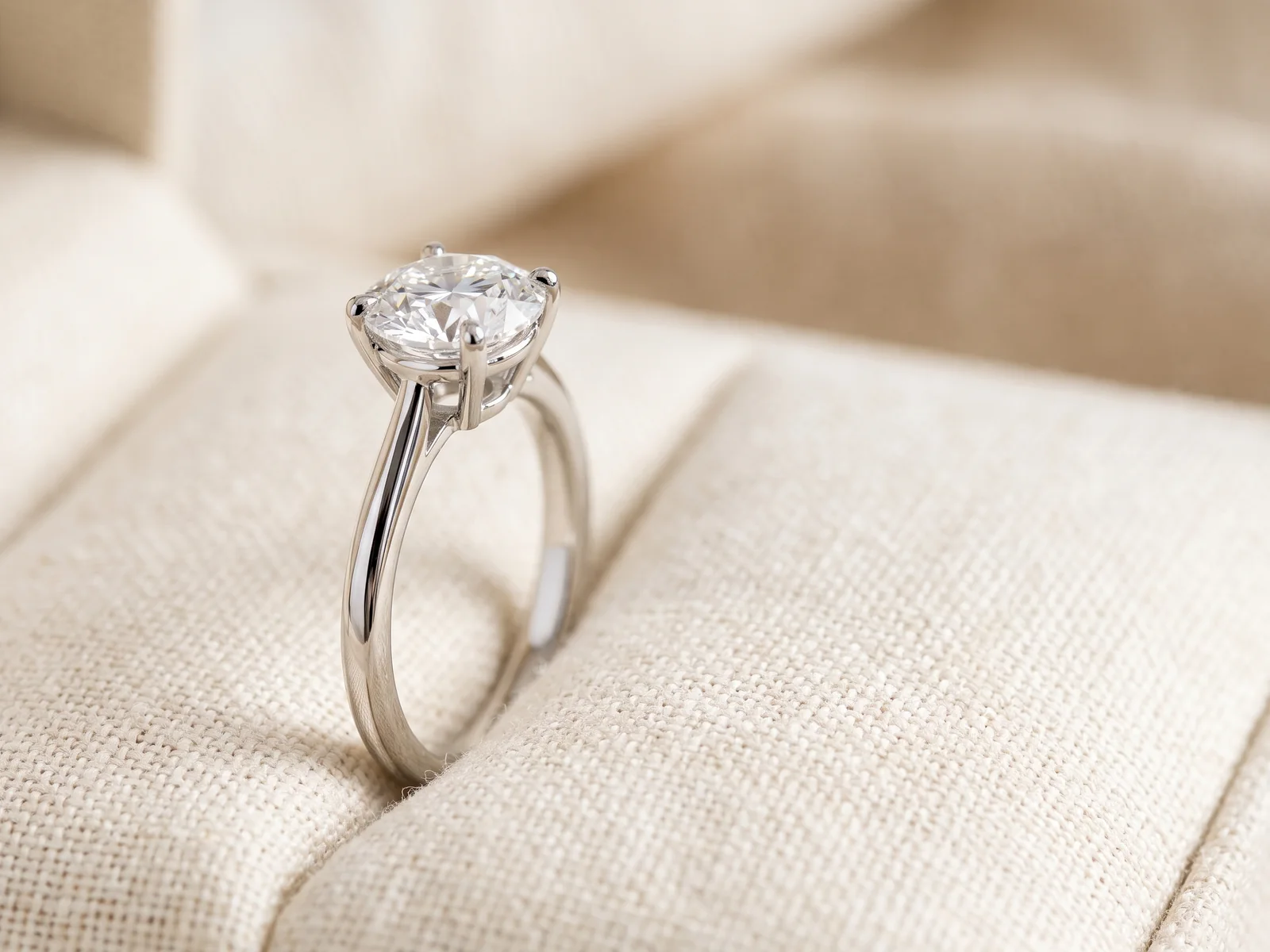
The gallery is the metalwork that sits under the centre stone and holds the head (the claws or bezel that grip the stone) up off the band. Look at a ring face-up and you see the stone; turn it side-on and you see the gallery. Under gallery details are anything added to that zone: a row of small diamonds, an openwork pattern, a bridge with a tiny gemstone, an engraved name or a carved motif. If you are new to how rings are put together, our overview of engagement ring setting styles covers the main structures first.
Because these details sit below the girdle (the widest edge of the stone), they barely change what people see from across the table. They are mostly for the wearer: the view when you glance down at your hand at an angle, when you take the ring off, or when someone asks to see it up close. Most can be added to almost any setting, from a simple solitaire to a three-stone ring.
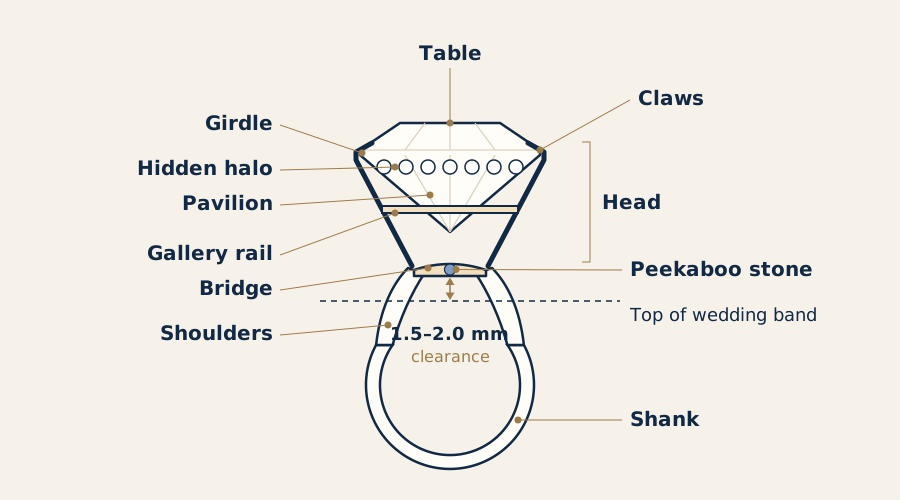
A few terms you will see throughout this guide. The shank is the band itself. The shoulders are where the band rises towards the head. The gallery rail is a thin ring of metal joining the claws partway down. The bridge is a bar or arch of metal under the head that connects the two shoulders. Each is explained again in our plain-English jewellery glossary, and the wider engagement rings and education hub links every setting guide we have written.
What types of under gallery details are there?
There are six common under gallery details. Many rings combine two or three, such as a hidden halo sitting on a filigree bridge with a single sapphire on the side.
| Detail | What it is | Seen from | Main care point |
|---|---|---|---|
| Hidden halo | A row of small diamonds or gemstones set around the gallery just below the girdle | Side view and at an angle | Tiny beads or claws can wear; check yearly |
| Bridge | A bar or arch of metal under the head joining the two shoulders | Side view | Strong; collects dirt underneath |
| Peekaboo stone | A single small stone set into the side of the bridge or gallery, often a birthstone | Side view | Choose a hard gem, 8 or more on the Mohs scale |
| Filigree or openwork | Fine pierced or wire patterns in the gallery | Side view; light passes through | Thin wires can bend; clean gently |
| Engraving | Hand-cut or laser patterns, initials or a date | Side view or inside the band | Shallow engraving softens with wear |
| Cathedral arches | Shoulders sweep up to meet the head in arches | Side view and slightly face-up | Raises the profile; check band fit |
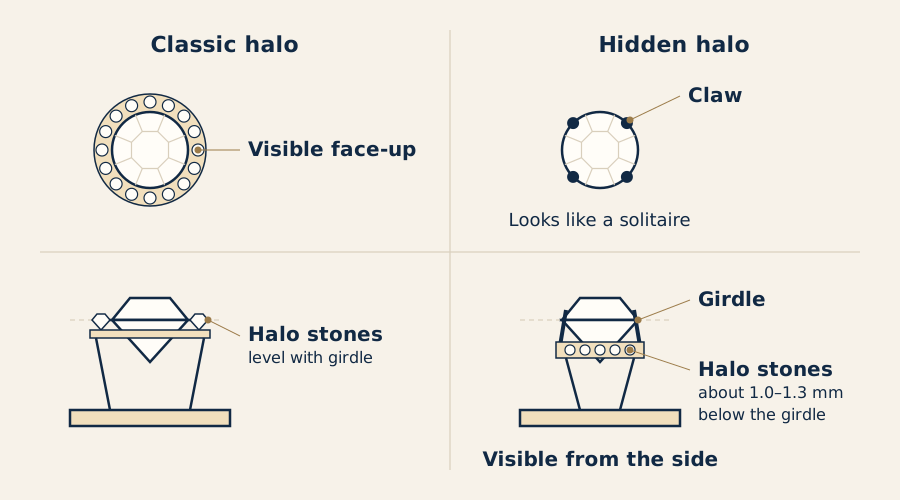
The hidden halo is the most requested. A classic halo surrounds the stone face-up and makes it look larger. A hidden halo sits under the girdle instead, so face-up you see a solitaire and from the side you catch a ring of sparkle. Around a 1 carat round (about 6.4–6.5 mm across), a hidden halo typically uses 14–20 diamonds of about 1.0–1.3 mm each. If you are weighing it against a visible halo, our guide to how halo outlines are shaped for each diamond covers the face-up options.
Filigree (fine wire or pierced lace-like metalwork) and milgrain (a row of tiny metal beads along an edge) are closely associated with the Edwardian and Art Deco periods, roughly 1900 to the late 1930s, and suit vintage-inspired rings with old-world detail. The gallery's basic frame can be a basket, trellis or peg head (see how basket, trellis and peg head settings differ), and that choice decides how much room there is for decoration. For personal touches such as a hidden birthstone or a fingerprint engraving, browse our ideas for hidden personal details in a custom ring.
How is an under gallery built?
Most under gallery work today starts in CAD (computer-aided design). The jeweller models the head, gallery and shank to the exact millimetre measurements of your centre stone, then prints a resin or wax model, which is cast in metal using the lost-wax method. After casting, the piece is cleaned up and polished by hand, the small stones are set under a microscope, and the claws for the centre stone are shaped and tightened last.
Detail work under the gallery needs enough metal to survive decades of wear. As a rough guide, gallery rails and bridges are usually around 1.0–1.5 mm thick, and claws for a 1 carat centre about 1.0–1.3 mm at the tip. Each hidden halo stone needs a wall of metal around its seat so the tiny beads or claws holding it have something to grip. A model that looks elegant at ten times size on screen can be too fine once it is cast.
The claws can be round, tab, eagle, V-shaped or doubled, and each changes how the head meets the gallery: see the differences between round, eagle, tab, V and double claws. Some settings go the other way and remove most of the gallery, holding the stone by pressure or a slim frame; our page on how tension and suspended settings are engineered explains that approach.
Metal matters more under the gallery than almost anywhere else, because the fine sections take knocks you do not notice. Platinum (usually 95% pure in jewellery) is dense and tends to move rather than wear away when it is scratched, which helps fine claws and beads last. 18 carat gold (75% gold) loses tiny amounts of metal over time instead; 18 carat white gold is usually rhodium plated (a thin, bright white coating) and needs replating every 1–3 years. 9 carat gold (37.5% gold) is also used and is hard-wearing, though paler in colour.
Are hidden halos and under gallery stones secure?
Yes, if they are built with enough metal and checked regularly. The centre stone is no less secure because of a hidden halo; it is still held by its own claws or bezel. What needs attention is the small stones. Each 1 mm diamond in a hidden halo is typically held by two to four tiny beads or claws of metal, often only about 0.3–0.5 mm across. Those wear down faster than a centre claw, especially on the side of the ring that brushes your other fingers or catches on knitwear.
From the repair bench, the pattern is predictable. The parts of a gallery that wear first are the ones that touch things: the lower edge of a hidden halo that rubs against a wedding band, the palm side of the bridge, and any filigree wire thinner than about 0.8 mm. Rings set very high, around 8 mm or more from finger to the top of the stone, also take more knocks.
- Bezel-set accent stones: a thin rim of metal around each stone protects better than beads. Our guide to bezel set engagement rings explains the trade-off with sparkle.
- Shared claws: one claw holding two neighbouring stones uses metal efficiently and leaves fewer weak tips.
- Recessed seats: setting the hidden halo slightly inside the outline of the gallery, so the metal rather than the stones takes any contact.
- A protected point: on pears, marquises and hearts, the claw at the tip must not be crowded out by the hidden halo. See where claws go on pointed diamond shapes.
Not sure which one is right?
Send us the stones you are looking at and our gemologist will tell you which to choose and why.
Which diamond shapes and gemstones suit under gallery details?
Almost any shape can take under gallery work, but the outline changes what fits. A hidden halo follows the girdle, so it is straightforward on rounds and ovals and needs careful corner work on squares and pointed shapes.
| Centre shape | Hidden halo | Other details that suit |
|---|---|---|
| Round | Easiest; even spacing all the way round | Filigree, cathedral bridge, peekaboo stone |
| Oval | Very good; follows the curve | Bridge with side stones, engraving |
| Pear and marquise | Good, leaving room for a V-claw at each point | Peekaboo stone on the bridge |
| Emerald and asscher | Possible; stones run in straight lines with one at each corner | Art Deco filigree, milgrain |
| Princess and radiant | Possible; corners need claw protection | Bridge, peekaboo stone |
| Cushion | Very good; softened corners | Filigree, hidden halo |
Orientation changes things too. An east-west ring with the stone set sideways shows its gallery along the finger rather than across it, which gives a hidden halo more room to be seen. Two-stone toi et moi rings pairing two centre stones can carry a shared bridge under both stones, and cluster engagement rings often hide a pattern of tiny stones beneath the cluster.
For the accent stones, hardness matters because they sit low, where knocks happen. Diamond (10 on the Mohs scale, the 1–10 scale of scratch hardness), sapphire and ruby (both 9) and moissanite (about 9.25) are the sensible choices for a hidden halo or peekaboo stone. Natural and lab-created sapphires have the same hardness. Lab-grown diamonds are real diamond and work as accent stones too; just make sure the design brief states whether the small stones are natural or lab-grown. Emerald (7.5–8, and often brittle), tanzanite (6–7) and opal (5.5–6.5) are better kept out of exposed spots.
Will a wedding band sit flush with an under gallery?
Sometimes, and it is worth deciding before the design is finalised. A wedding band sits flush (touching along its length with no gap) only if nothing under the head hangs lower than the top of the band. Most wedding bands are about 1.5–2.0 mm high, so the lowest point of the gallery needs to clear the shank by at least that much. A hidden halo adds width under the stone and often 1–1.5 mm of height; a bridge that drops low can block a band too.
| Under gallery detail | Effect on a straight band | Common fix |
|---|---|---|
| Plain basket, standard height | Usually sits flush | None needed |
| Hidden halo, standard height | Small gap, or the band touches the stones | Raise the head slightly, or choose a contoured band |
| Low bridge | Band may rock or leave a gap | Lift the bridge above band height |
| Cathedral arches | Usually flush; arches rise above the band | Check shoulder width |
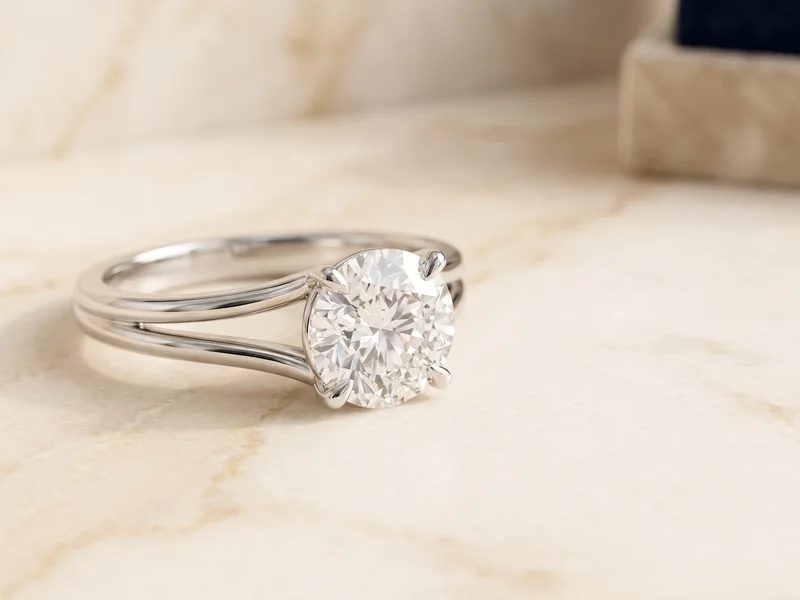
| Split shank | Band sits beside the split, not under it | A matching curved band |
Contact matters as much as fit. If a band rubs directly against hidden halo stones, both wear: the beads holding the stones thin out and the band picks up a groove. A split shank, where the band divides towards the head, or a bypass ring whose ends wrap past each other changes the gap altogether, so check the profile with your band held against it, or ask for a render showing both rings together.
Are under gallery details worth it?
They are worth it if the side view of the ring matters to you or you want a hidden personal touch. They are less useful if you want the lowest possible profile, or a ring that takes seconds to clean.
| Option | Look | Approx. extra cost (AUD) | Cleaning effort |
|---|---|---|---|
| Plain gallery | Clean and simple | Included | Low |
| Engraving or milgrain | Subtle texture | about $100–$500 | Low |
| Peekaboo stone | One spot of colour or sparkle | about $100–$600, depending on the gem | Low |
| Filigree or openwork | Vintage, lacy | about $200–$800 | Medium |
| Hidden halo, natural diamonds | Sparkle in profile | about $500–$2,000 | Medium to high |
| Hidden halo, lab-grown diamonds | The same look | about $300–$1,200 | Medium to high |
These are broad ranges only; the real figure depends on the metal, the number and quality of small stones and how much handwork is involved. Lab-grown accent diamonds cost less than natural melee (the trade term for very small diamonds), and at 1 mm the two look the same to the eye.
Related guideHidden Details That Make a Custom Engagement Ring PersonalExplore ring settings or create your ring
How do you clean and maintain an under gallery?
Galleries collect soap, hand cream, sunscreen and skin oils, and the more openwork and stones there are, the more places that build-up can lodge. It dulls the centre stone too, because a diamond's brilliance depends on light reflecting off its pavilion (the lower, pointed half), right where the gallery sits.
- Every week or two: soak for 15–20 minutes in warm water with a drop of mild dishwashing liquid, then brush gently from underneath with a soft toothbrush. Rinse and pat dry.
- Avoid: chlorine and bleach, which can weaken gold alloys over time, and toothpaste or other abrasive cleaners.
- Ultrasonic cleaners: generally fine for diamond, sapphire and ruby, but they can shake out small stones that are already loose, and should not be used on emerald, opal or treated stones.
- Every 6–12 months: a professional check of the claws and accent stones under magnification, plus a clean.
- Every 1–3 years for white gold: rhodium replating, which also makes thin claws easier to spot.
- Over 10–20 years: expect to retip claws (add new metal to worn tips) and possibly reset one or two accent stones.
Wear is normal and repairable. Bridges and gallery rails rarely need more than a polish; accent stone seats and fine filigree are the parts to watch. Taking the ring off for the gym, gardening and swimming saves most of the wear.
How do you plan under gallery details step by step?
- Choose the centre stone first. Its exact millimetre measurements set the size of the gallery and how many accent stones fit.
- Decide what the side view should say. Sparkle (hidden halo), colour (peekaboo stone), pattern (filigree or milgrain) or something personal (engraving).
- Pick the metal and height. Platinum or 18 carat gold for fine work, and a head height that suits your lifestyle.
- Check the band fit. Decide whether you want a straight band flush against it, a contoured band or a small gap.
- Choose the accent stones. Aim for 8 or more on the Mohs scale, and confirm whether they are natural or lab-grown.
- Review the CAD render side-on at actual size. Look for a clear rim of metal around each small stone and nothing crowding the centre claws.
- Plan the upkeep. Book a check every 6–12 months and keep a soft brush by the sink.
If you are still choosing the overall style, start by comparing the main setting styles side by side, then come back to the gallery once the head and band are settled.
Free consultation
Talk to a gemologist
Compare stones in person or online with Raj Sood, Graduate Gemologist (GIA), AJP (GIA).
Book a consultationShop this shape
FAQ
Common questions
What is a hidden halo on an engagement ring?
A hidden halo is a row of small diamonds or gemstones set just below the girdle of the centre stone. Face-up the ring looks like a solitaire; from the side you see a ring of sparkle.
Do hidden halos fall out?
The small stones can loosen over time because the beads or claws holding them are tiny, around 0.3–0.5 mm. A check every 6–12 months catches loose stones early, and a jeweller can tighten or reset them.
Can a wedding band sit flush with a hidden halo?
It can if the head is raised so the lowest point of the halo clears the band, usually by about 1.5–2.0 mm. Otherwise a contoured band or a small gap is the usual solution.
What is a peekaboo stone?
A peekaboo stone is a single small gem set into the side of the bridge or gallery, often a birthstone or sapphire. It is visible only from the side, so it works as a private detail.
Are under gallery details hard to clean?
They take a little more effort because dirt collects in openwork and around small stones. A soak in warm soapy water and a soft brush from underneath every week or two keeps them bright.
Can I add under gallery details to an existing ring?
Sometimes. Engraving and some peekaboo stones can be added later, but a hidden halo or new bridge usually means rebuilding the head, so it is easier to plan at the design stage.
Terms in this guide

Ask a gemologist
Not sure which diamond to choose?
Raj Sood is a Graduate Gemologist (GIA) and master jeweller. Bring the stones you are considering, or send the reports, and he will tell you honestly which one is better and why.
Keep learning
Related guides
 Engagement Rings & SettingsHidden Details That Make a Custom Engagement Ring Personal
 Engagement Rings & SettingsBasket vs Trellis vs Peg Head Settings
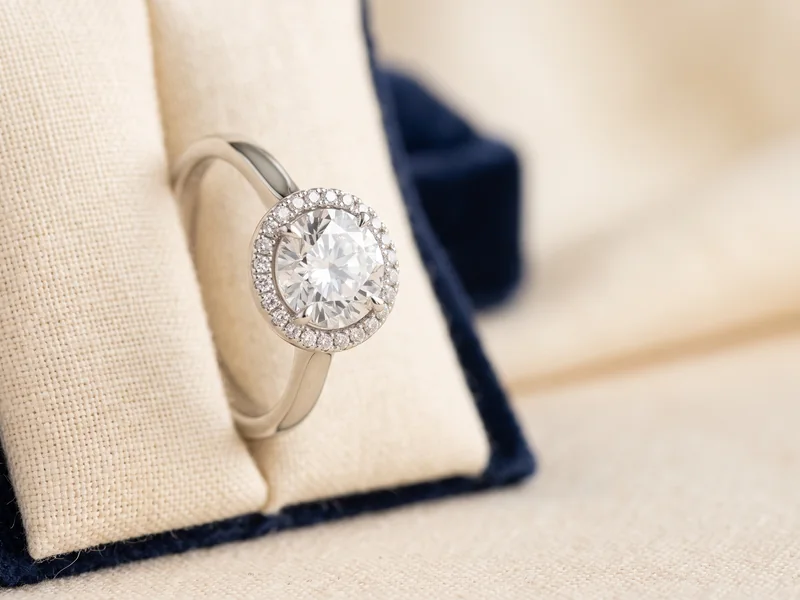 Engagement Rings & SettingsHalo Shapes Explained
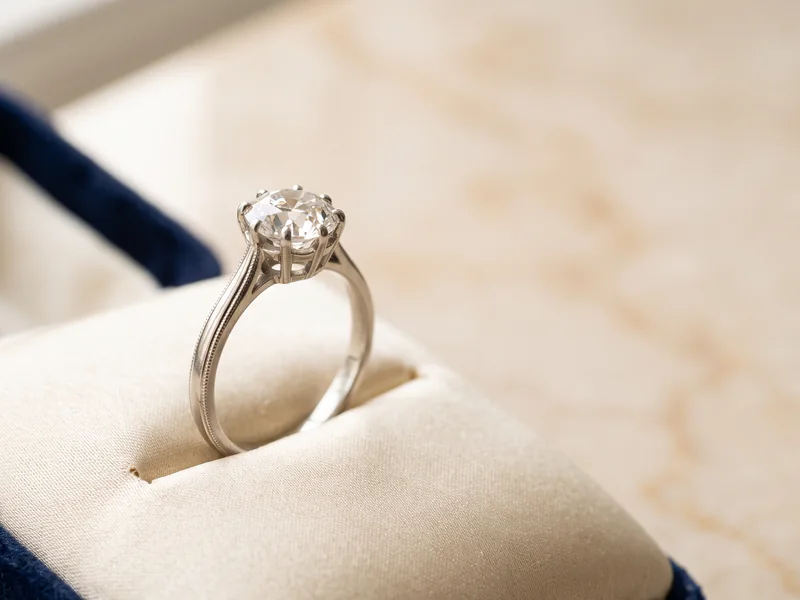 Engagement Rings & SettingsVintage-Inspired Engagement Rings with Old-World Detail and Custom Character
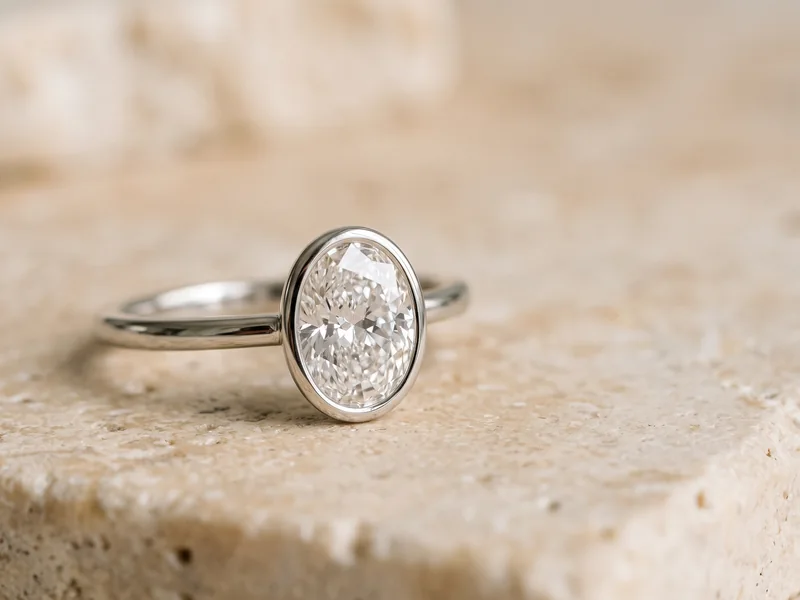 Engagement Rings & SettingsBezel Set Engagement RingsEngagement Rings & SettingsEngagement Rings & Education
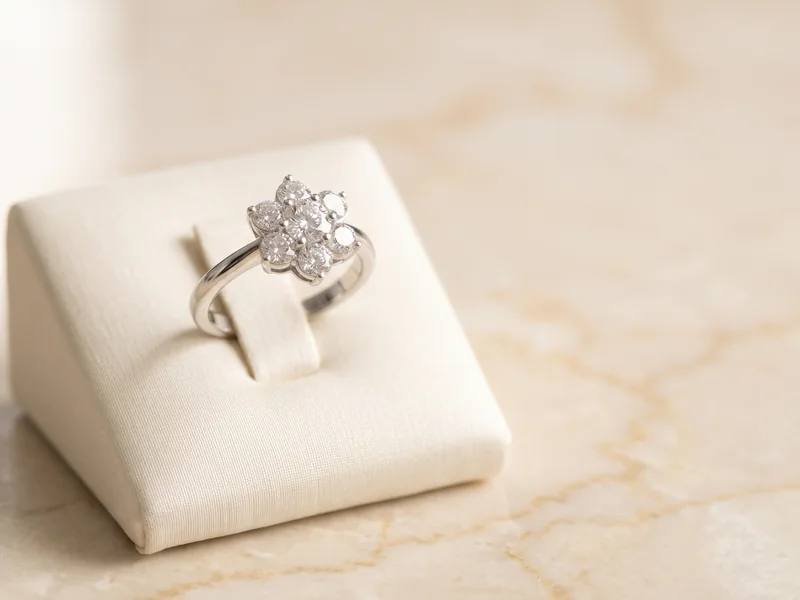 Engagement Rings & SettingsCluster Engagement Rings
Explore more
More guides on this topic
Education