
- Education
- Diamond Shapes
- Step Cut Diamonds: Emerald, Asscher, Baguette, Carré and More Explained
Diamond shapes
Step Cut Diamonds: Emerald, Asscher, Baguette, Carré and More Explained
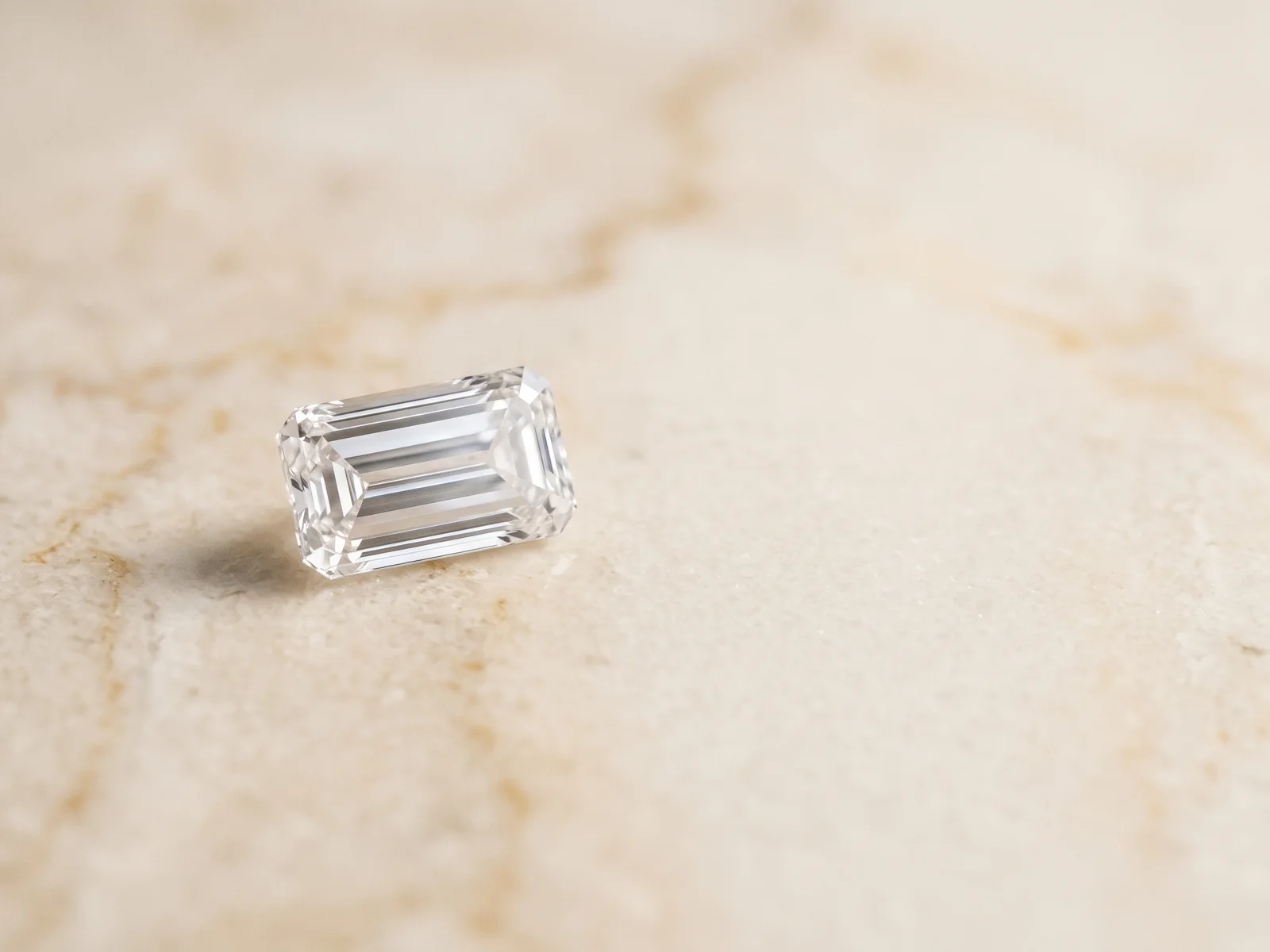
Step cut diamonds trade sparkle for clarity, calm and clean lines, which makes them the most revealing family of cuts: their open facets show clearly what is inside the stone. Here is how the family works, how each member differs and what to check before you choose one.
 Reviewed by Raj Sood, Graduate Gemologist (GIA), AJP (GIA)Master jeweller and Graduate Gemologist (GIA) · reviewed 4 November 2026
Quick answer
Step cut diamonds have long, straight facets arranged in parallel rows, like stairs, around a large open table. The family includes the emerald, Asscher, baguette, tapered baguette, carré, trapezoid and octagonal cuts. They show broad flashes of light rather than sparkle, so clarity and symmetry matter more, and they usually cost less per carat than rounds.
What are step cut diamonds?
A step cut is a faceting style, not a single shape. Instead of the triangles and kites of a round brilliant, the cutter polishes long, narrow, four-sided facets that run parallel to the edge of the stone. Seen from the side, the rows rise towards the large flat table (the top facet) on the crown and fall away towards the bottom on the pavilion, like a flight of stairs. That is where the name comes from.
Most larger step cuts have three rows of steps on the crown and three or more on the pavilion. The light they return comes in broad, slow flashes, often described as a hall of mirrors effect: as the stone moves, the rows switch between bright and dark like reflections in a series of mirrors. A brilliant cut breaks light into many small points of sparkle; a step cut shows you clean planes of light and the clarity of the crystal underneath.
Step cutting is one of the oldest ways of faceting diamond. It grew out of the early table cut, where cutters simply ground the point off an octahedral crystal, and it became the signature look of Art Deco jewellery in the 1920s and 1930s. Today the family sits alongside the brilliant and mixed families in our guide to every one of the 34 diamond cuts, and our introduction to how diamond shapes work explains how outline and faceting style fit together. Any unfamiliar term on this page is also defined in the GemTrove jewellery glossary.
Diamond itself is 10 on the Mohs hardness scale with a refractive index of about 2.42, whether natural or lab-grown. Those figures do not change with the cut, but the way the facets handle light does, and that is what separates a step cut from everything else.
How do step cut diamonds differ from brilliant cuts?
The difference is easiest to see side by side. A brilliant cut is designed to bounce light around inside the stone and scatter it; a step cut is designed to reflect it in large, orderly panels. Neither is better. They simply look different and behave differently when it comes to inclusions and colour.
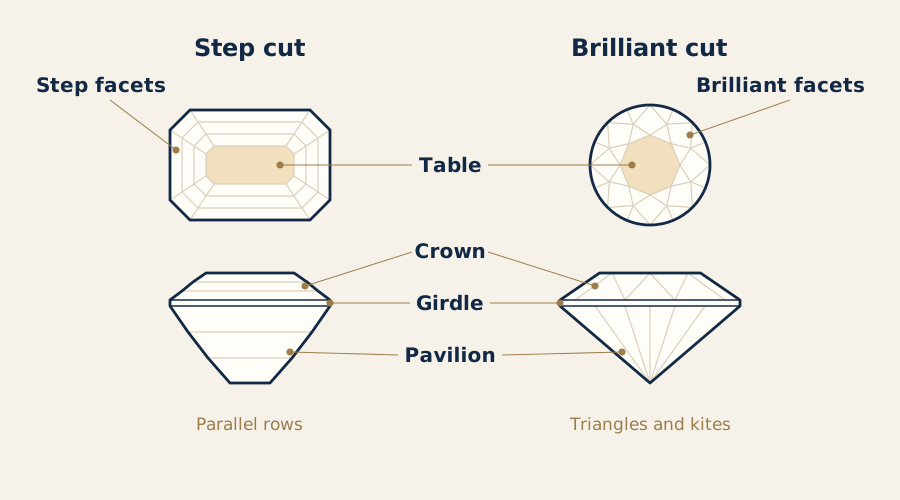
| Step cut | Brilliant cut | Mixed cut | |
|---|---|---|---|
| Facet shape | Long rectangles in parallel rows | Triangles and kites radiating from the centre | Step facets on the crown, brilliant facets on the pavilion (or a blend) |
| Light effect | Broad flashes, hall of mirrors | Fine, scattered sparkle | Sparkle with some step-like flashes |
| Hides inclusions | Poorly: large open table | Well | Fairly well |
| Shows body colour | More, especially at the corners | Less | Moderate |
| Examples | Emerald, Asscher, baguette, carré, trapezoid, octagonal | Round, oval, pear, heart, marquise | Princess, radiant, cushion (many versions) |
Some shapes look like step cuts but are not. The princess cut has a square outline like a carré or Asscher, but its facets are brilliant-style, so it sparkles far more; our princess vs Asscher comparison shows the two face-up. The radiant shares the emerald's cut-corner rectangle but uses brilliant faceting underneath. Cushion cuts can look vintage like an Asscher yet behave like a brilliant, as our guide to Asscher and cushion differences explains.
A simple test: look at the table. If you can see straight, parallel lines stepping down from it towards the edges, the stone is step cut. If the pattern looks crushed or star-like, it is a brilliant or mixed cut.
Which diamond shapes are step cuts?
Seven shapes make up the step cut family most people will meet. Two are usually centre stones, and the rest are mostly used as accents and side stones, although any of them can be cut large enough to stand alone.
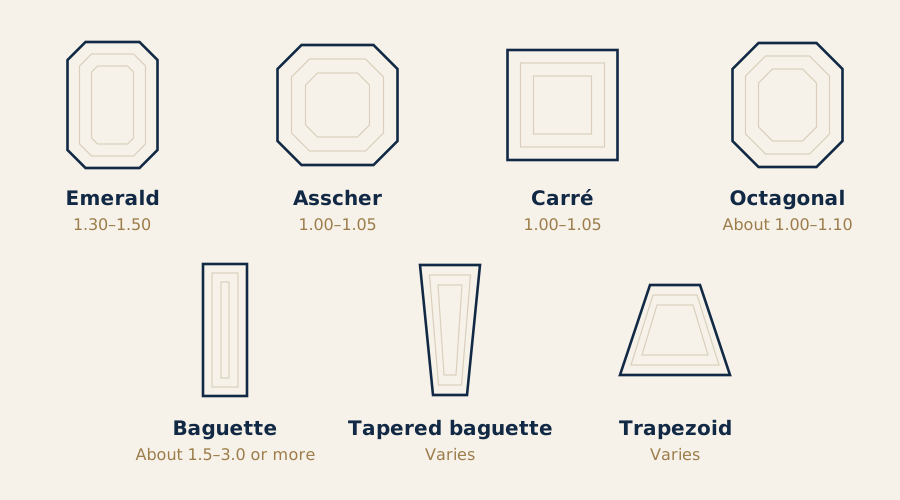
| Cut | Outline | Typical ratio | Corners | Main use |
|---|---|---|---|---|
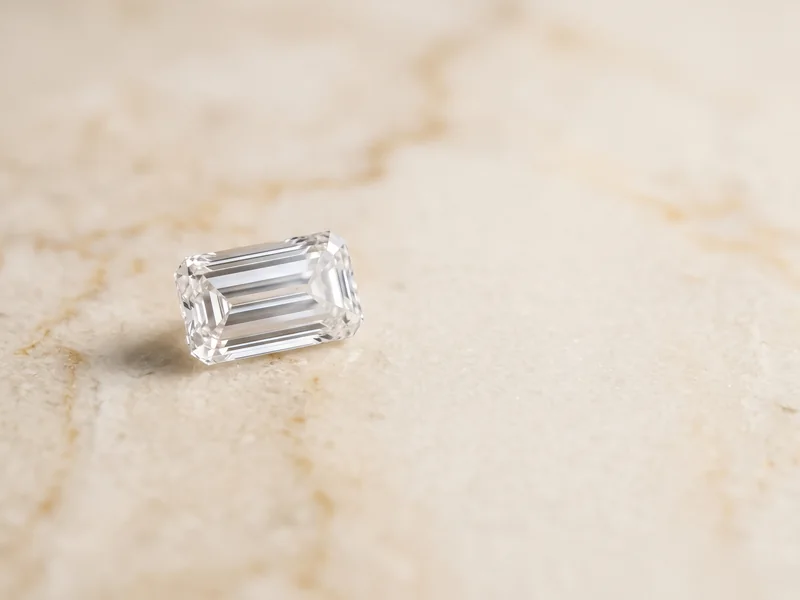
| Emerald | Rectangle | 1.30–1.50 | Cut (bevelled) | Centre stones, engagement rings |
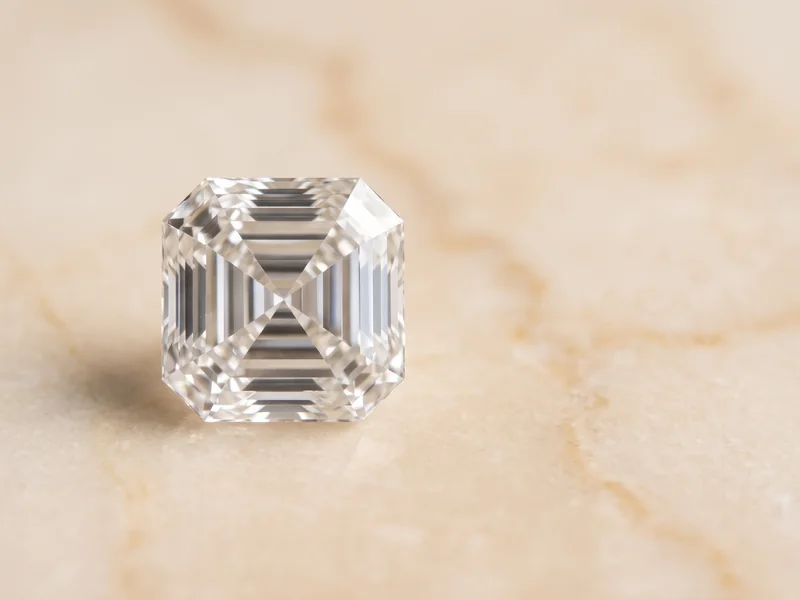
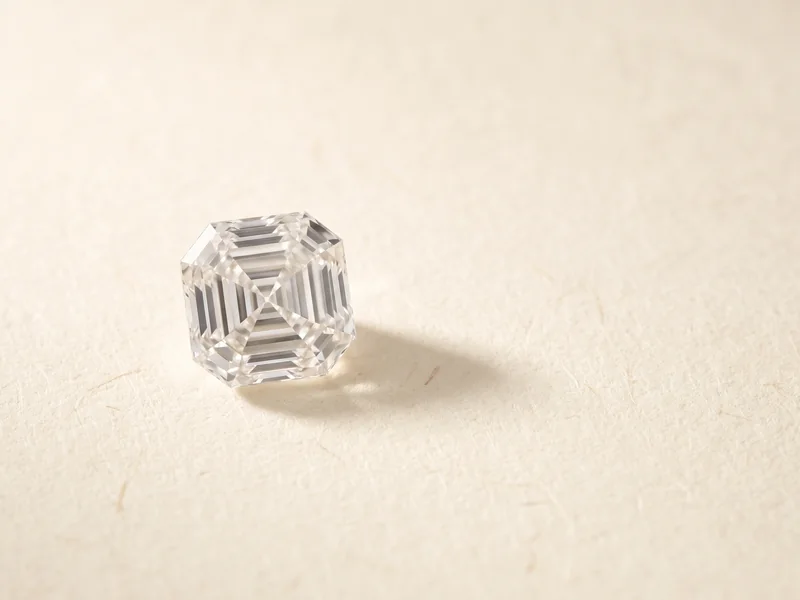
| Asscher | Square | 1.00–1.05 | Large cut corners, near-octagonal | Centre stones, vintage-style rings |
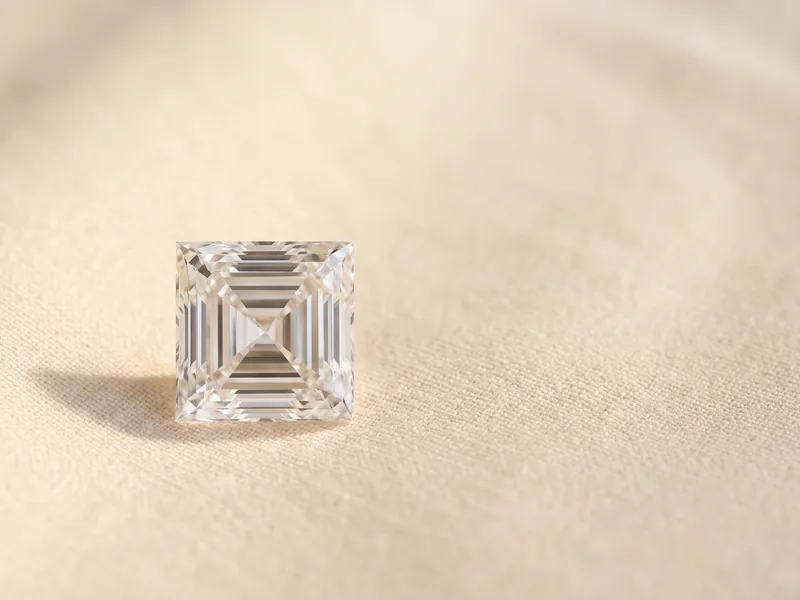
| Carré | Square | 1.00–1.05 | Sharp or very slightly cut | Accents, calibre work, small centre stones |
| Octagonal | Eight-sided | About 1.00–1.10 | Eight near-equal sides | Centre stones, Art Deco designs |
| Baguette | Long, narrow rectangle | About 1.5–3.0 or more | Sharp | Side stones, bands, clusters |
| Tapered baguette | Rectangle narrowing at one end | Varies | Sharp | Side stones pointing to a centre |
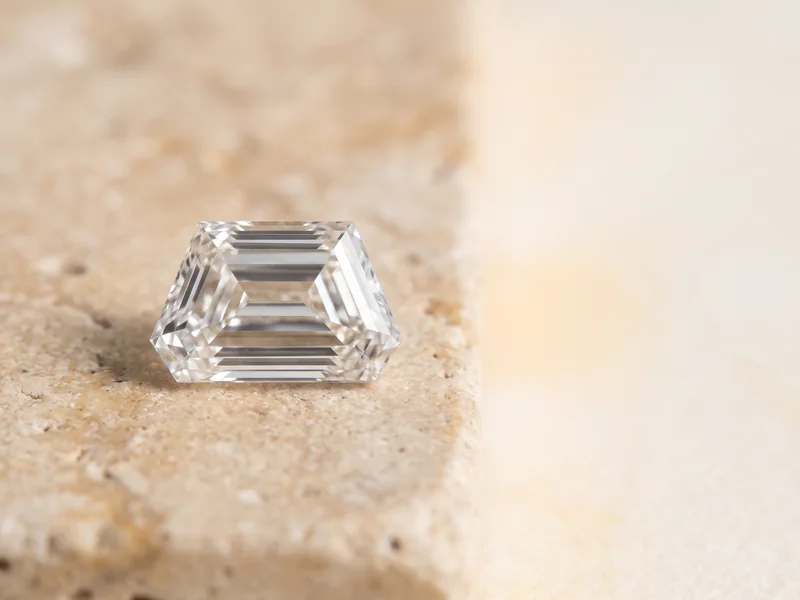
| Trapezoid | Four sides, one end wider | Varies | Sharp | Matched pairs beside a centre |
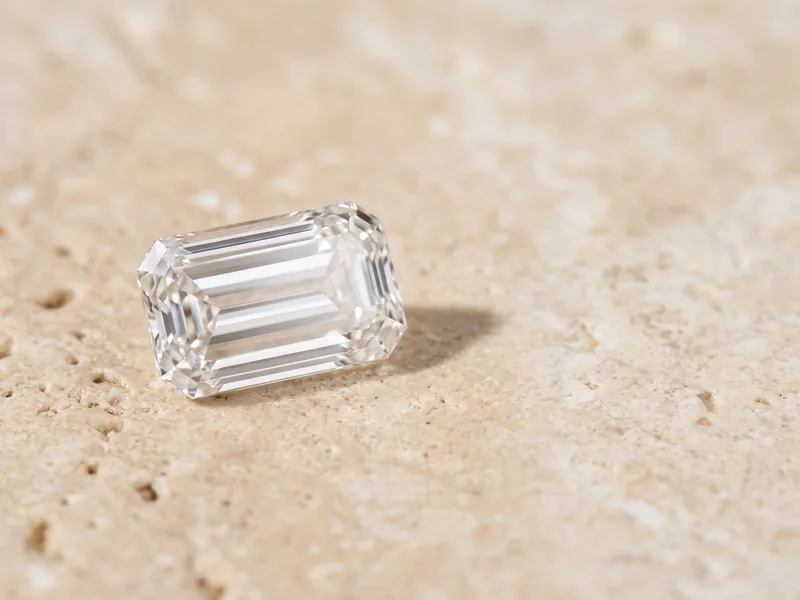
Each cut has its own detailed guide. For the classic rectangle, start with our emerald cut diamond guide. The square with deep cut corners is covered in our Asscher cut guide, and the slim rectangles used along shoulders and bands are in everything about baguette diamonds.
The less common members are worth knowing too. The carré, or square step cut is the sharp-cornered cousin of the Asscher. The trapezoid side stone is the traditional partner for an emerald or Asscher centre. And the eight-sided octagonal cut gives a softer, almost round outline while keeping the step look.
What is the difference between emerald and Asscher cut diamonds?
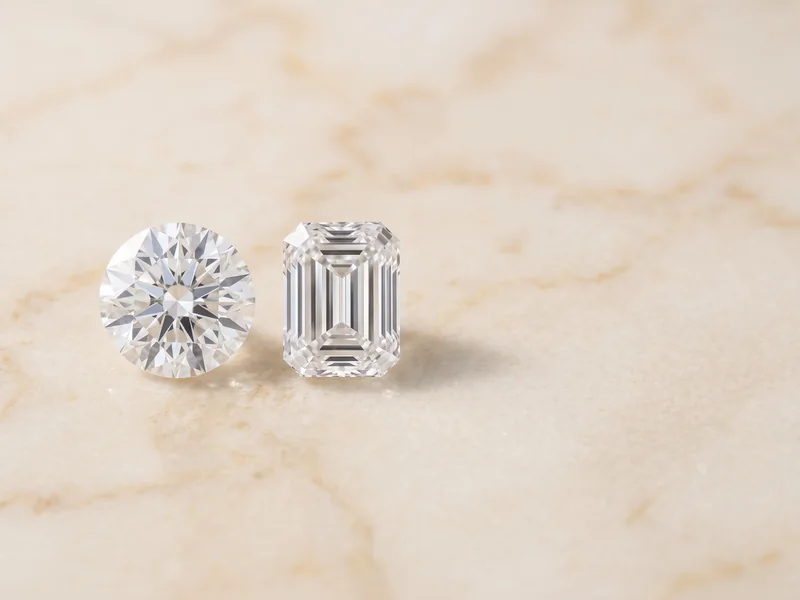
These are the two step cuts most often chosen for an engagement ring, and they are closely related. Both have cut corners, a large table and rows of steps. The difference is the outline and the depth.
- Emerald cut: a rectangle, usually 1.30–1.50 in length-to-width ratio (length divided by width). A 1 carat emerald faces up at about 7.0 × 5.0 mm. The long lines elongate the finger.
- Asscher cut: a square, usually 1.00–1.05. The corners are cut more deeply, so it looks almost octagonal. It has a higher crown, a smaller table and a deeper pavilion than most emeralds, so a 1 carat Asscher faces up at only about 5.5 × 5.5 mm.
That extra depth is what creates the Asscher's best-known feature. Looking down through the table, the corner facets reflect into a pattern of concentric squares with lines running out to the corners, known as the windmill. Our page on reading the Asscher windmill pattern explains what a well-cut one looks like. The Asscher dates from the early 1900s, when the Asscher family of cutters in Amsterdam developed it.
An emerald faces up noticeably larger than an Asscher of the same weight, and its long steps show a more dramatic hall of mirrors. An Asscher feels more compact and geometric. For a full point-by-point breakdown, read emerald vs Asscher, side by side.
Not sure which one is right?
Send us the stones you are looking at and our gemologist will tell you which to choose and why.
Do step cut diamonds need higher clarity and colour?
Usually, yes, a little. A brilliant cut's busy facet pattern hides small inclusions (internal features) well. A step cut's large table and long, open facets work like a window into the stone, so a crystal or feather that would vanish in a round can be easy to spot in an emerald or Asscher.
- Clarity: most people choose VS2 or better for a step cut centre stone, or a carefully checked SI1 that is genuinely eye-clean (no inclusions visible without magnification at normal viewing distance). Inclusions under the table matter most; ones near the corners are often hidden by the setting.
- Colour: step cuts show body colour more than brilliants, especially in the corners and along the ends of an emerald. In white gold or platinum, G–H is a common choice. In yellow or rose gold, I–J can look white.
- Small accents: for baguettes, carrés and trapezoids, matching the colour and clarity across the set matters more than chasing high grades, because the stones are small and seen together.
The other step cut problem is windowing: a washed-out, see-through patch in the centre of the stone, caused by a pavilion that is too shallow to reflect light back. It is common in emerald cuts cut to look large for their weight. Our guide to spotting windowing in an emerald cut shows how to recognise it, and the Asscher clarity grades worth paying for page covers square step cuts specifically.
GIA does not give an overall cut grade to step cuts or other fancy shapes, so judge proportions yourself. As a rough guide, many well-cut emerald cuts sit around 60–68% total depth with a table of about 60–69% of the width, while Asscher cuts tend to run deeper with a smaller table. Polish and symmetry grades of Very Good or Excellent help, because misaligned steps are easy to see.
Related guideEmerald vs Asscher Cut DiamondsWhat are baguette and carré diamonds used for?
The smaller step cuts are the supporting cast of fine jewellery, and they shape a ring's character as much as the centre stone does.
- Baguettes sit along the shoulders of a ring, in channel-set wedding bands and in clusters. Their clean lines contrast with a brilliant centre, or continue the look of a step cut one. Most are small, often around 0.05–0.20 carat each.
- Tapered baguettes narrow at one end, so a pair can point inwards towards the centre stone. The difference matters for fit and look; see our straight vs tapered baguette guide.
- Trapezoids are cut in matched pairs, wide end against the centre stone, to extend an emerald or Asscher into a three-stone ring.
- Carrés are set edge to edge in calibre settings (where stones are cut to fit a channel exactly), giving the unbroken line seen in Art Deco bands, and occasionally used as a small square centre.
Because these stones are small and set close together, matching is everything. A slightly warmer baguette next to its partner, or a pair of trapezoids cut at different angles, stands out more than a single lower grade would. Ask to see accent stones under the same light, side by side, before they are set.
Which setting suits a step cut engagement ring?
Step cuts have straight edges and corners, and the setting needs to respect both. The corners of an emerald or Asscher are bevelled, which makes them stronger than the sharp point of a princess, but carrés, baguettes and trapezoids often have true sharp corners that need covering.
- Four claws: one at each corner is the classic choice for an emerald or Asscher. The claws sit on the cut corners and keep most of the outline visible.
- Double claws: two slim claws at each corner add security and frame the steps, popular on larger emeralds.
- Bezel: a rim of metal around the edge suits the clean geometry and protects every corner, at the cost of a little light.
- Three-stone: an emerald or Asscher with trapezoid or tapered baguette side stones is the traditional step cut design.
- Channel setting: for baguettes and carrés in bands, with the stones held between two walls of metal and no claws on the corners.
Because step cuts show colour, the metal makes a real difference. Platinum and white gold keep a colourless stone looking crisp; yellow and rose gold warm it, which can be a deliberate choice for a vintage look. The hall of mirrors is also most visible when the table sits slightly higher, so a setting with a little lift lets the steps catch light from the side.
How much do step cut diamonds cost, natural or lab-grown?
Step cuts are made from both natural and laboratory-grown diamond. The two look the same to the eye and have the same hardness and refractive index; lab-grown diamonds are real diamond grown in a laboratory rather than mined, and they cost much less. Either way, a step cut centre stone should come with an independent grading report from a lab such as GIA or IGI, which states whether it is natural or lab-grown.
| 1 ct, G–H, VS | Lab-grown (approx. AUD) | Natural (approx. AUD) |
|---|---|---|
| Emerald cut | about $1,000–$3,000 | about $5,000–$14,000 |
| Asscher cut | about $1,000–$3,000 | about $5,000–$13,000 |
These are broad ranges only and move with the market and the exact grades. Step cuts usually cost less per carat than a round of the same weight, colour and clarity, because more of the rough crystal can be kept and demand is lower. Higher clarity pushes the price up faster in step cuts than in brilliants, since that is where buyers tend to spend. Small accents such as baguettes and trapezoids are priced by the carat, and well-matched pairs or sets cost more than loose singles.
Browse step cut diamonds: Asscher and baguette, natural and lab-grown
How do you choose a step cut diamond? Step by step
- Choose the shape first. Rectangle (emerald), square with deep corners (Asscher), sharp square (carré) or eight-sided (octagonal) for the centre.
- Read the report. Confirm the shape, measurements, colour, clarity, polish and symmetry, and whether the diamond is natural or lab-grown.
- Work out the ratio. Divide length by width: about 1.30–1.50 for an emerald, 1.00–1.05 for an Asscher or carré.
- Check the clarity under the table. Use magnified photos or a video; aim for an eye-clean stone, usually VS2 or a well-chosen SI1.
- Look for windowing. Watch a video as the stone tilts; the centre should flash between bright and dark, not stay pale.
- Check the steps line up. Rows should run parallel and evenly spaced, and the corners should match.
- Plan the setting and accents. Decide on claws or a bezel, and match any side stones for colour and cut before setting.
Free consultation
Talk to a gemologist
Compare stones in person or online with Raj Sood, Graduate Gemologist (GIA), AJP (GIA).
Book a consultationFAQ
Common questions
What is a step cut diamond?
A step cut diamond has long, straight facets arranged in parallel rows around a large table, like stairs. Emerald, Asscher, baguette, carré, trapezoid and octagonal cuts all belong to the step cut family.
Do step cut diamonds sparkle?
They sparkle less than brilliant cuts. Instead of many small flashes, they show broad flashes of light that switch on and off as the stone moves, often called the hall of mirrors effect.
Is a princess cut a step cut?
No. A princess cut has a square outline like a carré or Asscher, but it uses brilliant-style facets, so it sparkles much more and hides inclusions better.
Are step cut diamonds cheaper than round diamonds?
Usually, yes. Emerald and Asscher cuts typically cost less per carat than a round of the same weight, colour and clarity, though buyers often spend some of the difference on higher clarity.
What clarity do I need for an emerald or Asscher cut?
Most people choose VS2 or better, or an SI1 that has been checked to be eye-clean. The large open table makes inclusions easier to see than in a brilliant cut.
Can you get lab-grown step cut diamonds?
Yes. Lab-grown emerald, Asscher and baguette diamonds are widely available, cost much less than natural, and are graded by labs such as IGI on the same colour and clarity scales as natural diamonds (GIA now uses simpler descriptive grades for lab-grown).

Ask a gemologist
Not sure which diamond to choose?
Raj Sood is a Graduate Gemologist (GIA) and master jeweller. Bring the stones you are considering, or send the reports, and he will tell you honestly which one is better and why.
Keep learning
Related guides
 Diamond ShapesEmerald Cut Diamonds
 Diamond ShapesAsscher Cut Diamonds
 Diamond ShapesBaguette Cut Diamonds
 Diamond ShapesEmerald vs Asscher Cut Diamonds
 Diamond ShapesSquare Cut Diamonds (Carré)
 Diamond ShapesTrapezoid Cut Diamonds
 Diamond ShapesOctagonal Cut DiamondsDiamond ShapesAll 34 Diamond Cuts: Every Shape Explained and Compared
Explore more
More guides on this topic
Education