
- Education
- Diamond Shapes
- Pentagonal Cut Diamond Guide: Facets, Ratio, Colour and Settings
Diamond shapes
Pentagonal Cut Diamond Guide: Facets, Ratio, Colour and Settings
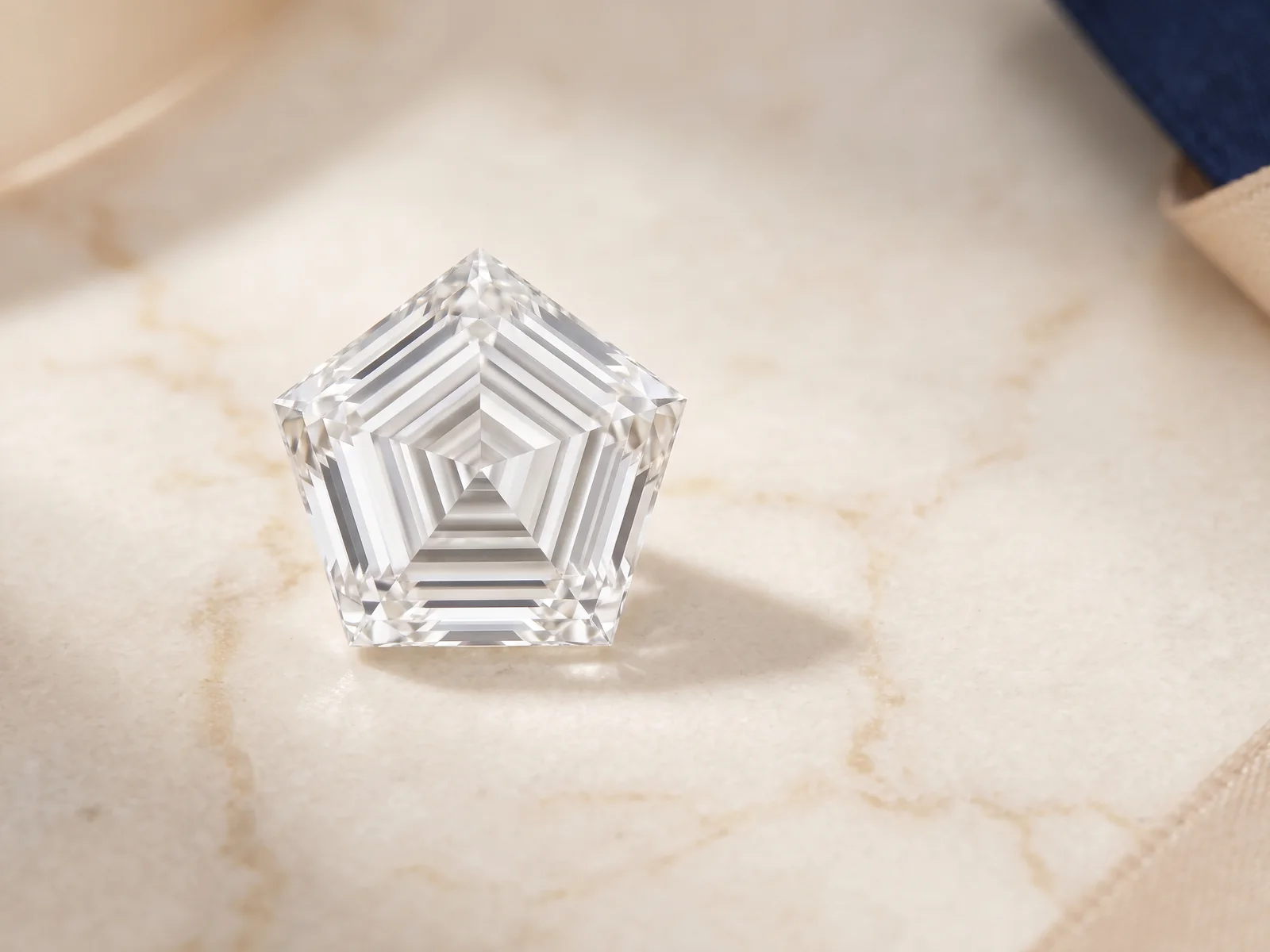
A pentagonal cut diamond is one of the rarest geometric shapes, and very little is written about it. Here is what to check before you choose one, from the facet style and ratio to the setting that keeps all five corners safe.
 Reviewed by Raj Sood, Graduate Gemologist (GIA), AJP (GIA)Master jeweller and Graduate Gemologist (GIA) · reviewed 4 November 2026
Quick answer
A pentagonal cut diamond is a five-sided fancy shape with 108° corners, cut either as a step cut with parallel facets or as a brilliant with triangular facets. Look for a length-to-width ratio of about 0.90–1.05, even sides, an eye-clean stone and a five-claw or bezel setting that protects every corner.
What is a pentagonal cut diamond?
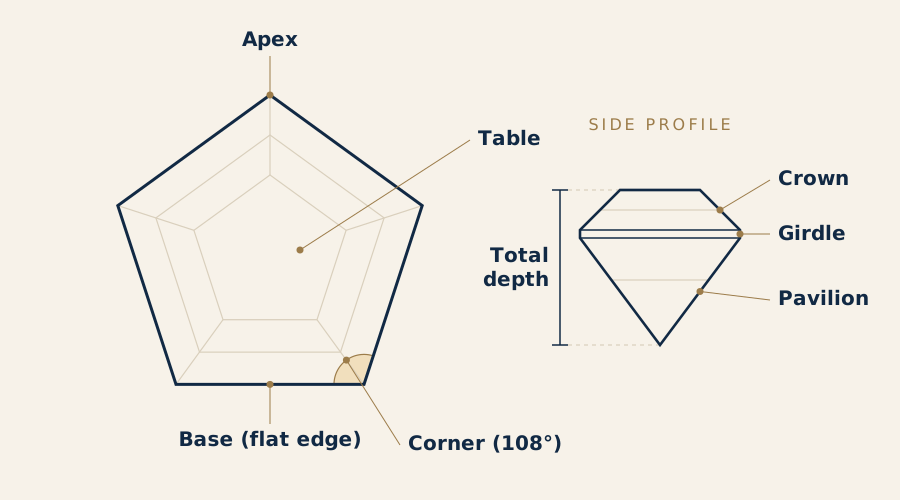
A pentagonal cut diamond has a five-sided outline: five straight edges meeting at five corners. In a regular pentagon every side is the same length and every inside corner measures 108°, which is blunter than the 90° corner of a square and much blunter than the 60° corner of a triangle. It is one of the rarer shapes in our guide to all 34 diamond cuts, compared side by side, and you will seldom see one in a shop window.
The pentagon belongs to the family of geometric diamond cuts, the angular shapes such as hexagons, kites and shields that have become popular for modern and art-deco style rings. Most pentagons are cut to order or in small batches, because shaping five even sides loses more of the rough crystal than a round or a cushion does. That is a large part of why they are hard to find.
Every pentagon has the same basic parts. The table is the large flat facet on top. The crown sits above the girdle (the thin outer edge that forms the outline) and the pavilion is the lower, pointed half that returns light to your eye. Around the outline sit five corners, and one of them, the apex, sits on its own opposite a flat edge called the base. Which way that apex points decides how the stone is set.
Diamond is 10 on the Mohs hardness scale, with a refractive index of about 2.42, which is why even a simple step-cut pentagon shows bright flashes. Hardness is not the same as toughness, though. Any corner is a thin edge that can chip along a cleavage plane (a natural line of weakness in the crystal) if it takes a hard knock, and a pentagon has five of them. The good news is that 108° corners are sturdier than the points on a princess or trilliant. If any term here is new, our plain-English jewellery glossary explains it.
How is a pentagonal diamond faceted?
There is no single standard facet pattern for a pentagon. Cutters use three main approaches, and the choice changes the look far more than the outline does.
| Faceting style | Typical facets | Look | Shows inclusions? |
|---|---|---|---|
| Step cut | Long facets in parallel rows around a large table, roughly 25–45 | Broad flashes of light and dark, crisp and architectural | Easily; choose a higher clarity |
| Modified brilliant | Triangular and kite-shaped facets, roughly 50–70 | Lively, scattered sparkle and fire, like a round | Hides small inclusions well |
| Rose or portrait style | Flat base with a low faceted dome, or a thin flat slice | Soft, glassy, vintage look; large face-up for its weight | Very easily; the shallow stone shows everything |
A step cut works like an emerald cut folded into five sides. Its facets run parallel to the girdle, so you see wide, mirror-like flashes rather than pinpoint sparkle. A brilliant pentagon packs in many small triangular facets that break light into sparkle and fire (flashes of rainbow colour). If you are weighing the two looks, our comparison of how rose and brilliant faceting differ shows the trade-off clearly, and the same logic applies to step cuts, which sit at the calm, glassy end of the scale.
Some cutters go further. Extra rows of facets, in the spirit of the heavily faceted Portuguese cut, can add sparkle to larger pentagons, and a five-pointed pattern is sometimes worked into the crown, much like the patterns used on star cut diamonds. Very thin pentagonal slices are also cut as portrait stones, flat enough to see straight through, usually for pendants and custom rings.
Grading reports describe the stone by its outline and faceting, for example 'pentagonal modified brilliant' or 'pentagonal step cut'. As with other fancy shapes, GIA gives no overall cut grade, so you judge the cut from the proportions, the polish and symmetry grades and, most of all, how the stone looks as it moves in a video.
What is the ideal ratio for a pentagonal cut diamond?
The length-to-width ratio compares the stone's length (from the apex to the middle of the opposite flat edge) with its width (across the widest point). Divide length by width from the report's measurements. Geometry gives a neat reference: a perfectly regular pentagon is about 0.95 times as long as it is wide. Most pentagons sit close to that number, and some reports list the measurements the other way round, so check which figure is which.
| Ratio | How it looks | Suits |
|---|---|---|
| Below 0.90 | Wide and flat, like a squashed house | Rarely chosen; east-west settings |
| 0.90–1.05 | Close to a regular pentagon, evenly balanced | Most rings, studs and pendants |
| 1.05–1.20 | Taller, with the apex starting to stretch | Longer fingers; a slightly elongated look |
| Above 1.20 | Long and pointed | Reads more like a shield than a pentagon |
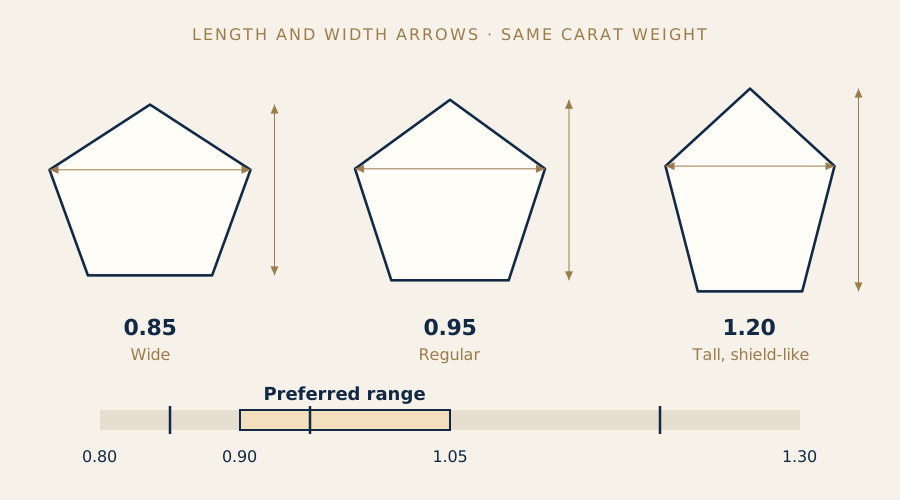
Once the ratio stretches past about 1.20, the stone starts to look like a shield cut, the pentagon's closest relative, which usually has a longer point and deliberately uneven sides. Proportions matter too. As a rough guide, many well-cut pentagons have a total depth of about 60–72% and a table of about 55–70% of the width. Too deep and the stone looks small for its weight; too shallow and light leaks out through the pavilion, leaving a glassy, washed-out centre called a window.
Check symmetry by eye as well as on paper. Look for five sides of even length, corners that look equally sharp, and a table centred within the outline. When a pentagon is set apex-up, your eye measures it against an invisible line running from the apex to the middle of the base, so a stone that leans even slightly looks off on the hand.
Should a pentagonal diamond point up or down?
Because one corner sits opposite a flat edge, a pentagon has a direction, and the way you set it changes its character.
- Apex up (point towards the fingertip): looks like a little house or shield and draws the eye along the finger. The most common choice for a pentagon diamond engagement ring.
- Apex down (flat edge towards the fingertip): reads softer and wider, and suits pendants, where the point hangs naturally towards the chain's lowest point.
- East-west (apex to one side): a modern, unexpected look across the hand, popular in stacking rings and two-stone designs.
This is the same decision you face with a kite cut diamond, and the same rule applies: settle the orientation before you choose the setting, because the claws, any side stones and the way a wedding band sits are all planned around it.
Not sure which one is right?
Send us the stones you are looking at and our gemologist will tell you which to choose and why.
How big does a pentagonal diamond look for its carat weight?
Face-up size (the size you see from above) depends on the depth and the faceting, but a pentagon close to 0.95 in ratio usually measures roughly as follows.
| Carat weight | Typical size (width × length) |
|---|---|
| 0.25 ct | about 4.3 × 4.1 mm |
| 0.50 ct | about 5.4 × 5.1 mm |
| 0.75 ct | about 6.1 × 5.8 mm |
| 1.00 ct | about 6.8 × 6.5 mm |
| 1.50 ct | about 7.7 × 7.3 mm |
| 2.00 ct | about 8.5 × 8.1 mm |
These are approximate figures only. A deep step-cut pentagon carries more weight in its pavilion and can face up a little smaller than a brilliant of the same carat, while a shallow rose-style pentagon spreads much wider but gives up brightness. Always compare the millimetre measurements, not just the carat weight.
Pentagons are popular from about 0.20 to 0.50 carat as accent stones, studs and stacking-ring stones, where five crisp corners read well up close. For a centre stone, 0.75 carat or more lets the outline show clearly once claws cover the corners, because each claw hides a little of the shape.
What colour and clarity suits a pentagonal diamond?
Corners collect colour. In a pentagon, any warm body colour tends to gather in the five corners, where facets crowd together and light travels a different path. Step cuts show colour more than brilliants, because their broad, open facets act like windows into the stone. In white gold or platinum, most people are happy from G colour or better in a step cut and H or better in a brilliant. In yellow or rose gold, I or J can look just as white, because the metal warms everything around it.
For clarity, aim for an eye-clean stone, meaning no inclusions (internal features) you can see without magnification at normal viewing distance. Step cuts hide very little, so VS2 or better is the usual target. Brilliant pentagons are more forgiving and a carefully chosen SI1 can be eye-clean. Check the plotting diagram on the report, which maps where each inclusion sits, and pay attention to the corners.
- Step cut, white metal: G colour or better, VS2 or better.
- Brilliant, white metal: H colour or better, VS2–SI1 eye-clean.
- Yellow or rose gold: I–J colour can look white in either style.
- Avoid: feathers (small internal cracks) that reach the surface at a corner, where they weaken the thinnest part of the stone.
What is the best setting for a pentagonal diamond ring?
A setting has two jobs here: protect the five corners and keep the outline visible. The usual options for a pentagonal diamond ring:
- Five claws: one claw at each corner. This is the most natural match for the shape and shows the most of the outline.
- Bezel or half-bezel: a thin rim of metal around the edge. Very secure, and it sharpens the geometric outline, though it hides a little of the stone.
- Pentagonal halo: small diamonds following the five sides make the centre look larger and shield the edges.
- Three-stone: trapezoid side stones continue the straight lines of the pentagon, while half moon side stones add a softer curve.
- East-west and stacking rings: small pentagons set sideways, often mixed with other geometric shapes.
- Pendants and studs: a bezel suits a pentagon pendant, and pentagon studs can be set as a mirrored pair.
Think about the wedding band early. Set apex-up, the flat base faces the band, so a straight band can sit almost flush, especially with a low bezel. Set apex-down, the point faces the band and pushes it away, so a contoured or notched band usually works better. Geometric stacking bands set with small pentagons, triangles or lozenge cut diamonds are a popular match for the shape.
How does a pentagon compare with hexagon, shield and other geometric cuts?
| Shape | Sides | Corner angle | Usual faceting | Corner risk |
|---|---|---|---|---|
| Pentagon | 5 | about 108° | Step or brilliant | Moderate |
| Hexagon | 6 | about 120° | Mostly step | Low |
| Octagon | 8 | about 135° | Mostly step | Low |
| Princess | 4 | 90° | Brilliant | Moderate to high |
| Triangle or trilliant | 3 | 60° (sides may curve) | Brilliant or step | High |
| Shield | Usually 5–7, irregular | Varies, with a long point | Step or brilliant | Higher at the point |
The more sides a shape has, the blunter its corners and the less they need protecting. A pentagon sits in the middle: sturdier than the princess cut's 90° corners, but with more character than the near-round outline of an octagon. If you like the clean lines but want even softer corners, look at the six-sided hexagonal cut or the eight-sided octagonal cut.
For something sharper, see triangular cut diamonds and the trilliant, with its curved sides and brilliant faceting. Unusual cousins include the calf's head cut, a six-sided shape with a pointed base and the Flanders cut with its cropped square corners. To see how every outline differs in look and price, start with our overview of diamond shapes.
Related guideGeometric Diamond Cuts: Shield, Kite, Hexagon, Pentagon and MoreHow much does a pentagonal cut diamond cost, natural or lab-grown?
Pentagons are cut from both natural and laboratory-grown diamond, and the two look identical to the eye. Lab-grown diamonds are real diamond, with the same hardness and refractive index, grown in a laboratory rather than mined. They cost much less than natural, and because custom geometric shapes are easier to plan from lab-grown rough, many of the pentagons on the market are lab-grown. Natural pentagons are genuinely scarce, especially above 1 carat. Both should come with an independent grading report from a lab such as GIA or IGI.
| 1 ct pentagon, G–H, VS | Approximate price range (AUD) |
|---|---|
| Lab-grown | about $1,000–$3,500 |
| Natural | about $5,000–$15,000 |
These are broad ranges only; prices move with the market and with the exact grades. Pentagons often cost less per carat than a round of the same weight, colour and clarity, because demand is lower. Scarcity can work the other way, though: a well-matched pair for earrings, or a large natural pentagon cut to order, can cost more than a standard shape. Within pentagons, what moves the price most is carat, colour, clarity and how evenly the five sides are cut.
Shop pentagonal diamonds: natural and lab-grown
How do you choose a pentagonal cut diamond? Step by step
- Read the report. Confirm the shape description, measurements, colour, clarity, polish and symmetry, and whether the diamond is natural or lab-grown.
- Pick a faceting style. Step cut for calm, mirror-like flashes; brilliant for sparkle and more forgiving clarity.
- Work out the ratio. Divide length (apex to base) by width; aim for about 0.90–1.05 for a classic pentagon.
- Check symmetry by eye. Five even sides, matching corners and a table centred in the outline.
- Watch a 360° video. Look for a window in the centre, colour pooling in the corners and inclusions near any corner.
- Decide the orientation. Apex up, apex down or east-west, before you choose the setting.
- Plan the setting and band. Five claws or a bezel to guard the corners, and a band that sits comfortably against the side facing it.
Free consultation
Talk to a gemologist
Compare stones in person or online with Raj Sood, Graduate Gemologist (GIA), AJP (GIA).
Book a consultationShop this shape
FAQ
Common questions
Are pentagonal cut diamonds rare?
Yes. Pentagons are one of the least common diamond shapes because cutting five even sides wastes more rough than standard shapes. Many available pentagons are lab-grown, and natural pentagons above 1 carat are scarce.
Is a pentagon diamond good for an engagement ring?
It can be. Its 108° corners are sturdier than a princess or trilliant, and with five claws or a bezel a pentagon is fine for everyday wear. Choose 0.75 carat or more if you want the outline to read clearly as a centre stone.
What is the ideal ratio for a pentagonal diamond?
A perfectly regular pentagon has a length-to-width ratio of about 0.95, and most people choose between 0.90 and 1.05. Above about 1.20 the stone starts to look like a shield.
Should I choose a step cut or brilliant pentagon?
A step cut gives broad, mirror-like flashes and an architectural look but shows colour and inclusions easily. A brilliant pentagon sparkles more and hides small inclusions, so it is more forgiving on clarity.
Are pentagonal diamonds cheaper than round diamonds?
They often cost less per carat than a round of the same grades because demand is lower. Custom-cut stones, large natural pentagons and matched pairs can cost more.
Can you get lab-grown pentagonal diamonds?
Yes. Lab-grown pentagons are easier to find than natural ones, cost much less and are graded by labs such as IGI on the usual colour and clarity scales (GIA now uses simpler descriptive grades for lab-grown diamonds).

Ask a gemologist
Not sure which diamond to choose?
Raj Sood is a Graduate Gemologist (GIA) and master jeweller. Bring the stones you are considering, or send the reports, and he will tell you honestly which one is better and why.
Keep learning
Related guides
 Diamond ShapesGeometric Diamond Cuts: Shield, Kite, Hexagon, Pentagon and More
 Diamond ShapesHexagonal Cut DiamondsDiamond ShapesShield Cut Diamonds
 Diamond ShapesAll 34 Diamond Cuts: Every Shape Explained and ComparedDiamond ShapesUnderstanding Diamond Shapes
 Diamond ShapesKite Cut Diamonds
 Diamond ShapesOctagonal Cut Diamonds
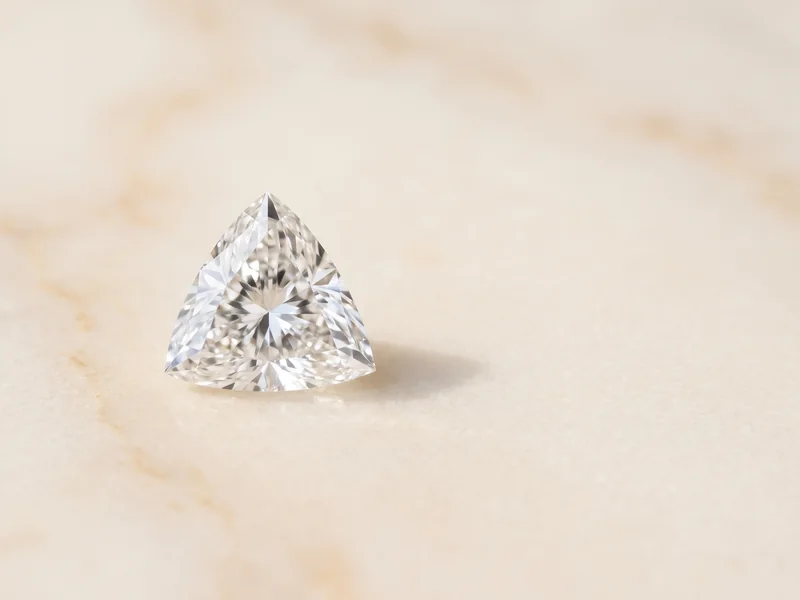 Diamond ShapesTriangular Cut Diamonds
Explore more
More guides on this topic
Education