
- Education
- Diamond Shapes
- Bullet Cut Diamond Guide: Shape, Ratio, Settings and Price
Diamond shapes
Bullet Cut Diamond Guide: Shape, Ratio, Settings and Price
A bullet cut diamond is rarely the star of a ring, but it decides how the whole design reads. Here is what the shape is, how it is faceted, and how to match, set and price a pair.
 Reviewed by Raj Sood, Graduate Gemologist (GIA), AJP (GIA)Master jeweller and Graduate Gemologist (GIA) · reviewed 4 November 2026
Quick answer
A bullet cut diamond is a step-cut, five-sided stone: a rectangle with one end tapered to a point, like a bullet. It is used mainly as a matched pair of side stones in three-stone rings. Look for a length-to-width ratio of 1.5–2.0, matched colour within one grade of the centre, eye-clean clarity and a setting that protects the point.
What is a bullet cut diamond?
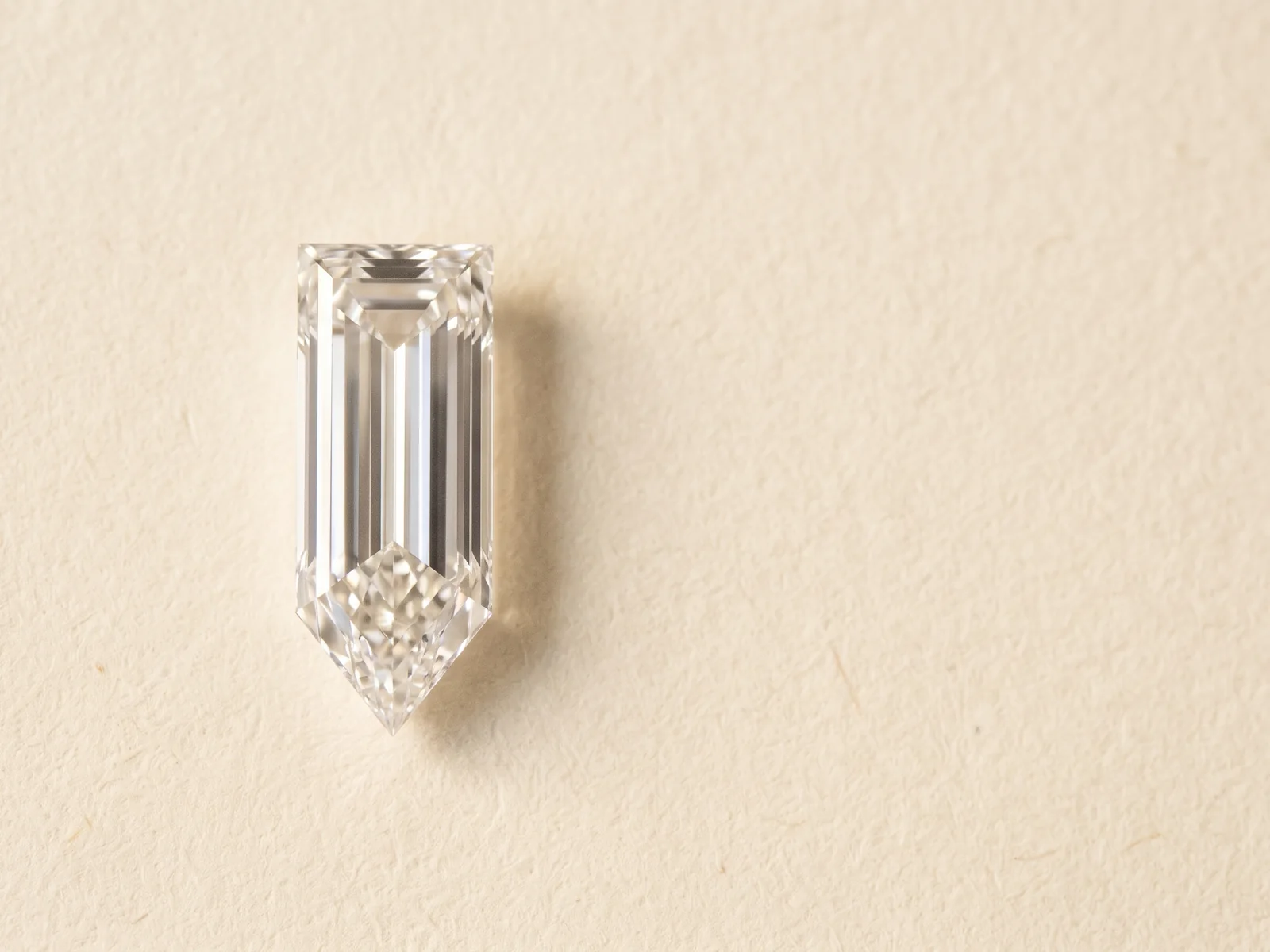
A bullet cut diamond is a five-sided fancy shape. Picture a long rectangle, then imagine one short end drawn out into a point, like the tip of a bullet or the gable of a house. The other end stays flat. Seen face-up (from above), the outline is a pentagon that is longer than it is wide.
Bullets are almost always cut as side stones: small diamonds that sit either side of a larger centre stone in a three-stone ring. They are usually cut and sold in matched pairs, mirror images of each other in size, colour and outline. A bullet can be set as a centre stone, and the shape turns up in Art Deco-style pieces and modern geometric designs, but that is the exception rather than the rule.
The bullet belongs to the family of geometric side stone shapes, alongside trapezoids, half moons, baguettes and trilliants. If you want to see where it fits in the bigger picture, our guide to how diamond shapes are grouped explains the families, and our full list of 34 diamond cuts shows the bullet next to every other shape. Any unfamiliar word in this article is also explained in our plain-English jewellery glossary.
How is a bullet cut diamond faceted?
Most bullets are step cuts. A step cut has long, flat facets (the polished surfaces of the stone) arranged in parallel rows, like steps running down from the table, the large flat facet on top. It is the same family as the classic baguette and the emerald cut. Instead of the scattered, sparkly flashes of a brilliant cut, a step cut gives broad flashes of light and dark, often called a hall-of-mirrors effect.
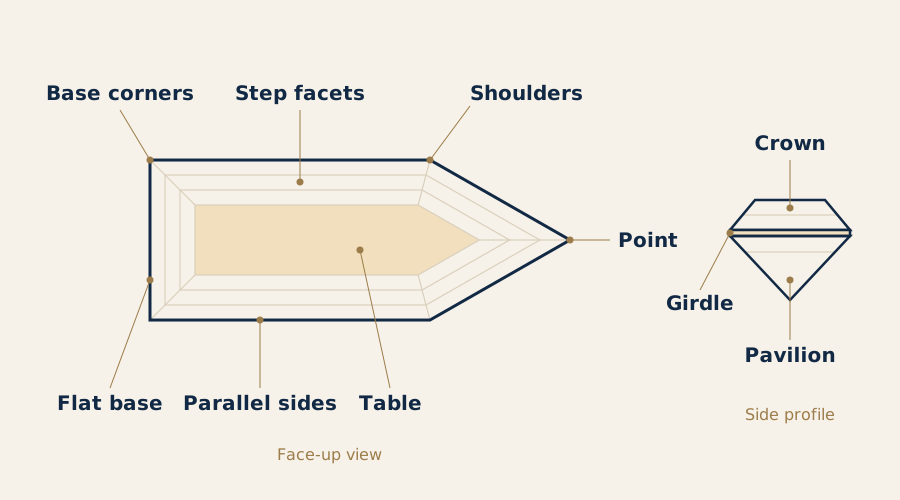
A typical bullet has a few rows of step facets on the crown (the top part, above the girdle) and more on the pavilion (the lower part). The exact facet count varies from cutter to cutter. Some cutters also produce brilliant-style bullets, with triangular and kite-shaped facets on the pavilion for more sparkle. These blend in better beside a round or oval centre, while step-cut bullets suit emerald, Asscher and other step-cut centres. Our comparison of how faceting styles differ, from rose to brilliant explains why these patterns behave so differently with light.
Diamond itself is 10 on the Mohs hardness scale, with a refractive index of about 2.42. Hardness is not toughness, though. Diamond can chip along its cleavage planes, and the bullet's point and its two sharp base corners are the thin, exposed areas. Labs such as GIA do not give fancy shapes an overall cut grade the way they do for rounds, so cut quality is judged from the proportions and from how the stone looks. If you are wondering what those grades mean for rounds, see what ideal and excellent cut grades really mean.
What is the ideal bullet cut diamond ratio?
The length-to-width ratio compares the length (from the flat base to the tip of the point) with the width (across the flat base). Divide the length by the width. A 6 × 3 mm bullet has a ratio of 2.00; a 5 × 3.5 mm bullet sits at about 1.43.
| Ratio | How it looks | Suits |
|---|---|---|
| Below 1.4 | Short and stubby, close to a shield or house shape | Compact designs, smaller centre stones |
| 1.4–1.7 | Balanced, the point clearly defined | Most three-stone rings with round, oval or cushion centres |
| 1.7–2.0 | Long and sleek, close to a baguette with a point | Emerald, radiant and elongated centres |
| Above 2.0 | Very slim, arrow-like | Bands and Art Deco-style designs |
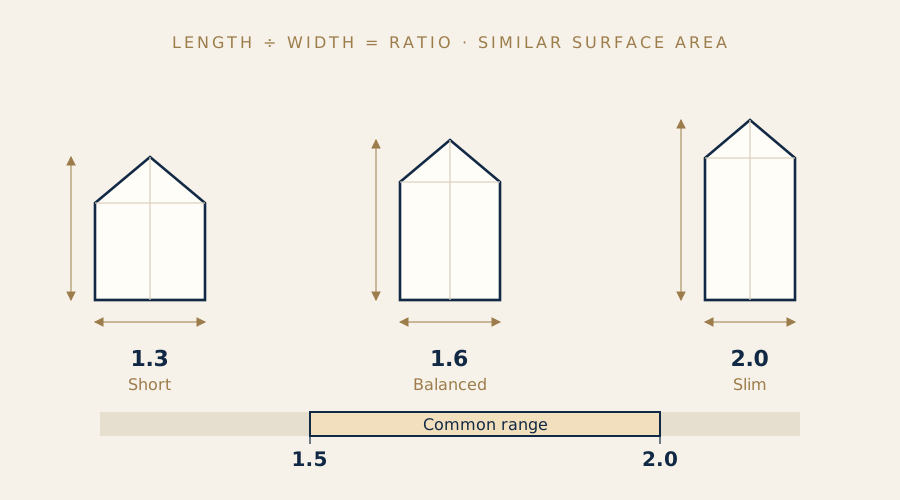
With side stones, the ratio of the bullet matters less on its own than how it relates to the centre stone. A good rule of thumb is that each bullet's length should be roughly two-thirds to three-quarters of the centre stone's length, and its width should leave the centre clearly dominant. A 1 carat round (about 6.4 mm across) often pairs well with bullets of about 4–5 mm in length; a 1.5 carat emerald cut (about 8 × 6 mm) may take 5–6 mm bullets.
Look at the point angle too. The two short edges that form the point usually meet at somewhere around 90 to 120 degrees. A sharper point looks more dramatic but is more fragile; a blunter point is safer and reads closer to an elongated lozenge cut. For a matched pair, both points must sit on the centre line and match each other, because the eye compares them side by side.
What sizes do bullet side stones come in?
Bullets are usually cut to calibrated sizes, meaning standard millimetre dimensions that fit standard settings. That makes it easier to replace one later or design around a known size. Carat weight depends heavily on the depth, so treat these as rough guides only.
| Size (length × width) | Approximate weight each | Typical use |
|---|---|---|
| 4 × 2.5 mm | about 0.10–0.15 ct | Beside a 0.50–0.75 ct centre |
| 5 × 3 mm | about 0.15–0.25 ct | Beside a 0.75–1.00 ct centre |
| 6 × 3.5 mm | about 0.25–0.40 ct | Beside a 1.00–1.50 ct centre |
| 7 × 4 mm | about 0.40–0.60 ct | Beside a 1.50–2.50 ct centre |
| 8 × 5 mm and up | about 0.70 ct and up | Larger centres or as a centre stone |
Because step cuts show their depth honestly, a bullet cut too deep will look small for its weight and slightly dark at the point. Compare the millimetre measurements of a pair, not just the carat weight, and ask for both stones' measurements to be within about 0.1 mm of each other.
Not sure which one is right?
Send us the stones you are looking at and our gemologist will tell you which to choose and why.
What colour and clarity should bullet side stones be?
Step cuts show body colour and inclusions (internal features) more clearly than brilliants, because the long, open facets act like windows. In a bullet, any warmth tends to gather towards the point, where the facets converge. Side stones are small, so they hide colour better than a large centre, but they sit right next to the centre stone, where any difference is easy to see.
- Colour: match the side stones to within one colour grade of the centre. With an F–G centre in white gold or platinum, G–H bullets usually blend well. In yellow or rose gold, H–I bullets can look just as white.
- Clarity: aim for eye-clean, meaning nothing visible without magnification at normal viewing distance. For step-cut bullets that usually means VS2 or better; a brilliant-style bullet can hide a careful SI1.
- Point and corners: avoid feathers (small internal cracks) or chips near the point or base corners, which are the thinnest areas.
- Fluorescence: try to match it across the pair and the centre; a strongly fluorescent bullet can look different from its partner in sunlight.
Matching matters more than grade. Two G VS2 bullets that look identical are better than an F and a G that look slightly different. If your centre is a step-cut shape such as an emerald or Asscher cut, pay extra attention to clarity, because all three stones will show the same window effect. Princess cut centre stones are brilliant-faceted, so they hide inclusions better.
Small bullets are often sold as matched pairs without full grading reports, or with a single report covering the pair. Larger bullets, especially lab-grown ones, often come with an IGI or GIA report. Either way, the paperwork should clearly say whether the stones are natural or lab-grown.
What is the best setting for a bullet cut diamond?
The bullet has three exposed points: the tip and the two corners of the flat base. A good bullet cut diamond setting protects all three while letting the straight edges line up neatly against the centre stone. The usual options:
- Claw setting: usually four or five claws, with a V-claw (a V-shaped claw) or a small claw covering the point and claws at both base corners. Lets the most light in.
- Bezel or half-bezel: a thin rim of metal around the edge, or around the point and corners only. Very secure and clean-looking, ideal for active hands.
- Basket with shared claws: the bullet shares claws with the centre stone, so the stones sit closer together and the ring looks more continuous.
- Channel setting: in bands, bullets can be set between two metal walls, though this suits the shape less often than it suits baguettes.
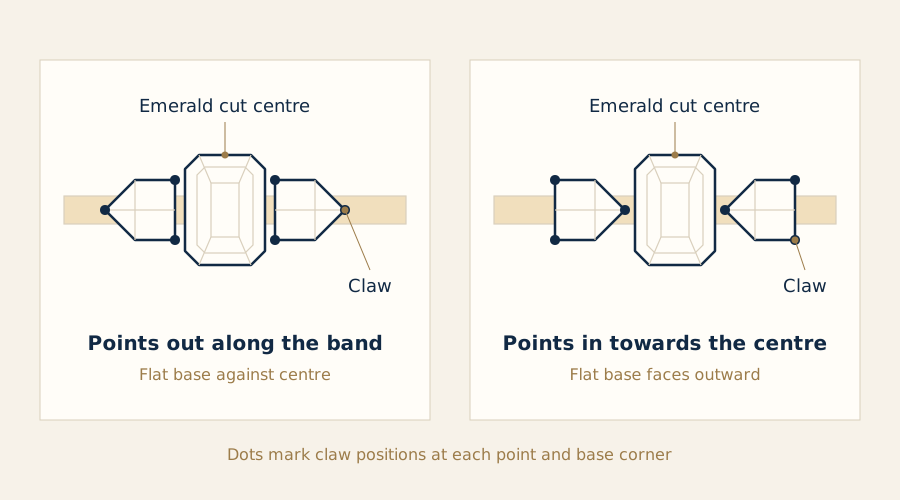
In a three-stone ring, bullets are most often set with the flat base against the centre stone and the point running out along the band, so the ring tapers towards the finger like an arrowhead. Some designs reverse this and point the bullets in towards the centre. Both are legitimate; it depends on the centre shape and how wide you want the ring to look. Our guide to choosing side stone cuts for a three-stone ring shows how each shape changes the overall outline.
What wedding band suits a bullet cut diamond ring?
A bullet cut diamond ring is usually wider across the top than a solitaire, and the bullets' points or base corners can sit close to the edge of the shank. That affects how a wedding band lies beside it.
- Straight bands: work when the setting is raised high enough that the band slides underneath the side stones. Check the gap before you choose.
- Contoured or notched bands: curve or dip around the side stones so the two rings sit flush. Often the neatest choice for a low three-stone setting.
- Plain metal bands: stop a busy look, since the bullets already add a lot of geometry.
- Matching bullet or baguette bands: a band set with small step-cut stones echoes the side stones for a coordinated look.
Bring the engagement ring when you choose a band, or have the band made alongside the ring, so the profile of the setting and the band can be matched. Metal colour should also match exactly: two different white golds can look slightly different side by side if one has been rhodium plated and the other has not.
Bullet cut vs trapezoid, baguette and other side stones: how do they compare?
| Bullet | Trapezoid | Tapered baguette | Half moon | Trilliant | |
|---|---|---|---|---|---|
| Outline | Rectangle with one pointed end | Four sides, one end wider | Long rectangle narrowing at one end | Half circle, one straight side | Triangle with curved or straight sides |
| Usual faceting | Step cut (some brilliant) | Step cut | Step cut | Step or brilliant | Brilliant |
| Look in a ring | Points along the band, geometric | Fans out from the centre | Slim, linear, Art Deco | Soft curve hugging the centre | Sparkly, wide triangle |
| Exposed points | Three | Four corners | Four corners | Two corners | Three |
| Best with | Emerald, Asscher, radiant, round | Emerald, cushion, radiant | Emerald, round, oval | Oval, round, cushion | Round, princess, cushion |
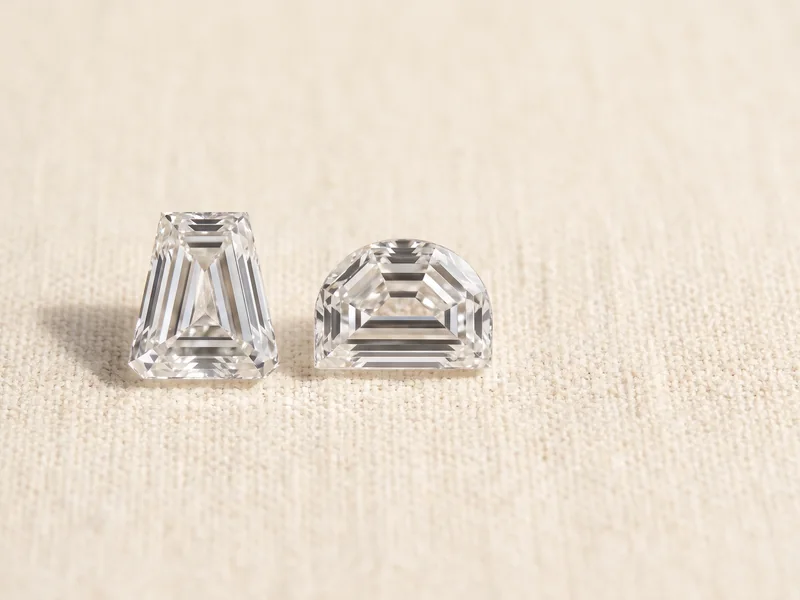
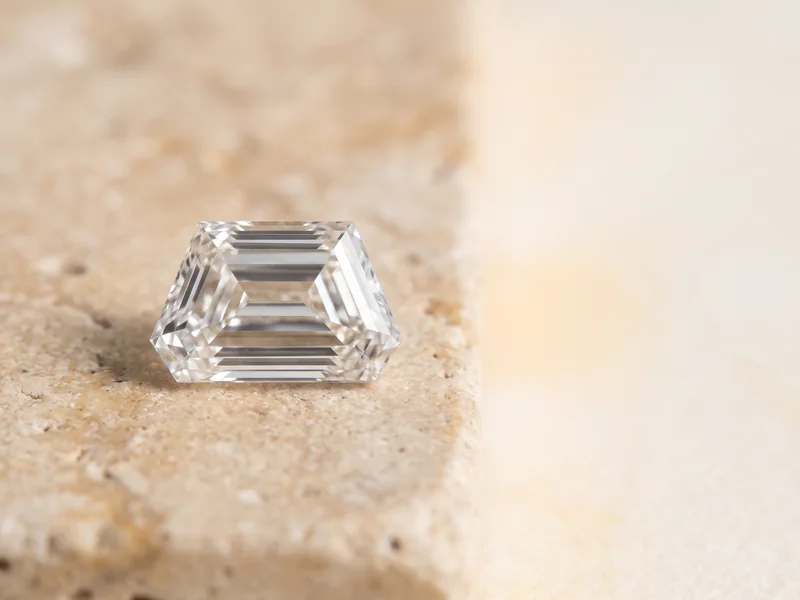
The bullet cut vs trapezoid choice comes down to direction. A trapezoid widens towards the centre stone and makes the ring look wide and fanned, while a bullet's point leads the eye along the band. Our guide to trapezoid side stones shows them in detail. For a softer frame around an oval or round, half moon cuts curve against the centre stone, and trilliant side stones add the most sparkle of the group.
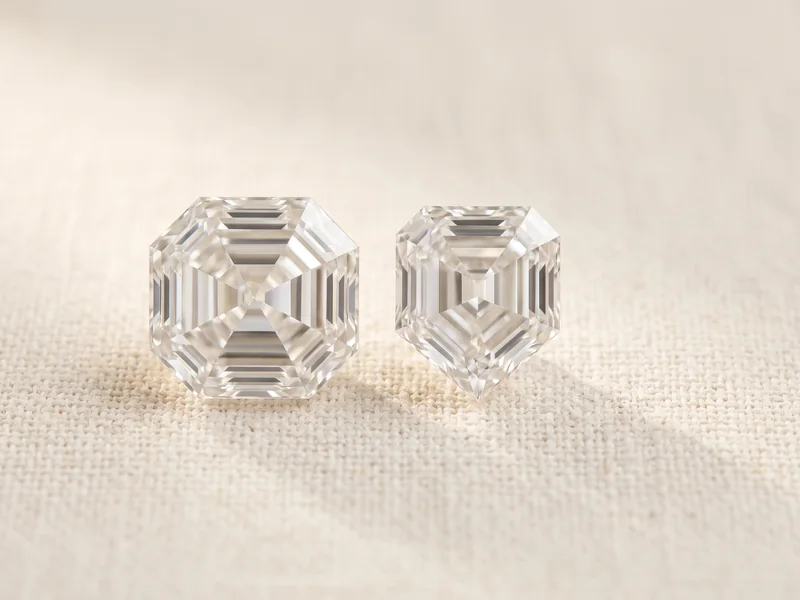
Related guideSide Stone Diamond Cuts: Trapezoid, Half Moon, Bullet, Baguette, TrilliantA few shapes are close cousins. Shield cut diamonds are similar in spirit but wider, with angled sides that taper to a point. Kite-shaped diamonds have points at both ends, and triangular step cuts drop the rectangular body entirely. If you like geometric outlines generally, six-sided hexagonal cuts work as a modern centre stone with bullets either side.
How much does a bullet cut diamond cost, natural or lab-grown?
Bullets are cut from both natural and laboratory-grown diamond, and the two look identical to the eye. Lab-grown diamonds are real diamond, grown in a laboratory rather than mined; they cost much less than natural diamonds and are easier to find as well-matched pairs. Natural bullets are less common, and finding two natural stones that mirror each other takes more time, which adds to the cost.
| Matched pair, about 0.40 ct total, G–H, VS | Approximate price range (AUD) |
|---|---|
| Lab-grown pair | about $300–$1,000 |
| Natural pair | about $1,200–$3,500 |
These are broad ranges only; prices move with the market, the grades and how closely the pair is matched. Per carat, small calibrated fancy shapes can cost more than you would expect, because cutting a precise point and a matching partner wastes more of the rough crystal and takes more labour. Per stone, though, side stones add far less to a ring's cost than the centre diamond. A single larger lab-grown bullet cut diamond for a centre stone is a niche item, and natural centre bullets over 1 carat are uncommon.
Browse lab-grown bullet cut diamonds
How do you choose bullet cut diamonds? Step by step
- Start with the centre stone. Its shape, size and faceting style decide whether step-cut or brilliant-style bullets will blend in.
- Check the paperwork. Confirm measurements, colour, clarity and whether the stones are natural or lab-grown.
- Work out the ratio. Divide length by width; most side stone pairs suit about 1.5–2.0.
- Size the pair to the centre. Each bullet's length is usually about two-thirds to three-quarters of the centre's length.
- Match the pair by eye. Compare colour, point shape and measurements side by side, ideally within about 0.1 mm.
- Check the point and corners. Look for chips, feathers or a point that sits off-centre.
- Choose the orientation and setting. Decide which way the points face, and make sure claws or a bezel protect the tip and both base corners.
- Plan the wedding band. Check the band can sit flush beside the side stones before the ring is finished.
Free consultation
Talk to a gemologist
Compare stones in person or online with Raj Sood, Graduate Gemologist (GIA), AJP (GIA).
Book a consultationShop this shape
FAQ
Common questions
What is a bullet cut diamond used for?
Mostly as a matched pair of side stones in three-stone engagement rings. Bullets also appear in bands, Art Deco-style pieces and, less often, as a geometric centre stone.
Which way should bullet side stones face?
Most often the flat base sits against the centre stone and the point runs out along the band, which tapers the ring towards the finger. Some designs point them inwards instead; both are fine if the claws protect the point.
Are bullet cut diamonds step cut or brilliant cut?
Most are step cuts, with long parallel facets like a baguette. Brilliant-style bullets exist too and blend better beside a round or oval centre stone.
Do bullet cut diamonds chip easily?
The point and the two base corners are the thinnest areas, so they are more exposed than a round's edge. A V-claw, corner claws or a bezel protects them for everyday wear.
What is the difference between a bullet and a trapezoid side stone?
A bullet has five sides and ends in a point, so it leads the eye along the band. A trapezoid has four sides and widens towards the centre, giving a broader, fanned look.
Can you get lab-grown bullet cut diamonds?
Yes. Lab-grown bullets are widely available in calibrated sizes and matched pairs, cost much less than natural bullets and are real diamond.

Ask a gemologist
Not sure which diamond to choose?
Raj Sood is a Graduate Gemologist (GIA) and master jeweller. Bring the stones you are considering, or send the reports, and he will tell you honestly which one is better and why.
Keep learning
Related guides
 Diamond ShapesSide Stone Diamond Cuts: Trapezoid, Half Moon, Bullet, Baguette, Trilliant
 Diamond ShapesTrapezoid Cut Diamonds
 Diamond ShapesBaguette Cut Diamonds
 Diamond ShapesShield Cut DiamondsDiamond ShapesUnderstanding Diamond Shapes
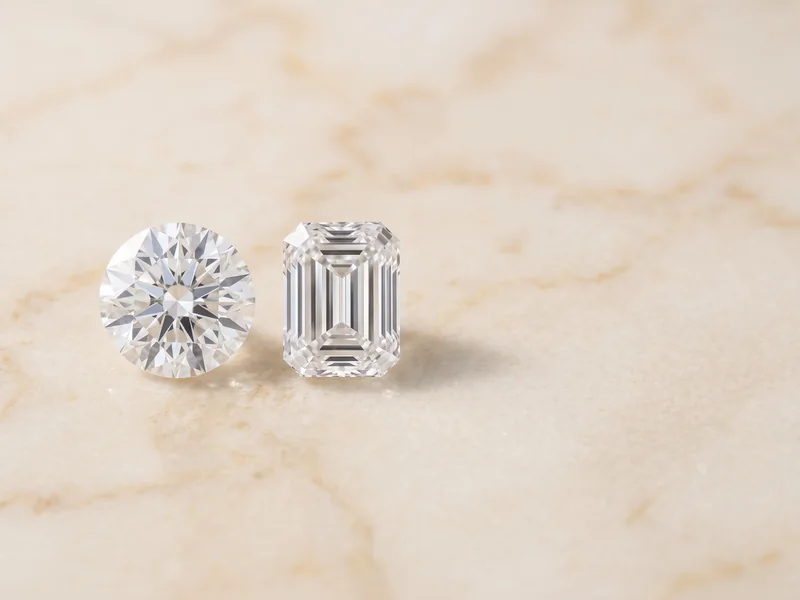 Diamond ShapesAll 34 Diamond Cuts: Every Shape Explained and Compared
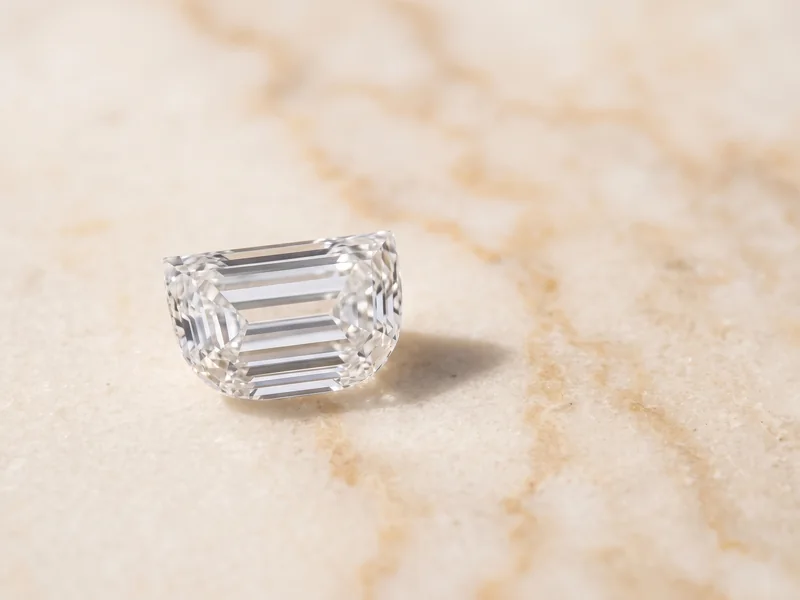 Diamond ShapesHalf Moon Cut Diamonds
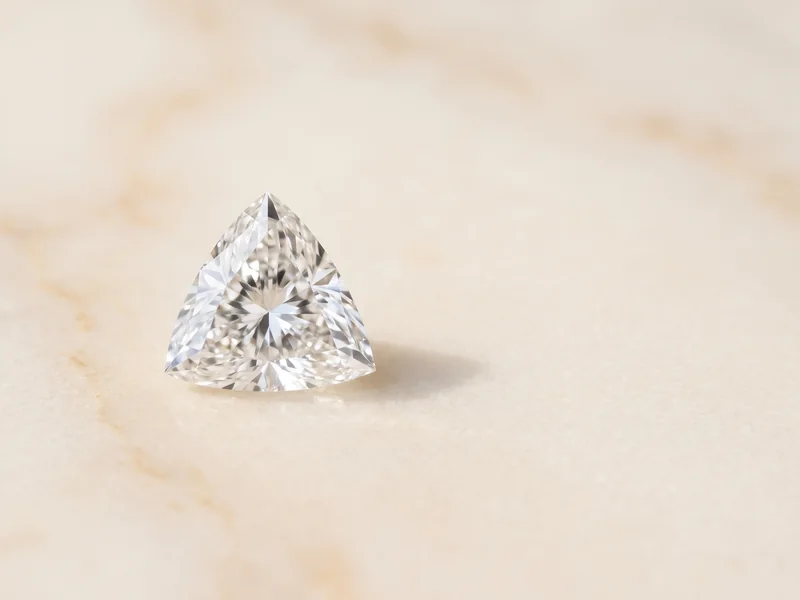 Diamond ShapesTrilliant Cut Diamonds
Explore more
More guides on this topic
Education