
- Education
- Diamond Shapes
- Princess Cut Diamond Corner Protection: Settings, Girdles and Everyday Care
Diamond shapes
Princess Cut Diamond Corner Protection: Settings, Girdles and Everyday Care
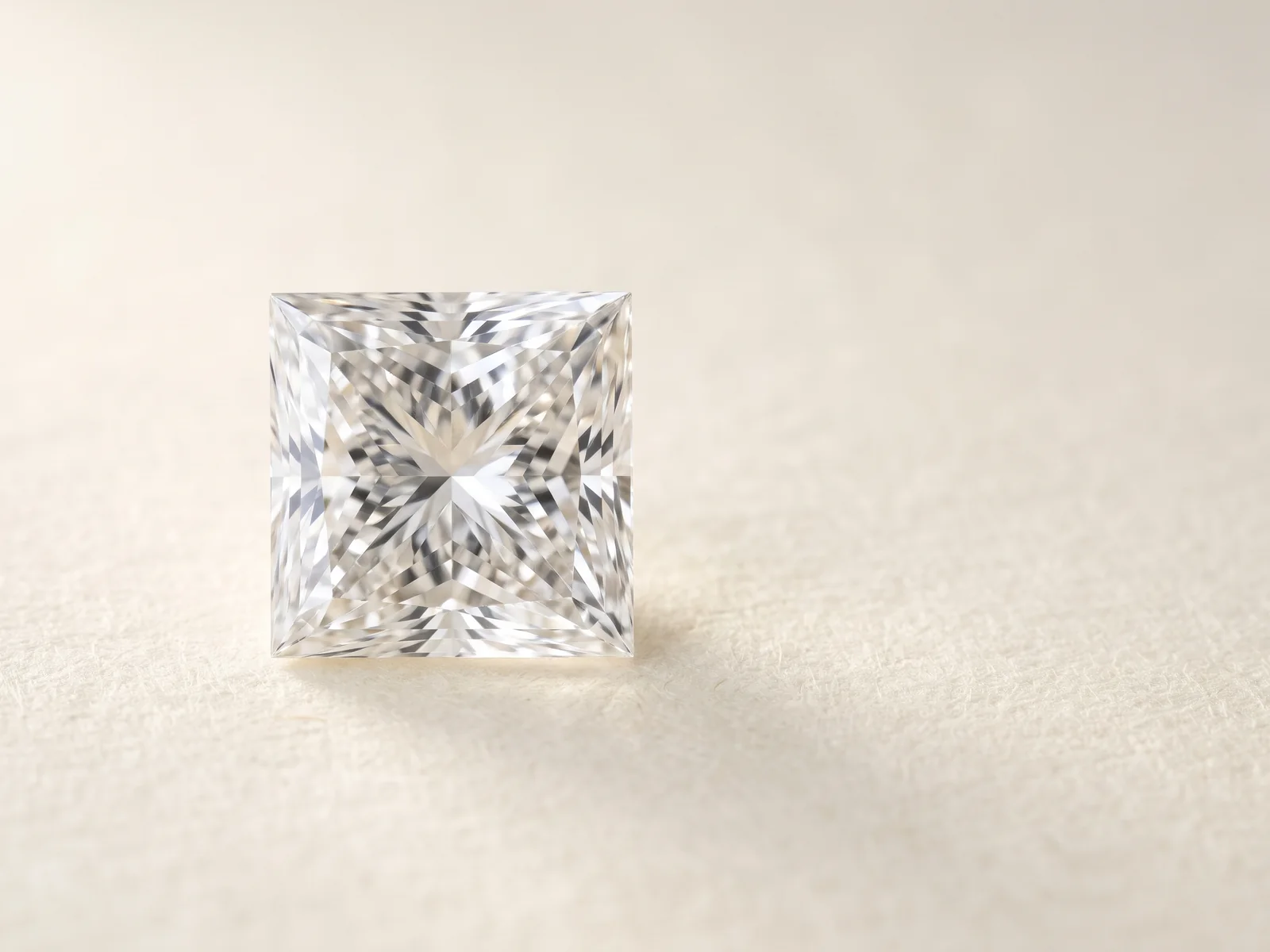
Princess cut diamond corner protection is the single most important thing to plan when you choose a square diamond. The four pointed corners are where a princess is thinnest, and where almost every chip we see begins.
 Reviewed by Raj Sood, Graduate Gemologist (GIA), AJP (GIA)Master jeweller and Graduate Gemologist (GIA) · reviewed 4 November 2026
Quick answer
Princess cut diamond corner protection means setting the stone so its four pointed corners are covered by metal. Choose a diamond with a medium to slightly thick girdle at the corners, then cover each corner with a V-claw or bezel. Avoid exposed corners, have claws checked every 6–12 months and remove the ring for heavy work.
Why does a princess cut diamond need corner protection?
A princess cut is a square (or very slightly rectangular) diamond with four pointed corners of roughly 90° and brilliant-style faceting, usually somewhere between 50 and 58 facets. Seen from above it looks crisp and geometric; seen from the side it has a deep, inverted-pyramid shape. For the full picture of how it is cut and graded, start with our complete princess cut diamond guide.
Those corners are the reason this guide exists. Diamond is 10 on the Mohs scale, the hardest natural material, with a refractive index of about 2.42. But hardness is resistance to scratching, not resistance to knocks. Diamond has four directions of cleavage (planes along which the crystal can split cleanly), and its toughness is rated only 'good'. A sharp blow landing on a thin point concentrates all the force in a tiny area, and that is exactly what a princess corner is.
Rounds, ovals and cushions have no points at all, so a knock glances off a curved edge. A princess has four, and on a ring they face outwards towards door frames, car keys, benchtops and gym equipment. If you are still weighing up which outline suits you, our page on how the main diamond shapes compare sets the princess beside every other option, and our overview of all 34 diamond cuts in one place covers the rarer ones too. Any term below you have not met before is explained in our plain-English jewellery glossary.
Where exactly is a princess cut weakest?
The weak spot is the girdle at each corner. The girdle is the narrow outer edge where the top half of the diamond (the crown) meets the bottom half (the pavilion). In a princess the crown is shallow, so at the corners the crown facets, the pavilion facets and the girdle all meet in a very small volume of diamond. If the girdle is cut too thin there, the corner can be almost knife-edged.
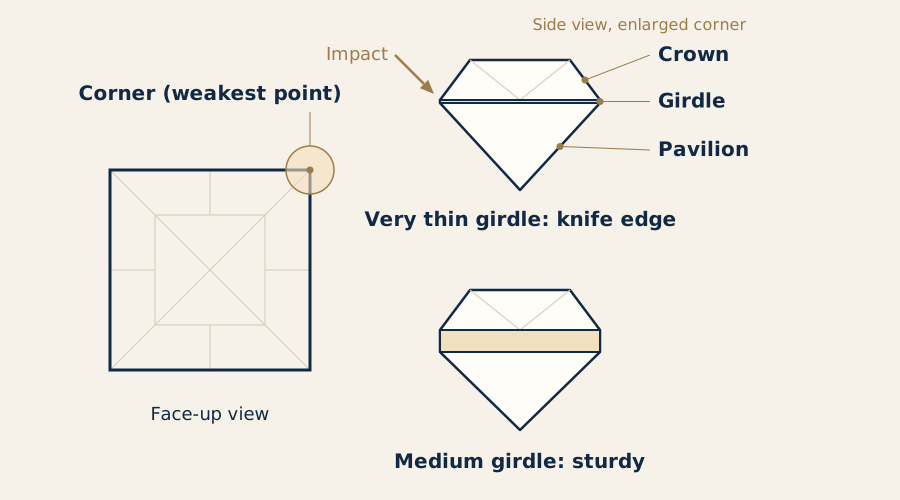
Grading reports describe girdle thickness on a fixed scale, usually as a range such as 'Thin to Medium' because thickness varies around the stone. In a princess, the thinnest reading is very often at the corners. Here is how to read it:
| Girdle grade | What it means at a princess corner | Our view |
|---|---|---|
| Extremely Thin | Close to a knife edge | Avoid; high chipping risk even in a protective setting |
| Very Thin | Little material at the point | Only with a full bezel, and ideally avoid |
| Thin | Acceptable if the corners are fully covered | Fine under V-claws or a bezel |
| Medium | Sturdy without wasting weight | The sweet spot |
| Slightly Thick | Very robust corners | Excellent for everyday wear |
| Thick | Extra weight hidden in the edge | Durable, but the stone may face up smaller |
| Very Thick to Extremely Thick | Weight carried in the girdle, not the face | Looks small for its carat; avoid |
Two other features matter. A natural (a small patch of original crystal surface left on the girdle) or an extra facet at a corner is usually harmless, but a chip or feather (a small internal crack) that reaches a corner is a warning sign, because that is where a break would start. Ask for the plotting diagram on the report and check that nothing sits right at a point.
GIA does not give princess cuts an overall cut grade the way it does for rounds, though some labs and retailers apply their own grades; our explainer on what cut grades like Ideal and Excellent actually measure shows why a top grade does not automatically mean durable corners. Proportions also play a part: well-cut princesses commonly sit at about 65–75% total depth with a table of about 67–75% of the width. Depth and pavilion angles shape the chevron patterns under a princess's table, but corner strength comes down mostly to the girdle.
Which setting gives the most princess cut diamond corner protection?
Once the stone is sound, the setting does the rest. The rule is simple: every corner should be covered by metal. Round claws placed on the flat sides, or thin round claws perched on the points, leave the corners exposed. Here is how the common options compare:
| Setting | Corner protection | Light and visibility | Upkeep | Suits |
|---|---|---|---|---|
| Four V-claws | High: each corner wrapped | Most of the stone visible | Check claws every 6–12 months | Classic solitaires |
| Full bezel | Very high: whole edge enclosed | Hides a thin rim of the outline | Low; little to snag | Active lifestyles, nurses, tradies |
| Half-bezel | High at the covered sides | More open than a full bezel | Low | A modern look with good security |
| Halo with corner claws | High if the centre corners are clawed | Makes the centre look larger | Small halo stones need checks too | Smaller centre stones |
| Four round claws on the corners | Moderate: tip is held but sides exposed | Very open | Higher risk over time | Not recommended for daily wear |
| Tension or bar setting | Low unless specially designed | Very open | Specialist work | Rarely advised for a princess |
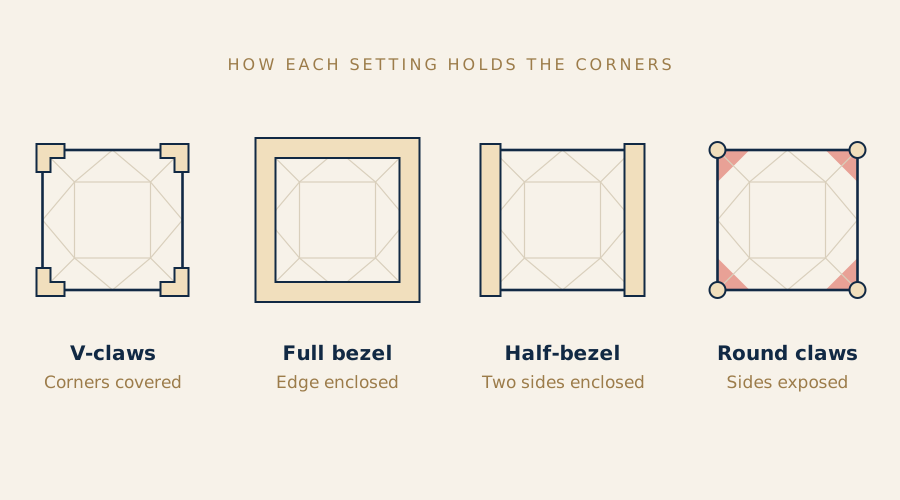
A V-claw (sometimes called a V-prong or chevron claw) is a claw shaped like a V that folds over both edges of a corner, so the point sits inside the metal rather than against it. A bezel is a continuous rim of metal around the whole girdle. Both keep the corners clear of impact; the bezel is more protective, the V-claw shows more of the diamond.
Are V-claws or a bezel better for a princess cut engagement ring?
Both work. The choice comes down to how you live and how much of the outline you want to see.
- Choose V-claws if you want the crisp square shape fully on show and more light entering the sides. They suit most office and home routines, provided the claws are checked regularly.
- Choose a full bezel if you work with your hands, play sport, garden or simply know you knock your rings. A bezel also never catches on knitwear or hair.
- Choose a half-bezel (metal on two opposite sides, open on the other two) as a middle path: the ends of each rim wrap around the corners, so all four points are still covered by metal.
The metal matters too. Platinum (usually 950 parts per thousand) is dense and tough; when it wears, it tends to move rather than break away, so a platinum V-claw usually thins slowly and stays tight. 18ct gold claws are a little harder at first but lose metal as they wear, so they need re-tipping (rebuilding the claw tip) a little sooner. 9ct gold is harder again but more brittle in fine claws. White gold is normally rhodium plated, and the plating wears off the claw tips first, which is a useful early sign of wear.
Claw thickness should suit the stone: fine claws look delicate in photos but wear through faster. For a centre stone of around 1 carat, many jewellers use noticeably heavier claws on a princess than on a round of the same size, precisely because the corners carry the risk.
Not sure which one is right?
Send us the stones you are looking at and our gemologist will tell you which to choose and why.
How do you protect princess cut corners in a wedding band or side stones?
Small princess diamonds, usually about 1.5–3.0 mm, are popular in wedding and eternity bands because they sit edge to edge with almost no gaps. Their corners need the same care as a centre stone, just at a smaller scale.
- Channel setting: stones sit in a row between two metal walls, so all four corners of each stone are tucked under the channel. This is the most common and most protective setting for a princess cut wedding band.
- Bar setting: thin metal bars separate the stones, leaving two sides open. The corners at the bar are protected; the open edges are more exposed.
- Invisible setting: grooves are cut into the girdles of the stones, which slide onto a hidden metal frame. It looks seamless, but the grooves add stress points and a single knock can loosen a stone, so it needs careful inspection.
- Flush setting: small princesses sunk into the band with only the table showing. Very protective and low-profile.
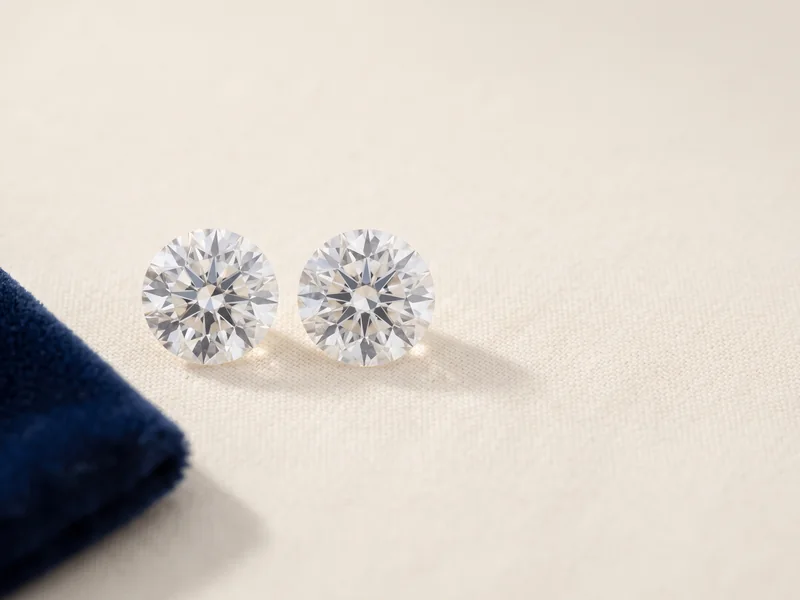
When you pair a band with a princess engagement ring, the band should sit just below or against the centre setting without the claws grinding against it. Two hard edges rubbing together every day wear down claws quickly. A band that sits flush, or a fitted (shaped) band, keeps contact on metal rather than on the corners. Some people choose a softer-looking, flat-backed stone for the band instead; our guide to rose cut and brilliant cut differences explains why rose cuts sit so neatly in bezels and low settings.
Is a princess cut too fragile for everyday wear?
No. With a sound girdle and covered corners, a princess is perfectly suitable for daily wear, and plenty are worn for decades without trouble. The chips we repair almost always come from one of three things: an exposed corner, a worn claw, or a stone with a very thin girdle. Fix those and the risk drops sharply.
If you love square diamonds but want less to worry about, several shapes keep the look with softer corners:
| Shape | Corners | Faceting | Corner risk |
|---|---|---|---|
| Princess | Four pointed 90° corners | Brilliant, chevron patterns | Highest of the square shapes |
| Radiant | Clipped (cut-off) corners | Brilliant, crushed-ice look | Low |
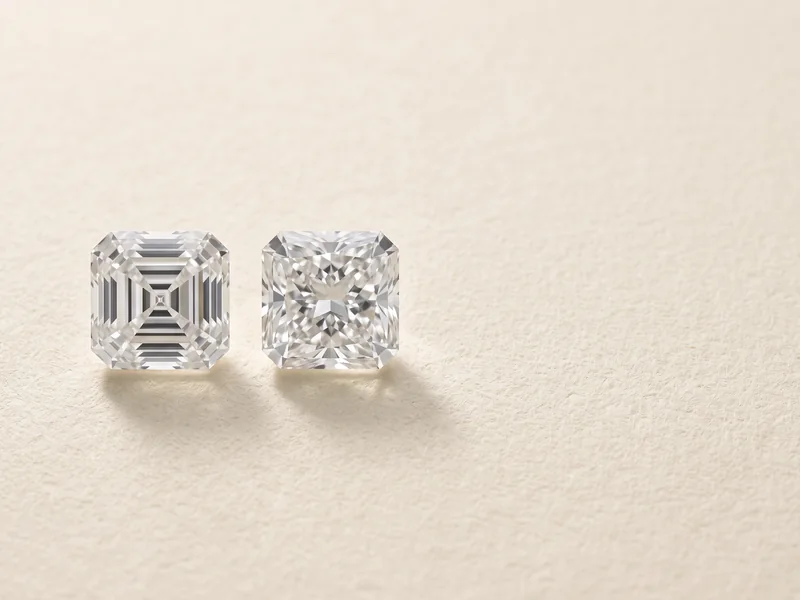
| Asscher | Clipped corners, octagonal outline | Step cut, hall-of-mirrors look | Low |
| Square cushion | Rounded corners | Brilliant or crushed-ice | Low |
| Emerald (square) | Clipped corners | Step cut | Low |
The closest alternative is the radiant: our guide to princess versus radiant, corner by corner shows how a radiant's cut-off corners remove the weak point while keeping a brilliant sparkle. If you prefer the clean lines of a step cut, see how a princess compares with an Asscher.
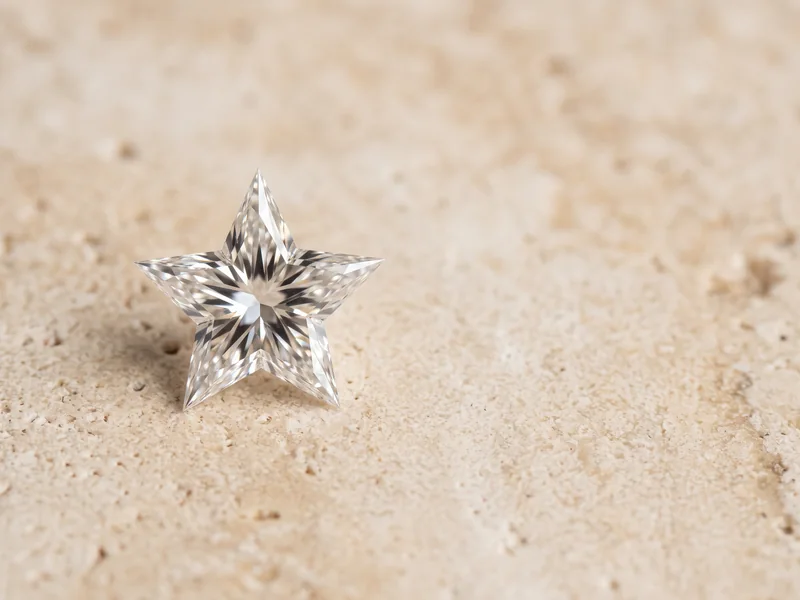
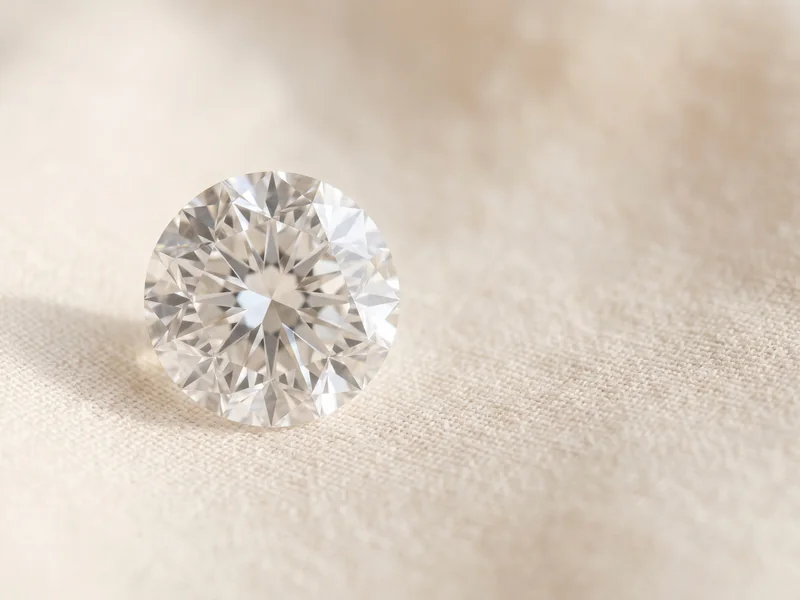
Related guidePrincess vs Radiant Cut DiamondsSpeciality cuts can also suit people who want something unusual. Star cut diamonds have points of their own and need the same protective thinking, while the many-faceted Portuguese cut is usually round and has no corners at all.
Do lab-grown princess cut diamonds chip differently from natural ones?
No. A lab-grown princess cut diamond is real diamond, grown in a laboratory rather than mined. It has the same crystal structure, the same hardness of 10, the same refractive index and the same cleavage, so its corners need exactly the same protection as a natural stone. What differs is cost: lab-grown diamonds cost much less than natural, so many people choose a larger lab-grown princess, and a larger stone has longer, more exposed corners. Our comparison of which shapes face up largest for their carat weight shows how the princess measures up against other outlines.
Princess cuts usually cost less per carat than rounds of the same grades, partly because the square outline keeps more of the rough crystal; our page on how prices differ between diamond shapes sets out that pattern across the main cuts. As a broad guide for a 1 carat princess, G–H colour, VS clarity:
| 1 ct princess, G–H, VS | Approximate price range (AUD) |
|---|---|
| Lab-grown | about $900–$2,500 |
| Natural | about $4,500–$10,000 |
These ranges move with the market and with the exact grades, so treat them as a starting point only. Whichever you choose, the girdle reading on the independent grading report (from a lab such as GIA or IGI) matters more for durability than the price tag. For guidance on colour and clarity choices, see choosing a princess for colour, clarity and size.
Shop princess cut diamonds: natural and lab-grown
How do you care for a princess cut ring day to day?
Good habits protect the corners as much as good metalwork does.
- Take it off for heavy work: gym weights, gardening, moving furniture, rock climbing and contact sport.
- Put it somewhere soft and separate: diamonds scratch other diamonds and can chip each other's corners if rings are tossed together in a dish.
- Feel for snagging: if the ring starts catching on jumpers or tights, a claw may have lifted or worn.
- Listen for a rattle: hold the ring near your ear and tap it gently; a click means the stone has movement.
- Clean gently: warm water, a drop of dishwashing liquid and a soft toothbrush. Ultrasonic cleaners are fine for most diamonds but can shake loose a stone with worn claws.
- Book a check every 6–12 months: a jeweller looks at every claw under magnification and re-tips any that have thinned.
If a corner does chip, it is not always the end of the stone. A small chip can sometimes be hidden under a V-claw or bezel, and a larger one can often be removed by recutting the corner, at the cost of some weight. It is worth having a gemmologist assess it before deciding.
How do you check princess cut diamond corner protection before you buy?
- Read the grading report. Confirm the shape, measurements, whether it is natural or lab-grown, and the girdle range. Avoid Very Thin or Extremely Thin readings.
- Ask where the thinnest girdle is. If the report says 'Thin to Medium', ask whether the thin part sits at the corners.
- Check the plotting diagram. Make sure no chip, feather or cavity sits at or near a corner.
- Inspect the corners in a 360° video. Look for chips, rough spots or knife-edge points as the stone turns.
- Choose a covering setting. Four V-claws, a full bezel or a half-bezel, with no corner left bare.
- Match the metal and claw weight to your life. Heavier claws or platinum for daily hard wear.
- Plan the wedding band. Make sure it sits flush and does not grind against the centre claws.
- Book regular checks. Put a reminder in your calendar for a claw check every 6–12 months.
Once the stone and setting tick every box, compare a few shapes side by side; our page showing every diamond shape side by side and the guide on how chevron patterns affect a princess's brilliance help you judge the look as well as the durability. For any unfamiliar word on a report, the glossary of terms such as girdle and culet has a plain explanation.
Free consultation
Talk to a gemologist
Compare stones in person or online with Raj Sood, Graduate Gemologist (GIA), AJP (GIA).
Book a consultationFAQ
Common questions
Do princess cut diamonds chip easily?
They chip more easily than rounds or cushions because of their four pointed corners. With a medium or slightly thick girdle and every corner covered by a V-claw or bezel, the risk is low for everyday wear.
What is the most protective setting for a princess cut diamond?
A full bezel encloses the whole edge and gives the most protection. Four V-claws are the most popular choice and protect each corner well while showing more of the diamond.
Can you use round claws on a princess cut?
You can, but round claws leave the sides of each corner exposed. V-claws are shaped to wrap both edges of the point, which is why most jewellers recommend them for a princess.
What girdle thickness should a princess cut have?
Look for Medium to Slightly Thick, especially at the corners. Avoid Very Thin or Extremely Thin readings, and avoid Very Thick girdles, which make the stone look smaller for its weight.
Can a chipped princess cut diamond be fixed?
Often, yes. A small chip can be hidden under a V-claw or bezel, and a larger one can sometimes be polished out by recutting the corner, which reduces the carat weight slightly.
Are lab-grown princess cut diamonds as durable as natural ones?
Yes. Lab-grown diamonds have the same hardness, structure and cleavage as natural diamonds, so their corners need the same protection.

Ask a gemologist
Not sure which diamond to choose?
Raj Sood is a Graduate Gemologist (GIA) and master jeweller. Bring the stones you are considering, or send the reports, and he will tell you honestly which one is better and why.
Keep learning
Related guides
 Diamond ShapesPrincess Cut Diamonds
 Diamond ShapesPrincess vs Radiant Cut DiamondsDiamond ShapesPrincess vs Asscher Cut DiamondsDiamond ShapesPrincess-Cut Diamond Chevron PatternsDiamond ShapesUnderstanding Diamond Shapes
 Diamond ShapesRose Cut vs Brilliant Cut Diamonds
 Diamond ShapesStar Cut Diamonds
 Diamond ShapesPortuguese Cut Diamonds
Explore more
More guides on this topic
Education