
- Education
- Diamond Shapes
- Star Cut Diamond Guide: Facets, Ratio, Colour and Settings
Diamond shapes
Star Cut Diamond Guide: Facets, Ratio, Colour and Settings
A star cut diamond has more fragile edges than almost any other shape: five fine points and five inner notches. Here is how to judge a star, from symmetry and ratio to the setting that keeps every tip safe.
 Reviewed by Raj Sood, Graduate Gemologist (GIA), AJP (GIA)Master jeweller and Graduate Gemologist (GIA) · reviewed 4 November 2026
Quick answer
A star cut diamond is a fancy shape with five points and five inner notches, usually faceted in brilliant style for sparkle. Look for evenly matched points, a length-to-width ratio of about 0.95–1.05, colour H or better, eye-clean clarity with no inclusions at the tips, and a bezel or five V-claws to protect every point.
What is a star cut diamond?
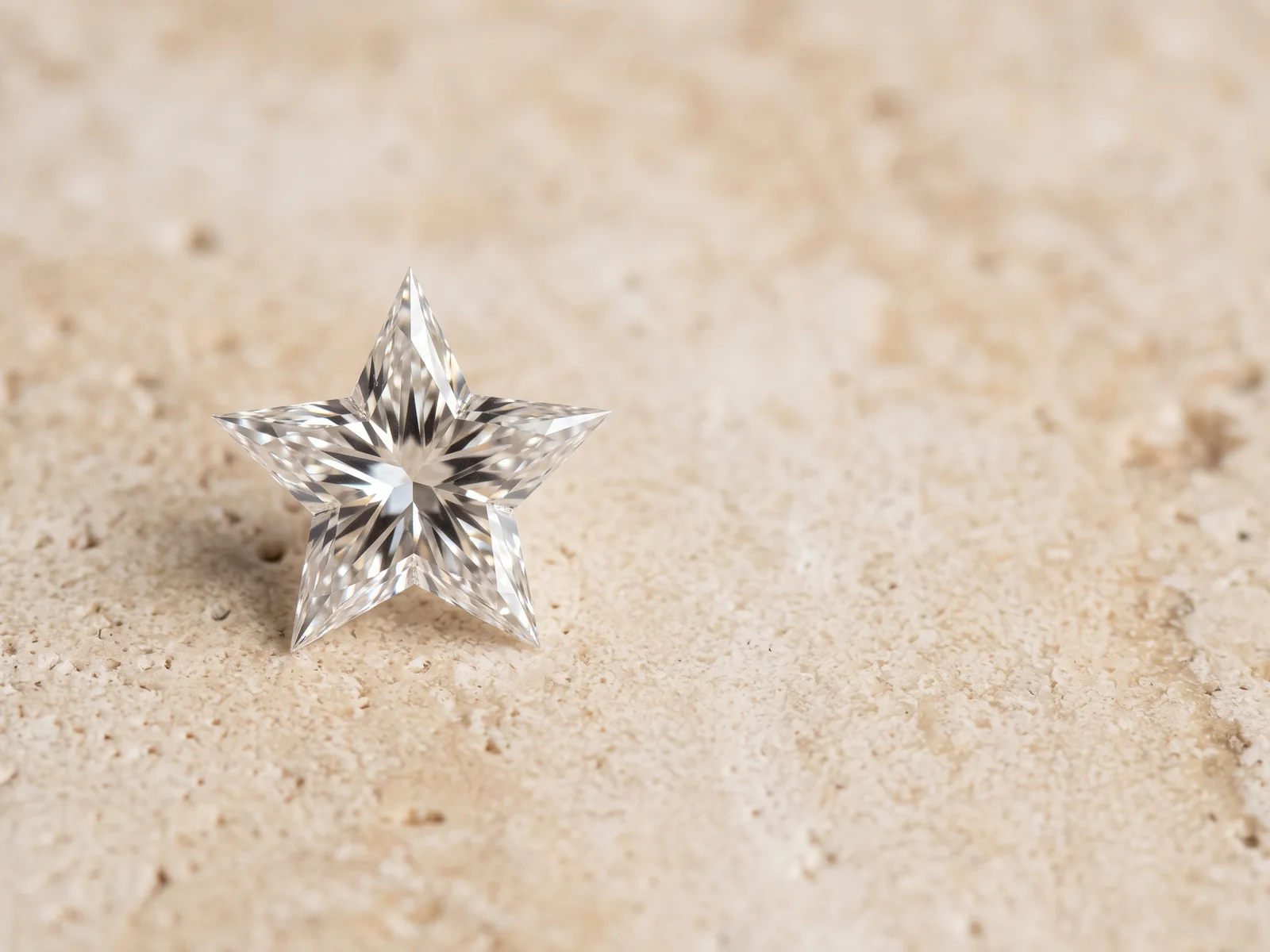
A star cut diamond is a fancy shape (any shape other than round) cut to a five-pointed star outline, the same star you would draw on a card. It has five outer points and five inner notches between them. Cutters call those notches re-entrant angles, because the outline turns back in on itself. Very few diamond shapes do that: a heart has one notch, its cleft, while a star has five. That is what makes it so distinctive, and so demanding to cut and set.
The name causes some confusion. Every round brilliant has eight small triangular star facets around its table (the large flat top facet), and some specialist round cutting styles carry 'star' in their names. On a grading report or in a diamond listing, though, 'Star' as a shape means the five-pointed outline. If you were looking for the round variations, our page on round, star and Portuguese cuts in the round brilliant family covers them. Six-pointed star diamonds also exist, but they are rarer again and usually custom cut.
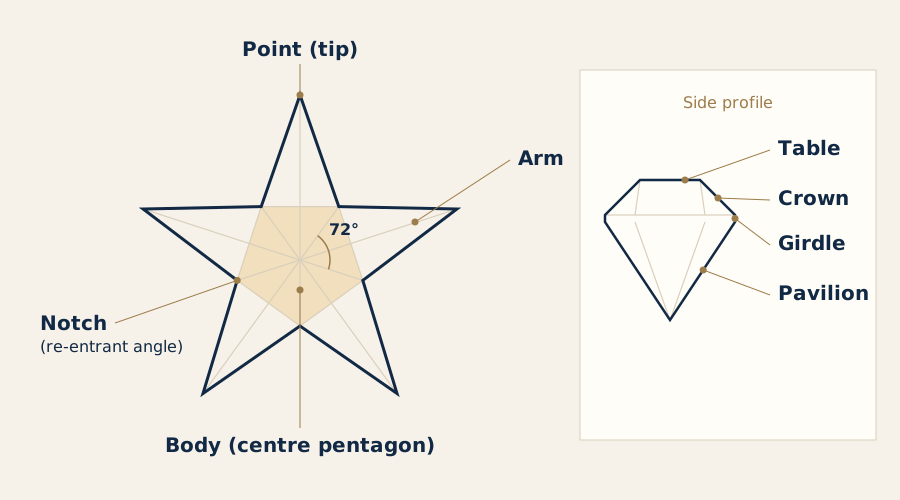
Diamond is 10 on the Mohs hardness scale and has a refractive index of about 2.42, which is why brilliant faceting returns so much light. Hardness, though, is resistance to scratching, not to knocks. Diamond can chip along its cleavage planes (natural planes of weakness in the crystal), and a star has ten vulnerable areas: five thin tips and five inner corners where stress collects. Almost every piece of advice in this guide follows from that.
The star sits in the novelty or geometric corner of the shape chart, alongside pentagons, hexagons and shields. To see where it fits, start with our overview of how diamond shapes are grouped, or compare it with all 34 diamond cuts side by side. Any word here you have not met before is explained in our plain-English jewellery glossary.
How is a star cut diamond faceted?
Most star shaped diamonds are faceted in a brilliant style: triangular and kite-shaped facets radiating from the centre out to each point, a little like the classic 57-facet round brilliant stretched into five arms. There is no standard facet count. Each cutter designs their own pattern, and a tiny accent star usually carries a simpler pattern than a 1 carat centre stone.
You will also come across two other styles. Step-cut stars have long, parallel facets running down each arm, like a row of tiny baguettes. They look glassier and more architectural, with broad flashes rather than pinpoint sparkle, and they show inclusions more easily. Rose-cut stars have a flat base and a faceted dome, so they look larger for their weight but softer in sparkle; our guide to how rose cuts differ from brilliant cuts explains that trade-off.
Why are stars so uncommon? A star throws away a lot of rough. To form five arms and five notches, the cutter has to saw and grind away the material between the arms, weight that never ends up in the finished stone. The points also have to be polished slowly so they do not chip on the wheel. As a result, natural star diamonds are mostly small. Laser sawing, and the larger, more regular crystals that laboratories can grow, have made lab-grown stars much easier to find in bigger sizes.
More facets do not automatically mean more brightness. The heavily faceted Portuguese cut shows that extra facets give finer, busier sparkle, but light return still depends on angles. In a star, each arm is narrow and fairly shallow, so light has less room to bounce before it leaks out. Expect the strongest sparkle in the body (the pentagon in the middle) and a little less life in the very tips.
What is the ideal star diamond ratio and proportions?
The length-to-width ratio compares the height of the star with its width, measured from the tip of the left arm to the tip of the right arm. Divide the height by the width, or follow the order the report gives. A geometrically regular five point star diamond measures about 0.95: slightly wider than it is tall. Most stars on the market sit between about 0.95 and 1.05.
| Ratio | How it looks | Suits |
|---|---|---|
| Below 0.95 | Wide and squat; the lower points look short | Rarely chosen; can look tipped backwards |
| 0.95–1.00 | Balanced, the classic star | Pendants, studs and most rings |
| 1.00–1.05 | Slightly taller, with a more prominent top point | A ring where you want a lengthening effect |
| Above 1.05 | Stretched; arms start to look unequal | Check it still reads as a regular star |
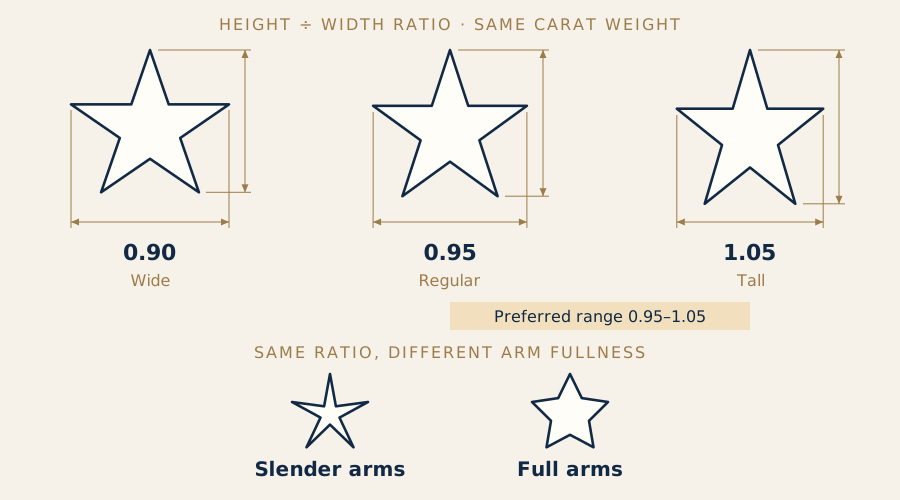
Ratio is only half the story. The other half is arm fullness: how deep the notches cut in towards the centre. Slender arms with deep notches look sharp and graphic but leave thin, fragile tips. Fuller arms with shallower notches look softer, carry more weight in the body and are noticeably tougher. For a ring worn every day, fuller arms are the practical choice; for earrings or a pendant, a sharper star is fine.
GIA does not give star shapes an overall cut grade; like all fancy shapes, they receive polish and symmetry grades only. Our guides to how diamond cut grades work and the difference between Ideal and Excellent cut labels explain why. There are no widely agreed ideal depth or table figures for stars either. As a loose guide, many well-cut stars fall somewhere around 45–65% total depth. Too deep and the centre looks small and dark; too shallow and it goes glassy and see-through, an effect called a window.
How do you check symmetry on a star shaped diamond?
A star has five-fold symmetry, so your eye compares all five arms at once, and even a small difference stands out. When you look at a star, check five things:
- Points: all five arms the same length, tapering evenly to a fine but not needle-thin tip.
- Notches: all five the same depth and spaced evenly around the centre, about 72° apart.
- Alignment: the top point sits directly above the gap between the two lower points, so the star does not lean.
- Tips: no chips, nicks or rough patches on any point; these show up clearly under magnification.
- Body: the centre pentagon looks bright, with no fixed dark spot as the stone moves.
The symmetry grade on a report (Excellent, Very Good, Good and so on) mainly describes how precisely the facets meet. It does not fully judge whether the outline looks balanced, so a star graded Very Good can still have one arm a touch shorter than the rest. Judge the outline with your own eyes, from a clear face-up photo or video.
Related guidePentagonal Cut DiamondsNot sure which one is right?
Send us the stones you are looking at and our gemologist will tell you which to choose and why.
How big should a star cut diamond be?
Under about 0.30 carat, the points of a star become tiny, and once five claws sit over the tips the outline can read as a spiky blob from across a room. For a centre stone, most people choose 0.50 carat or more, and the star really reads at a glance from about 1 carat. Small stars, from about 0.05 to 0.25 carat, work well where they are seen up close: as star shaped diamond earrings, in a pendant, or scattered as accents across a band.
| Carat weight | Star, point to point (approx.) | Round of same weight (approx. diameter) |
|---|---|---|
| 0.10 ct | 3.5–4.0 mm | 3.0 mm |
| 0.25 ct | 4.5–5.5 mm | 4.1 mm |
| 0.50 ct | 5.5–6.5 mm | 5.1 mm |
| 1.00 ct | 7.0–8.0 mm | 6.4 mm |
| 2.00 ct | 9.0–10.0 mm | 8.1 mm |
These star figures are broad estimates, because arm fullness and depth vary so much between cutters; always use the measurements on the report. The point-to-point figure flatters a star. The notches are empty space, so a 1 carat star spans wider than a 1 carat round but does not cover more area of diamond. In the hand it reads at a similar size to a round, with a much more noticeable outline.
What colour and clarity suit a star shape?
Thin points with crowded facets tend to gather body colour, so a faint warm tint shows at the tips of a star more than across the face of a round. In white gold or platinum, most people are happy from H colour or better; if you are sensitive to warmth, look at G or higher. In yellow or rose gold, I or J can look just as white, because the metal warms everything around it. Very small accent stars hide colour well, so G–I is usually plenty.
For clarity, aim for an eye-clean stone, meaning no inclusions (internal features) you can see without magnification at normal viewing distance. In a brilliant-style star that usually means VS2 or a carefully chosen SI1; step-cut stars show more, so lean towards VS. Where an inclusion sits matters more than its grade. A feather (a small internal crack) that reaches the surface near a tip or at a notch weakens exactly the part of the stone most likely to take a knock. Ask for the plotting diagram on the report, which maps every inclusion.
- White metal: G–H colour, VS2–SI1 eye-clean.
- Yellow or rose gold: I–J colour can look white, VS2–SI1 eye-clean.
- Avoid: feathers or chips at any point or notch, even if the overall grade looks good.
Coloured stars are popular too. Natural fancy coloured star diamonds are very rare. Lab-grown stars in blue, pink and yellow are easier to find; their colour may come from trace elements added during growth or from treatment after growth, and the report should say which.
What is the best star cut diamond setting for a ring?
Every point of a star is exposed, so the setting has one main job: cover all five tips. The usual options for a star cut diamond ring:
- Five V-claws: a V-shaped claw wrapped over each point. Secure, and it leaves the notches and outline visible.
- Full bezel: a thin rim of metal that follows the star outline. The most protective option, and it sharpens the shape visually, though it adds a narrow metal border.
- Five tip claws: fine round claws on each point. Lighter-looking, but they protect the tips less than a V-claw; better for earrings and pendants.
- Halo: small diamonds following the star outline, or a round halo enclosing it. It makes the star look larger and shields the edges.
- Pendants and studs: low-wear pieces where finer, sharper stars are perfectly sensible.
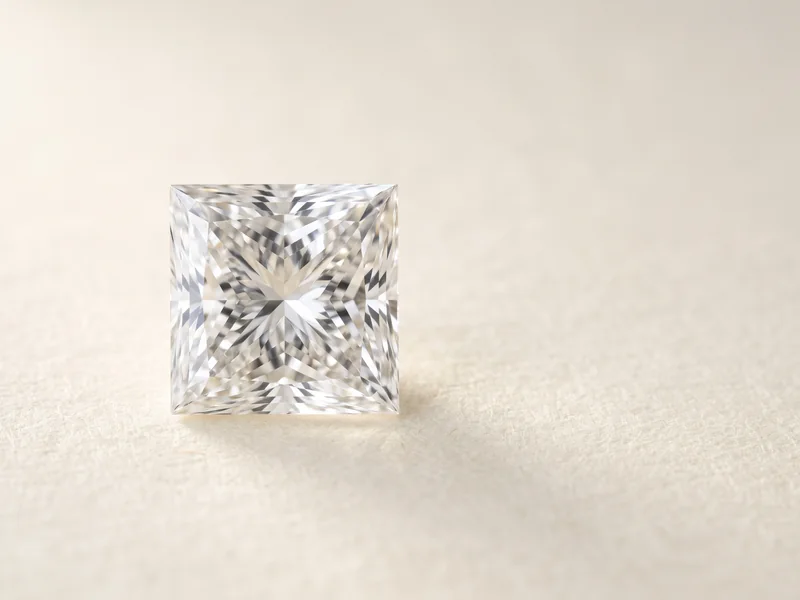
The thinking is the same as protecting a princess cut's corners, just multiplied: five points instead of four, plus five notches that should not take pressure from a claw. A good setter seats the stone so no claw pushes into a notch.
A star's lower points can catch on a straight wedding band and leave an uneven gap. A contoured band, or a head set slightly higher, solves that. Micro-pavé and bead-set bands add sparkle without competing with the outline, and small trapezoid side stones can echo the star's straight edges either side of the centre.
How does a star compare with other geometric diamond shapes?
| Star | Round | Princess | Triangular | Pentagonal | Shield | |
|---|---|---|---|---|---|---|
| Outline | Five-pointed star | Circle | Square | Three-sided | Five-sided | Crest outline |
| Exposed points | 5 (fine) | None | 4 | 3 | 5 (blunt) | Several, varies |
| Inner notches | 5 | None | None | None | None | None |
| Typical ratio | about 0.95–1.05 | 1.00 | 1.00–1.05 | about 1.00 | about 1.00 | Varies |
| Everyday wear | Needs full protection | Very practical | Protect corners | Protect points | Fairly practical | Protect points |
| Availability | Rare, mostly small natural | Very common | Common | Fairly common | Uncommon | Uncommon |
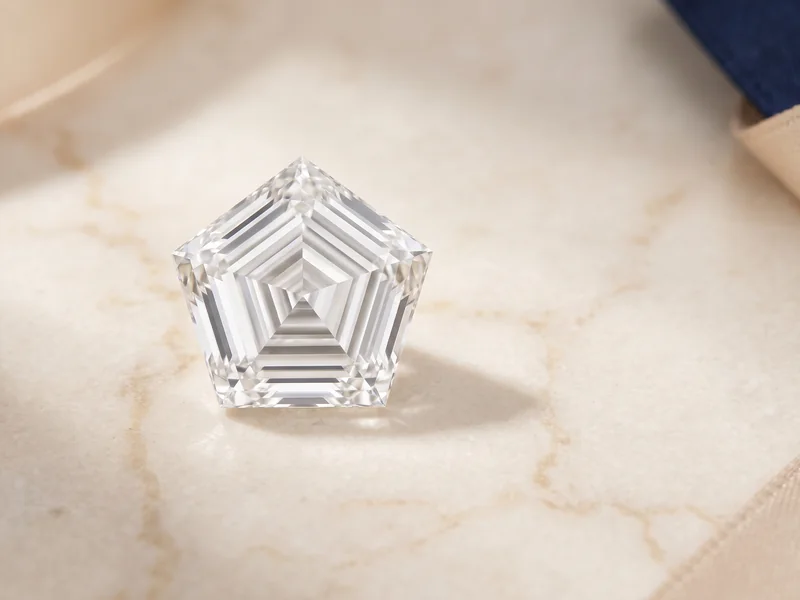
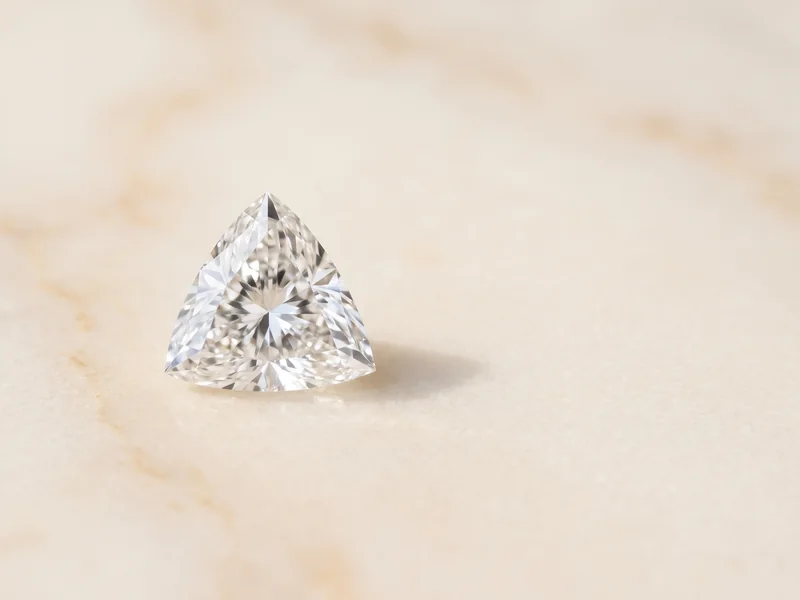
If you love the geometry of a star but want something tougher, the closest relative is the five-sided pentagon, which keeps the five-fold symmetry without the fragile arms. Our guides to triangular and trillion cuts, hexagonal diamonds and the crest-like shield cut cover the other angular options, and the eight-sided octagonal cut is a softer alternative with no sharp points.
For a more conventional square with crisp corners, read our princess cut guide. For something that moves and sparkles from every angle in an earring, a faceted briolette drop pairs well with small stars at the ear.
How much does a star cut diamond cost? Star diamond price in Australia
Stars are cut from both natural and laboratory-grown diamond, and the two look identical to the eye. Lab-grown diamonds are real diamond, grown in a laboratory rather than mined; they cost much less and are far easier to find as larger stars. Natural stars are rare above about half a carat. Both should come with an independent grading report from a lab such as GIA or IGI, which states whether the stone is natural or lab-grown.
| Star, G–H, VS | Approximate price range (AUD) |
|---|---|
| 0.30 ct lab-grown | about $300–$900 |
| 0.30 ct natural | about $800–$2,500 |
| 1 ct lab-grown | about $800–$3,000 |
| 1 ct natural | about $5,000–$15,000 |
These are broad ranges only. Because so few stars are sold, prices vary more than for common shapes, and they move with the market. What shifts the price most is carat, colour, clarity, how evenly the five arms are cut and whether any tip is chipped. Small natural stars are often priced near other fancy shapes per carat, but a well-matched natural star over 1 carat is uncommon and can carry a premium for rarity. A custom-cut star adds cutting cost on top.
Browse star cut diamonds: natural and lab-grown
How do you choose a star cut diamond? Step by step
- Read the report. Confirm the shape is listed as Star, and check the measurements, colour, clarity, polish, symmetry and whether the diamond is natural or lab-grown.
- Work out the ratio. Divide the height by the width; aim for about 0.95–1.05.
- Check all five arms. Equal length, even notches and a top point centred above the lower two.
- Inspect the tips and notches. Use the plotting diagram and a magnified video to rule out chips and feathers near any point.
- Watch a 360° video. Look for a bright centre with no fixed dark spot or glassy window.
- Decide on arm fullness. Fuller arms for a daily ring, sharper arms for earrings or a pendant.
- Plan the setting first. Make sure a bezel or five V-claws will cover every tip before you commit to the stone.
Free consultation
Talk to a gemologist
Compare stones in person or online with Raj Sood, Graduate Gemologist (GIA), AJP (GIA).
Book a consultationShop this shape
FAQ
Common questions
Are star cut diamonds good for engagement rings?
They can be, as long as the setting protects all five points. A full bezel or five V-claws, and a star with fuller arms, make a star cut diamond ring practical for everyday wear.
Do star shaped diamonds chip easily?
The five tips and five notches are the weakest areas, so a star is more exposed than a round. With a protective setting and no feathers near the points, chipping risk drops considerably.
What is the ideal star diamond ratio?
Most people prefer a length-to-width ratio between about 0.95 and 1.05. A regular five-pointed star is naturally slightly wider than it is tall, at about 0.95.
Are star cut diamonds expensive?
Small natural stars are often priced similarly to other fancy shapes per carat, but larger natural stars are rare and can cost more. Lab-grown star diamonds cost much less and are easier to find above 1 carat.
Can you get a lab-grown star diamond?
Yes. Lab-grown stars are much easier to find than natural ones, including in larger sizes and colours such as blue and pink, and are graded by labs such as IGI on the same colour and clarity scales used for natural diamonds.
Are star shaped diamond earrings a good choice?
Yes. Earrings take very few knocks, so even fine, sharp-pointed stars are fine there, and small stars of 0.10–0.25 carat each read clearly at the ear.

Ask a gemologist
Not sure which diamond to choose?
Raj Sood is a Graduate Gemologist (GIA) and master jeweller. Bring the stones you are considering, or send the reports, and he will tell you honestly which one is better and why.
Keep learning
Related guides
 Diamond ShapesRound Brilliant Family: Round, Star and Portuguese Cuts
 Diamond ShapesPentagonal Cut Diamonds
 Diamond ShapesTriangular Cut Diamonds
 Diamond ShapesPrincess-Cut Diamond Corner ProtectionDiamond ShapesUnderstanding Diamond Shapes
 Diamond ShapesAll 34 Diamond Cuts: Every Shape Explained and Compared
 Diamond ShapesRound Brilliant DiamondsDiamond ShapesPortuguese Cut Diamonds
Explore more
More guides on this topic
Education