
- Education
- Diamond Shapes
- Triangular Cut Diamond Guide: Facets, Proportions, Settings and Price
Diamond shapes
Triangular Cut Diamond Guide: Facets, Proportions, Settings and Price
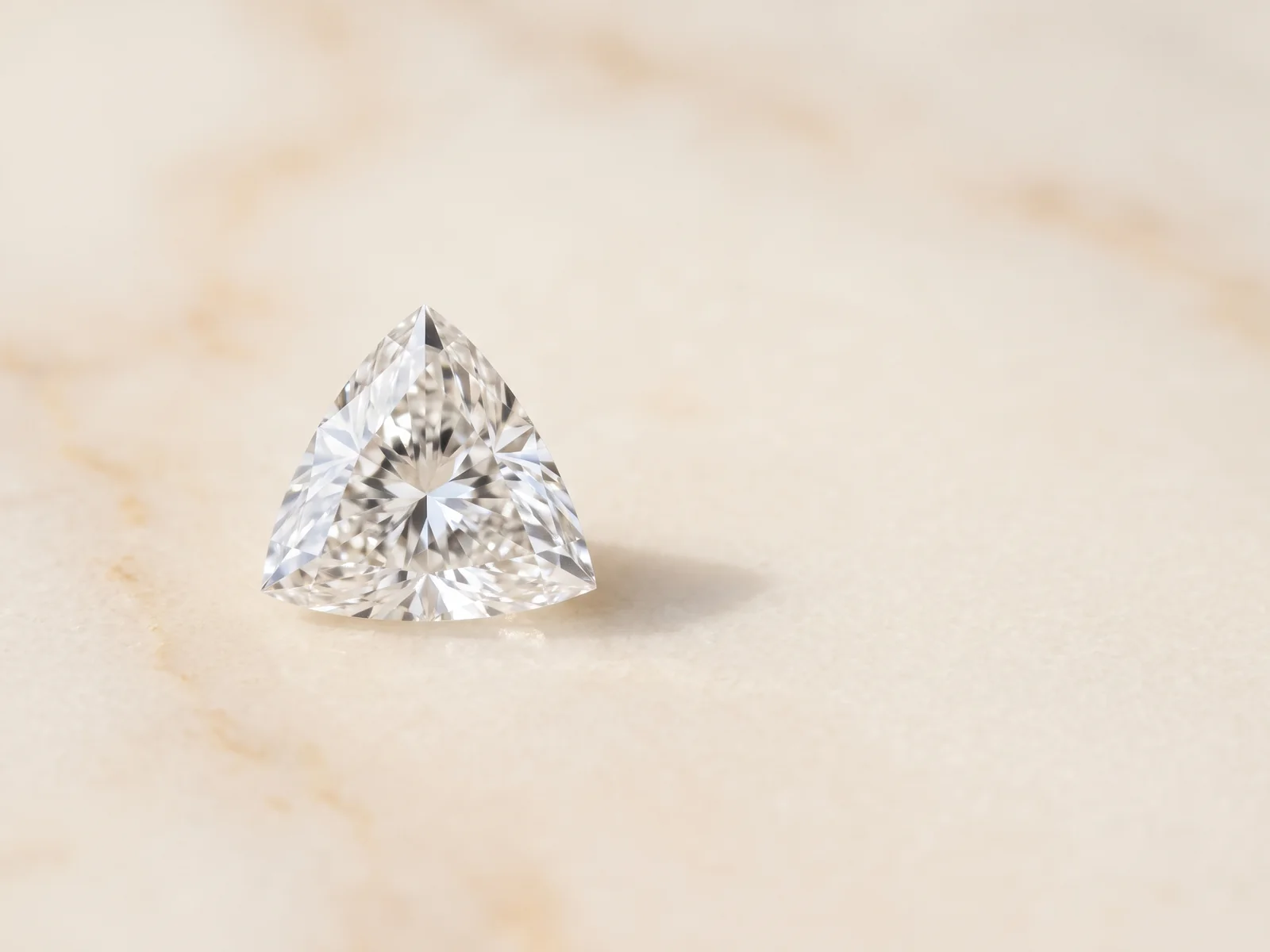
A triangular cut diamond is one of the boldest geometric shapes and one of the most useful side stones in jewellery. How it is faceted, proportioned and set decides whether it looks crisp and bright or flat and fragile.
 Reviewed by Raj Sood, Graduate Gemologist (GIA), AJP (GIA)Master jeweller and Graduate Gemologist (GIA) · reviewed 4 November 2026
Quick answer
A triangular cut diamond has a three-sided outline, cut either as a brilliant (often called a trillion or trilliant) for sparkle or as a step cut for clean, mirror-like lines. Look for equal sides, even corners, a depth that avoids a see-through window, and a setting with V-claws or a bezel protecting all three points.
What is a triangular cut diamond?
A triangular cut diamond is any diamond with a three-sided outline when you look at it from above (face-up). It is not one single cut but a small family: brilliant-cut triangles, usually sold as trillion or trilliant cuts; triangular step cuts, with straight rows of facets running parallel to the edges; and the occasional triangular rose cut, with a domed, faceted top and a flat base. They all share the same geometry: three sides, three corners and no curves to soften them.
Triangles have a long link with diamond rough. Some diamond crystals grow as macles: flat, triangular twinned crystals. Cutting a macle into a triangle keeps far more of its weight than forcing it into a round, which is one reason triangular cuts have stayed in use for centuries. The modern brilliant version was popularised in the 1960s, when a New York firm, the Henry Meyer Diamond Company, registered the name Trillion. Today trillion, trilliant and trillian are used loosely for the same kind of stone.
Diamond is 10 on the Mohs hardness scale and has a refractive index of about 2.42, which is what gives brilliant cuts their strong sparkle. Hardness is not the same as toughness, though. The three corners of a triangle are its thinnest, most exposed parts, and a sharp knock on a corner can chip it along a cleavage plane (a direction in the crystal where it splits more easily). Much of the advice below comes back to protecting those corners.
The triangle belongs to the wider family of geometric cuts alongside shields, kites and hexagons. For context on how it fits with rounds, ovals and the rest, see our overview of how diamond shapes differ or every one of the 34 diamond cuts compared. Any unfamiliar term here is also explained in our plain-English jewellery glossary.
How is a triangular diamond faceted: brilliant, step or rose?
The faceting style changes the look of a triangle more than almost any other shape, because a triangle has so little room for light to travel. Here is how the three styles compare:
| Style | Typical facets | Look | Hides inclusions? | Usual use |
|---|---|---|---|---|
| Brilliant (trillion or trilliant) | about 31–50 | Bright, scattered sparkle | Well | Centre stones, studs, side stones |
| Triangular step cut | roughly 10–25, in parallel rows | Clean, mirror-like flashes | Poorly; shows inclusions and colour | Side stones in Art Deco and modern rings |
| Triangular rose cut | roughly 9–24 on a domed top, flat base | Soft, glassy glow | Moderately | Antique-style and stacking rings |
Brilliant triangles come in two outlines. Curved (convex) sides bulge slightly outward, which carries a little more weight, improves brilliance and gives a softer look; they suit centre stones and studs. Straight (uncurved) sides sit flush against another stone, so they are the usual choice for triangle side stones beside a round, oval or square princess cut centre. Where a triangle has to sit against a curved centre stone, some are cut with one slightly concave side to fit snugly, so check the shape suits the stone it will sit beside.
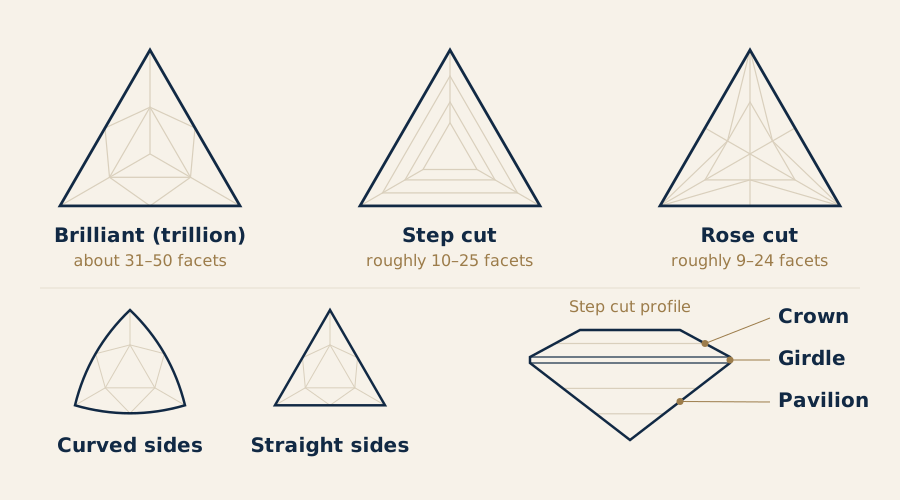
A triangular step cut diamond works like a tiny emerald cut: long, flat facets act as mirrors, so it gives broad flashes of light rather than sparkle. That makes it elegant beside a step-cut centre, but it is far less forgiving of colour and inclusions, because there is nothing busy for them to hide behind. If you are leaning towards the brilliant version, our detailed trilliant cut diamond guide covers its facet pattern and proportions in more depth. Triangular facets also appear inside other cuts: the six-pointed star cut is effectively built from triangles radiating out from a centre.
Related guideTrilliant Cut DiamondsWhat are the ideal proportions for a triangular cut diamond?
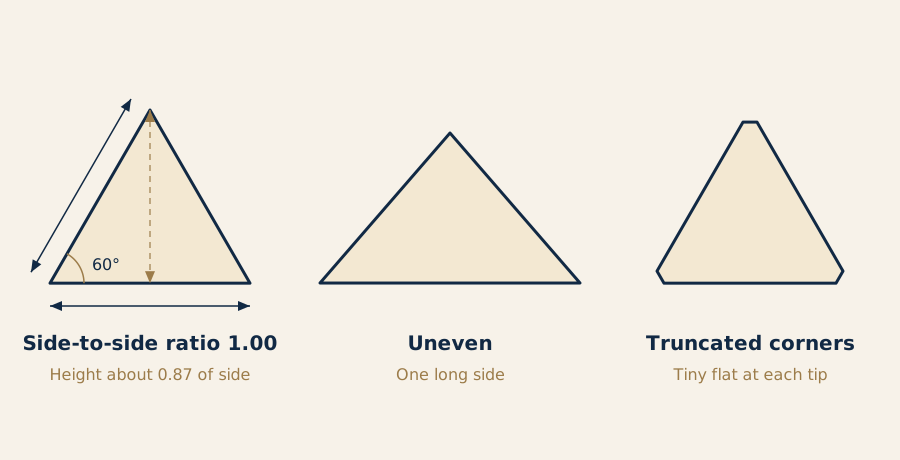
Most people want an equilateral triangle: all three sides the same length and all three corners at 60°. The length-to-width ratio compares the two main measurements on the grading report. Measured side to side, an equilateral triangle has a ratio of 1.00. Some reports instead give one side and the height (from a corner to the opposite side); because the height of an equilateral triangle is about 0.87 of its side, the same stone then shows a ratio of about 1.15. Check how the stone was measured before you judge its outline.
| Measurement | What to look for | Why it matters |
|---|---|---|
| Side-to-side ratio | about 1.00–1.05 | Equal sides read as a true triangle; uneven sides look lopsided |
| Total depth | roughly 35–50% of the width | Too shallow shows a window; too deep looks small and dark |
| Girdle at the corners | Thin to slightly thick, not extremely thin | A knife-edge corner chips easily |
| Corner tips | Crisp or very slightly truncated | A tiny flat at each tip resists chipping |
| Polish and symmetry | Very Good or Excellent | Uneven facets are easy to see in a simple outline |
Triangles are often cut shallow because the flat macle rough they come from is shallow to begin with. That keeps weight and spread, but if the pavilion (the lower half) is too flat, light passes straight through the middle and you see a window: a glassy, see-through patch where the stone should be bright. Hold a printed page under the stone or watch a 360° video against a patterned background; a window shows up as a pale area where you can read through the diamond.
GIA does not give triangles an overall cut grade the way it does for round brilliants, so proportions, polish, symmetry and your own eye are what you have to go on. Treat the numbers above as a starting point, not a rule: two stones with the same depth can look quite different depending on the facet angles.
How big does a triangular diamond look for its carat weight?
Because triangles are wide and usually shallow, their longest measurement is larger than the diameter of a round of the same weight. A 1 carat round is about 6.4–6.5 mm across, while a 1 carat brilliant triangle is often around 8 mm on each side. That long edge makes a triangle look large at a glance, but its actual face-up area is similar to, or a little smaller than, the round, because the corners taper away.
| Carat weight | Typical side length (brilliant triangle) |
|---|---|
| 0.10 ct | about 3.7 mm |
| 0.25 ct | about 5.0 mm |
| 0.50 ct | about 6.3 mm |
| 0.75 ct | about 7.3 mm |
| 1.00 ct | about 8.0 mm |
| 1.50 ct | about 9.2 mm |
| 2.00 ct | about 10.1 mm |
These are typical figures only; a deeper stone carries more weight underneath and looks smaller face-up, and step-cut triangles are often a touch smaller per carat than brilliants. For triangle side stones beside a 1 carat centre, most pairs sit somewhere between 0.15 and 0.35 carat each, which works out at roughly 4–5.5 mm a side. The aim is for each side stone to be about two-thirds to three-quarters the width of the centre, so it frames rather than competes.
If you like a pointed geometric shape but want more length on the finger, the elongated four-sided kite cut gives a similar crispness with a slimmer outline.
Not sure which one is right?
Send us the stones you are looking at and our gemologist will tell you which to choose and why.
What colour and clarity should a triangular diamond have?
In a triangle, body colour tends to gather in the corners, where the stone is thinnest and the facets converge. A brilliant triangle masks this reasonably well; a step cut shows it more. For a triangle diamond engagement ring with a triangular centre in white gold or platinum, most people are happy at H colour or better. In yellow or rose gold, I or J can look white, because the warm metal tints everything around it.
For clarity, aim for eye-clean, meaning no inclusions (internal features) you can see without magnification at a normal viewing distance. In a brilliant triangle that is usually VS2 or a well-chosen SI1. In a step-cut triangle, where the long open facets act like windows into the stone, VS1 or better is safer. Wherever you land, look closely at the corners: a feather (a small internal crack) that reaches the surface near a tip weakens the most exposed part of the stone.
- Brilliant centre, white metal: G–H colour, VS2–SI1 eye-clean.
- Brilliant centre, yellow or rose gold: I–J colour, VS2–SI1 eye-clean.
- Step-cut triangle: one grade higher in colour and VS1 or better in clarity.
- Triangle side stones: within one colour grade of the centre and eye-clean, so they do not look warmer or greyer beside it.
- Avoid: feathers or chips at a corner, and any windowing you can see face-up.
What is the best setting for a triangle diamond ring?
With three exposed corners, the setting's first job is protection. The usual options:
- Three V-claws: a V-shaped claw wrapped around each corner. This is the classic choice for a triangular centre stone and leaves the sides open to light.
- Bezel or half-bezel: a thin rim of metal around the edge. Very secure and suits a modern, architectural look, though it hides a little of the outline.
- Three-stone ring: a pair of triangle side stones, points facing outward, either side of a round, oval, cushion or emerald cut centre. Each outer corner still needs a claw.
- Toi et moi: a triangle paired with a second shape, such as a pear or oval, set side by side.
- Studs and pendants: triangles make neat studs, and in a pendant a point-down triangle hangs naturally. For a softer drop earring, a faceted briolette drop is the traditional alternative.
Triangles are not the only option for side stones. Trapezoid side stones give a wider, flatter shoulder, half moon side stones wrap the curve of a round or oval centre, and slim bullet cuts point towards the centre with a more pointed look. Triangles sit in between: bolder than bullets, more angular than half moons.
Plan the wedding band at the same time. Triangle side stones widen the ring at the shoulders, so a straight band can leave a gap or catch on a corner. Contoured (curved) bands, notched bands or a centre setting raised high enough for a straight band to slide underneath are the common solutions. Try the two rings together, or ask for a CAD render, before the stones are set.
How does a triangle compare with shield, kite and other geometric cuts?
| Triangle | Shield | Kite | Trapezoid | Half moon | |
|---|---|---|---|---|---|
| Outline | Three sides, three corners | Flat top, angled sides, point | Four sides, two long, two short | Four sides, one pair parallel | One straight side, one curve |
| Common faceting | Brilliant or step | Step or brilliant | Step or brilliant | Mostly step | Step or brilliant |
| Exposed corners | Three | One sharp point, plus top corners | One or two sharp points | Four, all fairly wide | Two |
| Typical role | Centre or side stones | Centre or side stones | Centre, toi et moi | Side stones | Side stones |
| Price per carat vs round | Usually lower | Usually lower | Usually lower | Usually lower | Usually lower |
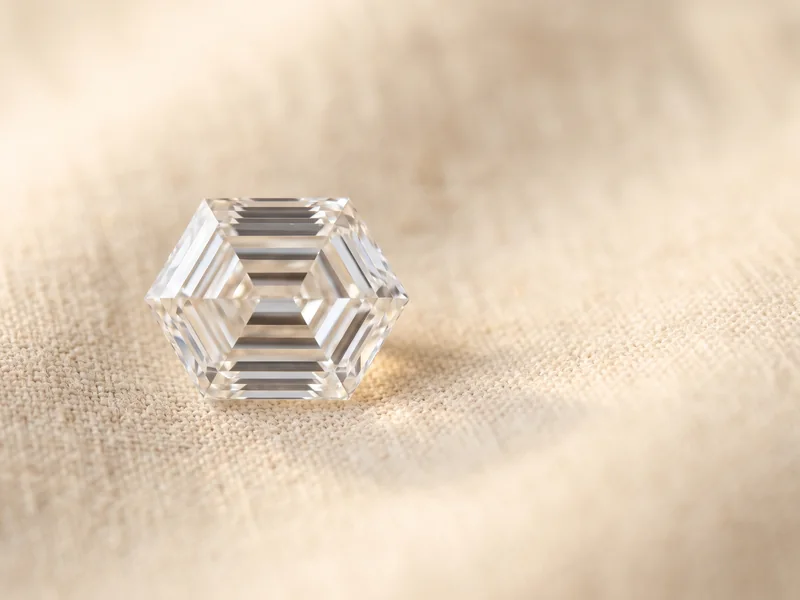
Of these, the closest relative is the shield: a triangle with its top corners clipped and a flat top edge. See our guide to shield cut diamonds if you want a similar outline with fewer sharp corners. Adding sides softens the look further, from the five-sided pentagonal cut to the hexagonal cut and the eight-sided octagonal cut.
Other geometric shapes worth knowing are the long, rhombus-shaped lozenge cut, the shield-like calf's head cut with its pointed base, and the Flanders cut with its clipped square corners. All of them, like the triangle, are usually cut to order or in small numbers, so supply is thinner than for rounds and ovals.
How much does a triangular cut diamond cost in Australia?
Triangles are cut from both natural and laboratory-grown diamond, and the two look identical to the eye. Lab-grown diamonds are real diamond, grown in a laboratory rather than mined; they cost much less, and a lab-grown triangle diamond is easier to find in matched pairs and larger sizes. Natural triangles are scarcer, especially well-matched pairs. Either way, a centre stone should come with an independent grading report from a lab such as GIA or IGI.
| Stone | Approximate price range (AUD) |
|---|---|
| Lab-grown, 1 ct, G–H, VS | about $1,000–$3,000 |
| Natural, 1 ct, G–H, VS | about $5,000–$12,000 |
| Lab-grown matched pair, 0.50 ct total | about $400–$1,200 |
| Natural matched pair, 0.50 ct total | about $1,500–$4,000 |
These are broad ranges only; prices move with the market and the exact grades. A triangle usually costs less per carat than a round of the same weight, colour and clarity, partly because demand is lower and partly because flat macle rough suits the shape. Matched pairs carry a premium over two unmatched stones, because the cutter has to match size, colour, clarity and outline. When you compare triangular diamond prices in Australia, compare the millimetre measurements and the report grades, not just the carat weight.
Shop triangular cut diamonds: natural and lab-grown
How do you choose a triangular cut diamond? Step by step
- Decide the role. Centre stone, side stones or studs: this decides curved or straight sides and brilliant or step faceting.
- Read the report. Confirm the shape, measurements, colour, clarity, polish and symmetry, and whether the diamond is natural or lab-grown.
- Check the outline. Work out the ratio from the measurements and check the three sides look equal by eye.
- Look for a window. Watch a 360° video against a patterned background; a pale see-through centre means the stone is too shallow.
- Inspect the corners. Look for chips, feathers or a knife-thin girdle at each tip.
- Match pairs carefully. For side stones, compare side lengths, colour and clarity of both stones together.
- Plan the setting and band. Make sure every exposed corner has a V-claw or bezel, and check how a wedding band will sit before setting.
Free consultation
Talk to a gemologist
Compare stones in person or online with Raj Sood, Graduate Gemologist (GIA), AJP (GIA).
Book a consultationShop this shape
FAQ
Common questions
Is a trillion the same as a triangular cut diamond?
A trillion, or trilliant, is the brilliant-cut version of a triangular diamond. Triangular diamonds can also be step cut or rose cut, which look quite different.
Are triangular diamonds good for engagement rings?
Yes, as long as all three corners are protected by V-claws or a bezel. A brilliant triangle of 0.75 carat or more makes a distinctive centre stone, and smaller triangles are a popular choice as side stones.
Do triangle diamonds chip easily?
The corners are the thinnest part, so they are more exposed than the edge of a round. In a protective setting a triangle is fine for everyday wear, but check the report and video for feathers near the tips.
Do triangular diamonds look bigger than round diamonds?
Their longest edge is longer than a round's diameter at the same weight, so they can look larger at a glance. The actual face-up area is similar or slightly smaller because the corners taper.
Are triangle diamonds cheaper than round diamonds?
Usually yes, per carat, at the same colour and clarity. Well-matched pairs of side stones cost more than two unmatched triangles.
Can you get lab-grown triangle diamonds?
Yes. Lab-grown triangles are widely available as centre stones and matched pairs, cost much less than natural triangles and come with reports from labs such as IGI and GIA.
Terms in this guide

Ask a gemologist
Not sure which diamond to choose?
Raj Sood is a Graduate Gemologist (GIA) and master jeweller. Bring the stones you are considering, or send the reports, and he will tell you honestly which one is better and why.
Keep learning
Related guides
 Diamond ShapesTrilliant Cut Diamonds
 Diamond ShapesGeometric Diamond Cuts: Shield, Kite, Hexagon, Pentagon and MoreDiamond ShapesShield Cut Diamonds
 Diamond ShapesHalf Moon Cut DiamondsDiamond ShapesUnderstanding Diamond Shapes
 Diamond ShapesAll 34 Diamond Cuts: Every Shape Explained and Compared
 Diamond ShapesKite Cut Diamonds
 Diamond ShapesHexagonal Cut Diamonds
Explore more
More guides on this topic
Education