
- Education
- Diamond Shapes
- Lozenge Cut Diamond Guide: Shape, Ratio, Settings and Price
Diamond shapes
Lozenge Cut Diamond Guide: Shape, Ratio, Settings and Price
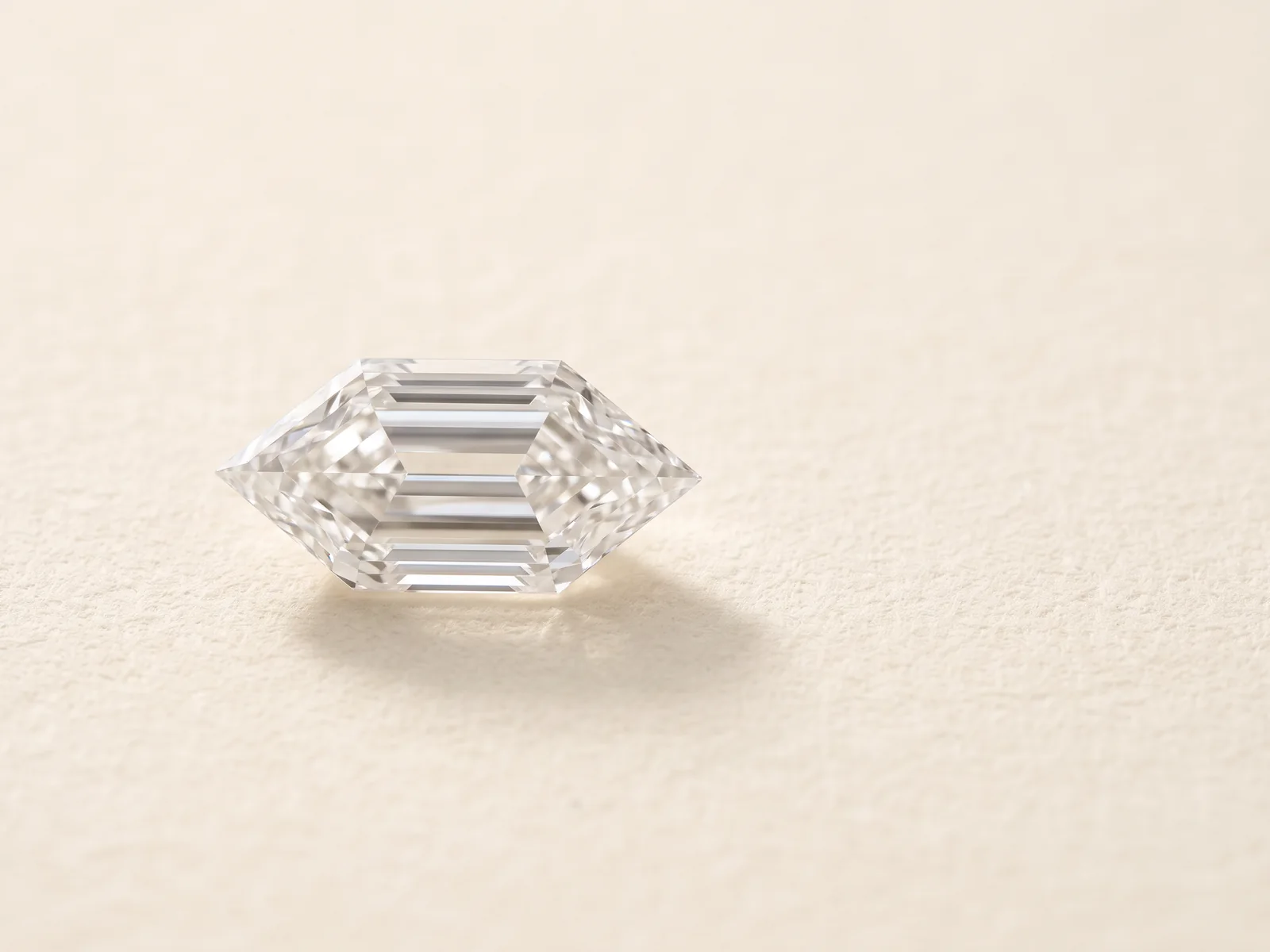
The lozenge cut diamond is one of the rarest outlines you can choose: a crisp rhombus with two sharp points. Here is how it is faceted, what ratio to look for and how to set it so those points stay safe.
 Reviewed by Raj Sood, Graduate Gemologist (GIA), AJP (GIA)Master jeweller and Graduate Gemologist (GIA) · reviewed 4 November 2026
Quick answer
A lozenge cut diamond has a rhombus outline: four equal-length sides with two sharp points and two wider corners, usually step cut like a baguette. Look for a length-to-width ratio of about 1.40–2.00, VS2 or better clarity, G–H colour in white metal, and claws or a bezel that protect both sharp points. Most are used as side stones.
What is a lozenge cut diamond?
A lozenge cut diamond has a rhombus outline: four straight sides of equal length, with two opposite corners that are sharp and two that are wider. Picture the diamond symbol on a playing card and you have it. Some jewellers call it a rhombus cut diamond or simply a lozenge shaped diamond. It belongs to the family of geometric diamond cuts alongside shields, kites and hexagons, and it is one of the rarer outlines in our guide to all 34 diamond cuts explained and compared.
The shape is not new. Flat, lozenge-shaped table cut and rose cut diamonds appear in older Indian and European jewellery, and Art Deco jewellers of the 1920s and 1930s used small lozenges, cut to exact sizes, to build geometric patterns in brooches, bracelets and rings. Today most lozenges are cut as side stones or accents, though larger ones are made as centre stones for people who want an outline very few others wear.
Diamond is 10 on the Mohs hardness scale, with a refractive index of about 2.42. Hardness is resistance to scratching, though, not to knocks. Diamond can still chip along its cleavage planes (natural planes of weakness in the crystal) if a thin edge is hit, and a lozenge has two thin, sharp points. Much of the advice below is about protecting them. If any term here is new to you, our plain-English jewellery glossary explains it.
How is a lozenge cut diamond faceted?
The outline tells you the shape; the facets tell you how it will behave in light. Lozenges are cut in three main styles:
- Step cut: the most common. Long, flat facets run parallel to the four edges, stepping down like stairs, much like a step-cut baguette diamond. A lozenge step cut diamond gives broad, clean flashes of light, often called the hall-of-mirrors effect, rather than fine sparkle. Facet counts vary with the number of steps, commonly somewhere around 25–40.
- Brilliant cut: triangular and kite-shaped facets, as on a round brilliant, arranged inside the rhombus outline. More sparkle and better at hiding small inclusions, but less common.
- Rose cut: a flat base with a low dome of triangular facets on top. Seen mostly in antique and antique-style pieces; our comparison of rose cut and brilliant cut faceting explains how the two handle light.
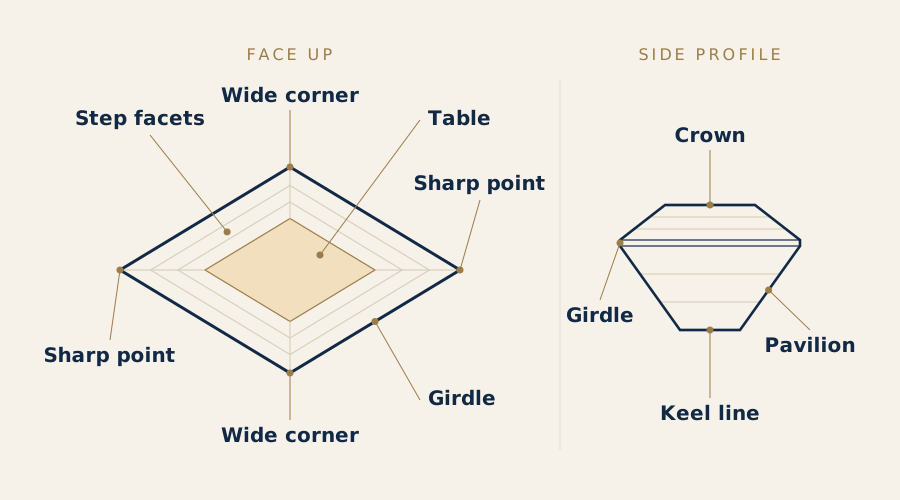
Seen from the side, a lozenge has the usual crown (top section), girdle (the thin outer edge) and pavilion (the lower section). On a step-cut lozenge the pavilion facets often meet in a short ridge called a keel line rather than a single point. The table, the large flat facet on top, is usually a smaller rhombus that mirrors the outline.
What is the ideal length-to-width ratio for a lozenge cut diamond?
The length-to-width ratio compares the distance from point to point with the distance across the two wider corners. Divide the length by the width on the grading report. The ratio also sets the angle at the sharp points, which matters for both looks and durability: the higher the ratio, the sharper (and more fragile) the points.
| Ratio | Angle at sharp points | How it looks | Suits |
|---|---|---|---|
| 1.00–1.20 | about 90–80° | Nearly a square turned on its corner | Geometric designs; reads almost as a square |
| 1.20–1.40 | about 80–71° | Soft, broad lozenge | Side stones beside a round or oval |
| 1.40–2.00 | about 71–53° | The classic elongated lozenge | Most centre stones and side stones |
| Above 2.00 | under 53° | Very slim, needle-like points | Accent work; points are the most fragile |
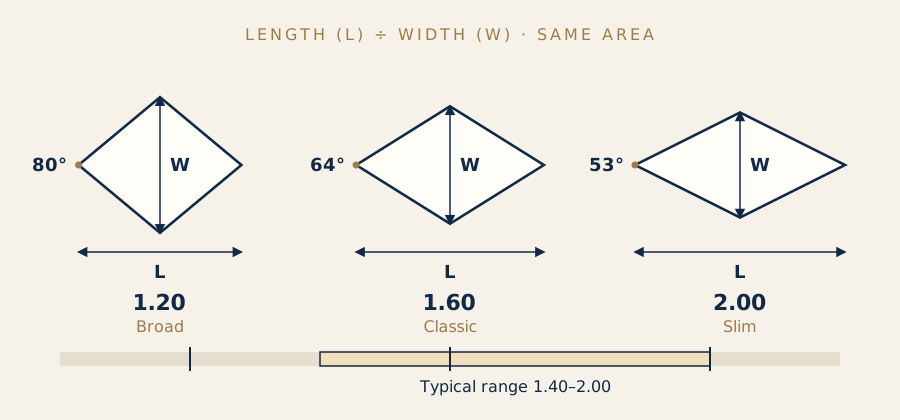
At a ratio of exactly 1.00 the shape stops being a lozenge in the usual sense and becomes a square set on its corner, the same outline as a princess cut turned on its point. Most people who choose a lozenge want the elongated look, so 1.40–2.00 is where most stones sit.
GIA does not give fancy shapes like the lozenge an overall cut grade, so judge the stone from its polish, symmetry and how it looks. As a rough guide, many step-cut lozenges sit at a total depth of about 60–72% of the width. A stone cut too shallow can show a window: a washed-out, see-through patch in the middle where light passes straight through instead of reflecting back. Too deep and the stone looks small for its weight and can go dark at the points.
How big is a lozenge cut diamond in millimetres?
A rhombus covers only half the area of the rectangle that would fit around it, so a lozenge looks long for its carat weight but less solid than a baguette of the same length and width. Here are rough face-up sizes for a step-cut lozenge at a ratio of about 1.65:
| Carat weight | Approximate size (length × width) |
|---|---|
| 0.10 ct | about 4.5 × 2.7 mm |
| 0.25 ct | about 6.5 × 4.0 mm |
| 0.50 ct | about 8.0 × 5.0 mm |
| 1.00 ct | about 10.0 × 6.0 mm |
| 1.50 ct | about 11.5 × 7.0 mm |
These are estimates only, because depth varies a lot between cutters. Always compare the millimetre measurements on the report rather than carat weight alone. Lozenge side stones usually run from about 0.10 to 0.30 carat each and are often calibrated, meaning cut to exact standard sizes so pairs match. Our guide to side stone shapes and how to pair them covers how side stones are sized against a centre diamond.
Not sure which one is right?
Send us the stones you are looking at and our gemologist will tell you which to choose and why.
What colour and clarity should you choose for a lozenge?
Step cuts are honest. Their long, open facets give you a clear view into the diamond, so inclusions (internal features) and body colour both show more than in a brilliant cut. In a lozenge, colour also tends to gather at the two sharp points, where the stone is thinnest and light bounces between closely angled facets.
- White gold or platinum: G–H colour for most people; F or better if you are sensitive to a warm tint.
- Yellow or rose gold: I–J can look white, because the metal warms everything around it.
- Clarity, step cut: VS2 or better for an eye-clean stone (no inclusions visible without magnification at normal distance).
- Clarity, brilliant cut: a carefully chosen SI1 can work, as the busier facets hide more.
- Avoid: feathers (small internal cracks) at or near the sharp points, where they can weaken the stone.
- Pairs: side stones should match the centre within about one colour grade.
What is the best setting for a lozenge cut diamond?
The two sharp points are the weak spots, so a good setting covers them first. The usual choices for a lozenge diamond ring:
- Four claws with V-claws: a V-claw (a V-shaped claw) wraps each sharp point, while simple claws hold the two wider corners.
- Bezel: a thin rim of metal around the whole edge. The most secure option, with a clean, modern look.
- Half-bezel: metal covers the two points and leaves the long sides open to light.
- East-west: the lozenge set sideways across the finger, which keeps the points away from the wedding band, though they then face the neighbouring fingers.
- As side stones: lozenge side stones flank a round, oval or emerald centre, points facing outwards or towards the centre, in the way trapezoid side diamonds, half moon side stones and triangular trilliant cuts are used.
- Geometric clusters: small lozenges combined with bullet cuts and baguettes in Art Deco style patterns.
Which wedding band suits a lozenge diamond ring?
A lozenge set north-south (pointing along the finger) has a point that reaches towards the wedding band. If the head sits low, a straight band will touch the claw and can rub against it over time. There are three common ways around this:
- Raise the setting slightly so a straight band slides underneath the point.
- Contoured or notched band: shaped to curve around the point so the two rings sit flush.
- Set the lozenge east-west: the wide corners face the band instead, and a straight band sits neatly beside it.
Lozenges also work in the band itself. A row of small lozenges set point to point creates a zigzag eternity look, and alternating lozenges with round brilliants gives a band with more sparkle between the flashes.
How does a lozenge compare with kite, shield, baguette and princess diamonds?
| Lozenge | Kite | Shield | Baguette | Princess | |
|---|---|---|---|---|---|
| Outline | Rhombus, four equal sides | Four sides, two pairs of unequal length | Flat top tapering to a point | Long rectangle | Square |
| Lines of symmetry | Two | One | One | Two | Four |
| Usual faceting | Step, sometimes brilliant | Step or brilliant | Step or brilliant | Step | Brilliant |
| Sharp points | Two | One or two | Usually one | None | Four 90° corners |
| Typical use | Side stones, some centres | Side stones, unusual centres | Side stones | Side stones, bands | Centre stones |
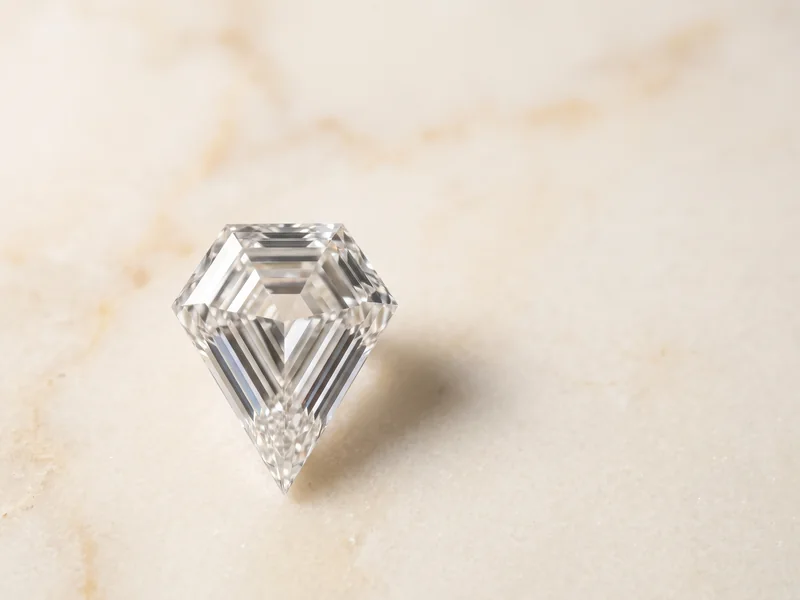
The lozenge vs kite diamond question comes up most. A lozenge is symmetrical both ways, with its widest point exactly in the middle. A kite has its widest point closer to one end, so one point is long and one is short; see our kite cut diamond guide for the details. The shield cut has a flatter top edge and suits pairs beside a centre stone.
If you like straight edges but want no sharp points at all, the six-sided hexagonal cut and the eight-sided octagonal cut spread the angles out and are tougher at the corners. To see every outline side by side, start with our overview of how diamond shapes differ.
How much does a lozenge cut diamond cost in Australia?
Lozenges are cut from both natural and laboratory-grown diamond, and the two look the same to the eye. Lab-grown diamonds are real diamond, grown in a laboratory rather than mined, with the same hardness and refractive index; they cost much less. Natural lozenges are rarer, and both should come with an independent grading report from a lab such as GIA or IGI.
| Lozenge, G–H, VS | Lab-grown (AUD, approx.) | Natural (AUD, approx.) |
|---|---|---|
| Matched pair, 2 × 0.25 ct | about $400–$1,000 | about $1,200–$3,000 |
| 0.50 ct single | about $400–$1,200 | about $1,500–$3,500 |
| 1.00 ct single | about $900–$2,500 | about $4,500–$10,000 |
These are broad ranges only, and prices move with the market and the exact grades. Per carat, a lozenge diamond usually costs less than a round of the same colour and clarity, because demand is lower. The catch is choice: few lozenges are cut, so finding one with the ratio, size and grades you want can take time, and well-matched pairs carry a premium for the matching work.
Browse lozenge cut diamonds: natural and lab-grown
How do you choose a lozenge cut diamond? Step by step
- Read the report. Confirm the shape, measurements, colour, clarity, polish and symmetry, and whether the diamond is natural or lab-grown.
- Work out the ratio. Divide length by width; about 1.40–2.00 gives the classic elongated lozenge.
- Check the points. Make sure both points are crisp and level, with no chips or feathers near the tips.
- Watch a video. Look for a window in the middle and for points that go dark as the stone turns.
- Compare millimetres. Judge face-up size from the length and width, not carat weight alone.
- Match any pairs. For side stones, check that length, width and colour line up closely.
- Plan the setting and band. Choose V-claws or a bezel for the points and decide on north-south or east-west before you commit.
Free consultation
Talk to a gemologist
Compare stones in person or online with Raj Sood, Graduate Gemologist (GIA), AJP (GIA).
Book a consultationShop this shape
FAQ
Common questions
What is a lozenge cut diamond?
It is a diamond with a rhombus outline: four equal sides, two sharp points and two wider corners. Most are step cut, like a baguette, and they are often used as side stones.
What is the difference between a lozenge and a kite cut diamond?
A lozenge is symmetrical both ways, with its widest part in the centre. A kite has its widest part closer to one end, so one point is noticeably longer than the other.
Are lozenge cut diamonds good for engagement rings?
Yes, as long as the two sharp points are protected by V-claws or a bezel. Choose at least about 0.50 carat for a centre stone so the outline reads clearly on the hand.
Do lozenge cut diamonds sparkle?
Step-cut lozenges give broad flashes of light rather than the fine sparkle of a round brilliant. Brilliant-cut lozenges exist and sparkle more, but they are harder to find.
Can you get a lab-grown lozenge diamond?
Yes. Lab-grown lozenges are available, though less widely than common shapes, and they cost much less than natural lozenges of the same size and grades.
Are lozenge diamonds more expensive than round diamonds?
Usually not per carat, because demand is lower. Matched pairs and stones with unusually even points can cost more than average lozenges.
Terms in this guide

Ask a gemologist
Not sure which diamond to choose?
Raj Sood is a Graduate Gemologist (GIA) and master jeweller. Bring the stones you are considering, or send the reports, and he will tell you honestly which one is better and why.
Keep learning
Related guides
 Diamond ShapesKite Cut Diamonds
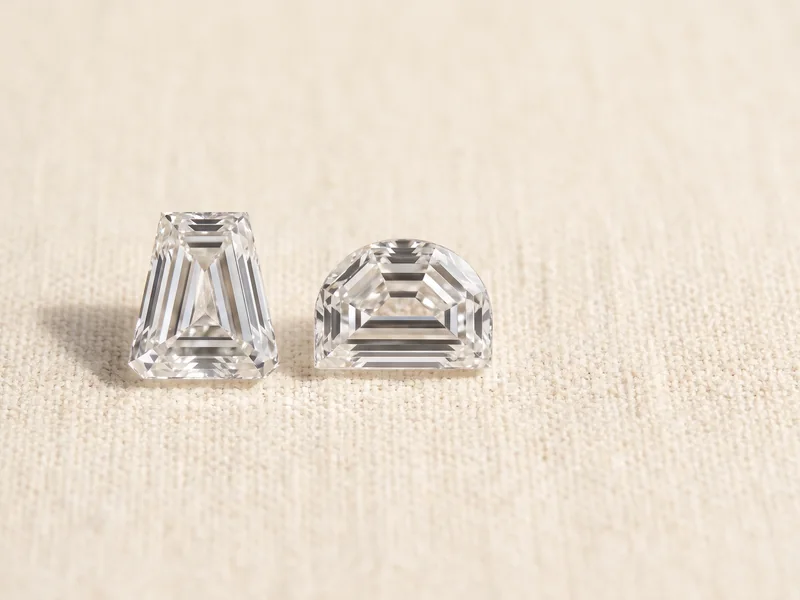 Diamond ShapesSide Stone Diamond Cuts: Trapezoid, Half Moon, Bullet, Baguette, Trilliant
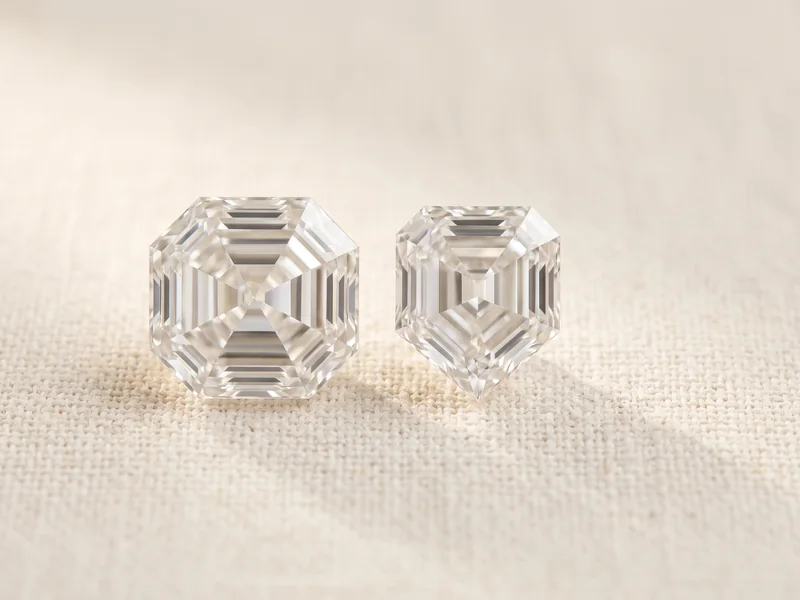 Diamond ShapesGeometric Diamond Cuts: Shield, Kite, Hexagon, Pentagon and More
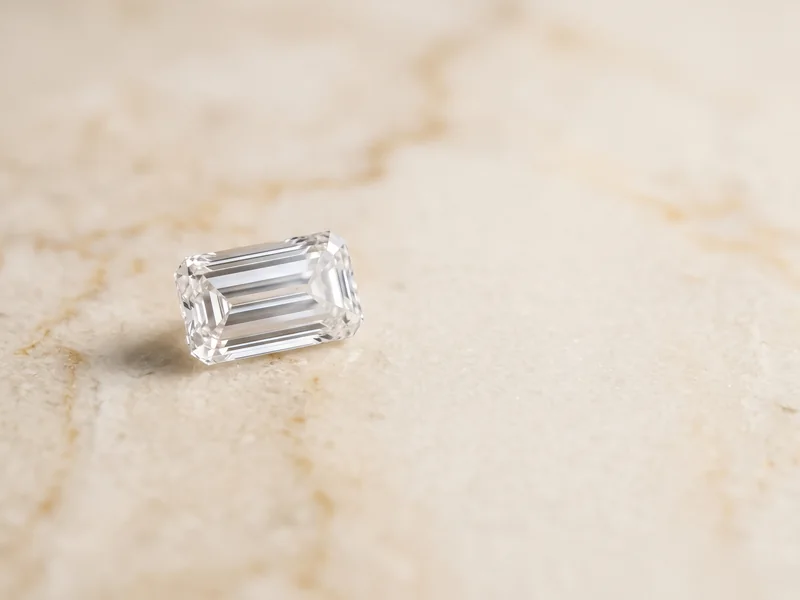 Diamond ShapesBaguette Cut DiamondsDiamond ShapesUnderstanding Diamond Shapes
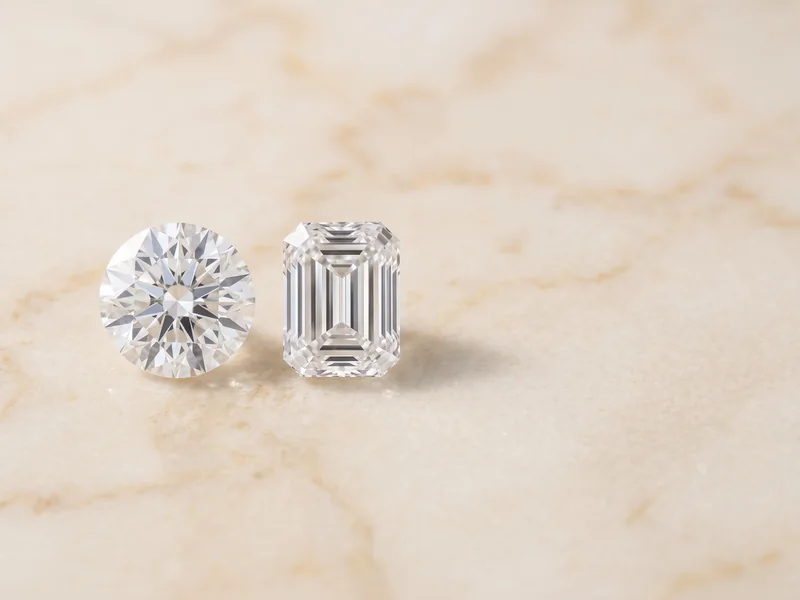 Diamond ShapesAll 34 Diamond Cuts: Every Shape Explained and Compared
 Diamond ShapesTrapezoid Cut Diamonds
 Diamond ShapesHalf Moon Cut Diamonds
Explore more
More guides on this topic
Education