
- Education
- Certificates & Valuations
- GIA vs IGI vs HRD: Diamond Certificates Compared
Certificates & Valuations
GIA vs IGI vs HRD: Diamond Certificates Compared
The lab name at the top of a diamond certificate changes how far you can trust the grades, and often the price. Here is how GIA vs IGI vs HRD compare for natural and lab-grown diamonds bought in Australia.
 Reviewed by Raj Sood, Graduate Gemologist (GIA), AJP (GIA)Master jeweller and Graduate Gemologist (GIA) · reviewed 4 November 2026
Quick answer
GIA, IGI and HRD are all independent labs that grade diamonds on the 4Cs. GIA is the reference standard for natural diamonds and is generally seen as the strictest. IGI grades most of the world's lab-grown diamonds and many natural ones. HRD, based in Antwerp, is respected in Europe but less common in Australia. None gives a value.
GIA vs IGI vs HRD: what is the difference?
All three are independent gemmological laboratories. A diamond is sent to them, they measure it, grade its colour and clarity (and cut, for round brilliants), record its weight to two decimal places and issue a report with a unique number. None of them sells diamonds, and none puts a dollar value on the stone. The real differences are their history, where they operate, how strictly they draw the line between grades, and how they handle laboratory-grown diamonds.
- GIA (Gemological Institute of America): a non-profit founded in 1931 that developed the 4Cs and the D-to-Z colour scale. It is the reference point for natural diamonds worldwide.
- IGI (International Gemological Institute): founded in Antwerp in 1975, now with labs across Asia, Europe and North America. It grades a large share of jewellery-trade natural diamonds and most lab-grown diamonds.
- HRD Antwerp: the grading lab linked to the Belgian diamond industry, issuing reports since 1973. Well regarded in Europe, but you will see it less often in Australian shops.
If reports are new to you, start with our overview of diamond certificates and jewellery reports, then come back here for the lab-by-lab detail. For labs beyond these three, see every major grading lab compared.
What does a diamond certificate actually tell you?
'Certificate' is the everyday word. The labs call them grading reports, because they record what the lab observed on the day it examined the stone; they do not certify value or promise anything about the future. A full report records:
- Shape and cutting style: for example, round brilliant or pear modified brilliant.
- Measurements: length × width × depth in millimetres, to 0.01 mm. This is the stone's fingerprint for matching it to the paper.
- Carat weight: to two decimal places (1 carat = 0.2 grams).
- Colour grade: D (colourless) to Z (light yellow or brown).
- Clarity grade: from Flawless down to I3, usually with a plotting diagram, a map of the inclusions (internal features) and blemishes (surface marks).
- Cut, polish and symmetry: an overall cut grade for round brilliants, and polish and symmetry grades for every shape.
- Fluorescence: whether the diamond glows under ultraviolet light, and how strongly.
- Proportions: table and depth percentages, crown and pavilion angles, girdle thickness and culet.
- Comments and inscription: treatments, growth method for lab-grown stones, and any number laser inscribed on the girdle (the thin outer edge).
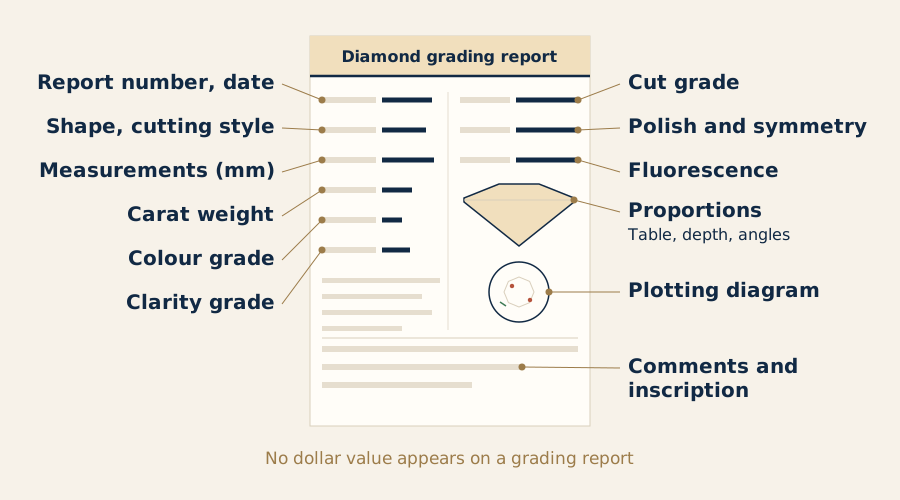
What a report does not tell you: the price, whether the stone in front of you is the one on the paper (unless you check the inscription or measurements), or anything about the ring it sits in. Our walk-through on reading a GIA grading report line by line takes each box in turn, and the jewellery glossary defines every term you will meet.
Who are GIA, IGI and HRD?
| Lab | Started | Based | Known for | How often you see it in Australia |
|---|---|---|---|---|
| GIA | 1931 | Carlsbad, California; labs in New York, Mumbai, Bangkok, Hong Kong and elsewhere | Developed the 4Cs; the benchmark for natural diamonds | Very common for natural diamonds from about 0.30 ct |
| IGI | 1975 | Founded in Antwerp; labs in India, Hong Kong, Thailand, the US, Belgium and more | The largest grader of lab-grown diamonds; also grades many natural stones | Very common, especially for lab-grown |
| HRD Antwerp | 1973 | Antwerp, Belgium | European grading tradition with its own terms | Less common; mostly stones traded through Antwerp |
GIA is a non-profit that also runs gemmology education. Raj Sood's Graduate Gemologist (GIA) diploma comes from that education arm, which is separate from the grading lab. IGI is a commercial, for-profit company, and HRD Antwerp is owned by the Antwerp World Diamond Centre. Ownership does not make one lab honest and another not, but it helps explain why each has a different focus.
Some labs, GIA included, also offer origin services for certain natural diamonds, tracing the rough to a source country. These are separate documents from a grading report and are not needed to buy, insure or value a diamond.
Is IGI as good as GIA, and where does HRD sit?
Colour and clarity grading is a trained judgement made against master stones and written criteria. Every reputable lab uses the same names (D, E, F… VVS1, VS2, SI1…), but the line between a G and an H, or a VS2 and an SI1, is drawn by people. A lab's reputation rests on where it draws those lines and how consistently it does so, stone after stone.
In the trade, GIA is treated as the benchmark for natural diamonds: if a GIA report says G VS2, dealers price it as a G VS2 without regrading it. IGI and HRD are established labs, but for natural diamonds many dealers consider their colour and clarity grades can sit about one grade softer than GIA on some stones, and they price with that in mind. That is a trade perception, not a rule. Plenty of IGI- and HRD-graded diamonds would receive identical grades at GIA.
For lab-grown diamonds the picture changes. IGI grades most lab-grown stones sold in Australia and has years of experience with CVD (chemical vapour deposition) and HPHT (high pressure, high temperature) material, so an IGI report is the normal document for a lab-grown diamond, not a second choice.
Our guides to the IGI natural diamond report and to how an HRD report is laid out show each lab's format box by box.
Not sure which one is right?
Send us the stones you are looking at and our gemologist will tell you which to choose and why.
How do GIA, IGI and HRD reports compare line by line?
| GIA | IGI | HRD | |
|---|---|---|---|
| Colour scale | D–Z | D–Z | D–Z, alongside descriptive terms such as 'Exceptional White' |
| Top clarity grade | FL (Flawless), then IF | FL, then IF | LC (Loupe Clean) |
| Overall cut grade | Round brilliants only, Excellent to Poor | Round brilliants; fancy shapes show polish and symmetry | Round brilliants, Excellent to Poor |
| Fluorescence terms | None, Faint, Medium, Strong, Very Strong | None, Faint, Medium, Strong, Very Strong | Nil, Slight, Medium, Strong |
| Plotting diagram | On full reports; not on the Dossier | On full reports | On full reports |
| Laser inscription | Optional on full reports; standard on the Dossier | Usually inscribed | Optional |
| Lab-grown diamonds | Described as Premium or Standard, not full 4C grades | Full colour, clarity and cut grades, growth method noted | Reports available |
| Online check | GIA Report Check | IGI Verify Your Report | HRD online report check |
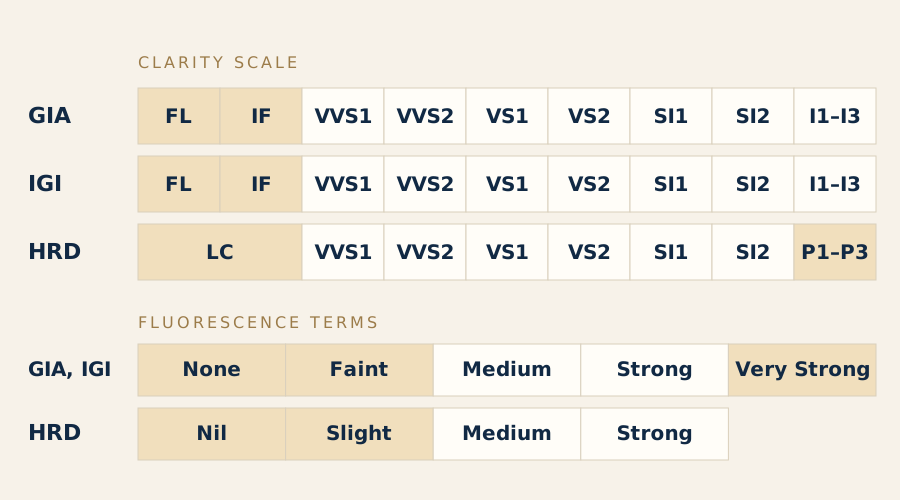
For pears, ovals, emeralds and other fancy shapes, no overall cut grade appears on a GIA report, so you rely on the proportions, polish, symmetry and your own eye. Our guide to judging cut in fancy shapes without a cut grade shows which numbers to look at.
GIA also issues a shorter Diamond Dossier for natural stones from 0.15 to 1.99 ct, with the report number laser inscribed on the girdle but no plotting diagram. The grades are applied to the same standard as the full report. See the GIA Dossier versus the full grading report for when each is used.
Which diamond certificate is best for a lab-grown diamond?
For most lab-grown diamonds in Australia the answer in practice is IGI. An IGI lab-grown report gives full colour, clarity and (for rounds) cut grades, states the growth method (CVD or HPHT), notes whether the stone has had post-growth treatment to improve its colour, and records a girdle inscription that usually begins with 'LG'. Our guide to reading an IGI report for a lab-grown diamond covers each field.
GIA has taken a different approach. Rather than full 4C grades, it now describes lab-grown diamonds as Premium or Standard based on their overall quality. That is useful as a quality floor but less precise when you are choosing between two stones. The details are in GIA's premium and standard lab-grown assessments.
Whichever lab is used, the report must state clearly that the diamond is laboratory-grown, and the girdle inscription should say so too. An inscription links a stone to a report number, but it can in principle be polished off or copied, so it is a check, not proof of identity on its own; what a laser inscription does and does not prove explains why.
Related guideDiamond Grading Labs ComparedDoes the grading lab change a diamond's price?
For natural diamonds, yes. Two stones with identical printed grades can be priced differently depending on the lab, and a GIA-graded natural diamond usually sits at the top of that range. The reason is confidence: the trade trusts that a GIA G is a G.
So if a natural diamond with an IGI or HRD report looks noticeably cheaper than a GIA stone with the same grades, it may simply be a GIA H, or a VS2 bordering SI1, priced fairly for what it really is. The discount is often the grade, not a bargain. That does not make it a poor choice; it means you should compare it with GIA stones a grade lower, not the same grade.
For lab-grown diamonds, the lab name matters far less to price. Size, colour, clarity and cut drive it, and lab-grown diamonds cost much less than natural diamonds of the same size and grades. Natural diamonds are rarer and priced for that rarity; neither type should be bought as an investment.
Very small diamonds, roughly under 0.30 ct, are often sold without a lab report because grading costs too much relative to the stone. Our guide to certified and uncertified diamonds explains when a report matters and when it does not.
Browse diamonds by grading lab
Is a diamond certificate the same as a valuation in Australia?
No, and confusing the two is the most common mistake we see. A grading report describes the diamond; a valuation puts an Australian dollar figure on the whole piece of jewellery for a stated purpose. Australian insurers usually ask for a valuation, not a GIA, IGI or HRD report, before they will cover a ring. Our guide to the difference between a valuation and a certificate goes further.
| Grading report (GIA, IGI, HRD) | Valuation | |
|---|---|---|
| Who issues it | An independent gemmological lab | A qualified valuer, usually a gemmologist |
| What it covers | The loose diamond only | The whole item: diamond, side stones, metal, making |
| Dollar figure | None | Yes, in AUD for a stated purpose |
| Main use | Proving the grades when buying or selling | Insurance, estates, family law, sale |
| Does it date? | Grades stay the same unless the stone is damaged | Yes; prices change, so it needs updating |
There are different kinds of valuation. An insurance valuation states the replacement value: what it would cost to replace the item with one of the same quality, usually including GST. Insurance valuations explained covers what your insurer needs to see. Estates, divorce settlements and sales use market value instead, which is normally lower; see valuations for estates and family law.
A careful valuer will quote the report number, check the inscription, re-measure and weigh the stone where it can be weighed, and note anything that differs from the report, such as a chip that happened after grading. Because prices move, especially for lab-grown diamonds and gold, it pays to know how often to revalue your jewellery; every two to three years is a common guide.
How to verify a diamond certificate: step by step
- Identify the lab and report type. Is it a full GIA report, a GIA Dossier, an IGI natural or lab-grown report, or an HRD report? Each tells you slightly different things.
- Check the number online. Enter it on the lab's own website and confirm every grade matches the paper or PDF you were given. Our guide shows how to verify a GIA report number; IGI and HRD have equivalent tools.
- Match the stone to the report. Compare the measurements (to 0.01 mm) and carat weight, then read the girdle inscription under a 10× loupe or microscope.
- Read the comments. Look for treatments, the growth method on a lab-grown stone, and notes about features not shown on the plot.
- Compare like with like. When weighing two natural diamonds from different labs, allow for grading differences rather than comparing grades at face value.
- Arrange a valuation once you own it. Keep the original report with the valuation and send both to your insurer.
Free consultation
Talk to a gemologist
Compare stones in person or online with Raj Sood, Graduate Gemologist (GIA), AJP (GIA).
Book a consultationFAQ
Common questions
Is IGI as good as GIA?
For lab-grown diamonds, IGI is the standard report and is entirely suitable. For natural diamonds, GIA is the trade benchmark and is generally seen as stricter, so IGI-graded natural stones are often priced a little below GIA stones with the same grades.
Is an HRD diamond certificate any good?
Yes. HRD Antwerp is an established European lab with its own grading terms, such as Loupe Clean for the top clarity grade. It is simply less common in Australia, so fewer local buyers and dealers are used to its reports.
Which diamond certificate is best in Australia?
For natural diamonds, GIA is the most widely recognised. For lab-grown diamonds, IGI is the most common and gives full 4C grades, while GIA now gives a Premium or Standard description instead.
Can I insure a diamond with just a GIA certificate?
Usually not. Australian insurers generally want a valuation that states a replacement value in AUD for the whole piece. The GIA report supports the valuation but does not replace it.
Can a diamond graded by IGI be regraded by GIA?
Yes. A loose diamond can be sent to another lab, which will issue its own report with its own number. The grades may match or differ by a grade, which is why some sellers submit natural stones to GIA.
Do lab reports expire?
No. The grades describe the stone and stay valid unless it is damaged or recut. A valuation, by contrast, should be updated every few years as prices change.

Ask a gemologist
Not sure which diamond to choose?
Raj Sood is a Graduate Gemologist (GIA) and master jeweller. Bring the stones you are considering, or send the reports, and he will tell you honestly which one is better and why.
Keep learning
Related guides
 Certificates & ValuationsHow to Read a GIA Diamond Report
 Certificates & ValuationsIGI Natural Diamond Report Explained
 Certificates & ValuationsHRD Diamond Report ExplainedCertificates & ValuationsJewellery and Diamond ValuationCertificates & ValuationsDiamond Certificates & Jewellery Reports
 Certificates & ValuationsGIA Diamond Dossier vs Diamond Grading ReportCertificates & ValuationsHow to Verify a GIA Report Number
 Lab-Grown DiamondsHow to Read an IGI Report for a Lab-Grown Diamond
Explore more
More guides on this topic
Education