
- Education
- Diamond Shapes
- Oval Diamond Hidden Weight: Why Some Ovals Look Smaller Than Their Carat
Diamond shapes
Oval Diamond Hidden Weight: Why Some Ovals Look Smaller Than Their Carat
Two oval diamonds can weigh exactly the same and still look different sizes on the hand. Hidden weight is the reason, and once you know where it sits, you can check for it on any grading report.
 Reviewed by Raj Sood, Graduate Gemologist (GIA), AJP (GIA)Master jeweller and Graduate Gemologist (GIA) · reviewed 4 November 2026
Quick answer
Hidden weight is carat weight an oval diamond carries where you cannot see it face-up: in a deep or bulging pavilion, a thick girdle or a tall crown. A 1 ct oval at 70% depth looks about like a 0.85 ct oval at 60%. Look for roughly 58–64% depth and a medium to slightly thick girdle.
What is hidden weight in an oval diamond?
Diamonds are priced by carat weight (one carat is 0.2 grams), but you never see the weight. You see the face-up size: the outline you look down on once the stone is set. Hidden weight is the part of a diamond's carat weight that sits below or around that outline, adding grams without adding visible size. Jewellers often talk about it the other way round, as spread: a well-spread diamond shows plenty of face-up area for its weight.
Every diamond shape can hide weight, but ovals are where it matters most for Australian buyers, because ovals are one of the most popular shapes for engagement rings and the cut varies a lot from stone to stone. Unlike a round brilliant, an oval has no overall cut grade from GIA, so a deep, heavy oval and a beautifully spread oval can carry very similar paperwork. If you are new to the shape, start with our complete oval diamond guide, then come back here for the detail.
To understand where weight can hide, it helps to know the basic parts of a cut diamond: the table (the large flat top facet), the crown (the sloping top section), the girdle (the thin outer edge where the stone is widest) and the pavilion (the cone-shaped lower half). Our overview of how every diamond shape is built shows these parts across all the main cuts, and the plain-English jewellery glossary defines each term if you need a refresher.
Where does an oval diamond hide its weight?
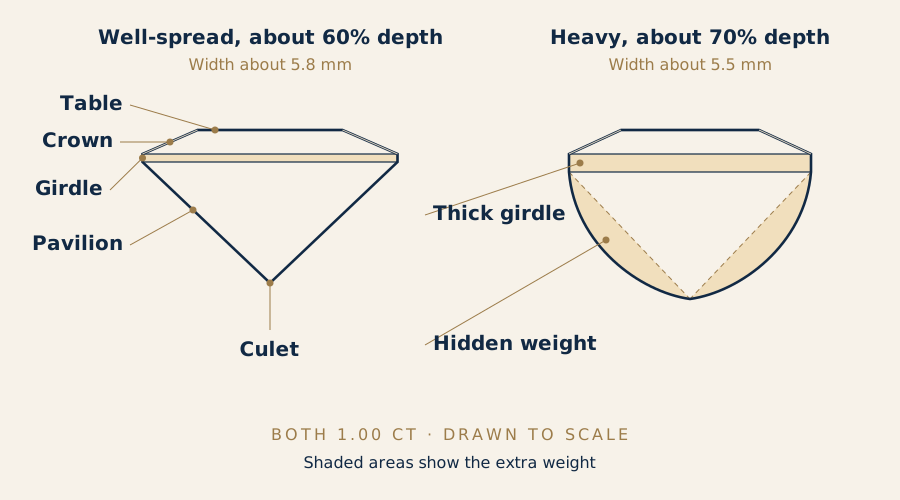
There are four places an oval can carry weight you will not see from above. Most heavy ovals have more than one of them.
- A deep pavilion: the lower cone is cut steeper or longer than it needs to be, so the stone goes down instead of out. This is the most common source of hidden weight.
- A bulging pavilion (belly): the pavilion facets curve outwards like the back of a spoon instead of running straight to the bottom. A belly adds volume, often without pushing the total depth percentage far out of range, which is why depth alone can miss it.
- A thick girdle: the outer edge is left chunky. A girdle graded Very Thick or Extremely Thick adds a band of weight right around the stone, and in an oval it is often thickest at the ends.
- A tall crown: a high crown adds some weight above the girdle. It can add fire (flashes of colour), so a slightly high crown is less of a concern than a heavy pavilion.
The outline itself also affects how big an oval looks. Ovals with pinched, narrow shoulders (the curves either side of the ends) lose face-up area compared with ovals whose shoulders are full. Our guide to rounded versus boxy oval shoulders explains how the outline changes both size and look. For the target numbers behind a well-cut oval, see the oval proportions chart.
Related guideOval Diamond Shoulders: Rounded vs Boxy OutlinesWhat depth percentage is too deep for an oval diamond?
Total depth percentage is the stone's height from table to culet (the very bottom point) divided by its width, shown on every grading report. For ovals, most well-spread stones sit at about 58–64%. Above about 65% you start paying for weight you cannot see; above about 68% the loss is easy to notice beside a well-spread stone.
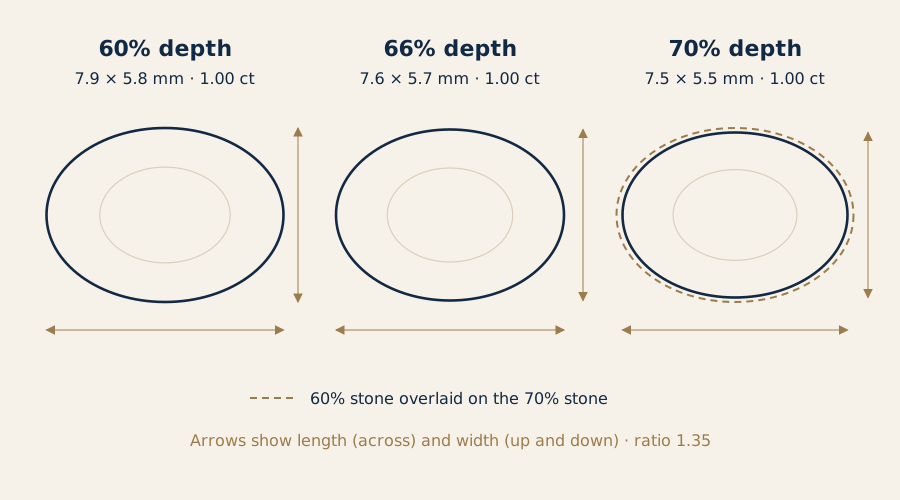
The table below uses the standard weight estimate for ovals (length × width × depth × 0.0062) to show how a 1.00 ct oval at a 1.35 ratio changes face-up as it gets deeper. Real stones vary with girdle thickness and outline, so treat these as guides, not specifications.
| Total depth | Approx. size of a 1.00 ct oval (length × width) | Face-up area compared with 60% depth |
|---|---|---|
| 58% | about 8.0 × 5.9 mm | about 2–3% larger |
| 60% | about 7.9 × 5.8 mm | reference |
| 62% | about 7.8 × 5.8 mm | about 2% smaller |
| 64% | about 7.7 × 5.7 mm | about 4% smaller |
| 66% | about 7.6 × 5.7 mm | about 6% smaller |
| 70% | about 7.5 × 5.5 mm | about 10% smaller |
A 10% loss of face-up area at 70% depth means that 1.00 ct oval looks roughly like a 0.85 ct oval cut at 60%. Going too shallow is not the answer either. Below about 56% depth, an oval often shows a window: a washed-out, see-through patch in the centre where light passes straight through instead of bouncing back. The length-to-width ratio also changes how big an oval looks, because longer ovals spread their weight over more length; our guide to choosing a length-to-width ratio for an oval covers that side of it.
What mm size should an oval diamond be for its carat weight?
The quickest check for hidden weight is to compare the millimetre measurements on the report with what a well-spread oval of that weight usually measures. If the width is noticeably under the typical figure for its ratio, the weight is going somewhere else.
| Carat weight | Well-spread oval (about 61% depth) | Heavy oval (about 68% depth) |
|---|---|---|
| 0.50 ct | about 6.2 × 4.6 mm | about 6.0 × 4.4 mm |
| 0.75 ct | about 7.1 × 5.3 mm | about 6.9 × 5.1 mm |
| 1.00 ct | about 7.8 × 5.8 mm | about 7.6 × 5.6 mm |
| 1.50 ct | about 9.0 × 6.7 mm | about 8.7 × 6.4 mm |
| 2.00 ct | about 9.9 × 7.3 mm | about 9.5 × 7.1 mm |
All figures are estimates at a ratio of about 1.35. A 0.2–0.4 mm difference sounds tiny, but on a finger it can make a 1 ct oval look closer to 0.90 ct. Ovals generally face up larger than rounds of the same weight, which is part of their appeal; our comparison of how ovals face up against rounds puts the two shapes side by side, and our page on which diamond shapes face up largest for their weight ranks every main cut. A heavy oval gives some of that advantage away.
Not sure which one is right?
Send us the stones you are looking at and our gemologist will tell you which to choose and why.
Why do cutters leave hidden weight in some oval diamonds?
Cutters are not trying to trick anyone; they are working with rough crystals and a price list. Three things push them towards heavier ovals:
- Yield: rough diamond is expensive, and every point of weight kept is worth money. Cutting a pavilion deeper often saves more of the crystal.
- Carat thresholds: prices per carat step up at popular weights such as 0.50, 0.70, 0.90, 1.00, 1.50 and 2.00 ct. A cutter who can finish a stone at 1.01 ct instead of 0.94 ct by leaving extra depth will usually do so, because the 1 ct stone sells for considerably more per carat.
- Bow-tie control: most ovals show a bow-tie, a dark band across the middle where light leaks out. Cutting the pavilion a little deeper can reduce it, so some extra depth is a deliberate trade-off rather than waste.
Girdles are sometimes left thick for safety too, because a very thin girdle can chip. A medium to slightly thick girdle protects the edge without adding much weight; very thick and extremely thick girdles go well beyond that. Other elongated shapes have the same pressures, and some are cut deeper by habit: elongated cushions, which are often cut deeper, are a good example of how much depth can vary between related shapes. The same checks apply across the wider family of elongated diamond cuts such as pears and marquises.
Is a deep oval diamond always a bad choice?
Not always. Hidden weight is a value question, not a quality fault. A slightly deep oval with a soft bow-tie and strong brightness can look lovelier than a shallow, spread stone with a window in the middle. The aim is balance: as much face-up size as the stone can give while it still returns plenty of light.
| Well-spread oval | Oval hiding weight | |
|---|---|---|
| Total depth | about 58–64% | about 65% and above |
| Girdle | Medium to Slightly Thick | Thick to Extremely Thick |
| Pavilion in profile | Straight, even slope | Deep or bulging belly |
| Width of a 1 ct (1.35 ratio) | about 5.7–5.9 mm | about 5.6 mm or less |
| Face-up look | Size you expect for the carat | Looks like a smaller carat |
| Bow-tie | Often visible, should move with the stone | Can be softer, or darker if very deep |
| Value | More visible size per dollar | Paying for weight you cannot see |
If a very deep stone does appeal to you, it is worth looking at shapes cut to a different brief. The moval, a newer oval-marquise hybrid, spreads its weight differently again, and our oval against pear comparison explains how a pear carries weight towards its rounded end.
Does a deep oval diamond sit higher in an engagement ring?
Yes. A deep pavilion needs more room underneath, so the setting has to lift the stone higher or use a basket that allows for the extra length. A 1 ct oval at 70% depth is roughly 3.9 mm tall, compared with about 3.5 mm at 60%. That extra 0.4 mm or so adds to the ring's overall height, which affects how a wedding band sits beside it and how often the ring catches on clothing.
A thick girdle also changes how claws grip the stone, because the claws need to be shaped around a taller edge. A well-made setting can be built around almost any stone once the measurements are known, but it is one more reason to check the profile before you commit. Our guide to oval engagement ring styles compares low-set, cathedral and halo designs for ovals.
Does hidden weight cost more in natural or lab-grown oval diamonds?
Hidden weight costs you in both, because both are priced per carat. In natural diamonds, the cost of each extra point is higher, so a heavy natural oval means paying a lot for weight under the girdle. Lab-grown diamonds are real diamond grown in a laboratory rather than mined; they cost much less per carat, so the money lost to hidden weight is smaller, but lab-grown ovals are cut deep too, and the same checks apply.
| 1 ct oval, G–H colour, VS clarity | Approximate price range (AUD) |
|---|---|
| Lab-grown | about $1,000–$3,000 |
| Natural | about $7,000–$16,000 |
These are broad ranges only; prices move with the market and the exact grades. The more useful number is what you can save by choosing spread over weight. A well-spread 0.90 ct oval at 60% depth faces up about the same as a 1.00 ct oval at 66% depth, and because it sits under the 1 ct price step it usually costs noticeably less. Use the depth and table targets for ovals as your filter, see natural and lab-grown oval options explained side by side, and compare how prices differ between diamond shapes if you are still choosing a shape.
Browse oval diamonds: natural and lab-grown
How do you spot hidden weight in an oval diamond? Step by step
- Read the report first. Note the carat weight, the measurements in millimetres, the total depth, the table and the girdle description, and whether the diamond is natural or lab-grown.
- Check the depth. About 58–64% is the usual range for a well-spread oval. Above about 65%, look harder at the next steps.
- Check the girdle. Medium, Slightly Thick or a range such as Medium to Thick is normal. Very Thick or Extremely Thick means weight around the edge.
- Compare the width with the size table. For a 1 ct oval at about 1.35 ratio, a width of roughly 5.7–5.9 mm is typical; 5.6 mm or less suggests hidden weight.
- Ask for a side profile photo or video. Look for a pavilion that bulges outwards instead of sloping evenly to the bottom.
- Watch a 360° video face-up. Check that the bow-tie moves and fades as the stone turns, and that there is no window in the centre.
- Compare two stones at the same price. Choose the one with more visible size and life, not the one with the higher carat on paper. Then match the shape to your hand with the oval ratio that suits your hand.
Free consultation
Talk to a gemologist
Compare stones in person or online with Raj Sood, Graduate Gemologist (GIA), AJP (GIA).
Book a consultationFAQ
Common questions
What does hidden weight mean in a diamond?
Hidden weight is carat weight that does not show from above, usually held in a deep or bulging pavilion, a thick girdle or a tall crown. The diamond weighs more but looks smaller face-up than a well-spread stone of the same weight.
What is a good depth percentage for an oval diamond?
Most well-spread ovals sit at about 58–64% total depth. Above about 65% the stone starts to hide weight, and below about 56% it can show a window in the centre.
How big is a 1 carat oval diamond in mm?
A well-spread 1 ct oval at a ratio of about 1.35 measures roughly 7.7–7.9 mm long and 5.7–5.9 mm wide. A heavy, deep oval of the same weight may be closer to 7.6 × 5.6 mm or smaller.
Can you see a bulging pavilion on a grading report?
Not directly. The report shows total depth and girdle thickness, but a belly can sit within a normal depth range, so ask for a side profile photo or video to check the pavilion shape.
Do lab-grown oval diamonds hide weight too?
Yes. Lab-grown ovals are cut by the same methods and can be deep or have thick girdles, so check the depth, girdle and millimetre measurements exactly as you would for a natural oval.
Is a deeper oval diamond more sparkly?
A little extra depth can reduce the bow-tie and keep the stone bright, but very deep ovals can look darker in the centre and smaller face-up. Balance matters more than depth alone.

Ask a gemologist
Not sure which diamond to choose?
Raj Sood is a Graduate Gemologist (GIA) and master jeweller. Bring the stones you are considering, or send the reports, and he will tell you honestly which one is better and why.
Keep learning
Related guides
 Diamond Anatomy & LightIdeal Proportions Chart: Oval Diamonds
 Diamond ShapesBest Length-to-Width Ratio for an Oval Diamond?Diamond ShapesOval Diamonds
 Diamond ShapesOval Diamond Shoulders: Rounded vs Boxy OutlinesDiamond ShapesUnderstanding Diamond Shapes
 Engagement Rings & SettingsOval Engagement RingsDiamond ShapesOval vs Round Diamonds
 Diamond ShapesOval vs Pear Diamonds
Explore more
More guides on this topic
Education