
- Education
- Engagement Rings & Settings
- Radiant Cut Engagement Ring Guide: Settings, Shape and Wear
Engagement rings & settings
Radiant Cut Engagement Ring Guide: Settings, Shape and Wear
A radiant cut engagement ring pairs the sparkle of a brilliant with the clean lines of a rectangle, and its clipped corners make it one of the easiest fancy shapes to set securely. Here is how to choose the shape, the setting and the band, and how each setting holds up over years of wear.
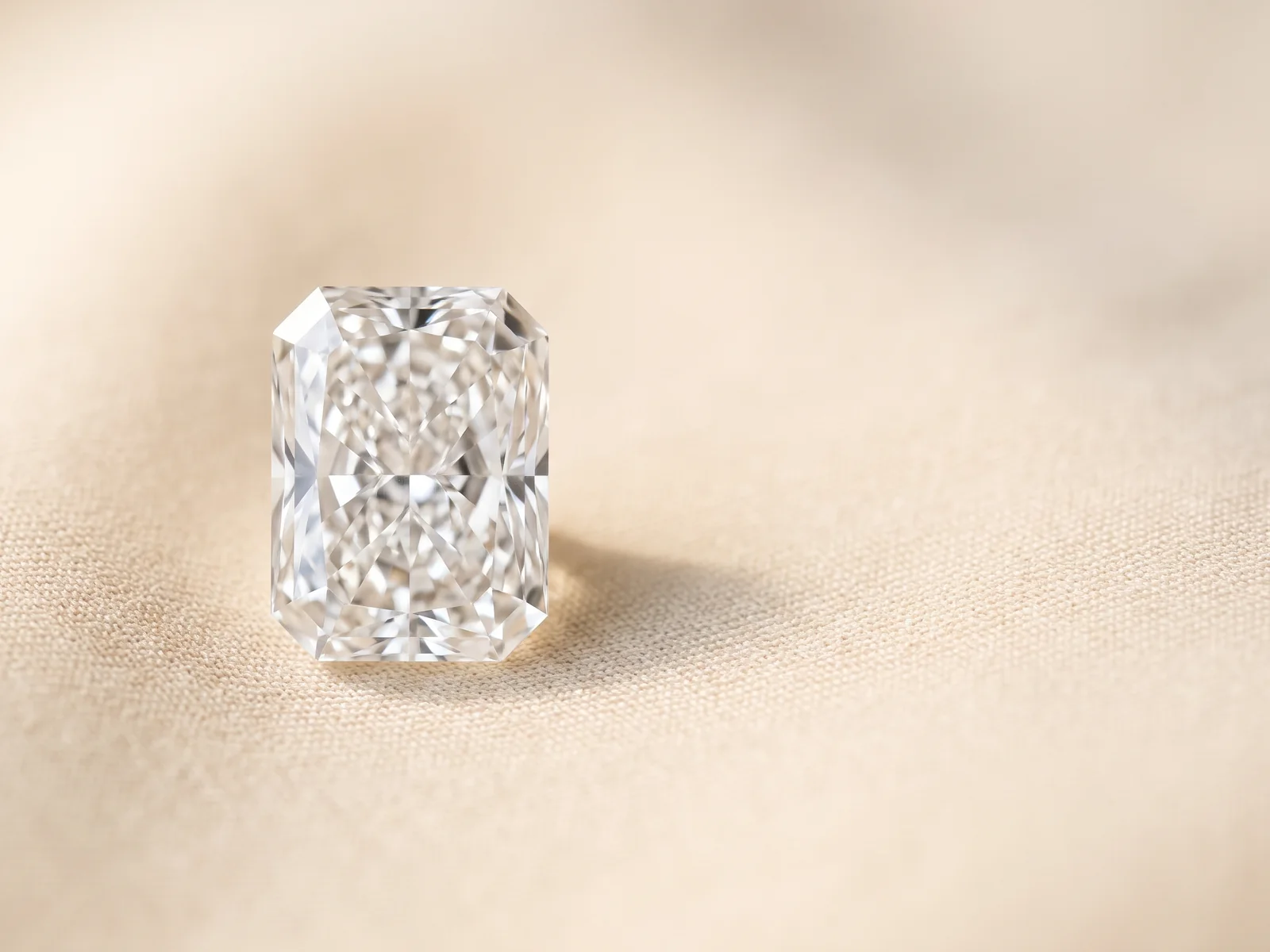
 Reviewed by Raj Sood, Graduate Gemologist (GIA), AJP (GIA)Master jeweller and Graduate Gemologist (GIA) · reviewed 4 November 2026
Quick answer
A radiant cut engagement ring sets a square or rectangular brilliant diamond with clipped corners, so there are no sharp points to protect. Four claws are the classic choice; double claws, a bezel or a halo add security. Aim for a ratio of about 1.00–1.05 for square or 1.20–1.40 for elongated, and an eye-clean stone.
What is a radiant cut engagement ring?
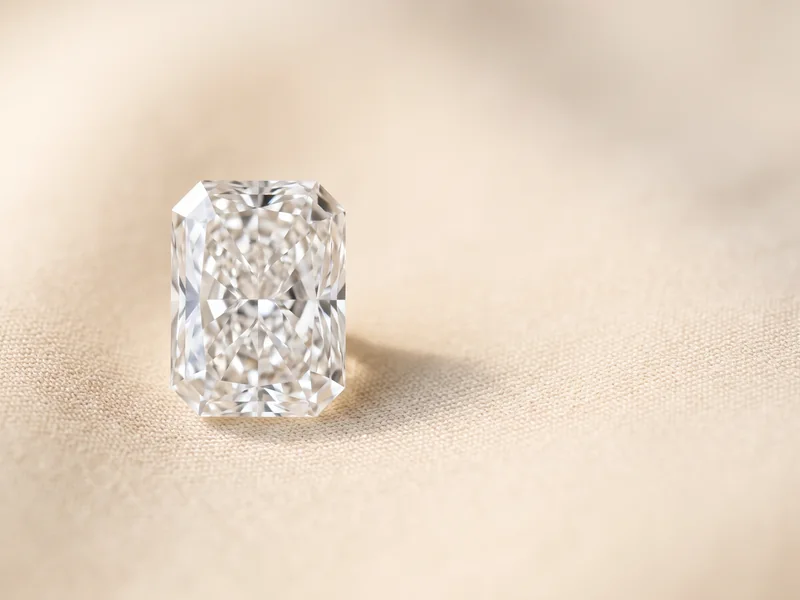
A radiant cut engagement ring is built around a radiant cut diamond: a square or rectangular stone with clipped corners (small angled facets that cut off each corner) and brilliant-style faceting on both the crown (the top half) and the pavilion (the bottom half). The original design, introduced in the late 1970s, has 70 facets. Our full guide to radiant cut diamonds covers the stone itself in more depth; this page is about turning it into a ring.
The clipped corners are the radiant's big practical advantage. A princess cut has four sharp points that need V-shaped claws to protect them. A radiant's corners are already blunted, so the thinnest, most chip-prone part of a square diamond simply is not there. That is why the clipped corners matter so much for an everyday ring: the stone can take ordinary claws, sits comfortably and is less likely to catch on knits or hair.
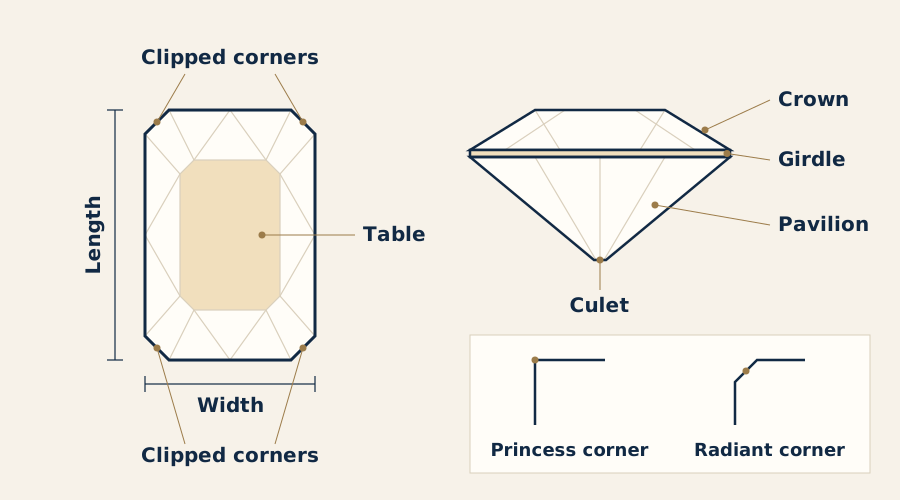
Diamond is 10 on the Mohs hardness scale, with a refractive index (how strongly it bends light) of about 2.42. Hardness is not toughness, though: a diamond can still chip along its cleavage planes if a thin edge takes a hard knock. Radiants also vary in how their sparkle looks. Some show a fine, scattered crushed-ice look, others larger, more distinct flashes; our page on crushed-ice and brilliant facet patterns explains how to tell them apart. If you are curious how brilliant faceting developed in the first place, see how brilliant faceting differs from the older rose cut. Any term you have not met is in the GemTrove jewellery glossary.
Square or elongated: which radiant shape suits an engagement ring?
Radiants are cut anywhere from a true square to a long rectangle, and the length-to-width ratio decides which you get. Divide the length by the width from the grading report: 1.00 is a perfect square, 1.30 means the stone is 30% longer than it is wide.
| Ratio | How it looks on the hand | Suits |
|---|---|---|
| 1.00–1.05 | Square; reads as a crisp, sparkly square | Shorter fingers, a bold modern look, halos |
| 1.05–1.15 | Slightly rectangular; can look like an uneven square | Often avoided; check it looks intentional |
| 1.20–1.40 | Classic rectangle; lengthens the finger | Most solitaires and three-stone rings |
| 1.40–1.55 | Long and slim, close to an emerald outline | Longer fingers, east-west settings |
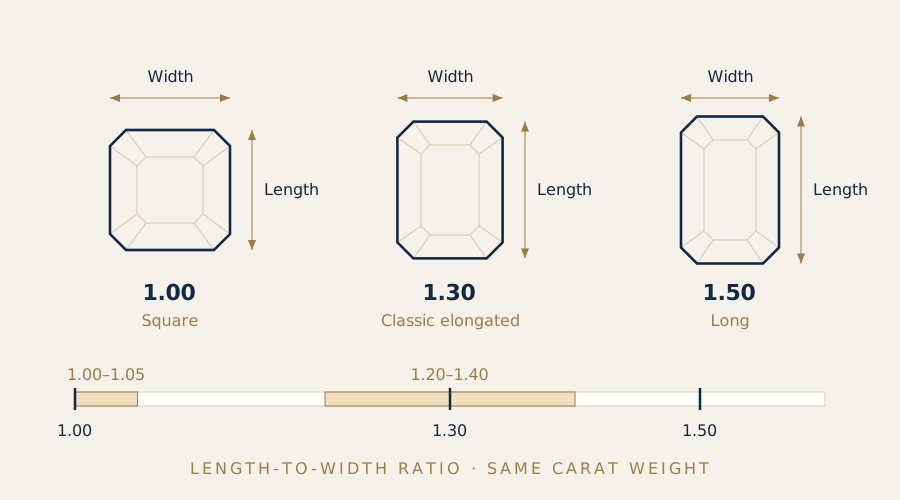
For a square radiant engagement ring, most people look for 1.00–1.05, so the stone reads clearly square rather than slightly off. Our guide to square radiants covers what else to check. For an elongated radiant engagement ring, 1.20–1.40 is the popular band; it looks rectangular without being narrow. See elongated radiant diamonds for the face-up size advantage of longer stones, and the radiant length-to-width ratio guide for worked examples.
Because GIA does not give radiants an overall cut grade, you judge the cut from proportions and from how the stone looks. As a rough guide, many well-cut radiants sit around 61–67% total depth and 61–69% table (the large flat top facet, as a percentage of width). Radiants are often cut deep to save weight from the rough, and a very deep stone carries weight underneath where you cannot see it. Watch for a dark bow-tie across the middle of elongated stones, a band where light leaks out rather than returning to your eye.
What is the best setting for a radiant cut engagement ring?
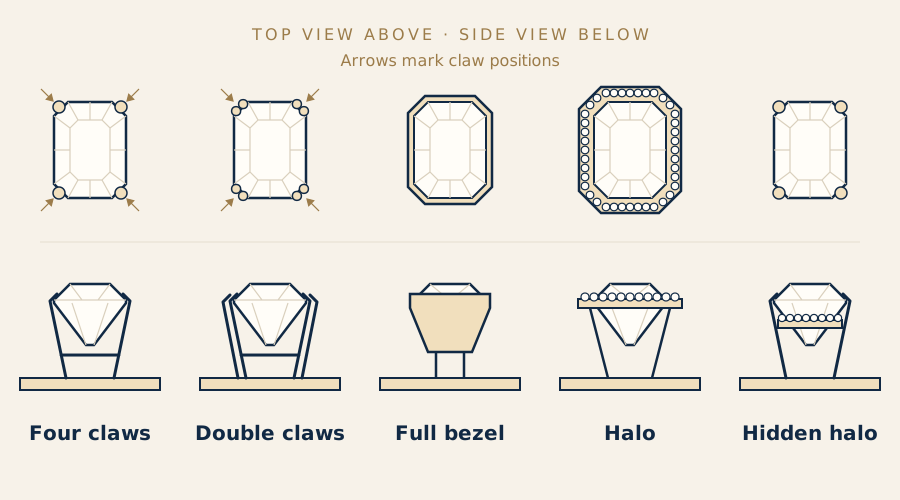
There is no single best setting; it depends on how you live and what you want the ring to look like. Because the corners are clipped, a radiant works with almost every style in our guide to every engagement ring setting style. The main radiant cut engagement ring settings:
- Four-claw solitaire: one claw on each clipped corner. Shows the most diamond and suits both square and elongated radiants.
- Double claws (eight claws): a pair on each corner. If one claw wears or bends, its partner still holds the corner.
- Full or half bezel: a thin rim of metal around all or part of the edge. The most protective option; it hides a sliver of the outline.
- Halo: a row of small diamonds around the centre stone. A radiant halo engagement ring makes the centre look larger, and the halo shields the girdle (the thin outer edge).
- Hidden halo: small diamonds set around the gallery (the side of the head under the stone), visible from the side but not from above.
- Three-stone: a radiant flanked by trapezoids, baguettes or smaller radiants, whose straight edges echo the centre.
- East-west: an elongated radiant set sideways across the finger for a lower, modern profile.
- Pavé band: small diamonds along the band; see micro-pavé, bead and bright-cut pavé for how each style is made.
| Setting | Security | How it wears over the years | Typical upkeep |
|---|---|---|---|
| Four claws | Good | Claw tips thin at the corners; may need re-tipping after several years of daily wear | Check claws every 6–12 months |
| Double claws | Very good | Wear is shared, so one worn claw is less of a risk | Check claws every 6–12 months |
| Full bezel | Highest | Rim can dent or lift after a hard knock but rarely loosens | Occasional check; reshaping if dented |
| Halo | Good for the centre | Small halo stones are the most common thing to come loose | Check halo stones every 6–12 months |
| Pavé band | Good | Small stones and beads wear, especially on the palm side | Check yearly; resizing is limited |
| Bezel-set east-west | Very good | Low profile takes fewer knocks | Occasional check |
How do radiant settings hold up over years of wear?
Seen from the repair bench, most problems with any engagement ring come from the same few places, and radiants are no exception. Claws are the first thing to go: they are worn by every hand wash, every bump on a door frame and every brush against a bench. On a radiant, the claws sit on the corners, which are the parts of the ring that take the most contact, so they tend to wear before anything else.
Metal choice changes how that wear plays out. Platinum is dense and tends to push aside rather than wear away when scratched, so claws keep their mass longer. 18ct white gold is harder at first but slowly loses metal, and it is usually rhodium plated (a thin white coating) that needs renewing every year or two to stay bright white. 18ct yellow and rose gold wear in a similar way to white gold without the plating.
- High settings catch more: a tall cathedral head looks elegant but snags on clothing and takes more knocks than a low basket.
- Halos and pavé need regular checks: small stones are held by tiny beads of metal that wear down over time.
- Bezels age gracefully: they rarely loosen, but a hard knock can dent the rim, which a jeweller can usually reshape.
- Thin bands bend: a band under about 1.8 mm wide can go out of round with daily wear, which strains the head and claws.
A simple habit makes the biggest difference: have the ring checked every 6 to 12 months and take it off for gym work, gardening and heavy cleaning. Caught early, a worn claw is a small fix; left too long, it can mean a lost stone.
Not sure which one is right?
Send us the stones you are looking at and our gemologist will tell you which to choose and why.
What carat size looks good in a radiant engagement ring?
Radiants are often cut fairly deep, so they can face up (look from above) a little smaller than a round of the same weight. Elongated radiants spread their weight over a longer outline and tend to look larger for their carat than square ones. Compare millimetres, not just carats.
| Carat weight | Square (about 1.02) | Elongated (about 1.30) |
|---|---|---|
| 0.50 ct | about 4.6 × 4.5 mm | about 5.4 × 4.2 mm |
| 0.75 ct | about 5.1 × 5.0 mm | about 6.0 × 4.6 mm |
| 1.00 ct | about 5.6 × 5.5 mm | about 6.5 × 5.0 mm |
| 1.50 ct | about 6.4 × 6.3 mm | about 7.5 × 5.8 mm |
| 2.00 ct | about 7.0 × 6.9 mm | about 8.2 × 6.3 mm |
These are typical figures only; a stone cut deeper or shallower will measure differently. Most radiant engagement rings sit between 0.70 and 2.00 carats. A halo adds roughly 1.5–2 mm to the visual width, which is why many people choose a halo with a smaller centre stone.
What colour and clarity should a radiant engagement ring diamond have?
Radiants hold and show body colour more than rounds do. The brilliant faceting and deep pavilion tend to concentrate any warm tint, especially at the corners. In platinum or white gold, most people are happy from H colour or better; if you are sensitive to warmth, look at G or higher. In yellow or rose gold, I or J can look white because the metal warms everything near it. Radiants are also popular in fancy yellow, where that colour concentration works in the stone's favour.
Clarity is where radiants are forgiving. The busy facet pattern hides small inclusions (internal features) well, so an eye-clean stone, one with nothing visible without magnification at normal distance, is often found at SI1 and sometimes SI2. Check that no inclusion sits at a corner or reaches the surface near a claw, where it could weaken the stone.
- White metal: G–H colour, VS2–SI1 eye-clean.
- Yellow or rose gold: I–J colour, VS2–SI2 eye-clean.
- Avoid: feathers (small internal cracks) at the corners or under a claw.
How does a radiant compare with princess, cushion, emerald and asscher?
| Radiant | Princess | Cushion | Emerald | Asscher | |
|---|---|---|---|---|---|
| Outline | Square or rectangle, clipped corners | Square, sharp corners | Rounded square or rectangle | Rectangle, clipped corners | Square, clipped corners |
| Facet style | Brilliant | Brilliant | Brilliant | Step cut | Step cut |
| Look | Lively, often crushed-ice | Crisp, bright cross pattern | Soft, broad or crushed flashes | Broad flashes, hall of mirrors | Concentric squares |
| Typical ratio | 1.00–1.50 | 1.00–1.05 | 1.00–1.30 | 1.30–1.50 | 1.00–1.05 |
| Hides inclusions | Well | Well | Well | Poorly | Poorly |
| Corner protection | Four claws enough | V-claws needed | Four claws enough | Four claws enough | Four claws enough |
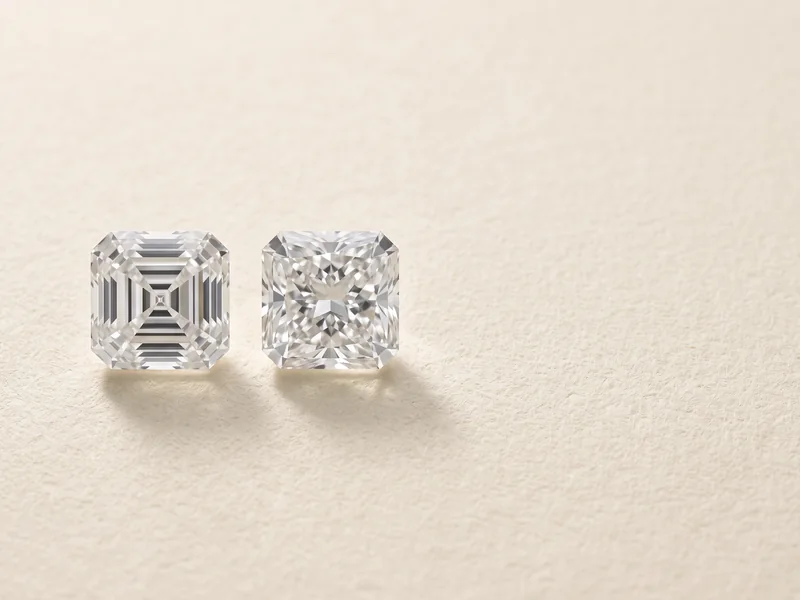
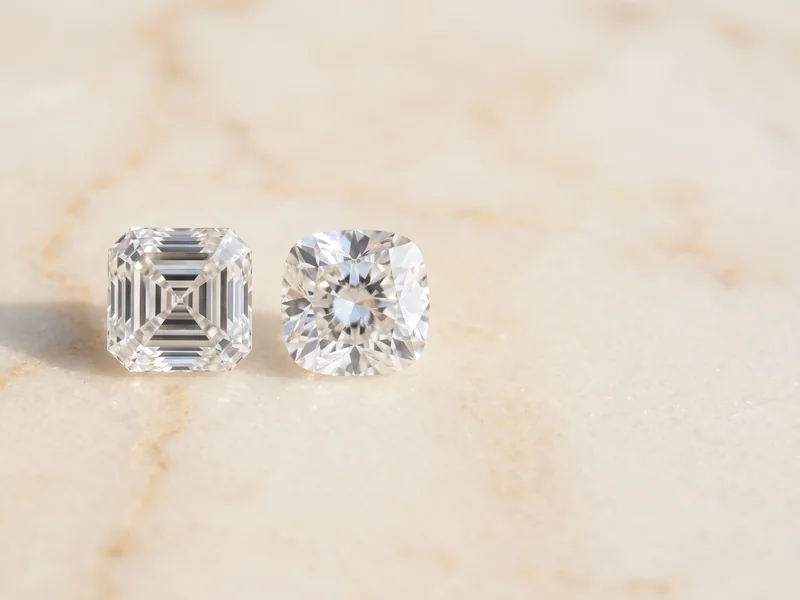
If you like a square but want sharper lines, look at princess cut diamonds and the princess vs radiant comparison. For a softer outline, our radiant vs cushion breakdown explains how the two differ on the hand. If you are drawn to clean step facets, read the emerald vs radiant guide or asscher vs square radiant, side by side. The Flanders cut is another square brilliant with clipped corners, less common but worth knowing about.
Which wedding band suits a radiant cut engagement ring?
Because a radiant has straight sides and clipped corners, it pairs with more band styles than a pear or marquise. A straight band sits flush against most low-set radiants. Higher settings, halos and east-west stones may need a slightly curved or notched band to close the gap. Our guide to wedding bands that sit neatly beside a radiant shows the common pairings.
- Plain band: matches a four-claw or bezel solitaire and wears well for decades.
- Pavé or channel-set band: echoes a pavé engagement band; ask for matching widths, usually 1.8–2.5 mm.
- Contoured band: curves around a halo or low east-west stone.
- Matching metals: wear the same metal and carat of gold, as platinum can wear a softer gold band beside it.
How much does a radiant cut engagement ring cost in Australia?
Radiants are cut from both natural and laboratory-grown diamond, and the two look the same to the eye. A lab-grown radiant engagement ring uses real diamond grown in a laboratory rather than mined; it costs much less, especially in larger sizes. Natural radiants are rarer. Either way, ask for an independent grading report from a lab such as GIA or IGI, which will state clearly whether the stone is natural or lab-grown.
| Item (1 ct, G–H, VS) | Approximate price range (AUD) |
|---|---|
| Lab-grown radiant diamond | about $1,000–$3,000 |
| Natural radiant diamond | about $6,000–$14,000 |
| 18ct gold or platinum solitaire setting | about $1,500–$4,500 |
| Halo or pavé setting | about $2,500–$6,000 |
These are broad ranges and move with the market and exact grades. Radiants usually cost less per carat than rounds of the same weight, colour and clarity, partly because more of the rough crystal is kept when they are cut. The setting adds to the total: platinum generally costs more than 18ct gold, and halos and pavé add both diamonds and labour.
Shop radiant diamonds and ring settings
How do you choose a radiant cut engagement ring? Step by step
- Pick square or elongated. Aim for about 1.00–1.05 for a square look or 1.20–1.40 for a classic rectangle.
- Read the report. Confirm shape, measurements, colour, clarity, polish, symmetry and whether the diamond is natural or lab-grown.
- Check depth and table. Very deep stones look small for their weight; compare millimetres face-up.
- Watch a 360° video. Look for a dark bow-tie that stays put and for inclusions near the corners.
- Choose the setting for your life. Four claws for maximum sparkle, double claws or a bezel if you are hard on your hands.
- Plan the band. Check that a wedding band can sit flush or choose a contoured band now.
- Book regular checks. Have the claws and any small stones checked every 6–12 months.
Free consultation
Talk to a gemologist
Compare stones in person or online with Raj Sood, Graduate Gemologist (GIA), AJP (GIA).
Book a consultationFAQ
Common questions
Are radiant cut engagement rings durable?
Yes. The clipped corners remove the sharp points that make princess cuts prone to chipping, so a radiant is one of the more practical fancy shapes for everyday wear. A sound setting and regular claw checks do the rest.
What is the best ratio for a radiant cut diamond?
It depends on the look you want. About 1.00–1.05 reads as square, while 1.20–1.40 is the most popular range for an elongated radiant; stones around 1.10 can look like an uneven square.
How many claws should a radiant engagement ring have?
Four claws, one on each clipped corner, is the classic setting. Double claws (eight in total) add security, because each corner is still held if one claw wears.
Do radiant diamonds look bigger than round diamonds?
Usually not carat for carat, because radiants are often cut deeper. Elongated radiants face up larger than square ones, and a halo adds roughly 1.5–2 mm of visual width.
What is the difference between a radiant and a princess cut?
Both are square or rectangular brilliants, but a radiant has clipped corners while a princess has sharp pointed corners. The radiant's corners are less likely to chip and need no V-claws.
Can you get a lab-grown radiant engagement ring?
Yes. Lab-grown radiants are widely available, cost much less than natural radiants and are graded by labs such as IGI on the same colour and clarity scales as natural diamonds (GIA now uses simpler descriptive grades for lab-grown stones).

Ask a gemologist
Not sure which diamond to choose?
Raj Sood is a Graduate Gemologist (GIA) and master jeweller. Bring the stones you are considering, or send the reports, and he will tell you honestly which one is better and why.
Keep learning
Related guides
 Diamond ShapesRadiant Cut DiamondsEngagement Rings & SettingsEngagement Ring Setting Styles GuideWedding Bands & EternityBest Wedding Band for Radiant Cut Engagement RingsDiamond ShapesRadiant Diamond Length-to-Width Ratio Guide
 Diamond ShapesPrincess vs Radiant Cut Diamonds
 Diamond ShapesRadiant vs Cushion Cut DiamondsDiamond ShapesEmerald vs Radiant Cut DiamondsDiamond ShapesElongated Radiant Cut Diamonds
Explore more
More guides on this topic
Education