
- Education
- Diamond Shapes
- Princess vs Radiant Cut Diamonds: Which Square Shape Suits You?
Diamond shapes
Princess vs Radiant Cut Diamonds: Which Square Shape Suits You?
Princess vs radiant cut is one of the closest calls in diamond shapes: both are square-ish brilliants, but the corners, sparkle and shape options are different. Here is how they compare on the hand, in the setting and on price.
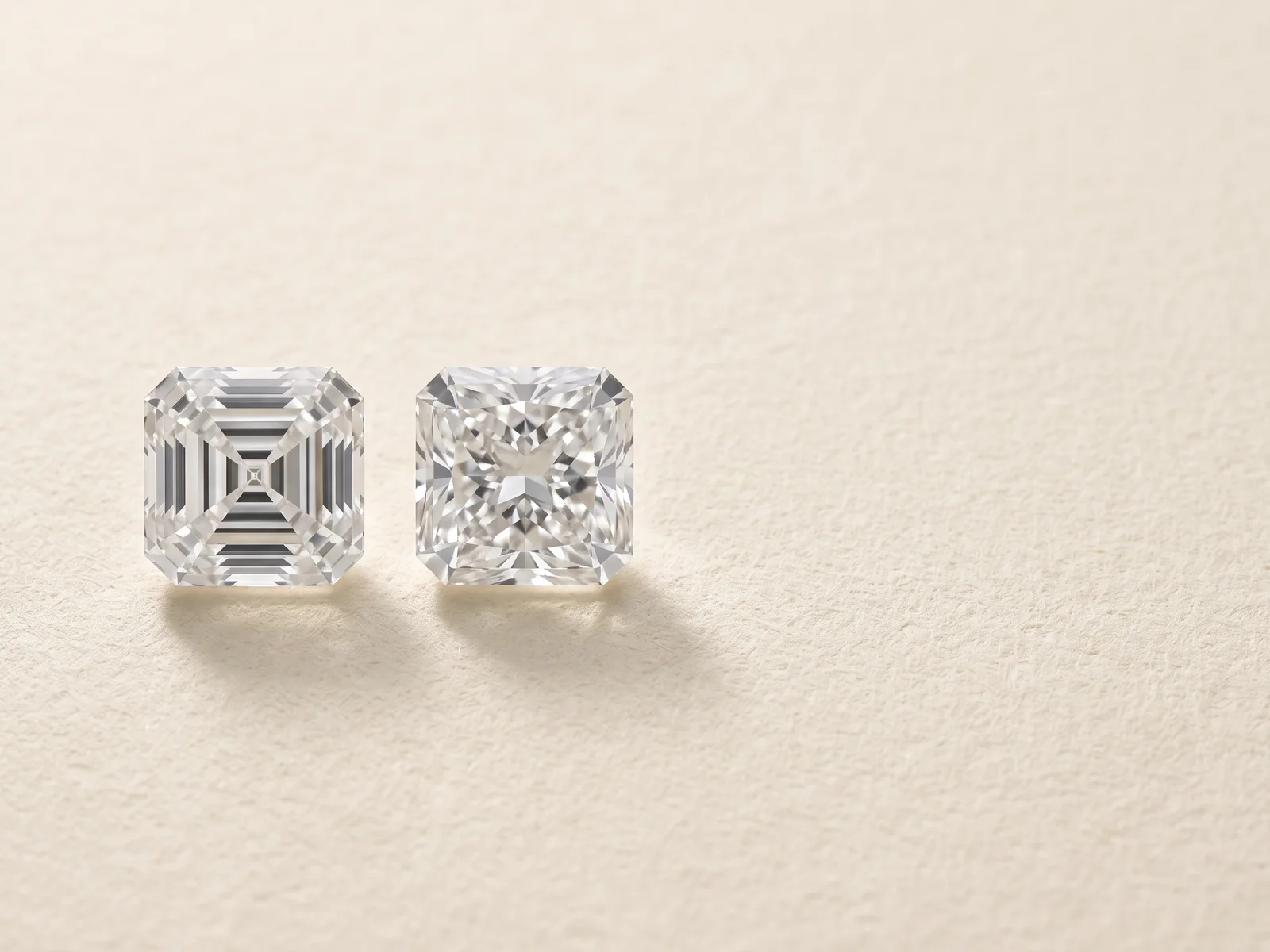
 Reviewed by Raj Sood, Graduate Gemologist (GIA), AJP (GIA)Master jeweller and Graduate Gemologist (GIA) · reviewed 4 November 2026
Quick answer
A princess cut is a square brilliant with four sharp corners and a bold, cross-shaped sparkle. A radiant cut has clipped corners, comes square or rectangular, and shows a busier, crushed-ice sparkle. In the princess vs radiant cut choice, the radiant is tougher at the corners and more flexible in shape; the princess looks crisper and more geometric.
What is the difference between princess and radiant cut diamonds?
Both shapes are square or near-square brilliants. That means they are faceted to break light into lots of bright flashes, rather than the long, mirror-like steps you see in an emerald or Asscher cut. The difference comes down to the corners and the facet pattern underneath. A princess cut has four sharp, pointed corners and an outline that is almost always square. A radiant cut has its corners clipped (trimmed off at an angle), so its outline really has eight sides, and it can be cut anywhere from a true square to a long rectangle.
The radiant came first, in the late 1970s, when cutter Henry Grossbard combined the outline of an emerald cut with brilliant-style faceting on both the crown (the top half) and the pavilion (the lower half). The princess followed around 1980 as a square answer to the round brilliant, with long, pointed chevron facets running down the pavilion to a point. Most radiants have about 70 facets; most princess cuts have somewhere between 50 and 58, depending on the cutter.
For the full detail on each shape on its own, see our complete princess cut guide and our radiant cut diamond guide. Both belong to the wider family of fancy shapes covered in our overview of every diamond shape, and any unfamiliar word on this page is defined in the GemTrove jewellery glossary.
Both are diamond, so both share the same physical properties: 10 on the Mohs hardness scale and a refractive index of about 2.42. Nothing about the material changes between them. What changes is the geometry, and geometry decides how each stone sparkles, how big it looks, and how well it stands up to knocks.
Princess vs radiant cut: how do they compare side by side?
| Princess | Radiant | |
|---|---|---|
| Outline | Square with four sharp corners | Square or rectangular with clipped corners |
| Usual length-to-width ratio | 1.00–1.05 | 1.00–1.05 (square) or 1.20–1.50 (elongated) |
| Facets | About 50–58 | About 70 |
| Sparkle pattern | Bold cross or X, larger flashes | Busy, crushed-ice or finer brilliant pattern |
| Typical total depth | About 65–75% | About 60–68% |
| Corner risk | Higher; each point needs a claw over it | Lower; clipped corners are much stronger |
| Colour | Corners can show a little warmth | Tends to deepen colour; popular for fancy yellows |
| Price per carat | Below a round; similar to a radiant | Below a round; similar to a princess |
| Look on the hand | Crisp, modern, geometric | Softer, brighter, more glittery |
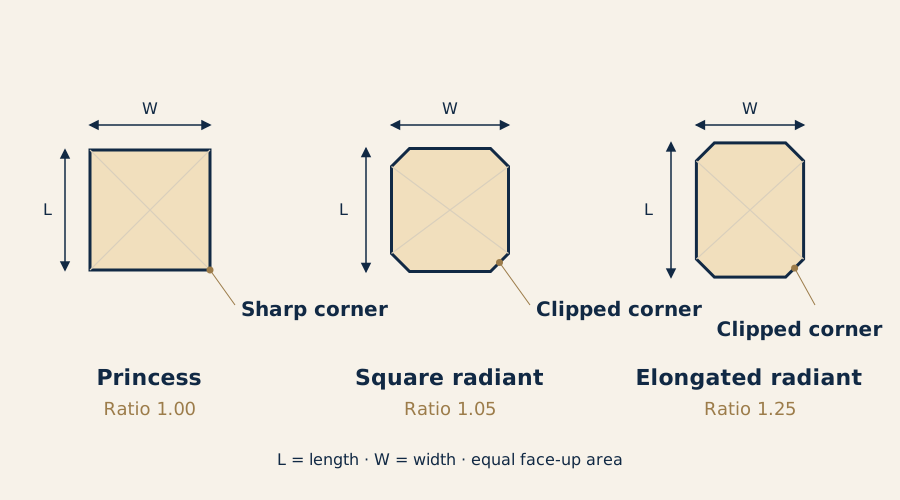
If you only remember one row, make it the corners. Everything else, from the setting to the risk of chipping, follows from whether the stone has four sharp points or four short flat edges. The ratio row matters next: a princess is a square shape, full stop, while a radiant gives you a choice between square and elongated. That choice changes how the stone sits on the finger far more than anything about the facets.
Which looks bigger on the hand, princess or radiant?
Carat is a weight, not a size, so two diamonds of the same carat can look quite different from above. What you see on the hand is the face-up size: the length and width of the stone looking straight down. Princess cuts are usually cut fairly deep to hold their sharp corners and keep the chevron sparkle, which puts more weight underneath where you cannot see it. Radiants are often a little shallower, but the clipped corners take away some surface area.
| Carat weight | Princess (square) | Square radiant (~1.05) | Elongated radiant (~1.25) |
|---|---|---|---|
| 0.50 ct | about 4.4 × 4.4 mm | about 4.6 × 4.4 mm | about 5.0 × 4.0 mm |
| 0.75 ct | about 5.0 × 5.0 mm | about 5.2 × 5.0 mm | about 5.7 × 4.6 mm |
| 1.00 ct | about 5.5 × 5.5 mm | about 5.7 × 5.4 mm | about 6.3 × 5.1 mm |
| 1.50 ct | about 6.3 × 6.3 mm | about 6.5 × 6.2 mm | about 7.2 × 5.8 mm |
| 2.00 ct | about 6.9 × 6.9 mm | about 7.2 × 6.8 mm | about 7.9 × 6.4 mm |
These are typical measurements only; any individual stone can sit a few tenths of a millimetre either side, depending on depth. The pattern is what counts. A princess and a square radiant of the same weight face up at almost the same size. An elongated radiant does not cover much more area, but its extra length makes it look bigger on the finger, the same way an oval looks larger than a round of the same weight.
If length is your aim, our guide to longer, rectangular radiants explains how far to stretch the shape, and the radiant length-to-width ratio guide shows each ratio on the hand. If you want a square stone and are simply deciding between the two, our page on square radiant diamonds covers the near-square end of the range in detail.
Square radiant vs princess at the same width is the trickiest comparison: the princess fills its square right to the corners, so it can look a touch bolder in outline, while the square radiant looks slightly rounder and softer. Neither is wrong. It comes down to whether you want sharp geometry or a softer frame.
Do princess or radiant cut diamonds sparkle more?
Both are brilliants and both are lively, but they sparkle differently. A princess has long chevron facets (V-shaped facets) on the pavilion. Depending on how many chevrons the cutter uses, you see either a few large, bold flashes or a finer pattern, and most princess cuts show a distinct cross or X running corner to corner. Our page on how chevron counts change princess sparkle shows the two-, three- and four-chevron looks side by side.
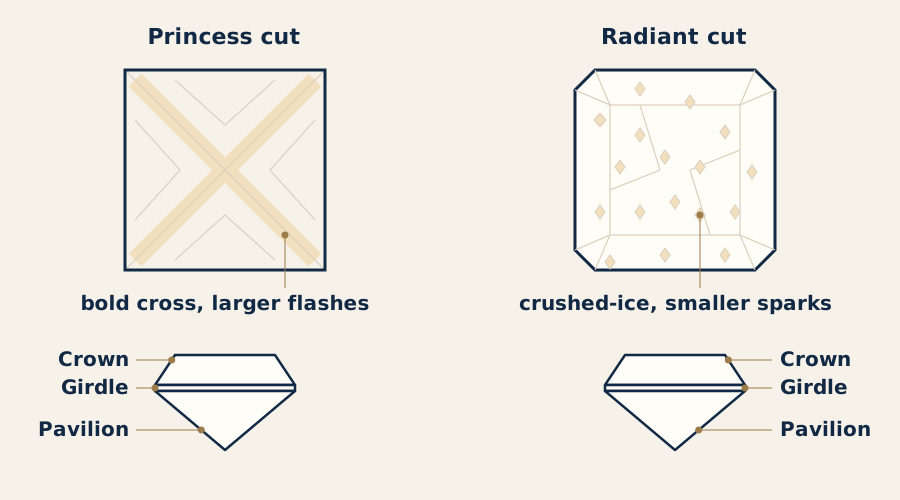
A radiant spreads its light into many smaller sparks. Many radiants show what the trade calls a crushed-ice look: a glittering, fragmented pattern like broken ice, rather than distinct flashes. Others are cut with a cleaner brilliant pattern that looks closer to a round. Neither is a grading fault; it is a style preference, and it is worth seeing both. Our guide to crushed-ice versus brilliant radiant patterns explains how to tell which one a stone has from its video.
On the question of princess cut vs radiant cut sparkle, the honest answer is that a well-cut example of either is very bright. The princess gives you bolder, more contrasty flashes; the radiant gives you more of them, smaller and busier. In low light, the larger flashes of a princess often read more clearly from across a room, while a radiant tends to look evenly bright up close. Elongated radiants can show a faint bow-tie (a dark band across the middle) just like ovals, so watch for one that stays dark as the stone moves.
Not sure which one is right?
Send us the stones you are looking at and our gemologist will tell you which to choose and why.
Do princess cut diamonds chip more easily than radiants?
Yes, the princess is the more vulnerable of the two, and this is the most practical difference between them. Diamond is extremely hard, but hardness is resistance to scratching, not resistance to knocks. Diamond has cleavage planes (directions along which the crystal can split), and a thin, sharp corner is exactly where a hard knock does the most damage. A princess has four of them.
A radiant's clipped corners are thicker and blunter, so they spread the force of a knock instead of concentrating it at a point. That is a big practical advantage of the clipped corners the radiant borrowed from the emerald cut, and our page on why the radiant's clipped corners matter explains the geometry. A radiant can still chip on a hard edge, but it is less likely to.
None of this rules out a princess for everyday wear. It just means the setting has to do its job. A V-claw (a claw shaped like a V that wraps over each corner) or a bezel protects the points completely. Our guide to protecting princess cut corners goes through each option, from V-claws to half-bezels, with the trade-offs in look and cleaning. If you work with your hands a lot, the radiant is the lower-maintenance choice.
What colour and clarity suit a princess or radiant?
Both shapes hide small inclusions (internal features) well, because brilliant faceting scatters light and breaks up your view into the stone. The goal for either is eye-clean: no inclusion you can see without magnification at normal viewing distance. In practice that is usually VS2 or a carefully chosen SI1.
Colour behaves a little differently. A radiant's faceting tends to concentrate body colour, so a faint warm tint can look slightly stronger than in a princess of the same grade. That is a drawback in a white diamond but an advantage in a coloured one, and it is why the radiant is such a common shape for fancy yellow and other coloured diamonds, natural and lab-grown. A princess tends to show any warmth in its corners, where the stone is thinnest.
- Princess in white metal: G–H colour, VS2–SI1 eye-clean, with no feathers (small internal cracks) near a corner.
- Radiant in white metal: F–H colour, as radiants can hold a tint; VS2–SI1 eye-clean.
- Either in yellow or rose gold: I–J colour often looks white against the warm metal.
- Coloured diamonds: the radiant usually shows richer colour than a princess of the same grade.
Whatever the shape, check the plotting diagram on the grading report. It maps where each inclusion sits, and for a princess you want the corners clear.
Princess vs radiant cut: which costs more in Australia?
There is not much in it. Both shapes cost less per carat than a round brilliant of the same weight, colour and clarity, partly because demand for rounds is higher and partly because square shapes keep more of the rough crystal when they are cut. Between the two, prices are close, and a well-cut stone with even proportions costs more than an average one in either shape.
Both are cut from natural and laboratory-grown diamond. Lab-grown diamonds are real diamond, with the same hardness and refractive index, grown in a laboratory rather than mined. They cost much less than natural diamonds and are easy to find in larger sizes. Natural diamonds are rarer. Either should come with an independent grading report from a lab such as GIA or IGI that clearly states whether the stone is natural or lab-grown.
| 1 ct, G–H, VS | Princess (approx. AUD) | Radiant (approx. AUD) |
|---|---|---|
| Lab-grown | about $800–$2,500 | about $800–$2,500 |
| Natural | about $5,000–$11,000 | about $5,000–$12,000 |
These are broad ranges only and they move with the market. Lab-grown prices in particular have fallen over recent years. Within each shape, carat, colour, clarity and how well the stone is cut move the price most. For radiants, the ratio matters too: a very popular ratio can cost a little more than an unusual one.
Browse princess and radiant diamonds: natural and lab-grown
Which settings suit a princess or radiant cut engagement ring?
Because the princess has sharp corners, the setting is mostly about protection. Four V-claws, one over each corner, is the classic choice. A bezel (a thin rim of metal around the edge) is even more secure and looks modern, though it hides a little of the outline. A princess sits naturally with its edges parallel to the band, or turned 45° as a diamond shape, which looks larger but exposes the points more.
A radiant gives you more freedom. Four claws, double claws or claws placed on the clipped corners all work, and the stone's corners are tough enough that standard claws are usually enough. Halos suit both shapes and frame them well. For ideas on everything from solitaires to three-stone designs, see our guide to radiant cut engagement ring styles.
Both shapes sit well next to a straight wedding band, because their flat sides line up cleanly against it. An elongated radiant set lengthways is the easiest to pair; our guide to choosing a wedding band for a radiant ring covers straight, contoured and diamond-set options. With a princess, check that the claws do not stand proud enough to catch against the band.
Princess or radiant: which shape suits you?
Once you have seen both side by side, most people know quickly. As a rough guide:
- Choose a princess if you like clean, sharp geometry, a bold cross-shaped sparkle and a truly square stone, and you are happy with a protective V-claw or bezel setting.
- Choose a square radiant if you want a square look with softer corners, a busier sparkle and less worry about chipping.
- Choose an elongated radiant if you want the stone to look longer and larger on the finger, or you like the outline of an emerald cut but want much more sparkle.
- Choose a radiant for colour if you are looking at a yellow or other coloured diamond, as the faceting tends to deepen the colour.
If you are torn between the radiant and something else, our comparisons may help. The emerald vs radiant comparison puts step-cut calm against radiant sparkle, while radiant vs cushion, point by point compares two shapes with softened corners. For square shapes with a step-cut look, see how an Asscher differs from a square radiant.
Related guideRadiant vs Cushion Cut DiamondsHow do you choose between a princess and radiant cut? Step by step
- Decide on square or elongated. If you want length, the radiant is your only option of the two. If you want square, compare both.
- Read the grading report. Confirm the shape, measurements, colour, clarity, polish and symmetry, and whether the diamond is natural or lab-grown.
- Work out the ratio. Divide length by width; aim for 1.00–1.05 for a square stone, or about 1.20–1.50 for an elongated radiant.
- Compare face-up size. Look at the millimetre measurements, not just the carat weight, and check the depth is not so deep that the stone looks small.
- Check the corners. On a princess, look closely for chips or feathers at each point. On a radiant, check the clipped corners are even.
- Watch a 360° video. Judge the sparkle pattern you prefer and, on elongated radiants, look for a bow-tie that stays dark.
- Plan the setting. V-claws or a bezel for a princess; claws, double claws or a halo for a radiant.
Free consultation
Talk to a gemologist
Compare stones in person or online with Raj Sood, Graduate Gemologist (GIA), AJP (GIA).
Book a consultationFAQ
Common questions
Is a princess or radiant cut more durable?
The radiant is more durable because its corners are clipped, which removes the sharp points where a diamond is most likely to chip. A princess is fine for everyday wear as long as its corners are protected by V-claws or a bezel.
Which looks bigger, a princess or radiant cut diamond?
At the same carat weight, a princess and a square radiant face up at almost the same size. An elongated radiant looks bigger on the finger because of its extra length.
Does a radiant cut sparkle more than a princess cut?
They sparkle differently rather than more or less. A princess shows bolder, larger flashes in a cross pattern, while a radiant shows many smaller sparks, often in a crushed-ice pattern.
Are princess cut diamonds cheaper than radiant cut diamonds?
Prices are very similar, and both cost less per carat than a round of the same grades. The quality of the cut, the carat, colour and clarity matter far more than the choice between the two shapes.
Can you get lab-grown princess and radiant diamonds?
Yes. Both shapes are widely available as lab-grown diamonds, which are real diamond grown in a laboratory and cost much less than natural stones. The grading report states whether a diamond is natural or lab-grown.
What is the difference between a square radiant and a princess cut?
Both are square, but the princess has four sharp corners and a cross-shaped sparkle, while the square radiant has clipped corners and a busier, more scattered sparkle. The square radiant looks slightly softer and is less prone to chipping.

Ask a gemologist
Not sure which diamond to choose?
Raj Sood is a Graduate Gemologist (GIA) and master jeweller. Bring the stones you are considering, or send the reports, and he will tell you honestly which one is better and why.
Keep learning
Related guides
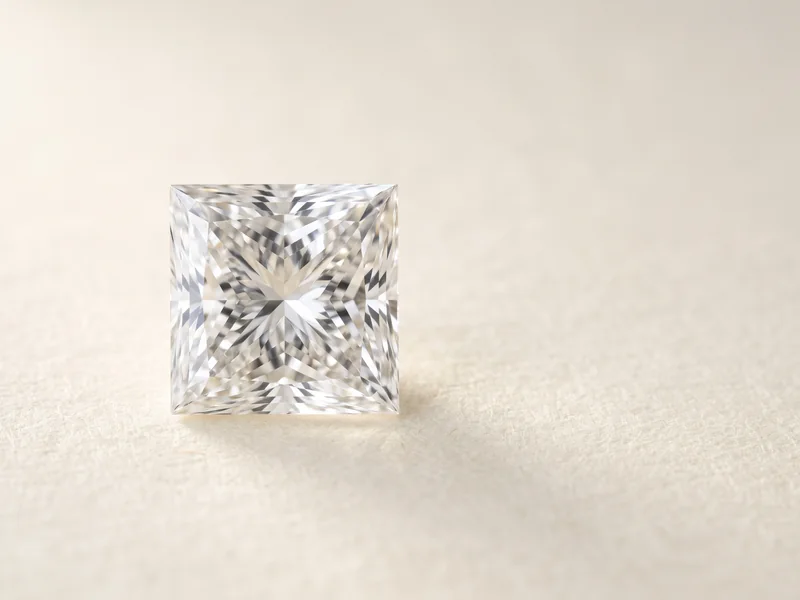 Diamond ShapesPrincess Cut Diamonds
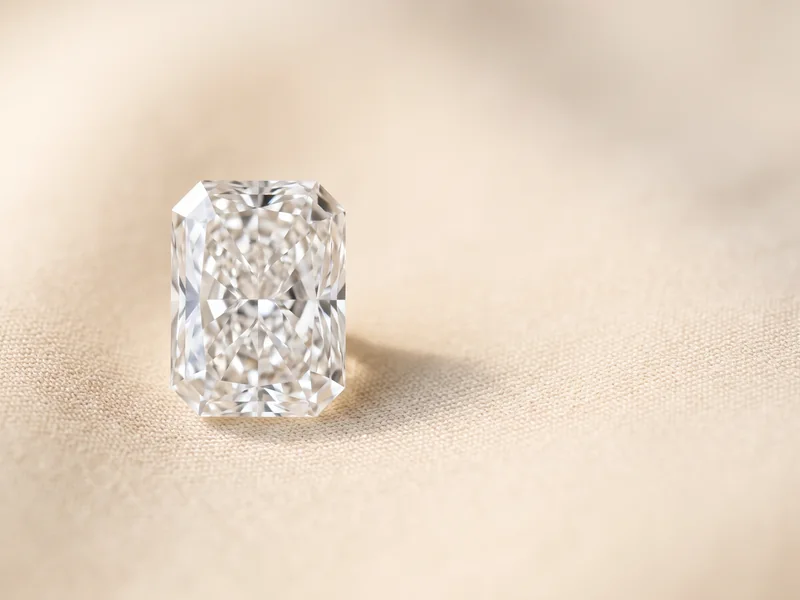 Diamond ShapesRadiant Cut Diamonds
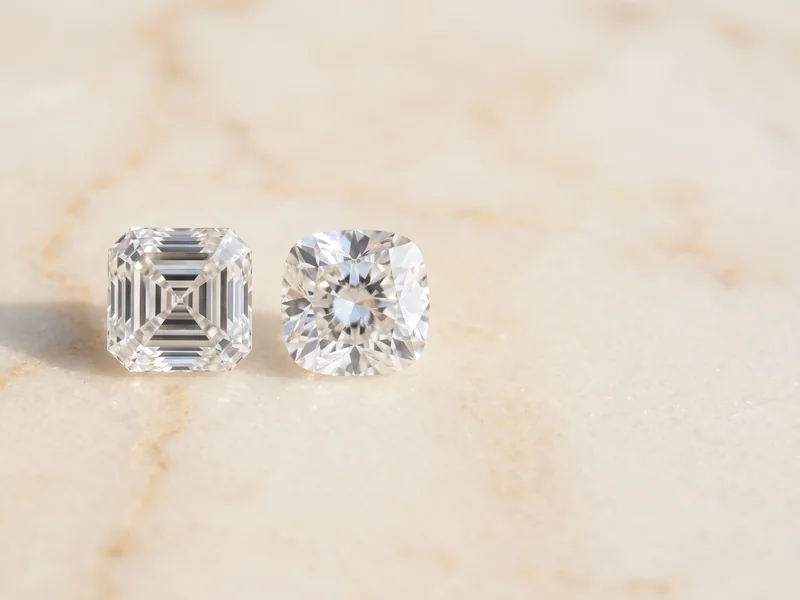 Diamond ShapesRadiant vs Cushion Cut Diamonds
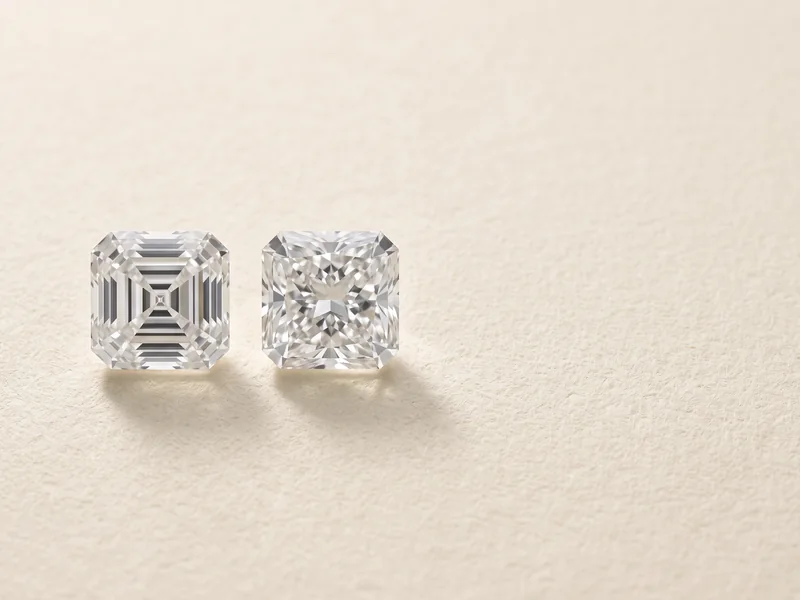 Diamond ShapesAsscher vs Square Radiant DiamondsDiamond ShapesUnderstanding Diamond ShapesEngagement Rings & SettingsRadiant Cut Engagement RingsDiamond ShapesEmerald vs Radiant Cut DiamondsDiamond ShapesElongated Radiant Cut Diamonds
Explore more
More guides on this topic
Education