
- Education
- Diamond Shapes
- Radiant Diamond Corners: Why the Clipped Shape Matters
Diamond shapes
Radiant Diamond Corners: Why the Clipped Shape Matters
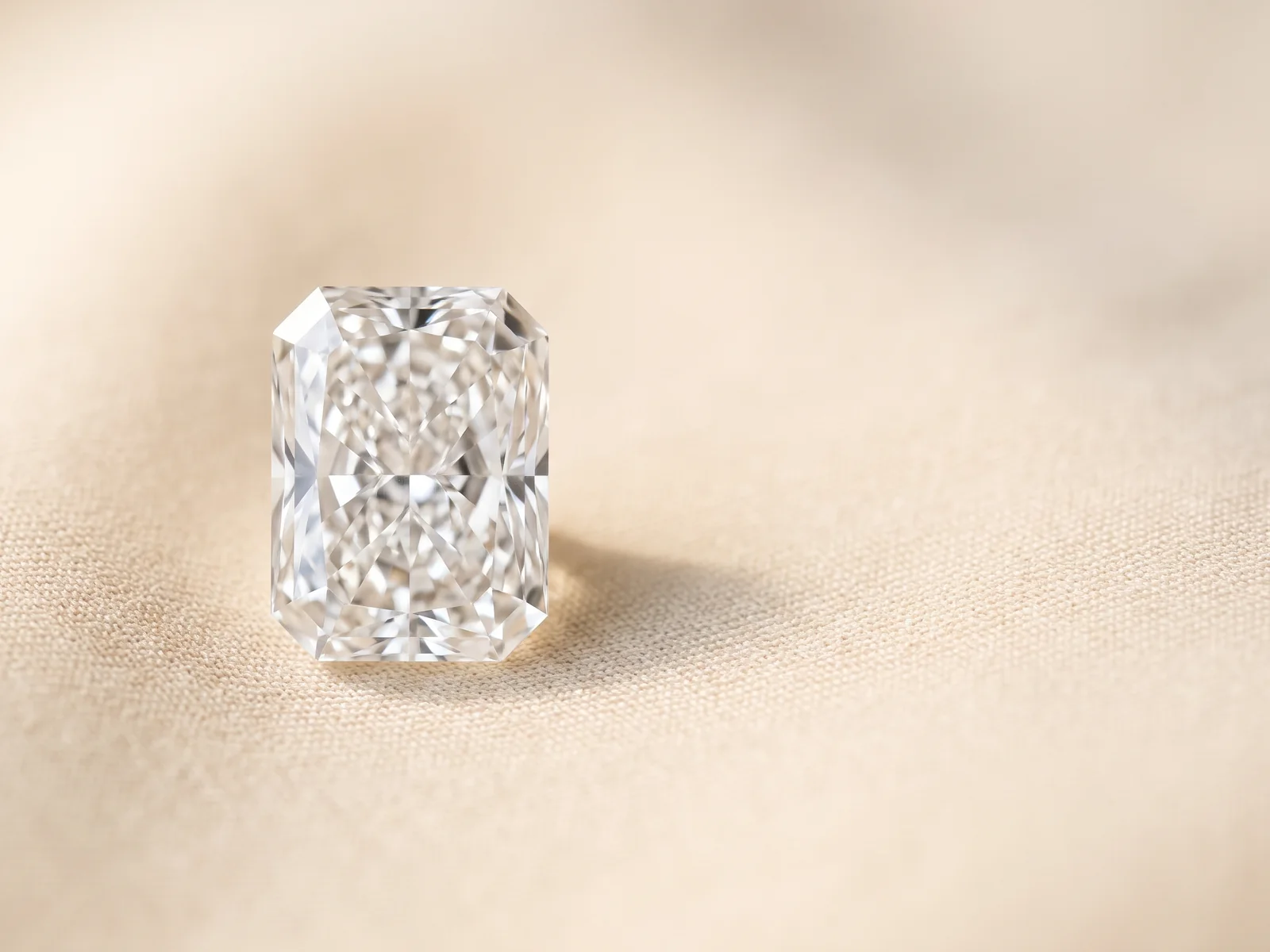
The four clipped corners are what make a radiant a radiant. They decide how tough the stone is, how its outline reads and which setting suits it, so here is exactly what to check in radiant diamond corners before you choose one.
 Reviewed by Raj Sood, Graduate Gemologist (GIA), AJP (GIA)Master jeweller and Graduate Gemologist (GIA) · reviewed 4 November 2026
Quick answer
Radiant diamond corners are the four angled edges cut where a square or rectangle would come to a sharp point. Clipping them removes the most chip-prone part of the stone and creates the radiant's octagonal outline. Look for four even corners, a girdle that is not extremely thin and claws that cover them.
What are radiant diamond corners?
A radiant is a square or rectangular diamond with its four corners cut off at an angle. Instead of meeting in a sharp point, each pair of sides is joined by a short, flat edge. Grading labs describe this outline as cut-cornered: on a GIA report a radiant is usually listed as a "cut-cornered rectangular modified brilliant" or "cut-cornered square modified brilliant". Those clipped corners give the radiant its eight-sided, octagonal outline.
The rest of the name matters too. A modified brilliant uses the triangular and kite-shaped facets of a round brilliant, rearranged to fit a different outline. The radiant was introduced in the late 1970s by cutter Henry Grossbard, whose design combined the clipped outline of an emerald cut with brilliant faceting on both the crown (top) and pavilion (underside). Most radiants today have somewhere around 62 to 70 facets. For grades, ratios and everything else about the shape, start with our complete radiant cut diamond guide.
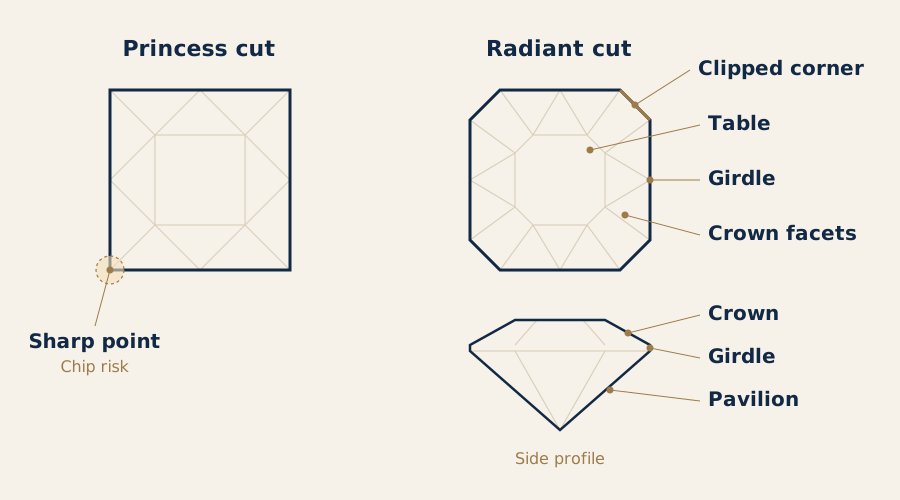
Clipped corners are not unique to radiants. Emerald and Asscher cuts are also cut-cornered, but they use long, parallel step facets rather than brilliant facets. Seeing where the radiant sits among its relatives is easier with our overview of how every diamond shape is built, and the radiant also appears in our guide to all 34 diamond cuts explained. Any unfamiliar word below is explained in our glossary of jewellery terms.
Why are radiant diamond corners clipped?
The short answer is durability. Diamond is the hardest natural material, 10 on the Mohs scale, but hardness (resistance to scratching) is not the same as toughness (resistance to chipping). Diamond has cleavage: four directions in its crystal structure along which it can split cleanly if it takes a sharp knock at the wrong angle. Thin edges and sharp points concentrate that force.
A square or rectangular stone with pointed corners has four of those weak spots, each where the crown, pavilion and girdle (the thin outer edge around the widest part of the stone) meet at a sharp tip. That is why the princess cut, the radiant's sharp-cornered cousin, is usually set with protective V-claws. Cutting the corners off removes the point entirely, so a knock lands on a flat edge with more material behind it. Our princess vs radiant comparison goes through the practical difference in everyday wear.
- Toughness: no sharp points, so radiant cut corners are far less likely to chip than princess corners.
- Setting choice: because the corners are not fragile tips, a radiant can take a wider range of claw styles.
- Outline: the clipped corners soften the square or rectangle, giving a gentler, octagonal look.
- Faceting space: the corner gives the cutter an extra facet zone, which helps spread brilliance into the ends of the stone.
The clipped corner is a deliberate part of the design, not a fault or a way of hiding damage. That said, it is still the outermost edge of the stone, and a corner with a very thin girdle can still chip. That is why the girdle description on the report matters, as covered further down.
Related guidePrincess vs Radiant Cut DiamondsHow do clipped corners change a radiant's sparkle?
A radiant's facet pattern is a busy mix of triangles and kites, which breaks light into many small flashes. People often call this a crushed ice look: lots of small, lively sparkle rather than the larger, bolder flashes of a round. The corners play their part, because the facets that run into each clipped corner carry that sparkle out to the ends of the stone.
When the pavilion angles near the corners are well judged, light returns to your eye right across the stone. When they are too steep or too shallow, the corners can look darker or glassy compared with the centre. You may also see a bow-tie, a dark band across the middle where light leaks out instead of coming back up. Both effects are easiest to judge on a 360° video, because a still photo can hide or exaggerate them.
This is the clearest difference between a radiant and an emerald cut, even though they share the same outline. An emerald's step facets create broad flashes and a hall-of-mirrors look with clear views into the stone; a radiant's brilliant facets scatter light and hide inclusions more easily. Our guide to how emerald step facets differ from radiant brilliance compares the two face-up.
Do corner sizes vary between radiant diamonds?
Yes, and more than most buyers expect. There is no fixed industry standard for how big a radiant's clipped corners should be, so each cutter makes a choice. The size of the corner relative to the sides changes the character of the stone:
| Corner size | How it looks | Closest to |
|---|---|---|
| Small (a short clip) | Crisp, nearly square-cornered outline | A princess cut, with more durability |
| Medium | Balanced octagon; the classic radiant look | The traditional radiant outline |
| Large (a long clip) | Softer, more rounded-looking octagon | An emerald or Asscher outline, with brilliant facets |
| Uneven | One or more corners noticeably longer or shorter | A sign of less careful cutting |
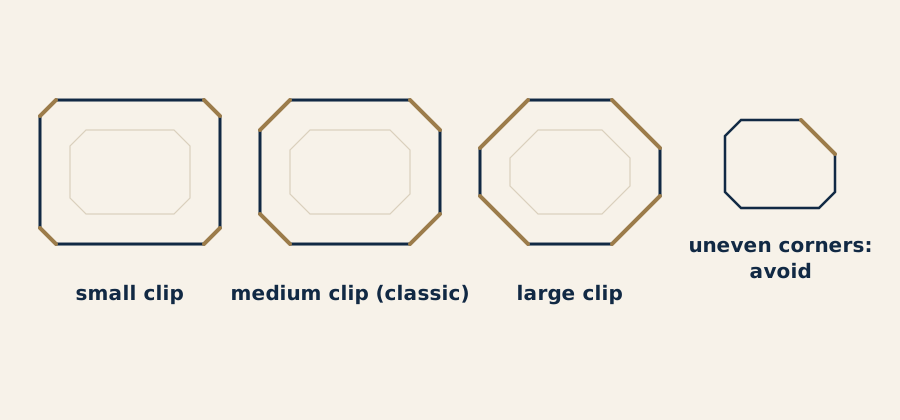
None of these is right or wrong; it is personal taste. What matters is that all four corners on the same stone match. Uneven corners make the outline look skewed, and in a four-claw setting they mean the claws sit at slightly different positions, which is easy to spot once the ring is on the hand. The effect is most obvious in square radiants with a 1.00–1.05 ratio, where the eye expects perfect symmetry.
Not sure which one is right?
Send us the stones you are looking at and our gemologist will tell you which to choose and why.
How do radiant corners compare with princess, emerald and cushion corners?
Corners are the easiest way to tell the square and rectangular shapes apart. This table puts radiant vs princess corners and the other close relatives side by side:
| Radiant | Princess | Emerald | Asscher | Cushion | |
|---|---|---|---|---|---|
| Corners | Clipped (cut-cornered) | Sharp points | Clipped | Large clipped | Rounded |
| Facet style | Brilliant | Brilliant | Step | Step | Brilliant (usually) |
| Outline | Octagonal square or rectangle | Square | Octagonal rectangle | Octagonal square | Pillow-like square or rectangle |
| Corner chipping risk | Low | Higher | Low | Low | Low |
| Typical corner protection | Claws at each corner or a bezel | V-claws | Claws or bezel | Claws or bezel | Round or claw tips |
| Hides inclusions | Well | Well | Less well | Less well | Well |
The cushion is the shape most often confused with a radiant, because both can be square or rectangular with lively brilliant faceting. The giveaway is the corner: a cushion's corners are curved, while radiant diamond corners are straight, flat clips. Curved sides and corners give a cushion a softer, pillow-like outline; the radiant looks more architectural. See radiant vs cushion side by side for photos and pricing patterns.
If you are torn between a crisp square and something softer, the radiant often sits in the middle: squarer than a cushion, tougher than a princess, and brighter than an emerald.
How do radiant corners look at different length-to-width ratios?
The length-to-width ratio is the stone's length divided by its width, taken from the measurements on the report. It changes how the corners read. On a square radiant all four clipped corners are equal and very visible; on a long rectangle they shrink relative to the long sides and the outline looks more like a softened bar.
| Ratio | Shape | Approximate 1 ct size | How the corners read |
|---|---|---|---|
| 1.00–1.05 | Square | about 5.4 × 5.4 mm | Four equal corners, very visible; any mismatch shows |
| 1.10–1.20 | Slightly rectangular | about 5.8 × 5.0 mm | Corners still prominent, softer outline |
| 1.20–1.35 | Classic rectangle | about 6.2 × 4.9 mm | Corners frame the ends; a popular engagement look |
| 1.35–1.50 | Elongated | about 6.6 × 4.7 mm | Corners smaller relative to the long sides |
These sizes are typical only. Radiants are often cut fairly deep, which keeps weight underneath and makes them face up (look from above) a little smaller than a round or oval of the same carat weight; our comparison of which diamond shapes face up largest for their weight puts the numbers side by side. Two 1 ct radiants can differ by several tenths of a millimetre across, so compare measurements, not just carat. Our radiant ratio guide with millimetre examples covers this in more depth, and if you prefer a longer look, see longer rectangular radiants above 1.30.
What is the best setting to protect radiant diamond corners?
Because radiant diamond corners are clipped rather than pointed, you have more freedom than with a princess cut. The setting still needs to guard the corners, since they are the edges most likely to meet a door frame or benchtop. Common choices:
- Four claws, one on each corner: the classic choice. The claw should sit squarely over the clipped edge so it covers the corner rather than gripping a side.
- Double claws: two slim claws either side of each corner, for eight in total. Very secure and they frame the octagonal outline.
- Flat or V-shaped claw tips: a flat-faced claw shaped to sit along the clipped corner gives the most coverage; V-claws also work on radiants with small clips.
- Bezel or half-bezel: a rim of metal around the edge protects every corner, a good choice for active hands.
- Halo: a border of small diamonds follows the octagonal outline and shields the girdle, while making the centre stone look larger.
Here the corner size matters in a very practical way. A claw made for a stone with small clips may not sit properly on one with large clips, and a gap at the corner leaves the edge exposed. That is why the setting should be built around the real stone. Our guide on why exact millimetre measurements matter for a custom setting explains how a seat is cut to fit, and you can see finished designs in our page on radiant engagement ring designs and claw styles.
Do corners affect radiant diamond price, natural or lab-grown?
The corners themselves do not have a price grade, but they feed into what you pay. A radiant with even corners, a sensible girdle and good light return across the ends is a better-cut stone, and that is reflected in price. Very uneven corners or an extremely thin girdle at the corners are reasons a stone might be priced lower, and reasons to look carefully before choosing it.
Radiants are cut from both natural and laboratory-grown diamond. Lab-grown diamonds are real diamond, with the same hardness of 10 and refractive index of about 2.42, grown in a laboratory rather than mined. They cost much less and are easy to find in larger sizes. Natural radiants are rarer. Both should come with an independent grading report, such as GIA or IGI, which states whether the stone is natural or lab-grown.
| 1 ct radiant, G–H colour, VS clarity | Approximate price range (AUD) |
|---|---|
| Lab-grown | about $900–$3,000 |
| Natural | about $6,000–$14,000 |
These are broad ranges only, and prices move with the market and the exact grades. Radiants usually cost less per carat than a round of the same weight, colour and clarity; our page on how prices differ across the main diamond shapes sets out the pattern. Because the brilliant faceting hides body colour and small inclusions well, many people choose an H or I colour and an eye-clean SI1 radiant. For grade-by-grade advice, see radiant colour, clarity and price in more depth.
Browse radiant diamonds: natural and lab-grown
How do you check radiant diamond corners before you buy?
- Read the report. Confirm the shape (cut-cornered square or rectangular modified brilliant), the measurements, and whether the diamond is natural or lab-grown.
- Check the girdle description. Aim for a range such as Thin to Medium or Medium to Slightly Thick. Avoid Extremely Thin, which leaves the corners exposed.
- Compare the four corners. On a face-up photo or video, the clipped edges should be the same length and at matching angles.
- Watch the corners on a 360° video. They should sparkle like the centre, not look dark or glassy, and any bow-tie should come and go rather than stay put.
- Look for inclusions at the corners. A feather (small internal crack) that reaches the girdle at a corner is worth avoiding; the plotting diagram on the report shows where inclusions sit.
- Work out the ratio. Divide length by width: about 1.00–1.05 for square, 1.20–1.35 for a classic rectangle.
- Plan the claws around the stone. Make sure the setting is built to the measured corners, so each claw covers its corner fully.
If a term on the report is unfamiliar, our plain-English jewellery glossary explains girdle descriptions, plotting diagrams and the rest.
Free consultation
Talk to a gemologist
Compare stones in person or online with Raj Sood, Graduate Gemologist (GIA), AJP (GIA).
Book a consultationFAQ
Common questions
Why does a radiant diamond have clipped corners?
The corners are cut off to remove the sharp points a square or rectangle would have. Points are where a diamond is most likely to chip, so clipping them makes the radiant tougher and gives it an octagonal outline.
Do radiant cut diamonds chip easily?
Not usually. Their clipped corners are far less vulnerable than a princess cut's points. The main thing to avoid is an extremely thin girdle at the corners, and a setting with claws over each corner adds protection.
What is the difference between radiant and cushion corners?
Radiant corners are straight, flat clips, so the outline is octagonal. Cushion corners are curved, giving a softer, pillow-like shape.
Do I need V-claws for a radiant diamond?
Not necessarily. Because radiant corners are clipped, standard or flat-faced claws placed over each corner work well, as do double claws or a bezel. V-claws are usually recommended for princess cuts, which have sharp points.
Should all four corners of a radiant be the same size?
Yes. Corner size varies between cutters, but on any one stone the four clipped corners should match. Uneven corners make the outline look skewed and the claws sit unevenly.
Are lab-grown radiant diamonds cut the same way?
Yes. Lab-grown radiants use the same cut-cornered outline and brilliant faceting as natural radiants and are real diamond. They cost much less, and the grading report will state that the stone is lab-grown.

Ask a gemologist
Not sure which diamond to choose?
Raj Sood is a Graduate Gemologist (GIA) and master jeweller. Bring the stones you are considering, or send the reports, and he will tell you honestly which one is better and why.
Keep learning
Related guides
 Diamond ShapesRadiant Cut Diamonds
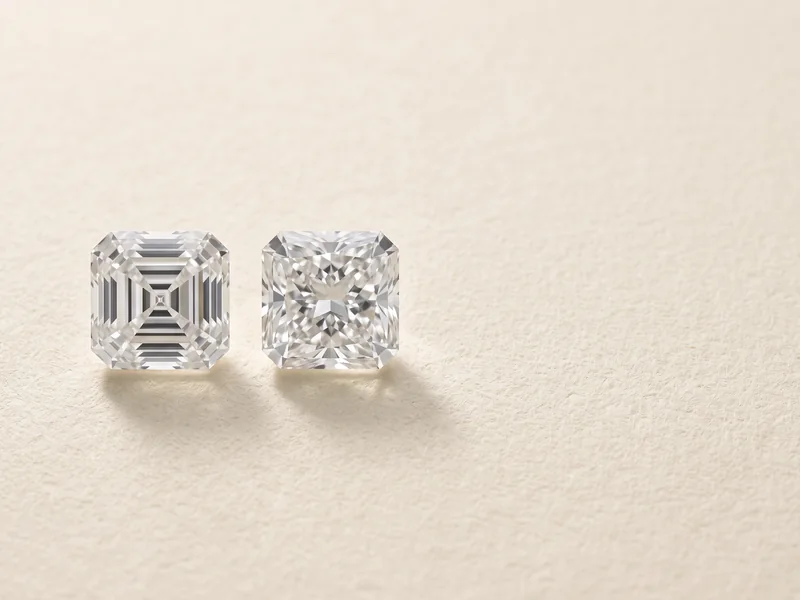 Diamond ShapesPrincess vs Radiant Cut DiamondsDiamond ShapesRadiant Diamond Length-to-Width Ratio GuideEngagement Rings & SettingsRadiant Cut Engagement RingsDiamond ShapesUnderstanding Diamond Shapes
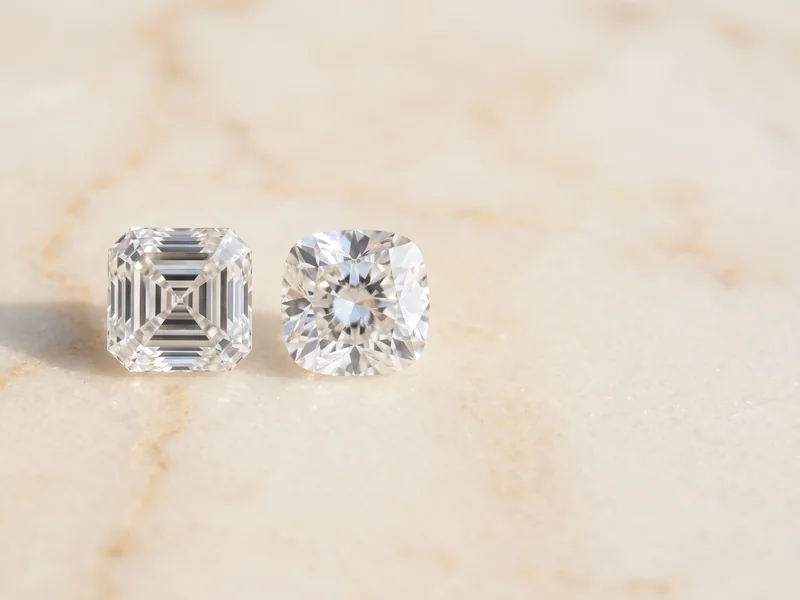 Diamond ShapesRadiant vs Cushion Cut DiamondsDiamond ShapesEmerald vs Radiant Cut DiamondsDiamond ShapesElongated Radiant Cut Diamonds
Explore more
More guides on this topic
Education