
- Education
- Diamond Shapes
- Flanders Cut Diamond Guide: Facets, Ratio, Colour and Settings
Diamond shapes
Flanders Cut Diamond Guide: Facets, Ratio, Colour and Settings
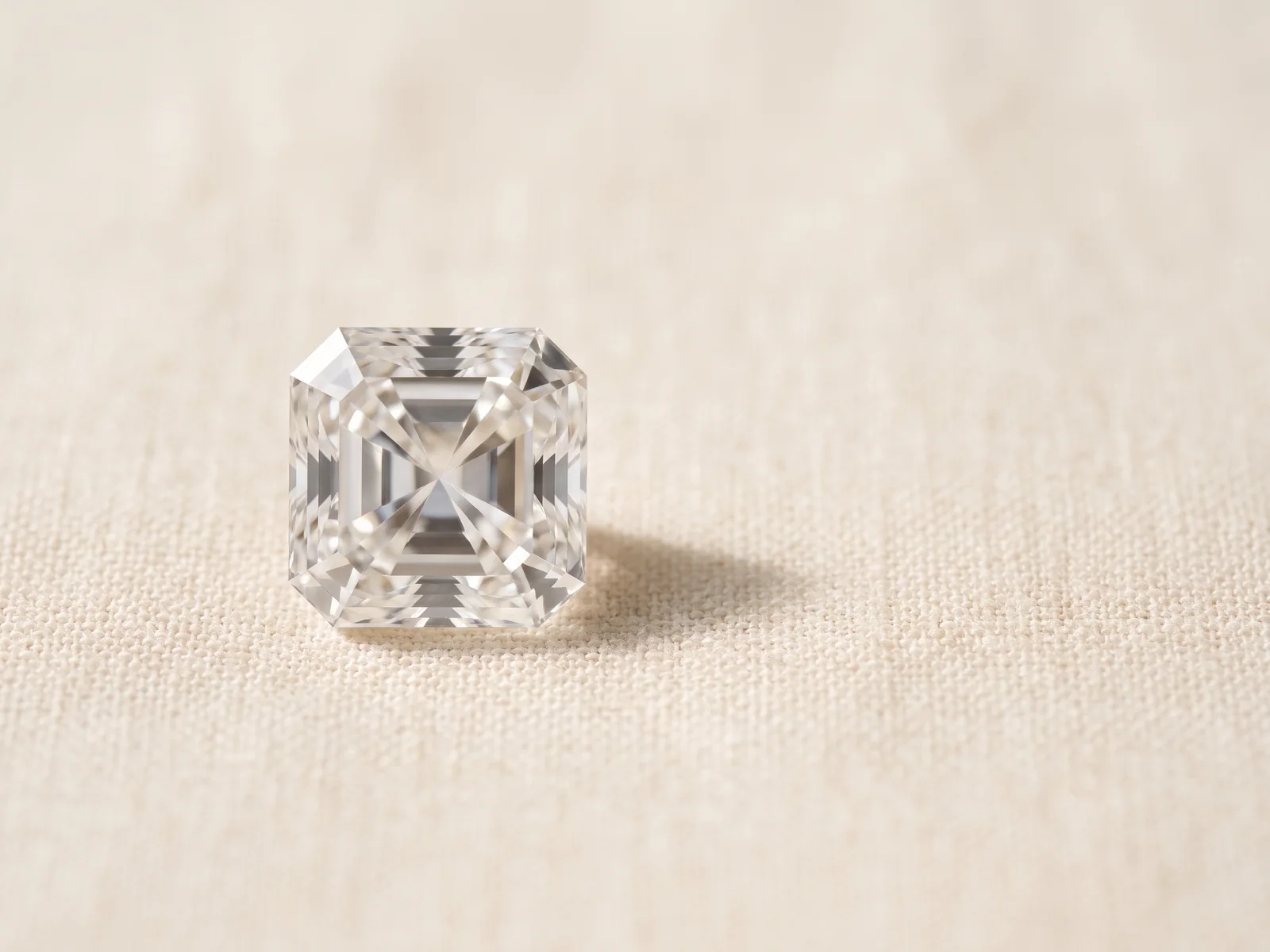
The Flanders cut diamond is one of the rarest square shapes you can buy: a brilliant-cut square with its corners trimmed off. Here is how it is faceted, what proportions to look for and how it compares with princess, radiant and cushion cuts.
 Reviewed by Raj Sood, Graduate Gemologist (GIA), AJP (GIA)Master jeweller and Graduate Gemologist (GIA) · reviewed 4 November 2026
Quick answer
A Flanders cut diamond is a square brilliant with cut-off corners, usually 61 facets, developed by Antwerp cutters and named after the Flemish region of Belgium. Look for a ratio of about 1.00–1.05, eye-clean VS2–SI1 clarity, H colour or better in white metal, and four claws or a bezel. It is rare, so most are sourced to order.
What is a Flanders cut diamond?
A Flanders cut diamond is a square brilliant with its four corners cut off. Those trimmed corners are called truncated corners, and they give the stone an eight-sided (octagonal) outline when you look at it from above, even though it still reads as a square on the hand. The name comes from Flanders, the Dutch-speaking region of Belgium that includes Antwerp, one of the world's oldest diamond cutting centres. You may also see it sold as the Flanders Brilliant.
"Brilliant" describes the faceting style: lots of triangular and kite-shaped facets arranged to break light into sparkle, rather than the long, flat, mirror-like facets of a step cut such as an emerald or Asscher. So a Flanders sits in the same family as the princess and the square radiant, but with a softer, slightly vintage outline.
It is genuinely uncommon. Most cutters and retailers never list one, and many shape charts leave it out altogether. Our guide to every diamond cut, including the rare ones places it alongside the other unusual shapes, and the family of square and cushion cuts shows where it fits among its closest relatives. If you are new to shapes in general, start with our introduction to how diamond shapes differ.
Like any diamond, a Flanders is 10 on the Mohs hardness scale, with a refractive index of about 2.42, which is what lets brilliant faceting return so much light. Any term here you have not met before is explained in our plain-English jewellery glossary.
How is a Flanders cut diamond faceted?
A typical Flanders has 61 facets, although the exact number varies a little between cutters. There are three things to look at in the facet pattern:
- The table: the large flat facet on top. On a Flanders it usually follows the stone's outline, so it is square with small trimmed corners.
- The crown: the upper part, between the table and the girdle (the thin outer edge). It carries brilliant-style facets that send light back up as sparkle.
- The pavilion: the lower part, pointing down to the culet (the tip or tiny facet at the bottom). Its main facets run towards the corners, which many people see as a cross or X pattern when the stone is face-up, similar to a princess.
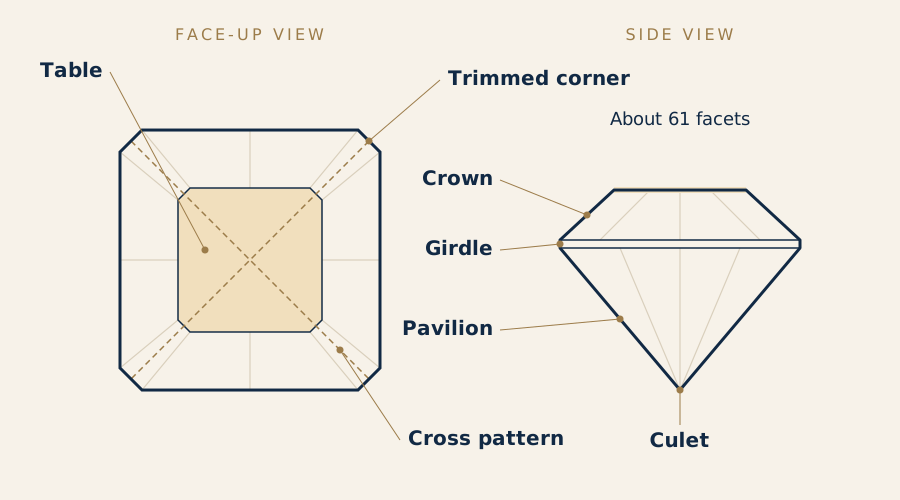
The result is a stone that looks crisper and more geometric than a cushion, but less sharp-edged than a princess. The light pattern tends to be bold and well defined rather than the fine, scattered sparkle of a crushed ice cushion.
It helps to see the Flanders in the long history of faceting. Older cuts had far fewer facets: our comparison of how a flat-backed rose cut differs from a brilliant explains why brilliants took over. Cutters have also experimented with heavily faceted designs such as the many-faceted Portuguese cut and decorative patterns like the six-pointed star cut. The Flanders is more restrained: a clean square brilliant with practical corners.
What are the ideal proportions and ratio for a Flanders cut diamond?
The length-to-width ratio compares the stone's length with its width. Divide one by the other using the measurements on the grading report. A ratio of 1.00 is a perfect square. Most people choose a Flanders between about 1.00 and 1.05, where the eye reads it as square.
| Ratio | How it looks | Suits |
|---|---|---|
| 1.00–1.03 | A true square | Classic solitaires and studs |
| 1.03–1.05 | Square to most eyes | Most engagement rings |
| 1.05–1.10 | Faintly rectangular | Fine if you like a slightly longer look |
| Above 1.10 | Clearly rectangular | Rarely cut; looks more like a rectangular radiant |
GIA does not give fancy shapes such as the Flanders an overall cut grade, so you judge the cut from the proportions, the polish and symmetry grades, and the stone itself. As a rough guide, square brilliants like the Flanders often sit at a total depth of about 65–75% and a table of about 60–72% of the width. A stone much deeper than that carries hidden weight underneath and looks small for its carat; much shallower and it can look glassy or show a dull centre.
Because the corners are trimmed, a Flanders is a little smaller face-up than a princess cut to the same depth, since that corner area is gone. The difference is small. Typical face-up sizes for a square Flanders at around 70% depth:
| Carat weight | Typical size (length × width) |
|---|---|
| 0.30 ct | about 3.8 × 3.8 mm |
| 0.50 ct | about 4.5 × 4.5 mm |
| 0.75 ct | about 5.1 × 5.1 mm |
| 1.00 ct | about 5.5 × 5.5 mm |
| 1.50 ct | about 6.3 × 6.3 mm |
| 2.00 ct | about 7.0 × 7.0 mm |
Always compare the millimetre measurements, not just the carat weight. Two 1 carat stones can differ by a few tenths of a millimetre, which you can see once they are set.
What colour and clarity should you choose for a Flanders cut?
Square brilliants tend to hold body colour in the corners, where light travels a longer path through the stone. Trimming the corners helps a little, but a Flanders still shows warmth more readily than a round. In white gold or platinum, most people are happy with H colour or better; choose G or higher if you are sensitive to a warm tint. In yellow or rose gold, I or J can look white, because the metal warms the whole ring.
For clarity, aim for an eye-clean stone: no inclusions (internal features) you can see without magnification at normal viewing distance. Brilliant faceting hides small inclusions well, so VS2 or a carefully chosen SI1 is usually enough. The places to watch are the corners and the girdle, where an inclusion that reaches the surface can become a weak point, and where claws may have to sit on top of it. The plotting diagram on the report shows where each inclusion is.
- White metal: G–H colour, VS2–SI1 eye-clean.
- Yellow or rose gold: I–J colour often looks white, VS2–SI1 eye-clean.
- Avoid: feathers (small internal cracks) or chips at the trimmed corners or along the girdle.
If you prefer a softer, glittery look that hides inclusions even better, a crushed ice cushion with its fine, broken-up sparkle is worth comparing. A Flanders has a cleaner, more structured light pattern, so inclusions near the centre are slightly easier to spot.
Not sure which one is right?
Send us the stones you are looking at and our gemologist will tell you which to choose and why.
Flanders cut vs princess cut: how do the square shapes compare?
The Flanders is easiest to understand next to the shapes it is usually confused with.
| Flanders | Princess | Square radiant | Cushion | |
|---|---|---|---|---|
| Outline | Square with trimmed corners | Square with sharp corners | Square with trimmed corners | Square with rounded corners |
| Typical facets | about 61 | about 50–58 | about 70 | about 58–64 |
| Face-up look | Bold cross, clean sparkle | Strong X, crisp sparkle | Lively, crushed-ice style sparkle | Soft, pillowy sparkle |
| Typical ratio | 1.00–1.05 | 1.00–1.05 | 1.00–1.05 | 1.00–1.10 |
| Corner chip risk | Low | Higher (sharp points) | Low | Low |
| Availability | Rare | Widely available | Available | Widely available |
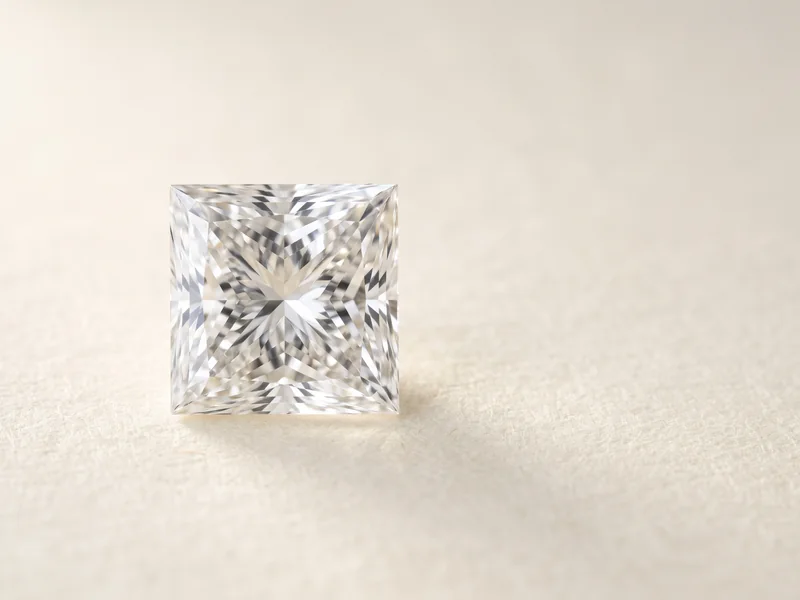
The princess cut is the Flanders' nearest relative. Both are square brilliants with a cross pattern, but the princess keeps four sharp points that need claws to protect them. The Flanders gives up a little of that crisp outline in exchange for tougher corners.
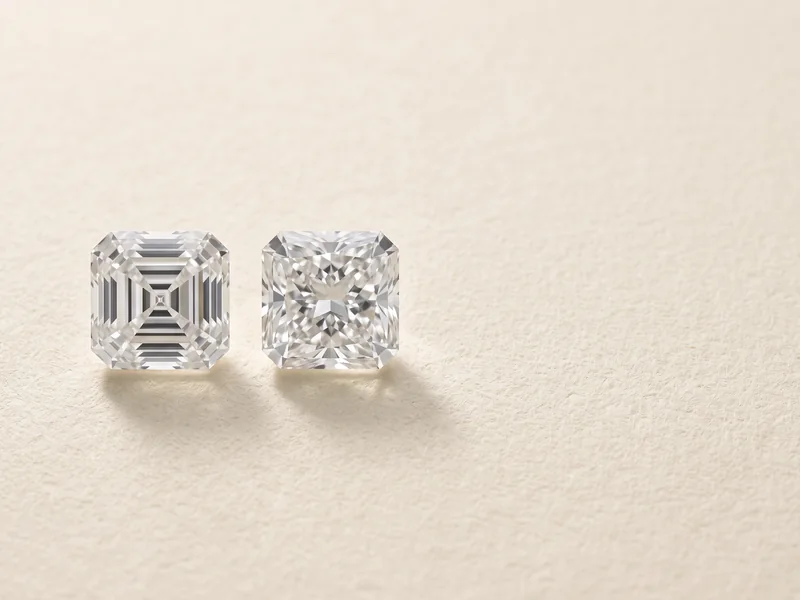
The square radiant also has trimmed corners, so the outlines look almost identical. The difference is inside: a radiant has more facets and a busier, more broken-up sparkle, while the Flanders is cleaner and more geometric. Our main radiant cut diamond guide covers rectangular radiants too.
A cushion cut, with its rounded pillow outline, is softer still and much easier to find. If you are drawn to octagonal and other many-sided outlines, the six-sided hexagonal cut is another geometric option worth seeing.
Related guideSquare and Cushion Cuts: Princess, Radiant, Cushion and FlandersWhat is the best setting for a Flanders cut diamond ring?
Because the corners are trimmed rather than pointed, a Flanders is more forgiving to set than a princess. The usual choices for a Flanders cut engagement ring:
- Four claws: one on each trimmed corner. Flat or slightly V-shaped claws suit the small corner facets and leave most of the outline on show.
- Double claws: two claws at each corner (eight in total) for extra security and a more detailed look.
- Bezel or half-bezel: a thin rim of metal around the edge. Very secure and practical for active hands, though it hides a little of the outline.
- Halo: a square or octagonal halo of small diamonds makes the centre look larger and protects the girdle.
- Side stones: trapezoid side stones and bullet cut shoulders echo the straight edges, while triangular accents, shield cut side diamonds or slim lozenge cuts give a more architectural three-stone design.
A Flanders also works well in studs and pendants. Its square outline sits neatly in a four-claw stud, and the trimmed corners are less likely to catch on hair or clothing than a princess's points.
For the wedding band, the Flanders' straight sides are an advantage. A plain straight band, or a band of small square or round diamonds, usually sits flush against a solitaire, especially if the setting is low or the basket under the stone is kept slim. A halo may need a slightly curved or notched band to sit close. Try the two rings together before you decide.
How much does a Flanders cut diamond cost, natural or lab-grown?
Flanders cuts are made from both natural and laboratory-grown diamond, and the two look identical to the eye. Lab-grown diamonds are real diamond, grown in a laboratory rather than mined; they cost much less and are easier to have cut to a specific shape. Natural Flanders cuts are harder to find, because few cutters produce them. Both should come with an independent grading report from a lab such as GIA or IGI that states whether the stone is natural or lab-grown.
| 1 ct Flanders, G–H, VS | Approximate price range (AUD) |
|---|---|
| Lab-grown | about $800–$2,500 |
| Natural | about $6,000–$12,000 |
These are broad ranges only; prices move with the market and the exact grades. Square brilliants usually cost less per carat than a round of the same weight, colour and clarity, because more of the rough crystal is kept. A Flanders tends to sit in a similar range to a princess, but rarity cuts both ways: there is less demand, yet fewer stones to choose from, and a stone cut to order can cost more than one already on the market.
At the time of writing we hold no Flanders cut diamonds in stock. If the look appeals, a well-cut square radiant or princess gives a similar outline and is far easier to find, or a Flanders can be sourced to your preferred size and grades.
Browse all diamonds (no Flanders in stock right now)
How do you choose a Flanders cut diamond? Step by step
- Confirm the cut name. Check the report and the seller's description; a square radiant or cut-corner princess is sometimes listed loosely as a Flanders.
- Read the report. Note the measurements, colour, clarity, polish, symmetry, and whether the diamond is natural or lab-grown.
- Work out the ratio. Divide length by width; about 1.00–1.05 reads as square.
- Check the proportions. Total depth of roughly 65–75% keeps the stone from looking small or glassy.
- Inspect the corners. All four trimmed corners should be equal, with no chips or inclusions reaching the surface.
- Watch a video. Look for an even cross pattern and no dark patches as the stone moves.
- Plan the setting. Choose claws that sit on the trimmed corners, or a bezel, and check the band sits flush.
Free consultation
Talk to a gemologist
Compare stones in person or online with Raj Sood, Graduate Gemologist (GIA), AJP (GIA).
Book a consultationShop this shape
FAQ
Common questions
What is the difference between a Flanders cut and a princess cut?
Both are square brilliants with a cross-shaped facet pattern. A princess has four sharp corners, while a Flanders has its corners trimmed off, which makes it less likely to chip.
Is a Flanders cut the same as a square radiant?
No, though the outlines look very similar. A square radiant usually has more facets and a busier, crushed-ice style sparkle, while a Flanders has about 61 facets and a cleaner, more geometric pattern.
Why is the Flanders cut so rare?
Few cutters produce it and few retailers list it, so demand stays low and supply stays small. Most Flanders cuts are sourced or cut to order rather than bought off the shelf.
Is a Flanders cut diamond good for an engagement ring?
Yes. Its trimmed corners are tougher than a princess's points, and with four claws or a bezel it suits everyday wear.
Can you get a lab-grown Flanders cut diamond?
Yes. Laboratory-grown diamond can be cut to a Flanders shape, costs much less than natural and is graded by labs such as IGI and GIA, with the report stating that it is lab-grown.
What ratio should a Flanders cut diamond have?
About 1.00–1.05 for a stone that looks square. Above about 1.10 it reads as a rectangle.

Ask a gemologist
Not sure which diamond to choose?
Raj Sood is a Graduate Gemologist (GIA) and master jeweller. Bring the stones you are considering, or send the reports, and he will tell you honestly which one is better and why.
Keep learning
Related guides
 Diamond ShapesPrincess Cut Diamonds
 Diamond ShapesSquare Radiant Cut Diamonds
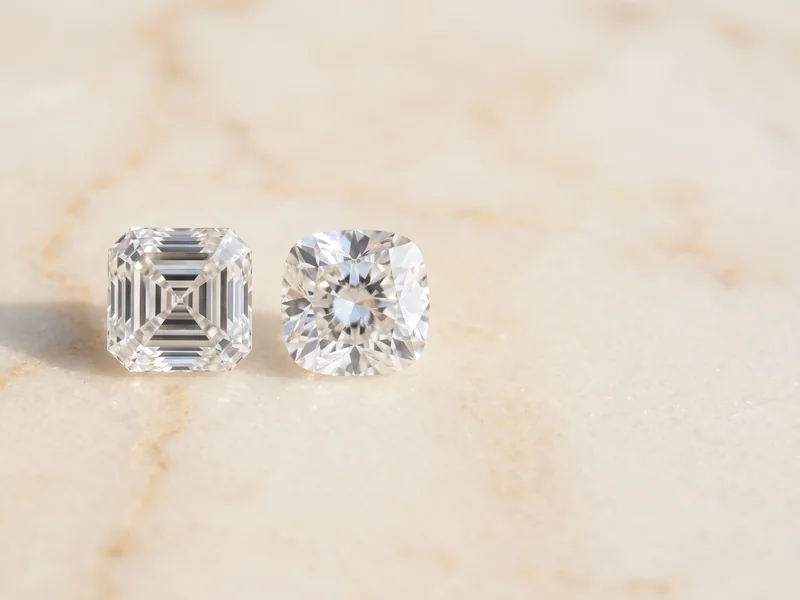 Diamond ShapesCushion Cut Diamonds: Brilliant, Modified & Buying GuideDiamond ShapesSquare and Cushion Cuts: Princess, Radiant, Cushion and FlandersDiamond ShapesUnderstanding Diamond Shapes
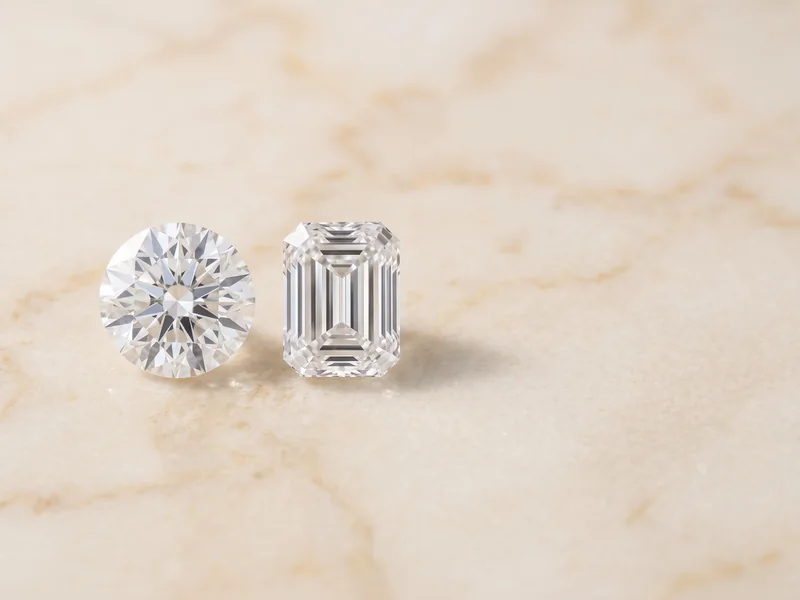 Diamond ShapesAll 34 Diamond Cuts: Every Shape Explained and Compared
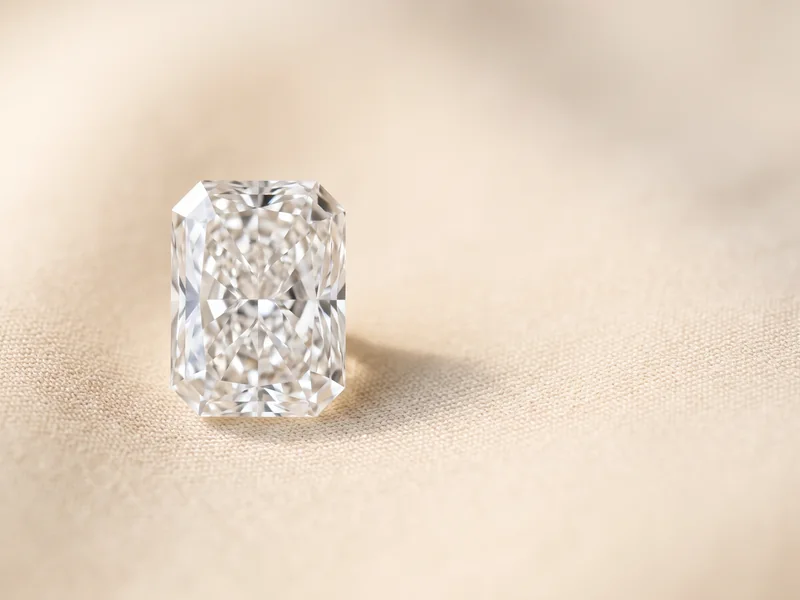 Diamond ShapesRadiant Cut Diamonds
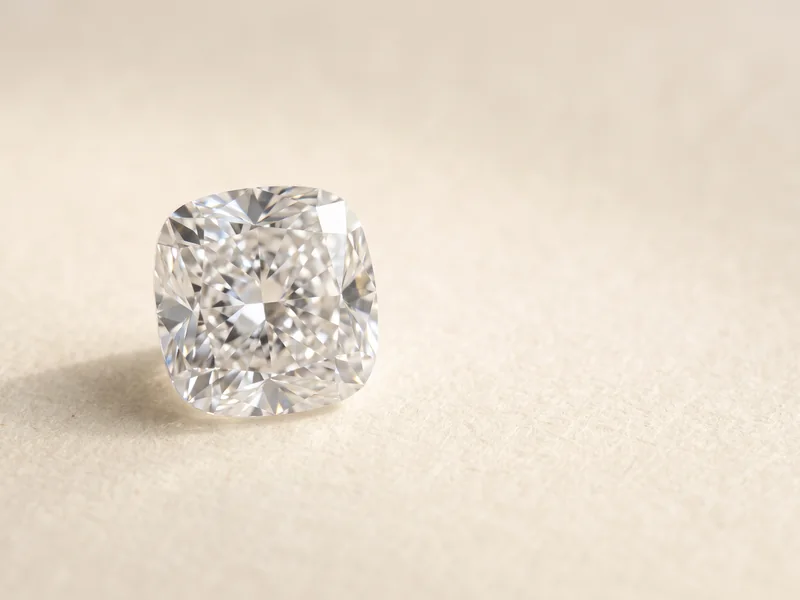 Diamond ShapesCushion Modified (Crushed Ice) Cut Diamonds
Explore more
More guides on this topic
Education