
- Education
- Diamond Shapes
- Crushed Ice Radiant Diamond vs Brilliant Facet Patterns: How to Tell Them Apart
Diamond shapes
Crushed Ice Radiant Diamond vs Brilliant Facet Patterns: How to Tell Them Apart
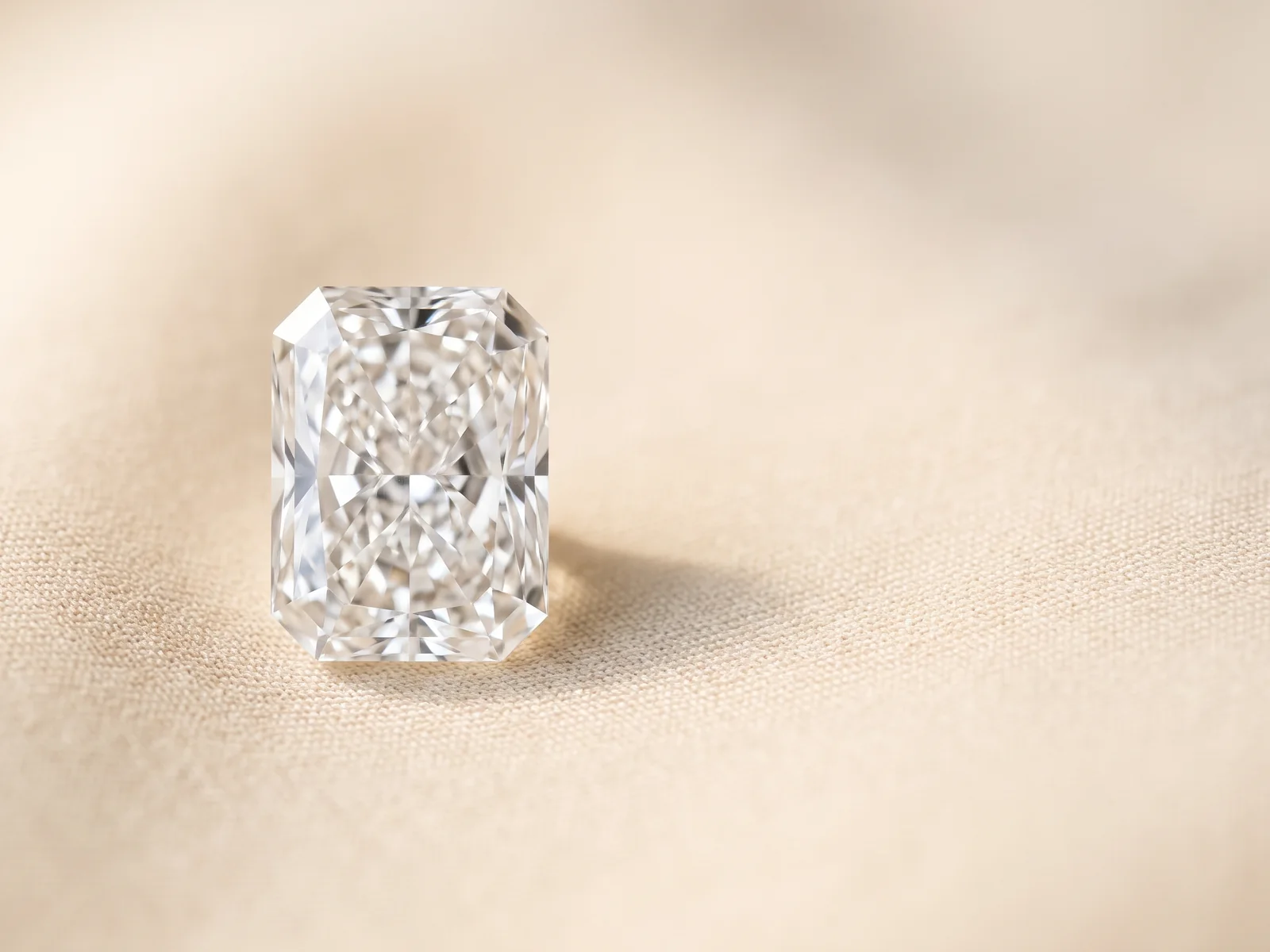
Two radiant diamonds with identical grades can sparkle in completely different ways. Here is how to tell a crushed ice radiant diamond from a brilliant facet pattern, why cutters choose each, and how the pattern affects colour, clarity, size and price.
 Reviewed by Raj Sood, Graduate Gemologist (GIA), AJP (GIA)Master jeweller and Graduate Gemologist (GIA) · reviewed 4 November 2026
Quick answer
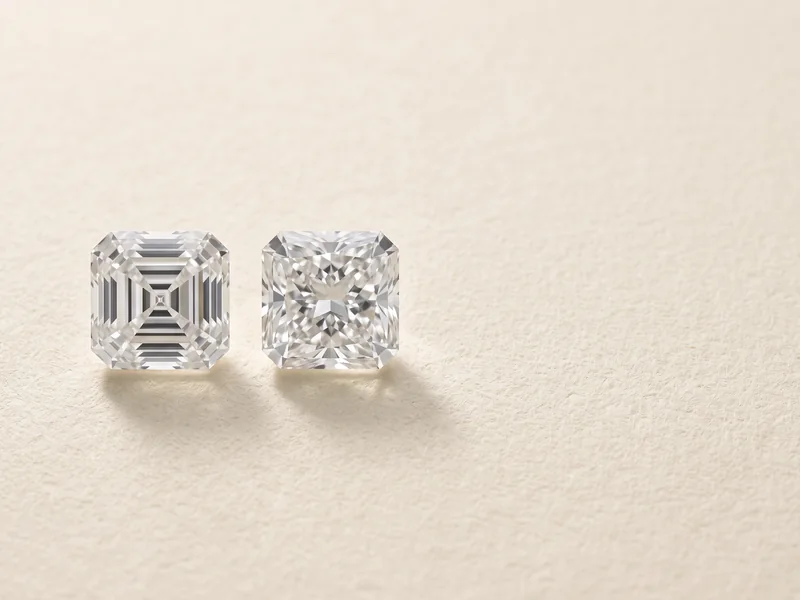
A crushed ice radiant diamond has many small, split pavilion facets that return light as fine, glittery pinpoints. A brilliant or 'chunky' radiant has fewer, larger facets that give bigger, bolder flashes and a visible X pattern. Neither appears on the grading report, so judge by eye in a 360° video and choose the look you prefer.
What is a crushed ice radiant diamond?
A radiant cut is a square or rectangular diamond with its four corners cut off (cropped), faceted in a brilliant style on both the crown (the top half, above the outer edge) and the pavilion (the bottom half). Henry Grossbard introduced it in 1977, and it was the first rectangular shape to pair an emerald-like outline with the kind of sparkle you see in a round brilliant. Most radiants have about 70 facets, though the count changes from cutter to cutter. For the full background on proportions and grading, see our complete radiant cut diamond guide.
A crushed ice radiant diamond is a radiant whose pavilion is cut with many small, split or extra facets. Instead of a few large flashes, light comes back to your eye as hundreds of tiny pinpoints, a bit like sunlight in a glass of crushed ice. The name describes a look, not a grade. You will not find the words 'crushed ice' on a GIA or IGI report. GIA lists a radiant as a cut-cornered rectangular modified brilliant or cut-cornered square modified brilliant, whatever its facet pattern.
The other main style is the brilliant pattern, which the trade often calls 'chunky'. It uses fewer, longer pavilion facets and gives larger, more defined flashes. Plenty of stones sit in between, and these are called hybrid patterns. The same split shows up in cushions too, and it is part of how different diamond shapes are faceted more broadly. The radiant is also one of the 34 diamond cuts in our shape library. Any unfamiliar word on this page, from culet to girdle, is explained in our plain-English jewellery glossary.
Diamond has a refractive index of about 2.42 (how strongly it bends light) and a dispersion of about 0.044 (how much it splits white light into spectral colours, which jewellers call fire). Facet pattern does not change either number. What it changes is the size of each flash. Large facets return light in broad blocks, with more visible colour in each flash. Small facets break the same light into fine glitter: less fire per flash, but many more points of sparkle.
What does a brilliant facet pattern look like in a radiant?
In a brilliant-pattern radiant, the pavilion has long main facets running from the girdle (the thin outer edge of the stone) down towards the culet, the point or tiny flat facet at the very bottom. Face-up, these reflect through the table (the large flat top facet) as a recognisable structure: an X or starburst running from the cropped corners to the centre, with clear, broad flashes of white and coloured light. The effect is closer to a princess or round brilliant than to an emerald cut.
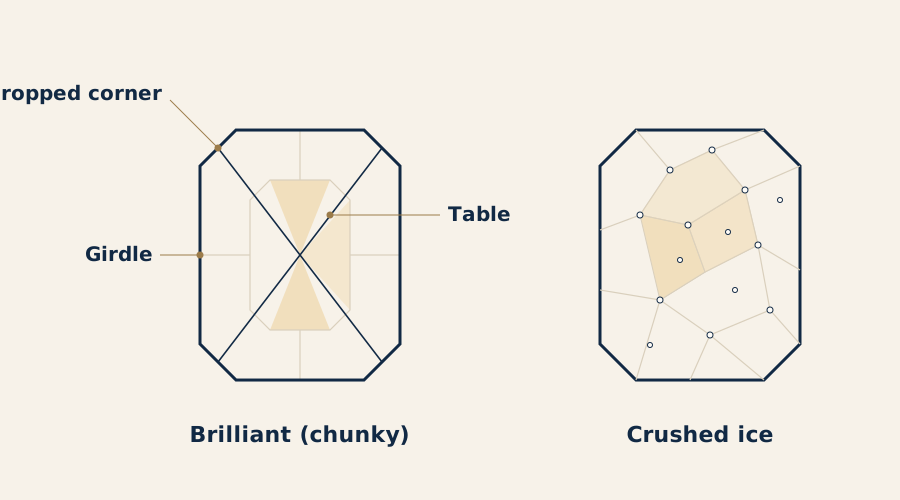
The signs of a brilliant or chunky radiant:
- A defined centre: you can trace lines or arrows from the corners into the middle of the stone.
- Larger flashes: individual flashes are easy to pick out, even in a 1 carat stone.
- Visible contrast: darker facets sit between the bright ones, giving a crisp, patterned look that some people describe as more architectural.
- More fire per flash: bigger facets spread colour out further, so rainbow flashes are more noticeable under spotlights.
If the brilliant pattern reminds you of a princess cut, that is because the two are close relatives. The main differences are the princess's sharp, uncut corners and its chevron-style pavilion; our page on how a radiant differs from a princess cut sets them side by side.
Crushed ice vs brilliant radiant: which sparkles more?
Neither pattern returns more light by default. A well-cut crushed ice radiant and a well-cut brilliant radiant can both be very bright; they simply break that light up differently. The choice is mostly about taste, with some practical knock-on effects for clarity, colour and face-up size.
| Crushed ice | Hybrid | Brilliant (chunky) | |
|---|---|---|---|
| Face-up look | Fine, glittery, even sparkle | Glitter in the centre, defined flashes towards the edges | Bold flashes with a clear X or starburst |
| Size of flashes | Many tiny pinpoints | Mixed | Fewer, larger flashes |
| Fire per flash | Lower | Moderate | Higher |
| Defined facet pattern | Little or none | Partial | Clear |
| Hides small inclusions | Well | Fairly well | Less well |
| Hides uneven cutting | Well | Fairly well | Shows it more readily |
| Typical depth | Often towards the deeper end | Middle of the range | Often towards the shallower end |
| Common use | Fancy coloured radiants, those who like a soft glow | Most commercial radiants | Those who want the crisp look of a round or princess |
A hybrid radiant mixes both: a crushed ice centre framed by larger flashes near the corners, or a brilliant pattern softened by a few split facets. Many radiants on the market are hybrids, and they are worth considering if you like some definition but also want the gentler glitter. Because the boundary between styles is a matter of degree, two people can look at the same stone and describe it differently.
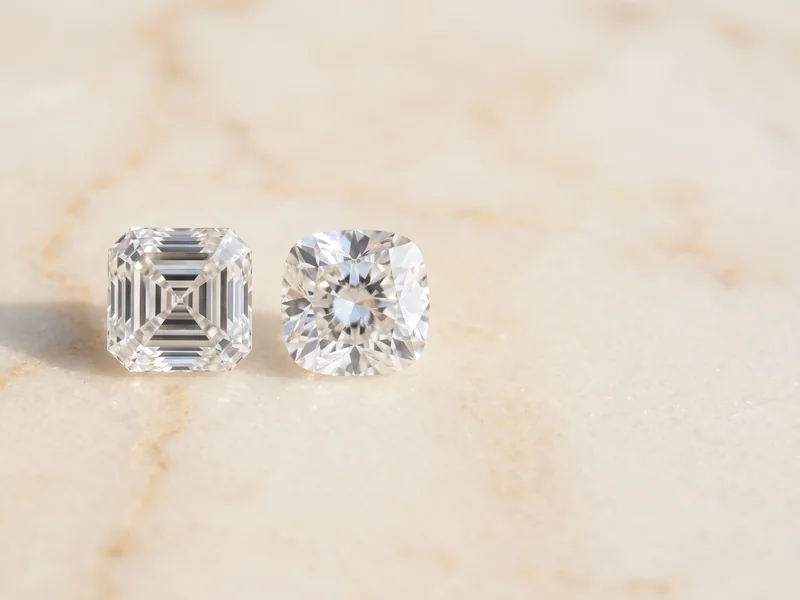
Related guideCushion Diamond Chunky Facets vs Crushed IceThe cushion cut faces exactly the same chunky vs crushed ice choice in cushions, and the reasoning carries over. If you are still deciding between the two shapes themselves, our radiant vs cushion comparison explains how the cropped corners of a radiant differ from the rounded corners of a cushion.
Why do some radiant diamonds look like crushed ice?
The facet pattern is a decision the cutter makes based on the rough crystal. Splitting the pavilion main facets into two or more tiers, or adding extra facets, lets the cutter keep more weight from deeper rough while still returning light. It can also cover dark areas that would show as dead patches with a simpler pattern, and it helps disguise small inclusions near the pavilion. A brilliant pattern needs more precise proportions to look good, so it often comes from rough that suits a slightly shallower stone.
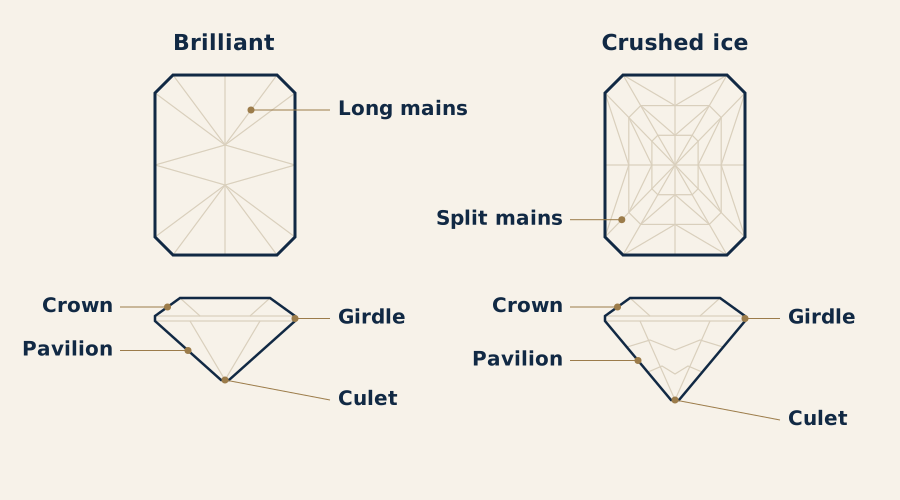
Because radiants are not given an overall cut grade by GIA, proportions are your best guide. These are typical ranges for well-cut radiants; a stone slightly outside them can still look lovely, so treat them as a starting point rather than a rule.
| Measurement | Typical range in a well-cut radiant | What it affects |
|---|---|---|
| Total depth | about 60–67% of the width | Above about 70% the stone faces up smaller for its weight |
| Table | about 61–69% of the width | Larger tables favour broad flashes; smaller tables favour fire |
| Girdle | Thin to slightly thick | Very thin girdles chip more easily; very thick ones add hidden weight |
| Culet | None or very small | A large culet can show as a dark or open spot face-up |
| Polish and symmetry | Very Good or Excellent | Affects how crisp a brilliant pattern looks |
Crushed ice radiants often sit towards the deeper end of the depth range. That is not a fault in itself, but a 1 carat stone at 70% depth can measure noticeably smaller across the top than one at 63%, so compare millimetre measurements as well as carat weight. Our comparison of which shapes face up largest for their weight puts this in context, and the radiant length-to-width ratio guide shows how outline and depth work together on face-up size.
Not sure which one is right?
Send us the stones you are looking at and our gemologist will tell you which to choose and why.
Does the facet pattern change which colour and clarity to choose?
Radiants tend to show more body colour than round brilliants because they are usually cut deeper and the cropped corners gather light, so warmth can collect there. The facet pattern adds a further twist. A crushed ice pattern spreads colour fairly evenly across the stone, which is one reason it is a common choice for fancy yellow and other coloured radiants: the colour looks fuller and more uniform. In a colourless stone it can make a faint tint look even rather than patchy. A brilliant pattern, with its contrast between bright and dark facets, can let colour sit more visibly in the corners.
For clarity, the aim is an eye-clean stone, meaning no inclusions (internal features) you can see without magnification at normal viewing distance. Crushed ice is very good at hiding small inclusions among all that glitter, so an SI1 crushed ice radiant is often eye-clean. A brilliant pattern has larger, more open facets, and an inclusion under one of them can be easier to spot, particularly in stones above about 1.5 carats.
- Crushed ice, white metal: about G–H colour, SI1 often eye-clean.
- Brilliant, white metal: about F–H colour, VS2 is the safer choice in larger stones.
- Either pattern in yellow or rose gold: I–J can look white because the metal warms everything around it.
- Fancy coloured radiants: crushed ice or hybrid patterns usually show colour most evenly.
If you would rather see every inclusion clearly and enjoy broad flashes of light instead of sparkle, compare the emerald cut's open step facets against the radiant's brilliance. Emerald cuts demand higher clarity because their facets act like windows.
How does length-to-width ratio affect the radiant facet pattern?
Radiants come in two main outlines: square and rectangular. The length-to-width ratio is the length divided by the width on the grading report. As the stone stretches, the facet pattern stretches with it, and that changes how each style reads.
- About 1.00–1.05: square radiant. Brilliant patterns look most symmetrical here, with a neat X from corner to corner.
- About 1.20–1.35: the classic rectangular radiant. Both patterns work well.
- About 1.35 and above: elongated radiant. Brilliant patterns can develop a bow-tie, a dark band across the middle where light leaks out. Crushed ice tends to disguise it.
If you like a long, slim radiant, our page on elongated radiants at 1.35 and above covers the bow-tie in more detail, and our overview of other elongated fancy shapes shows how the radiant compares with ovals, pears and marquises. To work out which ratio suits your finger and setting, start there before you narrow down the facet pattern, because the outline usually drives the first decision.
Which setting suits a crushed ice radiant engagement ring or a brilliant one?
The radiant's cropped corners make it much less likely to chip than a princess cut, so it does not need V-claws. Four claws, one on each corner, is the usual solitaire setting, and double claws on each corner add security and a slightly softer look. Beyond that, the facet pattern can guide the design:
- Crushed ice radiants read as one glowing mass, so they sit naturally in a halo, where small round diamonds extend that glitter outwards.
- Brilliant radiants show their pattern clearly in a simple solitaire or a hidden halo, where nothing competes with the X across the stone.
- Three-stone rings with trapezoid or baguette side stones suit both, adding clean lines on either side.
- Deeper stones, common with crushed ice, need a slightly taller basket or gallery so the pavilion does not sit on the finger.
For design ideas across solitaires, halos and three-stone rings, see our gallery of radiant cut engagement ring designs. If you are still checking grades before thinking about the setting, our guide to radiant proportions, colour and clarity grades is the place to start.
Is a crushed ice radiant diamond worth it? Natural and lab-grown prices
Radiants are cut from both natural and laboratory-grown diamond, and both come in crushed ice, hybrid and brilliant patterns; which one you get depends on the cutter, not on the origin. Lab-grown diamonds are real diamond, grown in a laboratory rather than mined, with the same hardness (10 on the Mohs scale) and refractive index. They cost much less than natural diamonds and are easy to find in larger sizes. Both should come with an independent report from a lab such as GIA or IGI, which states clearly whether the stone is natural or lab-grown.
| 1 ct radiant, G–H, VS | Approximate price range (AUD) |
|---|---|
| Lab-grown | about $1,000–$3,000 |
| Natural | about $6,000–$14,000 |
These are broad ranges only; prices move with the market and the exact grades. Because facet pattern is not graded, there is no fixed premium for either style. Price is still driven by carat, colour, clarity and cut quality. Crushed ice stones are sometimes cut deeper, so a crushed ice radiant can look a little smaller for the same price, while a well-defined brilliant pattern can be in slightly higher demand. Radiants also tend to cost less per carat than rounds, as our page on how prices differ across diamond shapes sets out, and the price gap between princess and radiant cuts is usually small.
So is a crushed ice radiant worth it? If you love fine, even glitter, want inclusions well hidden or are buying a coloured radiant, yes, it is a sensible choice. If you prefer crisp, bold flashes and a visible pattern, look for a brilliant or hybrid. Seeing the look and price of every diamond shape side by side can help you decide whether the radiant is the right shape at all.
Browse radiant and cushion modified diamonds: natural and lab-grown
How do you tell crushed ice from brilliant when choosing a radiant? Step by step
Because the report will not tell you the pattern, you need to check it yourself. These steps use the report and a 360° video; if any of the terms are new, look up definitions of pavilion, crown, table and girdle first.
- Read the report. Confirm the shape (cut-cornered rectangular or square modified brilliant), measurements, colour, clarity, polish, symmetry and whether the diamond is natural or lab-grown.
- Check the depth. Note the total depth percentage; a figure towards 67–70% or above often goes with a crushed ice pattern and a smaller face-up size.
- Work out the ratio. Divide length by width: about 1.00–1.05 for square, 1.20–1.35 for rectangular, higher for elongated.
- Pause the video face-up. Look for a clear X from corner to centre (brilliant), fine even glitter (crushed ice) or a mix (hybrid).
- Watch it rock. Let the stone tilt in the video and check for a dark bow-tie in the middle and for any inclusion that shows under a large facet.
- Compare like with like. Put two stones with similar grades but different patterns side by side, at the same size on screen, and choose the sparkle you prefer.
- Plan the setting. Make sure the basket height suits the stone's depth and that the style, solitaire or halo, suits the pattern you picked.
Free consultation
Talk to a gemologist
Compare stones in person or online with Raj Sood, Graduate Gemologist (GIA), AJP (GIA).
Book a consultationFAQ
Common questions
What does crushed ice mean in a radiant diamond?
It describes a radiant with many small, split pavilion facets, which make the stone sparkle with fine pinpoints of light like crushed ice. It is a description of the look, not a grade, and it does not appear on GIA or IGI reports.
Is crushed ice or brilliant better for a radiant cut?
Neither is better; they are different looks. Crushed ice gives soft, even glitter and hides small inclusions well, while a brilliant or chunky pattern gives bolder flashes and a visible X pattern.
Does the grading report say whether a radiant is crushed ice?
No. GIA describes radiants as cut-cornered rectangular or square modified brilliants regardless of facet pattern, so you need to judge the pattern from photos, a 360° video or in person.
Are crushed ice radiants cheaper?
There is no fixed price difference, because the pattern is not graded. Crushed ice stones are sometimes cut deeper, so they can look slightly smaller for their weight, which is worth checking in the millimetre measurements.
Can you get a lab-grown crushed ice radiant?
Yes. Lab-grown radiants are cut in crushed ice, hybrid and brilliant patterns, just like natural radiants, and they cost much less. The report will state that the diamond is lab-grown.
What is a hybrid radiant facet pattern?
A hybrid mixes the two styles, usually with crushed ice glitter in the centre and larger, more defined flashes towards the corners. Many radiants on the market fall into this group.

Ask a gemologist
Not sure which diamond to choose?
Raj Sood is a Graduate Gemologist (GIA) and master jeweller. Bring the stones you are considering, or send the reports, and he will tell you honestly which one is better and why.
Keep learning
Related guides
 Diamond ShapesRadiant Cut Diamonds
 Diamond ShapesCushion Diamond Chunky Facets vs Crushed IceDiamond ShapesRadiant Diamond Length-to-Width Ratio GuideDiamond ShapesElongated Radiant Cut DiamondsDiamond ShapesUnderstanding Diamond Shapes
 Diamond ShapesPrincess vs Radiant Cut DiamondsDiamond ShapesRadiant vs Cushion Cut DiamondsEngagement Rings & SettingsRadiant Cut Engagement Rings
Explore more
More guides on this topic
Education