
- Education
- Diamond Shapes
- Radiant Diamond Ratio Guide: Square, Rectangular and Elongated Length-to-Width
Diamond shapes
Radiant Diamond Ratio Guide: Square, Rectangular and Elongated Length-to-Width
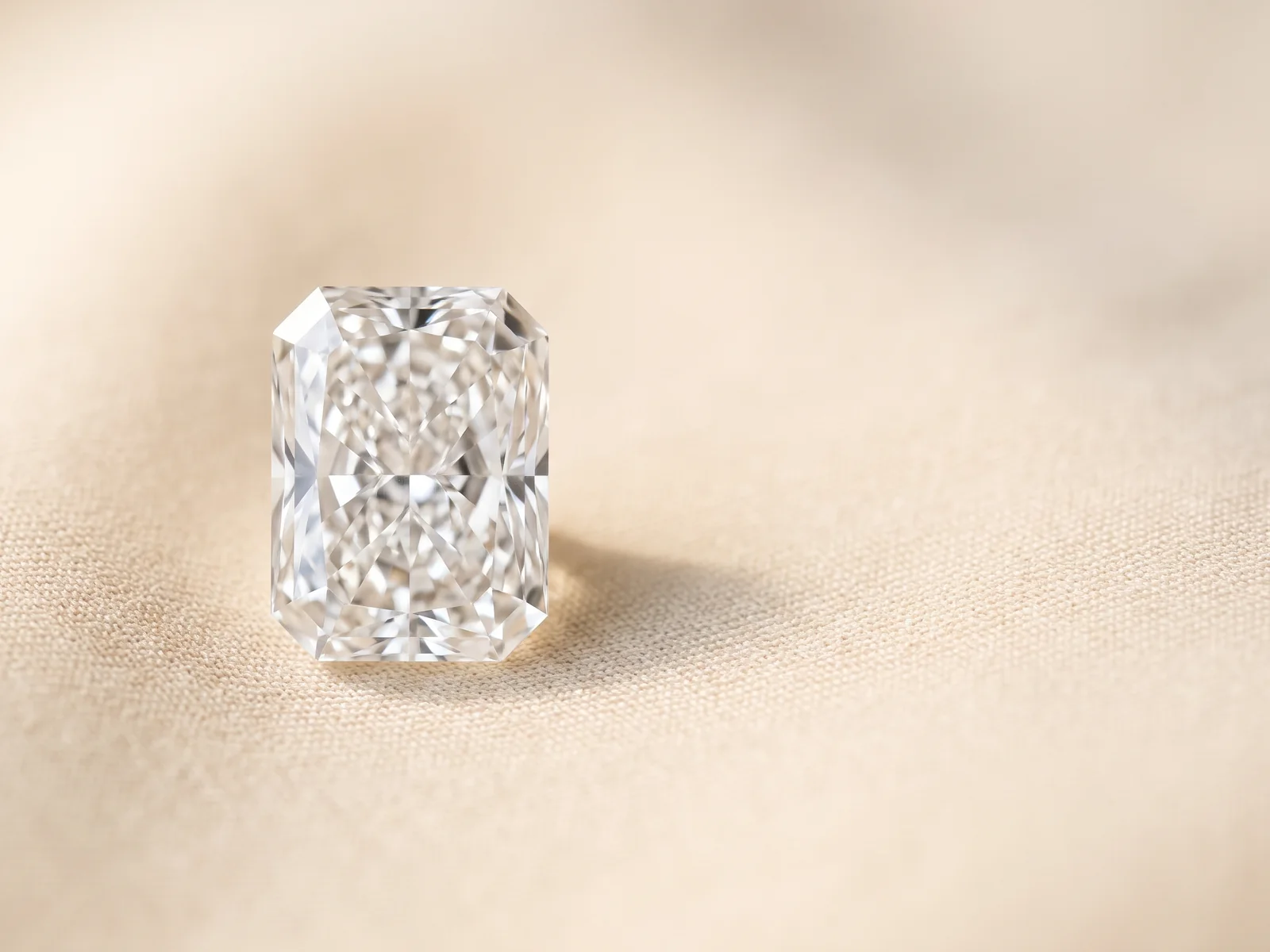
The radiant diamond ratio decides whether your stone looks square and compact or long and slender. It changes the stone's character more than almost any grade on the report.
 Reviewed by Raj Sood, Graduate Gemologist (GIA), AJP (GIA)Master jeweller and Graduate Gemologist (GIA) · reviewed 4 November 2026
Quick answer
The radiant diamond ratio is the stone's length divided by its width. A ratio of 1.00–1.05 looks square, 1.05–1.25 looks slightly rectangular, and 1.25 or more looks elongated. Most people choosing an elongated radiant prefer about 1.25–1.35. For brightness, pair the ratio with a depth of about 61–67% and a table of about 61–69%.
What is a radiant diamond ratio?
The length-to-width ratio (often shortened to L/W ratio) tells you how long a diamond is compared with how wide it is. Take the two face-up measurements from the grading report, divide the longer one by the shorter one, and you have the ratio. A radiant measuring 7.20 × 5.40 mm has a ratio of 1.33. One measuring 6.00 × 5.85 mm sits at 1.03 and looks almost square. The same maths works for every fancy shape, and our page on how length-to-width ratio works across every shape compares them all.
A radiant is a square or rectangular diamond with cut corners (small bevelled corners instead of sharp points) and brilliant-style faceting on both the crown (the top half) and the pavilion (the underside). Most radiants have about 70 facets. The cut was developed by cutter Henry Grossbard in the late 1970s to join the clean outline of an emerald cut with the sparkle of a round brilliant. For the full background on the shape, see our full guide to radiant cut diamonds.
Because a radiant can be cut anywhere from perfectly square to long and narrow, the ratio changes its personality more than in most shapes. Two 1 carat radiants with the same colour and clarity can look like different stones: one compact and bright, the other slim and sleek. Diamond is 10 on the Mohs hardness scale and has a refractive index of about 2.42. That high refractive index is what lets the radiant's busy faceting return so much light at any ratio. Any term here you have not met before is explained in our plain-English jewellery glossary.
What is the best radiant diamond ratio?
There is no single correct number. The right ratio is the one whose outline you like, as long as the rest of the cut is sound. Most radiants fall into these bands:
| Ratio | How it looks | What to know |
|---|---|---|
| 1.00–1.05 | Square | Compact and very bright; reads like a princess with softened corners |
| 1.05–1.15 | Almost square | Can look undecided: neither clearly square nor clearly rectangular |
| 1.15–1.25 | Gently rectangular | Clearly a rectangle while keeping a full, bright centre |
| 1.25–1.35 | Classic elongated | The range most people choose for an elongated radiant ring |
| 1.35–1.50 | Long and slim | Dramatic; check closely for a bow-tie and balanced corners |
| Above 1.50 | Very elongated | Uncommon; can look narrow on the finger, suits east-west settings and pendants |
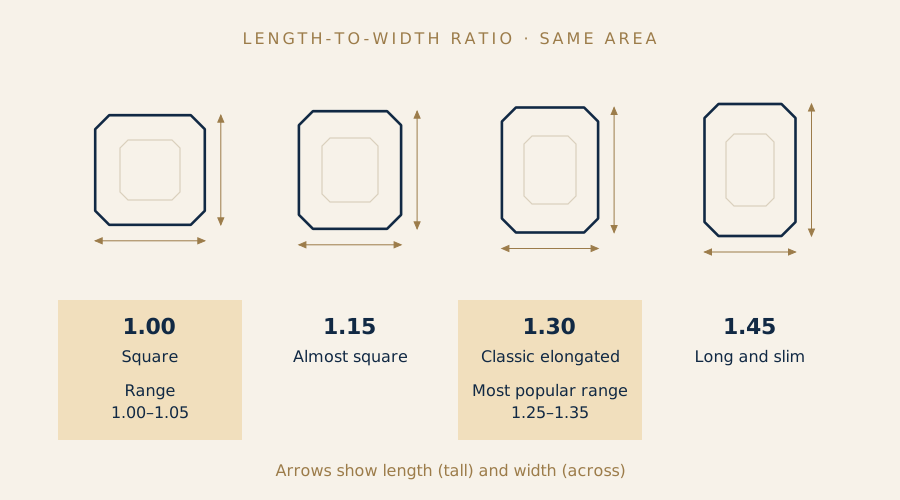
If you want a clearly rectangular stone, the best ratio for a radiant cut diamond for most people is about 1.25–1.35. In that band the stone looks long enough to slim the finger but still wide enough to keep plenty of sparkle in the centre. If you love a square, aim for 1.00–1.05, which gives sharp, even proportions.
The band to think twice about is roughly 1.05–1.15. Stones here are not faulty, and some people like their soft, slightly rectangular look, but they can read as a square that did not quite come out square. Look at a photo or video before deciding. Our page on elongated radiant cut diamonds in detail covers the longer end of the range, and the ratio also shapes which ring designs suit the stone, as shown in radiant cut engagement ring styles.
Should you choose a square or elongated radiant cut?
This is mostly taste, but a few practical points help:
- Square radiant cut diamond (1.00–1.05): looks balanced in a halo, sits neatly in a four-claw setting and tends to show the most even spread of sparkle. It can look a little smaller for its weight than an elongated stone.
- Elongated radiant (1.25–1.40): draws the eye along the finger, so it tends to make the hand look longer. It usually looks bigger per carat because length is what most people notice first.
- Long fingers: carry an elongated radiant easily; a square can look small unless you go up in carat.
- Shorter or smaller fingers: a 1.25–1.30 ratio often looks in proportion; above 1.45 the stone can extend past the width of a small finger and reach towards the knuckle.
Think about the band too. An elongated radiant set north-south (long side along the finger) leaves room either side for a straight wedding band. A square radiant with a halo is wider and may need a band that is shaped or set slightly apart.
Related guideElongated Radiant Cut DiamondsHow big is a radiant diamond at each ratio? Size chart
Carat is weight, not size. The ratio decides how that weight is spread out face-up (the size you see from above). This radiant diamond size chart shows typical measurements for well-cut stones at a depth of about 63–66%:
| Carat weight | Square radiant (about 1.00) | Elongated radiant (about 1.30) |
|---|---|---|
| 0.50 ct | about 4.4 × 4.4 mm | about 5.2 × 4.0 mm |
| 0.75 ct | about 5.0 × 5.0 mm | about 5.9 × 4.5 mm |
| 1.00 ct | about 5.5 × 5.5 mm | about 6.5 × 5.0 mm |
| 1.50 ct | about 6.3 × 6.3 mm | about 7.4 × 5.7 mm |
| 2.00 ct | about 7.0 × 7.0 mm | about 8.2 × 6.3 mm |
| 3.00 ct | about 8.0 × 8.0 mm | about 9.4 × 7.2 mm |
Radiants are cut fairly deep, so they carry more weight below the girdle (the thin outer edge) than a round brilliant does. A 1 carat round is about 6.4 mm across, while a 1 carat square radiant is about 5.5 mm a side, so the radiant shows a similar or slightly smaller face-up area for the same weight. An elongated radiant spreads its weight into length, which is why it usually looks larger than a square radiant of the same carat.
Depth matters as much as ratio here. A 1 carat radiant cut at 70% depth might measure only about 6.3 × 4.8 mm at a 1.30 ratio, so it looks closer to a 0.90 carat stone face-up. Always compare millimetres, not just carat weight.
Not sure which one is right?
Send us the stones you are looking at and our gemologist will tell you which to choose and why.
What depth and table suit a radiant diamond ratio?
GIA does not give radiants an overall cut grade the way it does for rounds, so you judge the cut from the numbers on the report and from how the stone looks. The depth is the height of the stone as a percentage of its width; the table is the large flat top facet, also as a percentage of width. As a guide for radiant cut depth and table:
- Depth: about 61–67% for a bright stone. Up to about 69% can still look good; above about 70% the stone hides weight underneath and can look dark in the centre.
- Table: about 61–69%. A smaller table gives more crown height and more fire (flashes of colour); a larger table gives more broad brightness.
- Girdle: thin to slightly thick. Very thin girdles are more prone to chipping; very thick ones add weight without adding size.
- Culet: none or very small (a culet is a tiny flat facet at the bottom point).
- Polish and symmetry: Very Good or Excellent.
Elongated radiants are more likely to show a bow-tie: a dark band across the middle, running across the width, where light leaks out instead of coming back to your eye. Above about 1.35, check for it carefully. A faint bow-tie that shifts as the stone moves adds contrast and is normal. A dark band that stays put in every position points to poor proportions.
Radiants also differ in their sparkle pattern. Some show a crushed ice look, with many small pinpoint sparkles, especially in square stones. Others show bigger, chunkier flashes. Neither is better; it is personal taste, and photos rarely capture it, so a 360° video is the way to judge it.
Why do the cut corners change how a radiant looks?
The cut corners are what separate a radiant from a princess, and their size changes how the ratio reads. Wide corners pull the outline towards an octagon, so a 1.30 stone can look a little shorter and softer than its numbers. Small corners keep the outline closer to a crisp rectangle, so the same 1.30 looks longer and sharper.
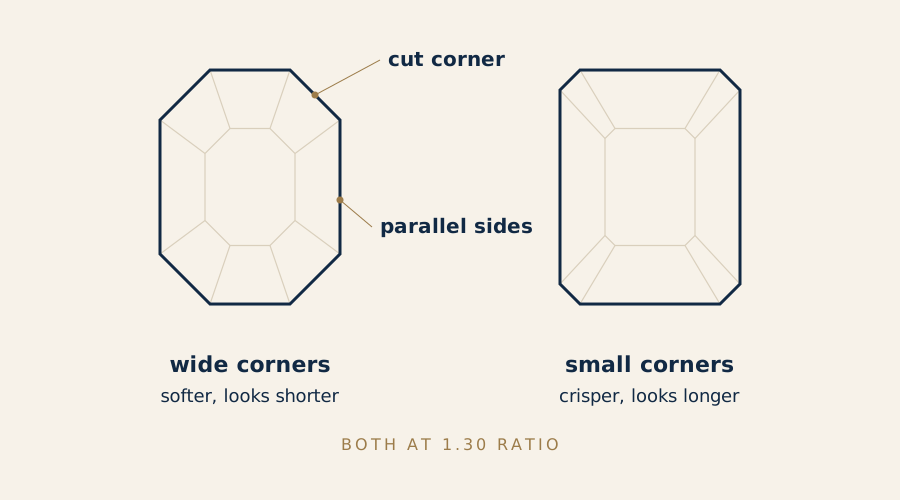
Check that all four corners are the same size and that the long sides are straight and parallel. If one pair of corners is larger, the stone can look slightly tapered, like a trapezoid, and the ratio on the report will not tell you. Our page on why the clipped corners matter goes through corner proportions with examples.
Those corners also help durability. A sharp corner, like a princess's, is a thin point that can chip if knocked. A bevelled corner spreads the edge out, so a radiant is less vulnerable at the corners, though claws over each corner are still sensible for daily wear.
How does the radiant ratio compare with other diamond shapes?
The radiant covers one of the widest ratio ranges of any shape, from square to quite long. Here is how it sits against its neighbours:
| Shape | Typical ratio range | Corners or points | Faceting style |
|---|---|---|---|
| Radiant | 1.00–1.50 | Four cut corners | Brilliant |
| Princess | 1.00–1.05 | Four sharp corners | Brilliant |
| Emerald | 1.30–1.50 | Four cut corners | Step cut (parallel rows) |
| Cushion | 1.00–1.20 (some to 1.30) | Rounded corners | Brilliant |
| Oval | 1.30–1.50 | None | Brilliant |
| Pear | 1.45–1.75 | One point | Brilliant |
| Marquise | 1.85–2.10 | Two points | Brilliant |
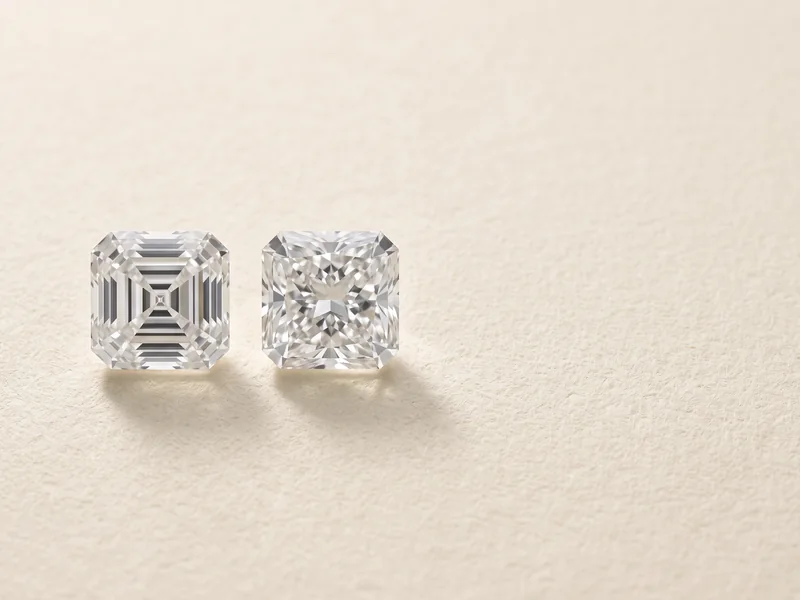
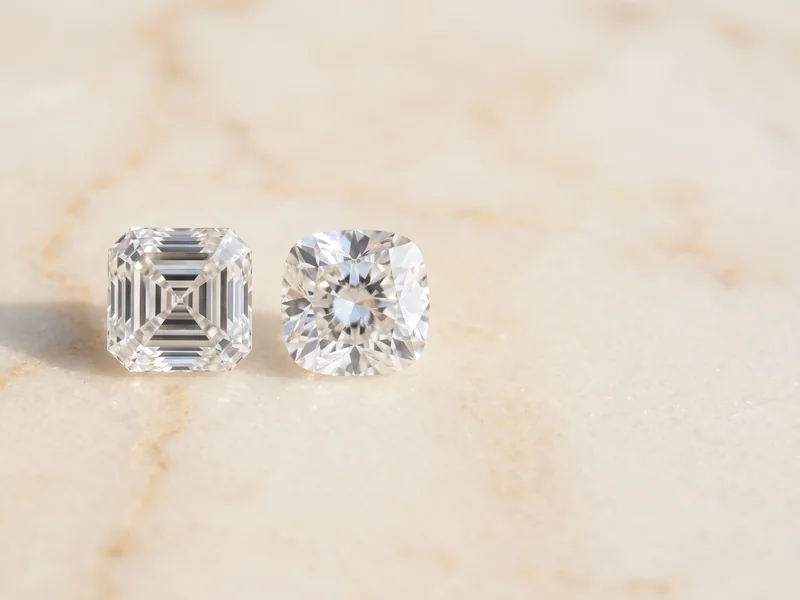
A square radiant is most often weighed up against a princess; see the princess vs radiant comparison for how corners and sparkle differ. An elongated radiant shares its outline with the emerald cut but not its faceting, which emerald vs radiant, step cut against brilliant explains. If you like a softer outline, look at how a radiant differs from a cushion.
For the ratio ranges of shapes with points, our pear diamond ratio guide and the marquise ratio ranges page use the same method. To see every shape side by side, start with our overview of every diamond shape.
Which setting suits each radiant ratio?
The ratio guides the setting, and the setting can make a radiant look more square or more elongated:
- Four claws: one on each cut corner. Clean and classic for any ratio; corner claws protect the corners.
- Double claws (eight): two at each corner. Extra security, and the claws can make a square radiant look slightly rounder.
- Halo: a row of small diamonds around the centre stone. On a square radiant it adds face-up size; on an elongated one it stretches the outline further.
- Side stones: trapezoids or tapered baguettes either side suit elongated radiants and continue their straight lines.
- East-west: setting an elongated radiant sideways across the finger suits ratios of 1.30 and above.
- Bezel: a thin rim of metal around the edge. Very secure, and it hides a little of the corner shape.
Whichever you choose, ask how the claws will sit over the corners and how much of the outline they cover, especially on a small square stone. For complete ring ideas, browse settings that suit a radiant engagement ring.
Does ratio affect radiant diamond price in Australia, natural or lab-grown?
The ratio is not a grade, so it does not set the price the way carat, colour and clarity do. But demand plays a part. Well-shaped elongated radiants around 1.25–1.40 are popular, so they can cost a little more than near-square stones of the same grades. Stones in the 1.05–1.15 band are often priced a little lower, which can suit you if you like their look.
Radiants are cut from both natural and laboratory-grown diamond, and the two look identical to the eye. A lab-grown radiant diamond is real diamond, grown in a laboratory rather than mined, with the same hardness and refractive index. It costs much less than a natural stone of the same size and grades. Natural radiants are rarer. Both should come with an independent grading report from a lab such as GIA or IGI, which states whether the stone is natural or lab-grown.
| 1 ct radiant, G–H, VS | Approximate price range (AUD) |
|---|---|
| Lab-grown | about $700–$2,500 |
| Natural | about $5,000–$11,000 |
These are broad ranges only; prices move with the market and the exact grades. Radiants also show body colour a little more than rounds, mostly in the corners, so many people choose H or better in white gold or platinum, and I–J in yellow or rose gold. For clarity, VS2 or a carefully chosen SI1 is usually eye-clean, as the brilliant faceting hides small inclusions well.
Shop radiant diamonds: natural and lab-grown
How do you check a radiant diamond ratio? Step by step
- Read the report. Confirm the shape, measurements, depth, table, polish and symmetry, and whether the diamond is natural or lab-grown.
- Work out the ratio. Divide the length by the width. Decide whether you want square (1.00–1.05) or elongated (about 1.25–1.35).
- Check the millimetres. Compare the face-up size against other stones, not just carat weight, and hold the measurements against your finger.
- Check the depth. Aim for about 61–67%; above 70% the stone will look small for its weight.
- Look at the corners. All four should match and the long sides should be parallel.
- Watch a 360° video. Look for a fixed dark bow-tie and decide whether you like a crushed ice or chunkier sparkle pattern.
- Plan the setting. Match the ratio to claws, halo or side stones before you commit to the stone.
Free consultation
Talk to a gemologist
Compare stones in person or online with Raj Sood, Graduate Gemologist (GIA), AJP (GIA).
Book a consultationFAQ
Common questions
What is the best ratio for a radiant cut diamond?
For a square look, 1.00–1.05. For an elongated look, most people prefer about 1.25–1.35, which is long enough to slim the finger while keeping a bright centre.
Is a 1.10 ratio radiant a bad choice?
Not if you like it. Stones around 1.05–1.15 can look neither clearly square nor clearly rectangular, so view a photo or video first; they are often priced a little lower.
Does an elongated radiant look bigger than a square one?
Usually, yes. A 1 carat radiant at 1.30 measures about 6.5 × 5.0 mm against about 5.5 × 5.5 mm for a square, and the extra length is what the eye notices.
Is the ratio shown on the grading report?
The report always lists the length, width and depth measurements. Some reports and online listings also show the ratio, but you can calculate it yourself by dividing length by width.
Do lab-grown radiant diamonds come in the same ratios?
Yes. Lab-grown radiants are cut in the full range from square to elongated and are graded the same way, usually by IGI or GIA, with the report stating that the stone is laboratory-grown.
What depth should a radiant diamond have?
About 61–67% is a good target. Deeper stones hide weight underneath and look smaller face-up, and can appear darker in the centre.

Ask a gemologist
Not sure which diamond to choose?
Raj Sood is a Graduate Gemologist (GIA) and master jeweller. Bring the stones you are considering, or send the reports, and he will tell you honestly which one is better and why.
Keep learning
Related guides
 Diamond ShapesRadiant Cut DiamondsDiamond ShapesElongated Radiant Cut Diamonds
 Diamond Anatomy & LightDiamond Length to Width Ratio GuideDiamond ShapesRadiant Diamond Corners: Why the Clipped Shape MattersDiamond ShapesUnderstanding Diamond Shapes
 Diamond ShapesPrincess vs Radiant Cut Diamonds
 Diamond ShapesRadiant vs Cushion Cut DiamondsDiamond ShapesEmerald vs Radiant Cut Diamonds
Explore more
More guides on this topic
Education