
Gemstones
Ruby vs Diamond: How They Compare for Rings, Wear and Price
Ruby vs diamond is a choice between the most famous red gemstone and the hardest natural material. Here is how they really differ in durability, sparkle, grading, treatments and price, explained from a Melbourne gemmologist's bench.
 Reviewed by Raj Sood, Graduate Gemologist (GIA), AJP (GIA)Master jeweller and Graduate Gemologist (GIA) · reviewed 4 November 2026
Quick answer
Ruby vs diamond comes down to colour versus sparkle. Diamond is carbon, 10 on the Mohs scale, with strong brilliance and fire. Ruby is red corundum, 9 on the Mohs scale, valued for its colour rather than sparkle. Both are tough enough for daily wear; a fine ruby can cost more than a diamond, though most rubies cost less.
What is the difference between a ruby and a diamond?
A diamond is crystallised carbon, formed deep in the earth's mantle under enormous heat and pressure. A ruby is a completely different mineral: corundum, which is aluminium oxide (Al2O3). Pure corundum is colourless. A trace of chromium turns it red, and that red stone is ruby. Every other colour of corundum, including blue, yellow, green and pink, is sold as sapphire. Our full ruby gemstone guide covers where rubies come from and how they form.
So the two stones share very little except their place at the top of the jewellery world. A diamond is chosen mostly for its light: how brightly it returns light and how much coloured fire it throws. A ruby is chosen for its colour. That single difference explains nearly everything else in this comparison, from grading to price to the way each stone is cut.
| Property | Ruby | Diamond |
|---|---|---|
| Mineral | Corundum (aluminium oxide with chromium) | Carbon |
| Mohs hardness | 9 | 10 |
| Toughness | Excellent; no cleavage | Good, but cleaves in four directions |
| Refractive index | 1.762–1.770 | 2.417 |
| Dispersion (fire) | 0.018 | 0.044 |
| Optic character | Doubly refractive, birefringence about 0.008 | Singly refractive |
| Specific gravity | About 4.00 | About 3.52 |
| Typical clarity | Usually has visible inclusions | Eye-clean stones are common |
| Common treatments | Heating very common; glass filling in low grades | Less common; HPHT colour, laser drilling, fracture filling |
| Main value factor | Colour | Cut and colour (the 4Cs) |
If ruby is one of several coloured stones you are weighing up, our overview of the wider world of coloured gemstones puts it alongside sapphire, emerald and the more affordable gems. Any unfamiliar term in this article is also explained in our plain-English jewellery glossary.
Ruby vs diamond: which is harder and tougher?
Diamond is harder. On the Mohs scale, which ranks minerals by which one can scratch another, diamond is 10 and ruby is 9. The scale is not even, though. The jump from 9 to 10 is far bigger than any other step: diamond is roughly four times harder than corundum in absolute terms. In practice that means almost nothing in daily life will scratch either stone except another diamond or corundum.
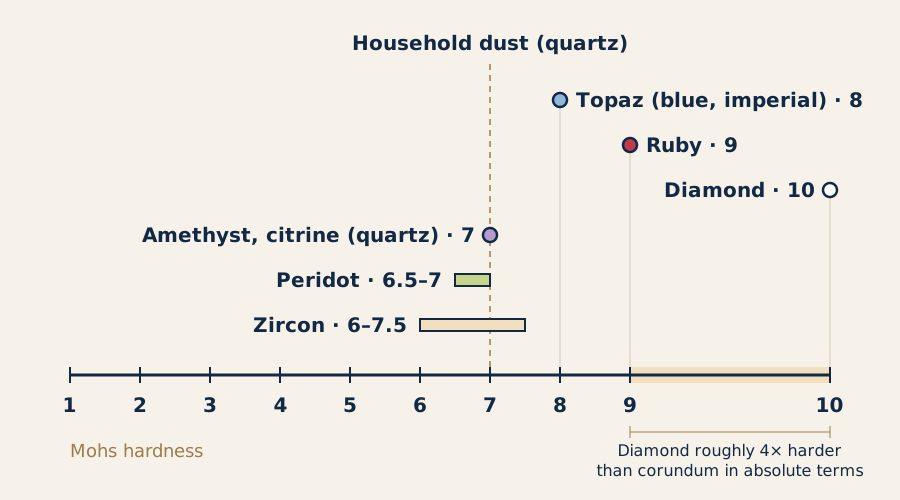
For context, many popular coloured stones sit well below ruby. Quartz gems such as purple amethyst, golden citrine and ametrine, which mixes both colours in one crystal are 7. Green peridot at 6.5–7 is softer again, and blue topaz at 8 is close to ruby but still a full step below. Household dust contains quartz, so anything softer than 7 slowly dulls with wear. Ruby and diamond both sit comfortably above that line.
Hardness is not the same as toughness. Hardness is resistance to scratching; toughness is resistance to chipping and breaking. Diamond has cleavage in four directions, meaning a sharp knock at the wrong angle can split it along a flat plane. Ruby has no true cleavage, though some rubies show parting (a weakness along twinning planes) and many contain fractures. Overall, gemmologists rate ruby's toughness as excellent and diamond's as good for jewellery. Neither is indestructible, and both can chip on a thin edge or point.
So, is ruby harder than diamond? No. But for an everyday ring the practical difference is small. A well-set ruby will keep its polish for decades, which is why it has been a ring stone for centuries.
How does ruby vs diamond sparkle compare?
This is where the two stones look most different. Refractive index (RI) measures how strongly a gem bends light. Diamond's RI of about 2.42 is very high, so light entering a well-cut diamond is bent sharply, bounces off the back facets and returns to your eye as bright white brilliance. Ruby's RI of about 1.76–1.77 is lower, so it returns less light.
Dispersion is the splitting of white light into rainbow flashes, usually called fire. Diamond's dispersion is 0.044; ruby's is 0.018. In a ruby, the strong red body colour hides most of what little fire there is. You will see red sparkle and glowing flashes, not rainbow colours. For a coloured stone with real diamond-like fire, natural zircon, which has strong dispersion is the classic example.
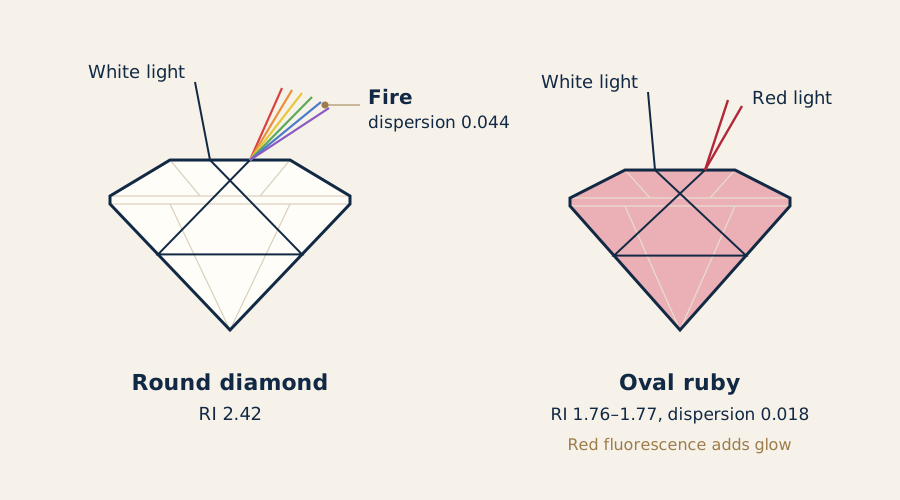
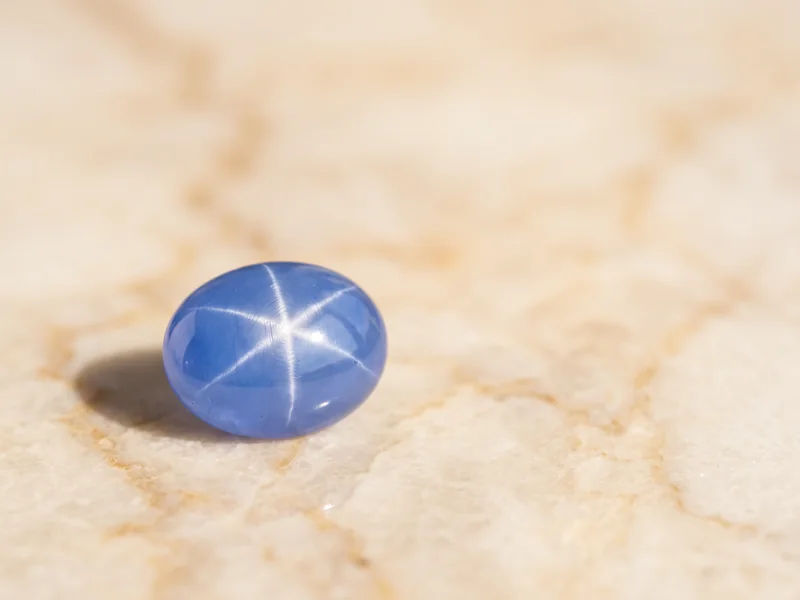
Ruby has two optical tricks diamond lacks. It is pleochroic, meaning it shows slightly different colours from different directions, typically purplish red one way and orangey red another, so the cutter orients the rough to show the better colour face-up. And the chromium that colours it also makes it fluoresce red under ultraviolet light, including the UV in daylight. That is why fine rubies seem to glow from within. Some rubies contain fine needles of rutile, called silk, which soften the look and, when dense and aligned, can be cut as star rubies with a six-rayed star.
How are rubies and diamonds graded?
Colourless diamonds are graded on the 4Cs: cut, colour (D to Z, where D is colourless), clarity (Flawless to I3) and carat weight. The scales are standardised, so a GIA or IGI report lets you compare two diamonds on paper with some confidence.
Ruby has no single universal grading scale. Labs describe its identity, origin where they can, and any treatments, and the trade judges quality mostly by eye. In order of importance:
- Colour: by far the biggest factor. The most valued rubies are a pure to slightly purplish red of medium to medium-dark tone with strong saturation. Too dark and the stone looks blackish; too light and it may be called pink sapphire instead.
- Clarity: GIA places ruby among the coloured stones that usually contain inclusions. Eye-clean fine rubies are rare and priced accordingly; a little silk is normal and expected.
- Cut: rubies are usually cut as ovals and cushions, often with a deeper pavilion to save weight. Look for even colour across the face and no large washed-out window in the centre.
- Carat: fine rubies over about 3 carats are much rarer than diamonds of the same size, so the price per carat climbs steeply.
- Treatment and origin: an unheated ruby with documented origin costs considerably more than a heated stone of similar look.
You will also hear the term pigeon's blood. It is a trade description for a vivid, saturated red with strong fluorescence, historically linked to Myanmar (Burma). A few labs use it as a colour-type comment on reports, but each lab applies its own criteria, so treat it as a description rather than a grade. Our guide to how to judge ruby colour, clarity and cut goes deeper into each factor.
Because ruby is denser than diamond (specific gravity about 4.00 against 3.52), a 1 carat ruby is physically smaller. A 1 carat round diamond is about 6.4 mm across; a 1 carat ruby oval is commonly around 7 × 5 mm, and a round ruby of the same weight is often under 6 mm. Compare millimetres, not just carats.
Not sure which one is right?
Send us the stones you are looking at and our gemologist will tell you which to choose and why.
Are rubies treated more often than diamonds?
Yes. Treatment is routine in ruby and comparatively uncommon in diamond, so it matters more when you compare them. The main ruby treatments:
- Heating: the most common. Heat improves colour and dissolves some silk. Most rubies on the market are heated, and the result is stable and permanent.
- Heating with flux: heat plus a flux that partly heals fractures, leaving glassy residue inside. Reports usually note the amount.
- Lead-glass filling: low-grade, heavily fractured corundum filled with lead glass to make it transparent. These are better described as composite rubies. They are inexpensive but can be damaged by a jeweller's torch, some cleaning chemicals and even mild acids.
- Other treatments: diffusion and dyeing exist but are less common.
Diamond treatments include HPHT (high pressure, high temperature) colour change, laser drilling to remove dark inclusions and fracture filling. All should be disclosed, and reputable grading labs note them. For either stone, ask what the stone is and whether it has been treated before you compare prices, because treatment changes value far more than most people expect.
Lab-grown ruby vs lab-grown diamond: are they real?
Both exist, and both are real. A lab-created ruby (also called synthetic ruby) is corundum with the same chemistry, hardness and refractive index as natural ruby, grown in a laboratory. A lab-grown diamond is real diamond, carbon in the same crystal structure as a mined stone. Neither is a fake or a simulant; a simulant is a different material that only imitates the look, such as red glass or cubic zirconia.
Lab-created ruby is old technology. The Verneuil (flame fusion) process was producing it commercially in the early 1900s, and it is still used for inexpensive stones and watch bearings. Flux-grown and hydrothermal lab-created rubies look more like natural stones and cost more. Lab-grown diamonds are made by HPHT or CVD (chemical vapour deposition) and became widely available in jewellery much more recently. Our guide to lab-created ruby, sapphire and emerald explains the growth methods and how labs tell them apart from natural stones.
Price behaves very differently. A lab-created ruby usually costs a small fraction of a natural ruby. A lab-grown diamond costs much less than a natural diamond but is still a substantial purchase, because cutting and polishing diamond is skilled, slow work. Whatever you choose, the stone should be clearly described as natural or lab-grown on the paperwork.
Shop natural gemstones
Ruby vs diamond price: how much does each cost in Australia?
There is no simple answer to whether ruby or diamond costs more, because ruby prices span a far wider range. A lead-glass composite ruby can cost less than a dinner out, while a fine unheated Burmese ruby can cost many times more than a diamond of the same weight. Diamond prices are more predictable because the grading is standardised.
| Stone (about 1 carat) | Approximate price range (AUD) |
|---|---|
| Lead-glass-filled (composite) ruby | Under about $100 |
| Lab-created ruby | About $20–$500, depending on growth method |
| Commercial heated natural ruby | About $500–$3,000 |
| Fine heated natural ruby | About $3,000–$15,000 |
| Fine unheated natural ruby | From about $15,000, often far more |
| Lab-grown diamond, round, G–H, VS | About $800–$2,500 |
| Natural diamond, round, G–H, VS | About $7,000–$15,000 |
These are broad ranges only and move with the market, origin and exact quality. What pushes a ruby's price up most is colour, then the absence of heat treatment, then size and clarity. Origin also plays a part: Myanmar, and more recently Mozambique, are the sources the market watches most closely, with Thailand, Sri Lanka, Madagascar and Tanzania also producing gem ruby.
So, are rubies rarer than diamonds? Gem-quality rubies in fine colour and larger sizes are rarer than diamonds of comparable quality. Small commercial rubies are plentiful. Rarity shows up in the price only at the top of the quality range.
Is a ruby or diamond engagement ring better for everyday wear?
Both can be worn every day. A diamond is the most scratch-resistant choice and keeps its sharp facet edges longest. A ruby at 9 on the Mohs scale is, with sapphire, the hardest natural gem in common use after diamond and holds up very well in an engagement ring, provided the setting suits your life. Our ruby engagement ring styles page shows how different settings handle a red centre stone.
- Claws: four or six claws show the most of the stone. Rubies are often oval or cushion, so claws at the ends protect the narrow points.
- Bezel: a rim of metal around the stone gives the most protection and suits active hands.
- Halo: a ruby centre with a diamond halo combines colour and sparkle, and the white diamonds make the red look richer. A ruby and diamond ring like this is one of the most requested designs.
- Metal: yellow and rose gold warm a ruby's red; white gold and platinum give a crisper contrast.
Care differs a little. A diamond, or a natural ruby that is untreated or heated only, can usually be cleaned in warm soapy water and is generally safe in an ultrasonic cleaner. Glass-filled and fracture-filled stones should never go in an ultrasonic, near a steam cleaner or under a jeweller's torch, so tell any jeweller what your stone is before repairs. If you are also considering blue, our comparison of ruby versus sapphire for an everyday ring covers the two colours of corundum side by side.
Ruby also carries meaning for many buyers. It is the traditional July birthstone and the gem for 40th wedding anniversaries. If you love warm colour but want a lower price, imperial topaz in its pinkish-orange to reddish tones is another option, though at 8 on the Mohs scale with perfect cleavage it needs a more protective setting than ruby.
Are rubies and diamonds found in Australia?
Australia is far better known for corundum's other colours. The central Queensland gemfields around Anakie, Rubyvale and Sapphire, and the New England district of New South Wales around Inverell and Glen Innes, have produced large volumes of blue, green and yellow sapphire. Despite the name, Rubyvale is a sapphire field. Rubies in Australia are uncommon: small rubies and pink sapphires turn up in some eastern fields such as Barrington Tops in New South Wales, and opaque ruby in rock is found in the Harts Range in the Northern Territory, but there is no significant commercial source of gem ruby.
Diamonds are a different story. The Argyle mine in Western Australia was one of the world's largest diamond producers by volume, known for brown and champagne diamonds and for most of the world's natural pink diamonds, until it closed in 2020. Opal, Australia's national gemstone, is another local speciality, from fields such as Lightning Ridge and Coober Pedy.
Related guideRuby vs Sapphire Engagement RingsHow do you choose between a ruby and a diamond? Step by step
- Decide what you want to see. If colour matters most, ruby. If bright white sparkle matters most, diamond. If you want both, consider a ruby with diamond accents.
- Ask exactly what the stone is. Natural, lab-created ruby or lab-grown diamond, and whether it has been heated, filled or otherwise treated.
- Get the right report. For diamond, a grading report from a lab such as GIA or IGI. For a significant ruby, an identification report stating natural or synthetic, treatment and, if offered, origin.
- Look at colour in several lights. View a ruby in daylight and under warm indoor light; a good ruby stays red rather than turning brownish or dark.
- Compare millimetre sizes. A ruby is denser than diamond, so the same carat weight looks smaller.
- Match the setting to your hands. Choose claws, a bezel or a halo based on how active you are, and plan how you will clean and maintain the ring.
Free consultation
Talk to a gemologist
Compare stones in person or online with Raj Sood, Graduate Gemologist (GIA), AJP (GIA).
Book a consultationShop this shape
FAQ
Common questions
Is ruby harder than diamond?
No. Diamond is 10 on the Mohs scale and ruby is 9, and diamond is roughly four times harder in absolute terms. Ruby is still hard enough for an everyday engagement ring.
Is a ruby more expensive than a diamond?
It depends on quality. Most commercial rubies cost less than a natural diamond of the same weight, but fine unheated rubies in top colour can cost considerably more per carat.
Does a ruby sparkle like a diamond?
Not in the same way. Ruby has a lower refractive index and less than half diamond's dispersion, so it shows a red glow and red flashes rather than white brilliance and rainbow fire.
Can you wear a ruby engagement ring every day?
Yes. At 9 on the Mohs scale with good toughness, ruby is one of the most durable coloured gems. Choose a protective setting and avoid glass-filled rubies for a ring worn daily.
Is a lab-created ruby a real ruby?
A lab-created ruby has the same chemistry and physical properties as natural ruby, so it is real corundum, but it must always be described as lab-created or synthetic. It usually costs a small fraction of a natural stone.
Are rubies found in Australia?
Only in small quantities. Australia's corundum fields mainly produce sapphire, with small rubies found in places such as Barrington Tops in New South Wales, but there is no major commercial ruby source.

Ask a gemologist
Not sure which diamond to choose?
Raj Sood is a Graduate Gemologist (GIA) and master jeweller. Bring the stones you are considering, or send the reports, and he will tell you honestly which one is better and why.
Keep learning
Related guides
 GemstonesRuby Gemstones MelbourneGemstonesHow to Judge Ruby QualityGemstonesRuby Engagement Rings
 Lab-Grown DiamondsLab-Grown Sapphire, Ruby and EmeraldGemstonesGemstones | Coloured Gemstones, Birthstones and Custom Jewellery
 GemstonesRuby vs Sapphire Engagement RingsGemstonesJuly Birthstone: Ruby
 GemstonesStar Sapphire and Star Ruby
Explore more
More guides on this topic
Education