
Gemstones
Ametrine Gemstone Guide: Colour, Origin, Value, Rings and Care
Ametrine puts two gems in one stone: purple amethyst and golden citrine, side by side in a single quartz crystal. Here is how that split forms, how to tell natural from lab-created ametrine, and whether it will cope with life in a ring.
 Reviewed by Raj Sood, Graduate Gemologist (GIA), AJP (GIA)Master jeweller and Graduate Gemologist (GIA) · reviewed 4 November 2026
Quick answer
Ametrine is a natural bicoloured quartz that shows purple amethyst and golden citrine zones in one crystal. Almost all of it comes from the Anahí mine in Bolivia. It rates 7 on the Mohs scale, has no cleavage and suits pendants, earrings and occasional-wear rings. Lab-created ametrine exists, so check disclosure. Value depends on a crisp, balanced colour split.
What is ametrine?
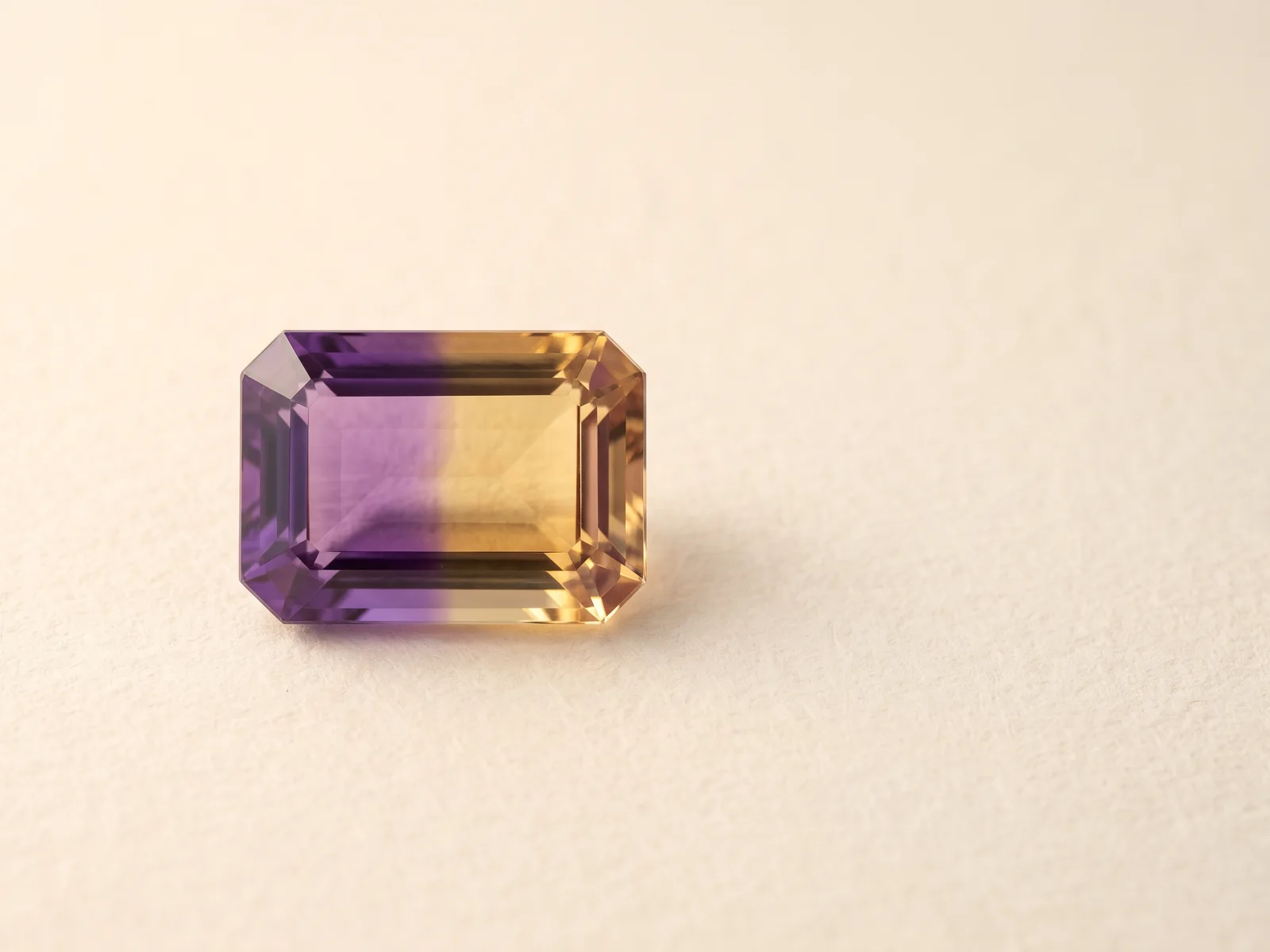
Ametrine is a variety of quartz, the same mineral as amethyst, citrine, rock crystal and smoky quartz. What makes it different is that one crystal holds two colour zones: a purple zone, which is amethyst, and a yellow to orange zone, which is citrine. The name joins the two: amethyst plus citrine. A cutter orients the rough so both colours show in the finished gem, usually meeting along a line across the middle of the stone.
Gemmologically, ametrine is silicon dioxide (SiO2). It has a refractive index of about 1.544–1.553 (the measure of how strongly it bends light), a birefringence of about 0.009 and a specific gravity of about 2.65. Those are standard quartz numbers, which matters later: a refractometer confirms the stone is quartz, but it cannot on its own tell natural ametrine from lab-created ametrine.
Ametrine sits among the more affordable coloured stones, alongside amethyst and citrine, and it is one of the best-known gems where two distinct colours occur naturally in one piece. To see how it fits with sapphires, garnets, tourmalines and the rest, start with our coloured gemstone overview. Any unfamiliar word on this page is defined in our plain-English jewellery glossary.
What colours does ametrine come in, and how does the split form?
The purple side ranges from a pale lilac to a deep, slightly reddish violet. The gold side ranges from pale lemon through golden yellow to a warm orange-brown. Most stones show the two colours as clear blocks; some show a softer gradient where the colours blend into a peach or smoky zone along the join.
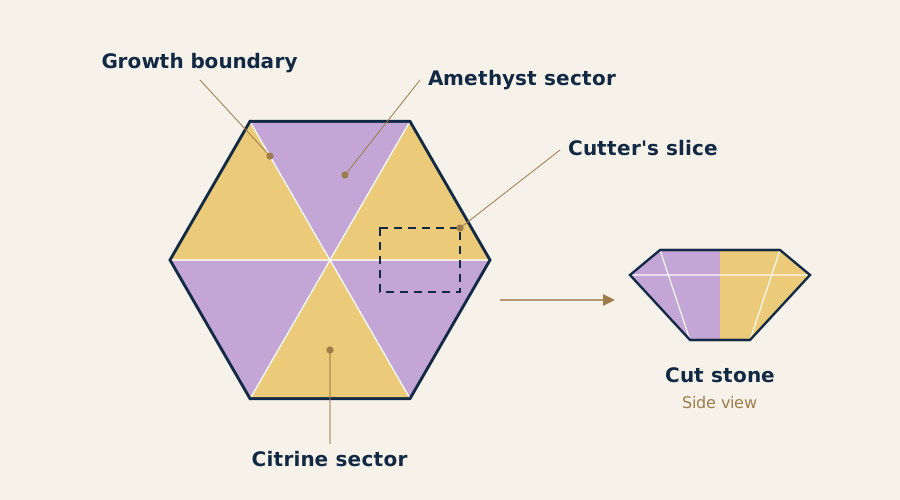
The split comes from how the crystal grew. Quartz crystals grow in sectors, wedge-shaped regions that build out from different crystal faces. In ametrine, iron impurities sit in slightly different states in neighbouring sectors. Where natural radiation in the rock acted on one type of iron, the quartz turned purple; in the alternate sectors, the iron gives a yellow colour instead. Differences in temperature as the crystal formed are thought to play a part. The result is a crystal with purple and gold sectors alternating around its centre.
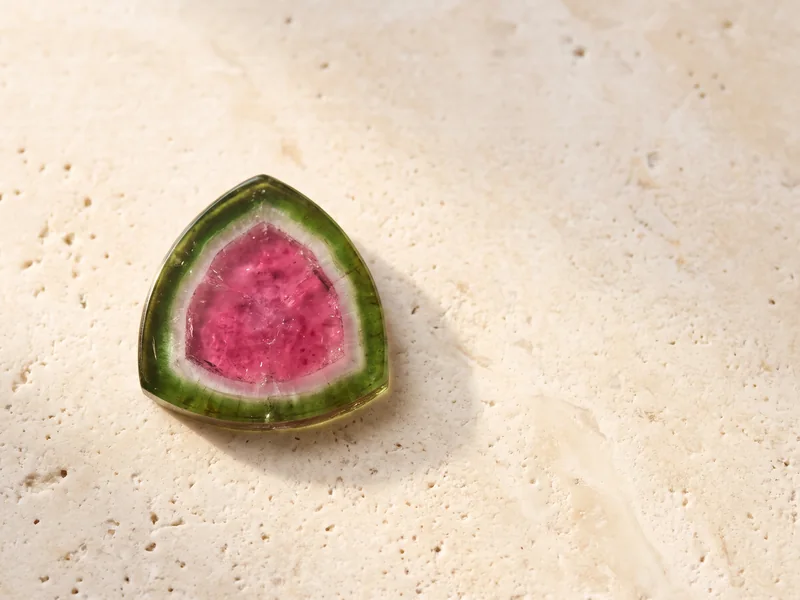
For a sense of how other gems handle two colours, watermelon tourmaline, another naturally bicoloured gem shows pink and green in concentric rings rather than side-by-side sectors. In both cases, the colour pattern is part of the crystal, not something added afterwards.
Related guideWatermelon TourmalineHow is ametrine cut to show both colours?
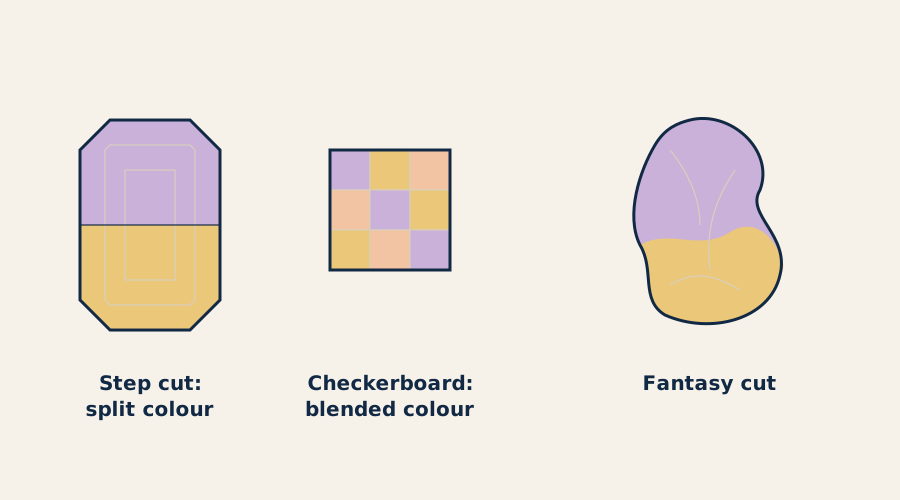
Because the colour pattern is fixed in the rough, the cut decides what you see. The cutter has three broad choices.
- Split colour: a rectangular step cut, such as an emerald cut or a long baguette, with the boundary running across the middle. The flat, parallel facets keep each colour clean, which is the classic look.
- Blended colour: a brilliant or checkerboard cut, where many small facets reflect both colours through the whole stone, giving a mix of purple, gold and peach flashes.
- Fantasy or carved cuts: concave facets, carved grooves or free-form shapes that play with the two zones. These are common in larger ametrine, where cutters have room to work.
Bolivian rough is often clean and available in larger pieces, so ametrine is commonly cut from about 3 carats up to 20 carats and more. In a small stone, under about 6 mm, the two colours have less room and the effect can look muddy, which is why most ametrine jewellery uses medium to large stones.
How hard is ametrine, and is it tough enough for a ring?
Ametrine rates 7 on the Mohs scale of hardness, which measures resistance to scratching. That equals the quartz in everyday dust (also 7) and is harder than window glass (about 5.5), so it resists casual scratching well, though gritty dust can still slowly abrade it. Quartz has no cleavage, meaning it has no flat plane along which it tends to split, and it breaks with a curved, shell-like fracture. Gemmologists rate its toughness, its resistance to chipping and breaking, as good.
| Gem | Mohs hardness | Toughness | Everyday ring wear |
|---|---|---|---|
| Diamond | 10 | Good (has cleavage) | Excellent |
| Sapphire and ruby | 9 | Excellent | Excellent |
| Alexandrite | 8.5 | Excellent | Excellent |
| Aquamarine and morganite | 7.5–8 | Good | Good with a protective setting |
| Tourmaline | 7–7.5 | Fair | Good with care |
| Ametrine | 7 | Good | Good with care; protective setting advised |
| Garnets | 6.5–7.5 | Fair to good | Good with care |
| Tanzanite | 6–7 | Poor to fair (has cleavage) | Occasional wear |
In a daily-wear ring, the facet edges of a Mohs 7 stone will slowly wear and pick up small nicks over years, especially on the hand you use most. That is why many people who want coloured stones every day choose harder gems, such as pink sapphire at 9 on the Mohs scale or the colour-change stone in our guide to alexandrite engagement rings. Ametrine sits close to beryl; our aquamarine engagement ring guide covers the same kind of trade-off. It is far more forgiving than tanzanite, which has a cleavage plane and needs gentler handling.
Ametrine's bigger weakness is heat, not hardness. Strong heat can change the colour, typically turning purple areas yellow, which would ruin the bicolour. A jeweller's torch close to the stone during a repair is the main risk, so the stone is usually removed before re-tipping claws or resizing.
Not sure which one is right?
Send us the stones you are looking at and our gemologist will tell you which to choose and why.
Where does ametrine come from?
Almost all gem ametrine on the market comes from the Anahí mine in the far east of Bolivia, near the Brazilian border. The mine produces amethyst, citrine and ametrine, and it is the only large, steady commercial source of ametrine known. Local legend links the mine's name to a princess called Anahí, but the story is folklore rather than documented history.
Small amounts of bicoloured amethyst-citrine quartz have been reported from Brazil and a few other localities, but nothing on the scale of Bolivian production. In practice, if a natural ametrine has a strong, clean split, Bolivia is the likely origin. Origin is rarely stated on a report for ametrine, and it has much less effect on price than it does for sapphire or Paraíba tourmaline.
Australia is not a known commercial source of ametrine. Australia does produce quartz, including amethyst, along with sapphires, opals and other gems, but ametrine you see in Australian jewellery will almost always have been mined in Bolivia and cut overseas.
Is ametrine natural or lab-created?
Both exist. Natural ametrine is mined. Lab-created ametrine, also called synthetic ametrine, is grown by the hydrothermal method, where quartz crystallises from a hot, pressurised water solution in a steel vessel. Lab-created ametrine has been produced commercially since the 1990s, mainly in Russia. It has the same chemistry, hardness and refractive index as natural ametrine, so it looks and wears the same, and it should always be sold as lab-created or synthetic.
A third kind of stone also turns up: amethyst that has been heat treated or irradiated and heated so that part of it turns yellow, imitating the natural split. The colour boundary in these stones is often softer or follows the shape of the stone rather than the crystal's growth sectors.
Telling these apart is a laboratory job. A refractometer and specific gravity test confirm quartz but cannot separate natural from synthetic. Gemmologists look instead at growth features under magnification and at the twinning pattern (natural amethyst zones usually show a striped internal structure called Brazil-law twinning, seen with a polariscope and immersion), and labs may use infrared spectroscopy to confirm. Our guide to the instruments gemmologists use to identify stones explains each tool.
- Natural ametrine: sector zoning that follows the crystal, often with twinning in the purple zone.
- Lab-created ametrine: very clean, sometimes with straight, even colour zones and growth features from the seed plate; must be disclosed.
- Treated amethyst: colour split produced by heat or irradiation; the treatment should be disclosed.
What affects ametrine price in Australia?
Ametrine is an affordable gem, and price is driven more by beauty than rarity. These are the factors a gemmologist weighs:
| Factor | What adds value | What lowers value |
|---|---|---|
| Colour saturation | Deep violet and rich gold | Pale lilac, washed-out lemon |
| Colour balance | Close to a 50/50 split in a split-colour cut | One colour dominating |
| Boundary | Crisp, straight line (or an attractive blend if intended) | Patchy, muddy or smoky join |
| Clarity | Eye-clean, which is normal for ametrine | Visible fractures or cloudiness |
| Cut | Symmetrical, well-polished, boundary centred | Off-centre split, windowing (a see-through centre) |
| Size | Larger stones show the split more clearly | Very small stones lose the effect |
| Origin type | Natural, disclosed | Lab-created or treated (lower price, must be disclosed) |
As a broad guide, commercial natural ametrine sells loose for roughly AUD $15–$60 per carat, and fine stones with strong, balanced colour or skilled fantasy cutting for roughly AUD $60–$150 per carat or more. Lab-created ametrine usually costs less again. So a well-cut 8 carat natural stone might sit somewhere around AUD $200–$1,000 loose. These are approximate ranges only; prices move with supply, and the setting and metal usually cost more than the stone.
Browse natural gemstones
Is ametrine a good choice for a ring or engagement ring?
Ametrine works well in a ring if you accept that it is a Mohs 7 stone. For a cocktail ring or a ring worn a few days a week, it is a sound choice. For an ametrine engagement ring worn every day for decades, expect some facet wear over time, and plan for a protective setting and the occasional repolish.
- Bezel or half-bezel: a rim of metal around the edge protects corners and the girdle; ideal for emerald and baguette cuts, whose corners are vulnerable.
- Four-claw with protected corners: V-claws or corner claws on a rectangular stone stop the points from chipping.
- Raised but not too high: a lower profile reduces knocks, especially on large ametrine, which is often 10 × 8 mm or bigger.
- Metal choice: yellow gold flatters the citrine side; white gold or platinum makes the purple look cooler. Rose gold sits between and softens both.
If you are drawn to soft, warm colour but want a slightly harder stone, peach-pink morganite at 7.5–8 is worth comparing. If it is the purple you love, rhodolite garnet's raspberry-purple tones give a deeper, redder purple with good brilliance.
How does ametrine compare with amethyst, citrine and bicolour tourmaline?
| Ametrine | Amethyst | Citrine | Watermelon or bicolour tourmaline | |
|---|---|---|---|---|
| Mineral | Quartz | Quartz | Quartz | Tourmaline |
| Colour | Purple and gold in one stone | Purple | Yellow to orange | Pink and green (and other pairs) |
| Mohs hardness | 7 | 7 | 7 | 7–7.5 |
| Refractive index | 1.54–1.55 | 1.54–1.55 | 1.54–1.55 | 1.62–1.64 |
| Main source | Bolivia | Brazil, Uruguay, Zambia and others | Brazil (often heated amethyst) | Brazil, Africa, USA and others |
| Typical price per carat | Low | Low | Low | Moderate to high |
Ametrine vs amethyst comes down to whether you want one colour or two; they wear identically. Tourmaline offers more colour combinations at a higher price. Within that family, neon Paraíba tourmaline sits at the rare and costly end, blue to blue-green indicolite and deep pink-red rubellite tourmaline are popular single-colour choices.
If the golden side of ametrine is what draws you, bright orange spessartine garnet has more fire and brilliance. For green alternatives with stronger sparkle, compare vivid green tsavorite with demantoid garnet, known for its high dispersion.
How do you clean and care for ametrine?
Ametrine is easy to look after if you keep it away from heat and hard knocks. Here is a simple routine.
- Wash it gently. Soak in warm water with a drop of mild dishwashing liquid for a few minutes.
- Brush behind the stone. Use a soft toothbrush to clear soap and skin oil from under the claws or bezel, where light enters the stone.
- Rinse and dry. Rinse in clean warm water and pat dry with a lint-free cloth.
- Skip steam and heat. Avoid steam cleaners and sudden temperature changes; ultrasonic cleaners are usually safe for clean, unfractured stones, but ask first if the stone has visible fractures.
- Limit strong sunlight. Purple quartz can slowly fade after very long exposure to strong light, so do not store ametrine on a sunny windowsill.
- Store it separately. Keep it in its own pouch so harder stones such as sapphire and diamond cannot scratch it.
- Mention heat sensitivity at repairs. Ask for the stone to be removed before any soldering, resizing or claw re-tipping.
Free consultation
Talk to a gemologist
Compare stones in person or online with Raj Sood, Graduate Gemologist (GIA), AJP (GIA).
Book a consultationShop this shape
FAQ
Common questions
Is ametrine a real gemstone?
Yes. Natural ametrine is a genuine variety of quartz, mined mainly at the Anahí mine in Bolivia. Lab-created ametrine also exists and must be sold as lab-created or synthetic.
Is ametrine expensive?
No, it is one of the more affordable coloured gems. Natural ametrine typically sells for roughly AUD $15–$150 per carat depending on colour, balance and cutting, so the setting often costs more than the stone.
Can you wear an ametrine ring every day?
You can, but at Mohs 7 the facet edges will wear slowly over years of daily use. A bezel or protective claws help, and a jeweller can repolish the stone if it becomes worn.
What is the difference between ametrine and amethyst?
Both are quartz with the same hardness. Amethyst is purple only, while ametrine has purple amethyst and golden citrine zones in one crystal.
How can you tell if ametrine is synthetic?
Not reliably by eye or with basic tests, because lab-created ametrine has the same properties as natural. A gemmological laboratory checks growth features, twinning and infrared spectra to separate them.
Does ametrine fade?
The purple zone can lighten slowly after long exposure to strong light, and heat can change its colour quickly. Normal wear and indoor storage are not a problem.

Ask a gemologist
Not sure which diamond to choose?
Raj Sood is a Graduate Gemologist (GIA) and master jeweller. Bring the stones you are considering, or send the reports, and he will tell you honestly which one is better and why.
Keep learning
Related guides
Explore more
More guides on this topic
Education