
Gemstones
Best Gemstones for Daily Wear Rings: The Complete Guide
A ring takes more knocks than any other piece of jewellery, so the best gemstones for daily wear are the ones that resist scratches, chips and chemicals. Choosing for durability matters as much as choosing a colour you love.
 Reviewed by Raj Sood, Graduate Gemologist (GIA), AJP (GIA)Master jeweller and Graduate Gemologist (GIA) · reviewed 4 November 2026
Quick answer
For a ring worn every day, choose a gemstone that is at least 8 on the Mohs hardness scale and has good toughness. Diamond, sapphire, ruby, moissanite, spinel and chrysoberyl (including alexandrite) are the most durable. Aquamarine, morganite and garnet suit daily wear with a protective setting; opal, pearl, emerald and tanzanite need more care.
What makes a gemstone suitable for everyday wear?
Gemmologists judge durability on three separate properties. A stone that scores well on all three will keep its polish and stay in one piece for decades on the hand; a stone that falls short on any one of them needs a more careful setting and a more careful owner.
- Hardness: resistance to scratching, measured on the Mohs scale from 1 (talc) to 10 (diamond). The scale is relative, not even: diamond at 10 is several times harder than sapphire at 9. Our full guide to gemstone hardness explains the scale.
- Toughness: resistance to chipping, cracking and breaking when the stone is knocked. A hard stone is not always a tough one, and a soft stone can be surprisingly tough.
- Stability: resistance to heat, light, chemicals and sudden temperature change, which can fade, crack or etch some gems.
Together these make up a gem's everyday durability. For a ring, hardness matters first, because ordinary dust contains quartz at 7 on the Mohs scale. Anything softer than 7 is slowly scratched and dulled every time it is wiped or brushed; anything 8 or above shrugs it off.
Toughness matters next, and it is closely linked to cleavage, a flat plane in the crystal along which a sharp knock can split the stone cleanly. Diamond, topaz and tanzanite all have cleavage; sapphire, spinel and garnet do not. If any of these terms are new, our jewellery glossary defines them in plain English.
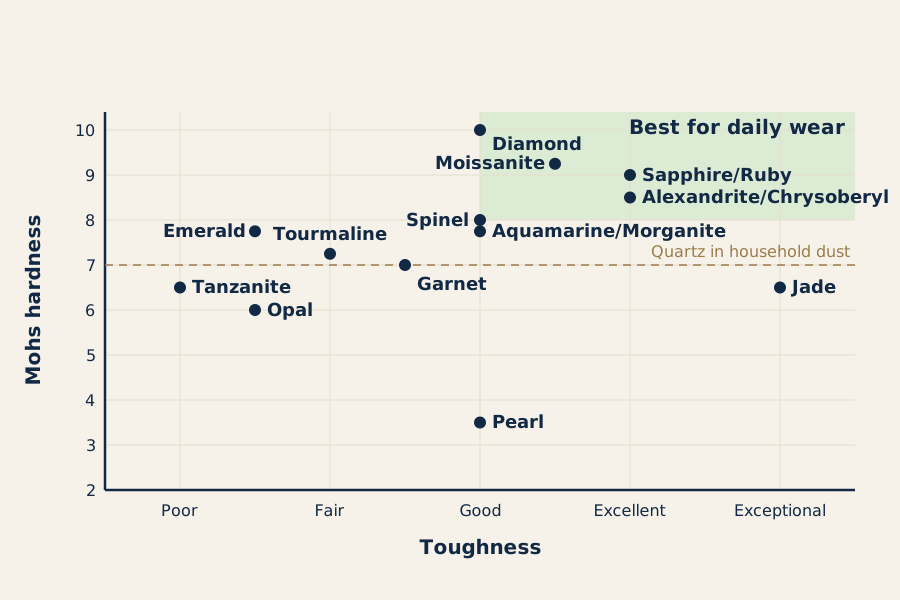
Which are the best gemstones for daily wear? A durability table
This table brings the three tests together for the stones people most often ask us to set in rings. Toughness uses the descriptive scale gemmologists use (exceptional, excellent, good, fair, poor) because there is no single number for it.
| Gemstone | Mohs hardness | Toughness | Daily wear in a ring |
|---|---|---|---|
| Diamond | 10 | Good (can cleave if struck hard) | Excellent |
| Sapphire and ruby | 9 | Excellent | Excellent |
| Moissanite (lab-created) | 9.25 | Good to excellent | Excellent |
| Chrysoberyl and alexandrite | 8.5 | Excellent | Excellent |
| Spinel | 8 | Good | Very good |
| Aquamarine and morganite | 7.5–8 | Good | Good, with a protective setting |
| Emerald | 7.5–8 | Poor to fair (often included) | Possible with care and a bezel or guarded claws |
| Garnet | 6.5–7.5 | Fair to good | Good for regular wear with some care |
| Tourmaline | 7–7.5 | Fair | Good with care |
| Jade (nephrite and jadeite) | 6–7 | Exceptional | Resists chipping but slowly scratches |
| Tanzanite | 6–7 | Poor (cleavage) | Occasional wear, protective setting |
| Opal | 5.5–6.5 | Poor to fair | Occasional wear, bezel setting |
| Pearl | 2.5–4.5 | Good (but soft) | Occasional wear only |
Values are typical ranges; individual stones vary with inclusions, treatments and cut. A heavily included stone is weaker than a clean one of the same species, and thin edges or sharp corners are always the first place a chip starts. You can see how each of these coloured gemstones and birthstones looks in jewellery on our gemstones overview.
Which gemstones are best for daily wear in an engagement ring?
An engagement ring is usually worn every day for life, so the same rules apply, only stricter. The stones we suggest most often for coloured gemstone engagement rings are:
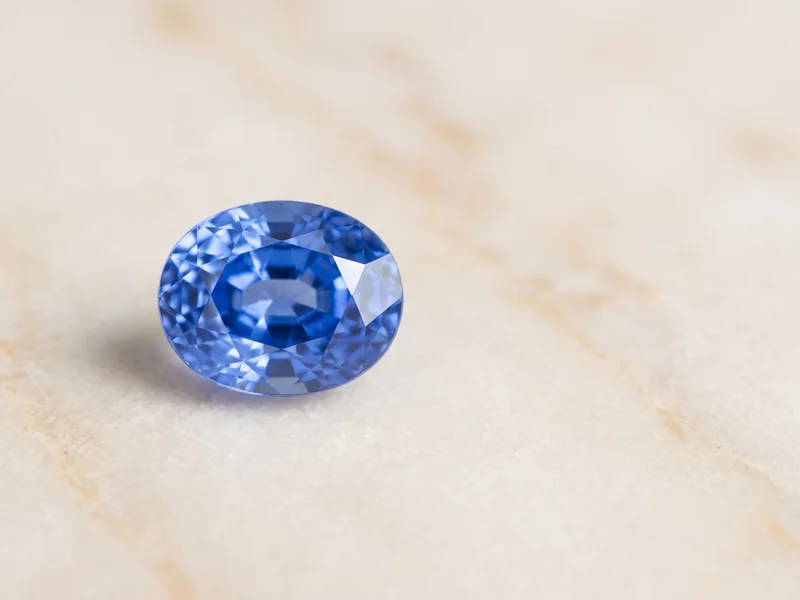
- Sapphire: hardness 9, excellent toughness, no cleavage and available in almost every colour, from royal blue to pink, teal, yellow and the pink-orange padparadscha. Our in-depth sapphire guide covers colours and quality.
- Ruby: the red variety of the same mineral, corundum, so it is just as durable.
- Spinel: hardness 8, no cleavage, bright and often untreated. A strong alternative to ruby or pink sapphire.
- Alexandrite: a chrysoberyl at hardness 8.5 with excellent toughness and a colour change from green in daylight to purplish red under warm light. Natural alexandrite is rare and expensive; lab-created alexandrite is far more common.
- Moissanite: a lab-created stone (silicon carbide) with more fire than diamond and hardness of 9.25, for those who want a colourless look at a lower cost.
Morganite and aquamarine are popular too, and they work well for many people, but at 7.5–8 they scratch and abrade faster than sapphire, and the facet edges soften after some years of daily wear. A light re-polish brings them back. Our honest look at morganite engagement rings covers what to expect over the years.
Related guideEngagement Rings with Colour, Meaning and Personal Gemstone ChoiceWhich gemstones should you avoid in an everyday ring?
No gemstone is off limits if you love it, but some need a realistic plan. These are the stones where we talk through the trade-offs before making a daily-wear ring:
- Opal: soft at 5.5–6.5, contains water, and can crack with knocks or sudden temperature change. Opal doublets and triplets (thin slices of opal glued to a backing) should never be soaked. A bezel helps a great deal.
- Pearl: very soft and damaged by perfume, sweat, chlorine and cleaning products.
- Emerald: hard enough, but almost always included, which makes it brittle, and usually clarity-enhanced with oil or resin, which is sensitive to ultrasonic cleaners. Our guide to emerald and its inclusions explains why it needs gentler handling.
- Tanzanite and topaz: both have cleavage, so a sharp knock on a hard surface can split the stone. Tanzanite is also only 6–7 in hardness.
- Peridot, moonstone and kunzite: softer or cleavage-prone stones that do better in pendants and earrings, where they are rarely knocked.
Stones prized for an optical effect need extra thought. The play-of-colour in opal and the glow of moonstone sit in softer materials, while star sapphire carries its effect in a hard, tough stone. Our guide to play-of-colour, asterism and other optical effects explains how each one forms.
Not sure which one is right?
Send us the stones you are looking at and our gemologist will tell you which to choose and why.
How does the setting protect a gemstone?
The setting can make a moderately durable stone practical, or leave a tough stone exposed. The main choices for daily wear:
| Setting | Protection | Suits |
|---|---|---|
| Bezel | Metal rim around the whole edge; very protective | Opal, emerald, tanzanite, active hands |
| Six claws | More grip, and one broken claw is less likely to lose the stone | Larger centre stones |
| Four claws | Shows the most stone; less edge cover | Hard, tough stones like sapphire |
| Halo | Small stones shield the centre's edge | Most stones; adds visual size |
| Low profile | Sits closer to the finger and gets knocked less | Anyone who works with their hands |
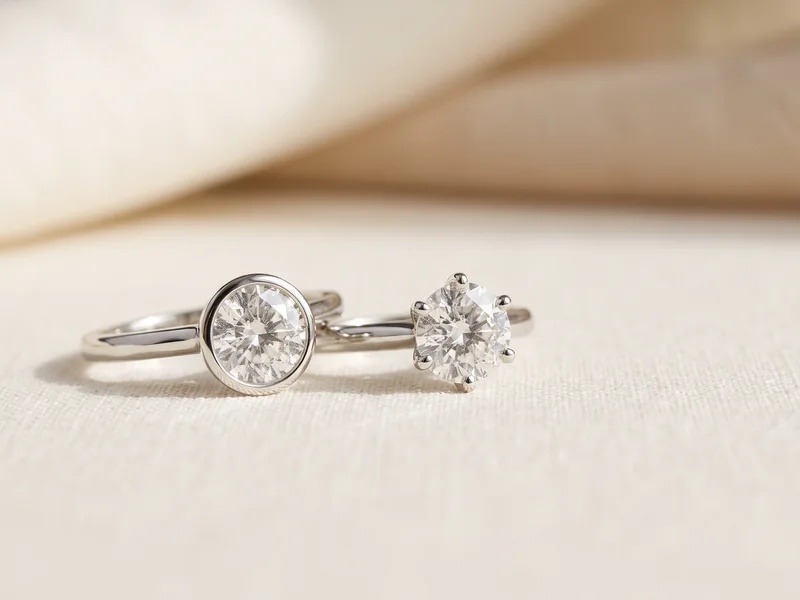
A bezel setting for soft gemstones is the single biggest change you can make: it covers the girdle, the thin outer edge where most chips start. For a detailed comparison, see bezel versus claw settings for everyday wear and our setting guide for diamonds and gemstones. Pointed and cornered shapes need extra protection: the same principle in our guide to protecting princess-cut corners applies to square-cut gemstones.
Do treatments affect gemstone durability?
Some do. Heat treatment of sapphire and ruby is stable and does not weaken the stone in normal wear. Fracture filling with lead glass in ruby, and oil or resin in emerald, can be damaged by heat, ultrasonic cleaners or solvents, which matters when a ring is resized, re-tipped or cleaned. A jeweller's torch near a glass-filled ruby can etch the filler in seconds.
Always ask what treatment a stone has had, and keep the answer with your ring paperwork so anyone repairing it knows. Our guide to treated and untreated gemstones explains each treatment and how it affects care. Gemmologists identify treatments with magnification, spectroscopy and other tests, set out in our scientific guide to gemstone identification.
Are there durable Australian gemstones for rings?
Yes. Australian sapphire from the New England fields of New South Wales and the central Queensland gemfields is as hard and tough as sapphire from anywhere, because it is the same mineral. It is known for deep blues, teals, greens and parti colours (two or more colours in one stone), which suit everyday rings well. How a lab tells an Australian sapphire from one mined elsewhere is covered in our guide to how gemstone origin is determined.
Australian opal is the other famous local gem, but it belongs in the more-care group: beautiful in a ring with a bezel and sensible habits, less suited to a hard-working hand. Solid opal is more durable than a doublet or triplet, and under Australian opal nomenclature, an opal sold simply as black opal should be natural solid opal, while doublets and triplets must be described as such.
Are lab-created gemstones as durable as natural ones?
Yes. A lab-created (synthetic) sapphire, ruby, spinel or alexandrite has the same chemistry, crystal structure and hardness as the natural stone, so it is equally durable in a ring. Lab-created stones often have fewer inclusions, which can make them slightly less prone to chipping. They cost much less than natural stones of the same colour and size. Natural gemstones are rarer and each carries the character of where it formed.
Either way, the stone should be disclosed clearly: a lab-created sapphire must always be sold as lab-created or synthetic, never simply as sapphire. Moissanite is only produced in laboratories for jewellery; natural moissanite is far too rare and small to cut.
Browse natural gemstones in our stock
We keep a selection of loose natural gemstones in stock, and most stones in this guide can be sourced for a custom ring.
How to choose a gemstone for a daily-wear ring: step by step
Even the toughest stone benefits from good habits. Take rings off for the gym, gardening and heavy cleaning, keep them out of chlorinated pools, and store them separately so a diamond or sapphire cannot scratch a softer stone. Our guide on wearing your ring in the shower, pool or at the beach goes through each case, and care instructions for each gemstone list which stones are safe in ultrasonic or steam cleaners.
- Be honest about your hands. Desk work, nursing, trades and sport all treat a ring differently.
- Start with hardness. For daily wear, aim for 8 or above; 7–8 works with a protective setting.
- Check toughness and cleavage. Avoid stones that can split along a plane unless the setting protects them.
- Ask about treatments. Filled or oiled stones need gentler cleaning and repairs.
- Match the setting to the stone. Bezel or halo for softer gems, claws for sapphire and spinel.
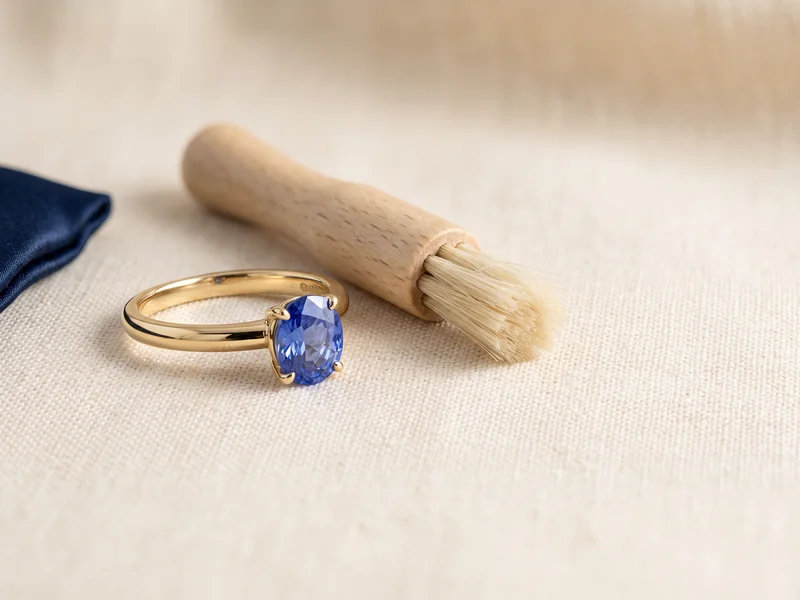
- Clean gently. Warm soapy water and a soft brush are safe for nearly every gem.
- Plan check-ups. Have claws and settings checked about once a year.
Free consultation
Talk to a gemologist
Compare stones in person or online with Raj Sood, Graduate Gemologist (GIA), AJP (GIA).
Book a consultationShop this shape
FAQ
Common questions
What is the most durable gemstone for a ring?
Diamond is the hardest, but sapphire and ruby combine hardness 9 with excellent toughness, so they resist both scratching and chipping very well. Among coloured stones, they are the safest choice for daily wear.
Is sapphire good for everyday wear?
Yes. Sapphire is 9 on the Mohs scale with excellent toughness and no cleavage, which is why it is the most popular coloured engagement stone.
Can you wear an opal ring every day?
You can, but it needs care. Opal is 5.5–6.5 on the Mohs scale and can crack with knocks or sudden temperature changes, so a bezel setting and taking it off for rough tasks are recommended.
Is morganite durable enough for daily wear?
Morganite is 7.5–8 with good toughness, so it suits daily wear with a protective setting. It will show wear sooner than sapphire and benefits from regular professional cleaning.
What hardness should a ring stone be?
Ideally 8 or higher on the Mohs scale. Stones between 7 and 8 can work with a protective setting; anything below 7 will gradually dull from everyday dust.
Are lab-created gemstones as durable as natural ones?
Yes. A lab-created sapphire or spinel has the same chemistry and hardness as the natural stone, so it is equally durable.

Ask a gemologist
Not sure which diamond to choose?
Raj Sood is a Graduate Gemologist (GIA) and master jeweller. Bring the stones you are considering, or send the reports, and he will tell you honestly which one is better and why.
Keep learning
Related guides
 GemstonesGemstone Hardness Guide
 GemstonesEngagement Rings with Colour, Meaning and Personal Gemstone Choice
 Engagement Rings & SettingsBezel vs Claw Settings for Everyday Wear
 GemstonesGemstone Durability for Everyday RingsGemstonesGemstones | Coloured Gemstones, Birthstones and Custom Jewellery
 Care, Repairs & RemodellingCan You Wear Your Ring in the Shower, Pool or at the Beach?
 Engagement Rings & SettingsDiamond & Gemstone Setting Guide
 GemstonesGemstone Care by Stone
Explore more
More guides on this topic
Education