
- Education
- Diamond Shapes
- Princess vs Asscher Cut Diamonds: Which Square Diamond Suits You?
Diamond shapes
Princess vs Asscher Cut Diamonds: Which Square Diamond Suits You?
Princess vs Asscher cut is the classic square diamond decision. Both look square from across the room, but one sparkles like a brilliant and the other glows like a step cut, and that changes the size, the price and how you set it.
 Reviewed by Raj Sood, Graduate Gemologist (GIA), AJP (GIA)Master jeweller and Graduate Gemologist (GIA) · reviewed 4 November 2026
Quick answer
A princess cut is a square brilliant with sharp corners and lively, scattered sparkle. An Asscher cut is a square step cut with clipped corners, a deep 'hall of mirrors' and calmer, broader flashes. Princesses face up slightly larger and cost a little less; Asschers chip less at the corners but show clarity and colour more.
Princess vs Asscher cut: what is the difference?
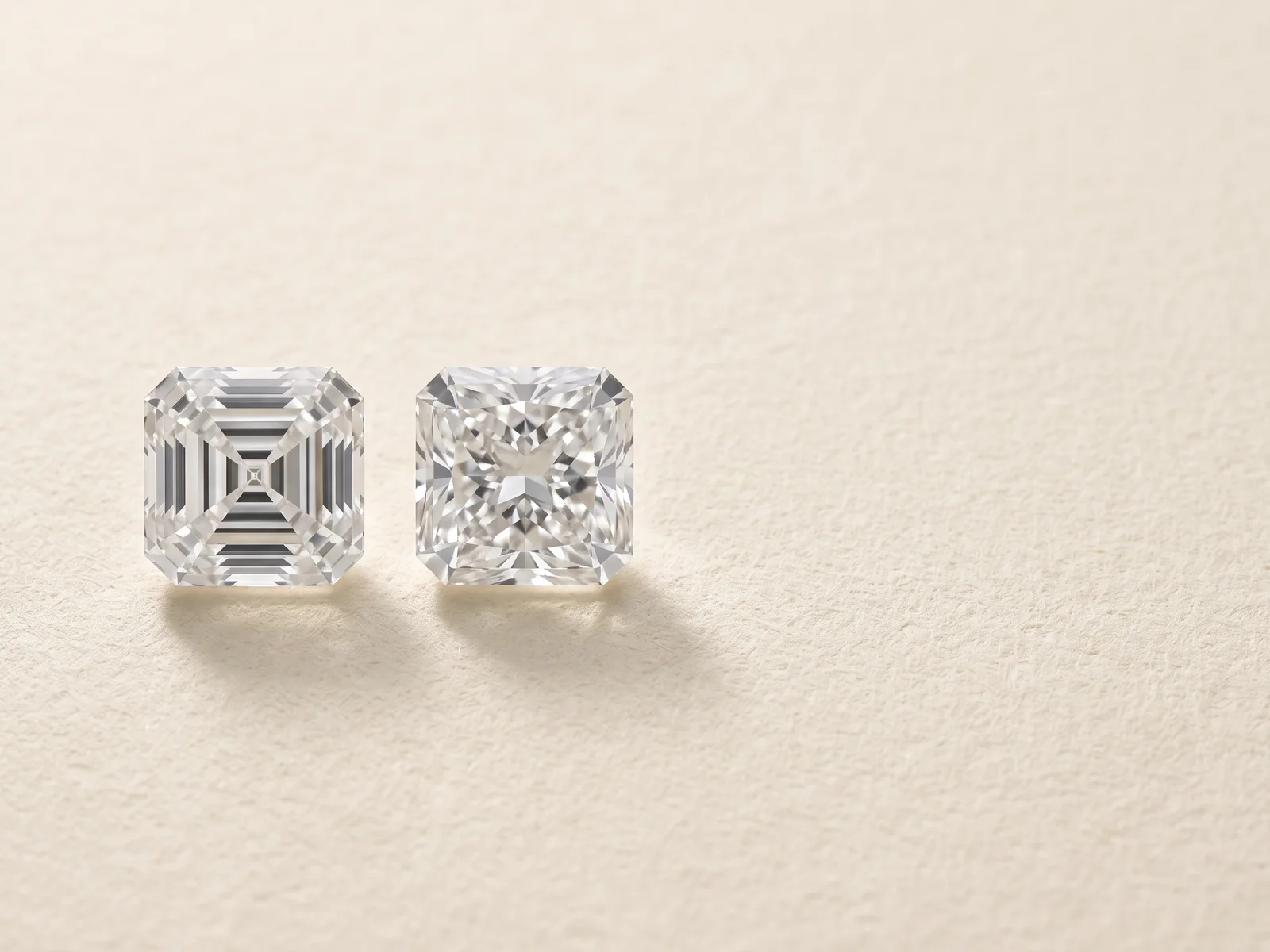
Both shapes are square, usually with a length-to-width ratio (length divided by width) of about 1.00 to 1.05. The difference is in how the facets, the small flat polished surfaces, are arranged. A princess cut is a square modified brilliant: it uses triangular and kite-shaped facets, like a round brilliant, to break light into lots of small, bright flashes. An Asscher cut is a square step cut: its facets are long, flat rows running parallel to the edges, like steps going down a staircase, which give broad flashes and a clear view into the stone.
The outline differs too. A princess has four sharp, pointed corners and fills the whole square. An Asscher has its corners clipped off, so face-up it is really an octagon, with a small table (the large flat top facet), a high crown and a deep pavilion (the lower half of the stone). Our full princess cut diamond guide and our page on everything to know about Asscher cut diamonds go deeper into each shape on its own.
The history explains a lot about the look. The Asscher was designed by Joseph Asscher in Amsterdam in 1902 and became a favourite of the Art Deco era, so it reads as vintage and architectural. The princess appeared around 1980 and became one of the most popular engagement shapes in the 1990s and 2000s, so it reads as modern and crisp. If you are still weighing up other shapes, start with how all the main diamond shapes compare, and any unfamiliar word here is explained in our plain-English jewellery glossary.
How are princess and Asscher diamonds cut?
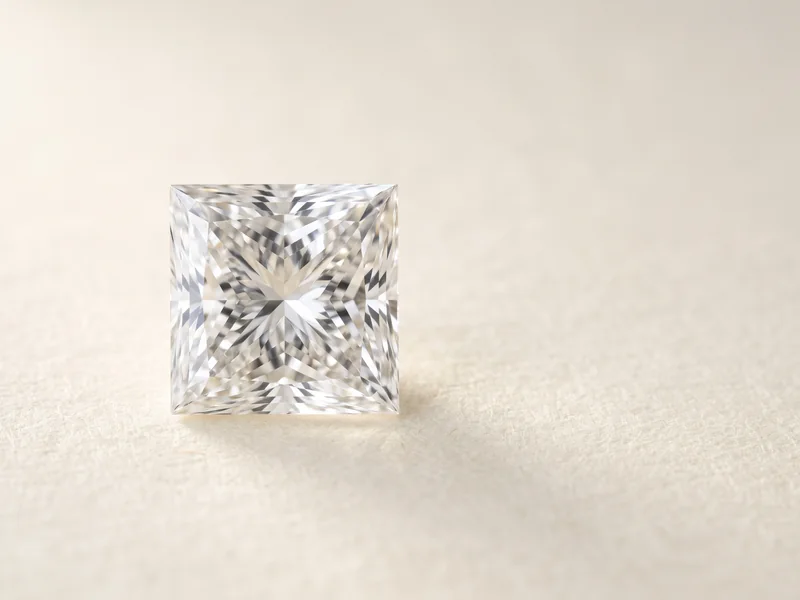
A princess usually has 57 or 58 facets, though some cutters add more, up to about 76. Looking through the table, you see an X shape running corner to corner, and on the pavilion you see chevrons: V-shaped facet patterns that repeat down the stone. Princesses are commonly cut with two, three or four chevrons. Fewer chevrons give bigger, bolder flashes; more give a finer, crushed-ice sparkle. Our page on how chevron patterns change princess sparkle shows the difference.
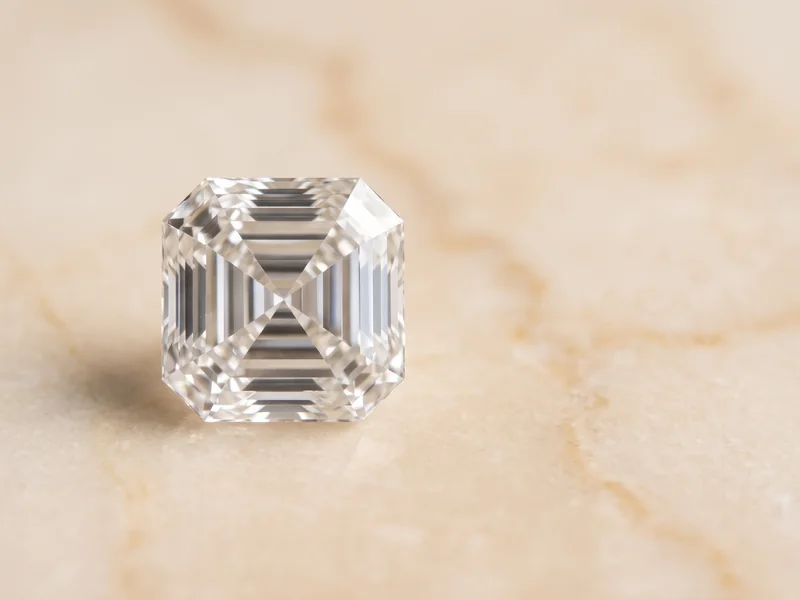
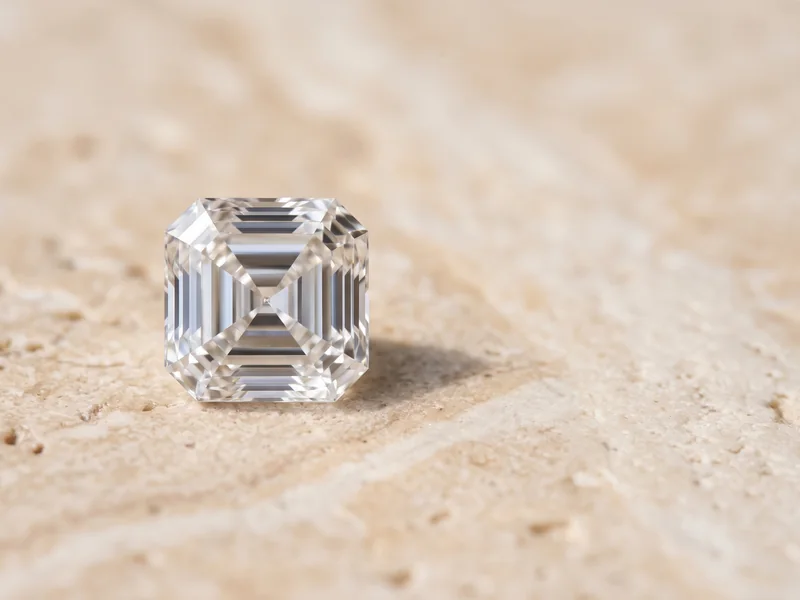
A classic Asscher has about 58 facets in step rows, with cut corners. A well-cut Asscher shows a windmill pattern: four sets of reflections running from the corners towards the centre, looking like the blades of a windmill, set inside concentric squares that seem to go down into the stone. That effect only appears when the crown is high, the table is small and the pavilion is deep enough. Our guide to the Asscher windmill pattern and what makes it appear explains how to spot it in a video. A trademarked variation, the Royal Asscher cut, has 74 facets.
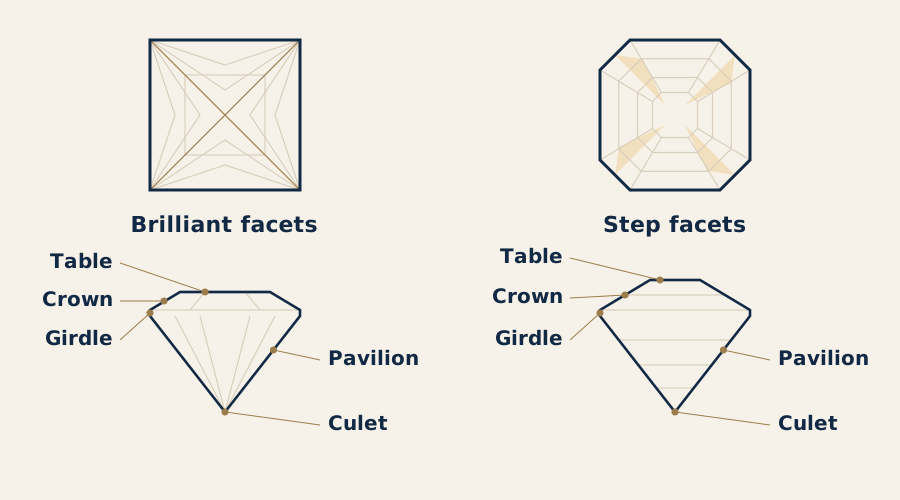
Because it is a step cut, the Asscher sits in the same family as the emerald, baguette and carré. See the step cut family, from emerald to carré for how that whole group behaves. The princess, by contrast, sits with brilliant-faceted fancy shapes such as the radiant and cushion.
Which looks bigger on the hand, princess or Asscher?
Carat is weight, not size, so what matters on the hand is the face-up size: the area you see from above. Princesses are deep stones, often with a total depth of about 68–75%, so a lot of their weight sits underneath. Asschers are often a little shallower, around 60–70%, but their clipped corners remove some of the face-up area. The result is that at the same carat weight the edge measurements are similar, and the princess usually looks slightly larger because it fills the full square.
| Carat weight | Princess (typical edge length) | Asscher (typical edge length) |
|---|---|---|
| 0.50 ct | about 4.4 mm | about 4.4–4.5 mm |
| 0.75 ct | about 5.0 mm | about 5.0 mm |
| 1.00 ct | about 5.5 mm | about 5.5 mm |
| 1.50 ct | about 6.3 mm | about 6.3–6.5 mm |
| 2.00 ct | about 6.9 mm | about 6.9–7.0 mm |
These are typical figures for square stones near a 1.00 ratio; individual stones vary with depth and how the corners are cut. The diagonal also matters. A 5.5 mm princess measures roughly 7.8 mm from corner to corner, which is why a princess set with its corners pointing along the finger (called 'on point' or kite setting) can look much larger. The Asscher's clipped corners shorten its diagonal, so it looks more compact and more like a single, solid block of light.
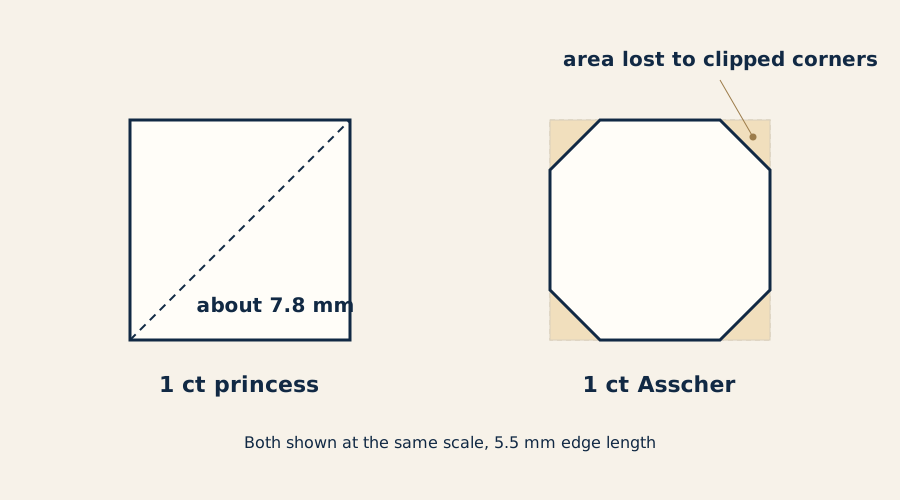
For comparison, a 1 ct round is about 6.4 mm across. Both square shapes measure smaller edge to edge than a round of the same weight, but the princess's square outline covers a similar area to that round, while the Asscher covers a little less.
Which sparkles more, princess or Asscher?
They sparkle differently rather than one simply sparkling more. A princess gives scintillation: lots of small, sharp flashes of white and coloured light that move as the stone moves. In shop lighting and in daylight it reads as bright and busy. Of the fancy shapes, it is one of the closest to a round brilliant in liveliness.
An Asscher gives broad, slower flashes and strong contrast: light and dark panels that switch on and off as the stone tilts. Gemmologists sometimes call this a 'hall of mirrors' effect. It looks glassy, calm and deep rather than glittery. People who love it describe it as elegant and architectural; people who prefer a princess find it quieter.
- Princess: high brilliance (white light return) and lots of scintillation; hides small inclusions well.
- Asscher: broad flashes, mirror-like depth and the windmill pattern; shows the inside of the stone clearly.
- Both: diamond has a refractive index of about 2.42, so even the calmer step cut still returns plenty of light when it is well proportioned.
Faceting style changes everything about how a stone handles light. At the far end of the range, a briolette, faceted all over with no table at all, shows how far cutters can move away from the flat-topped shapes compared here.
Not sure which one is right?
Send us the stones you are looking at and our gemologist will tell you which to choose and why.
What colour and clarity should you choose for each?
This is where the two shapes really part ways. A princess's brilliant facets scatter light and break up what you see inside the stone, so small inclusions (internal features) are well hidden. An Asscher's open step facets act like a window, so inclusions near the centre are easy to spot. The same goes for body colour: step cuts tend to show a warm tint a little more than brilliants.
| Princess | Asscher | |
|---|---|---|
| Clarity many choose | SI1–VS2, checked to be eye-clean | VS2–VS1, checked to be eye-clean |
| Colour in white gold or platinum | H or better | G or better |
| Colour in yellow or rose gold | I–J can look white | H–I can look white |
| Where inclusions show most | Corners, and near the centre with few chevrons | Anywhere under the table, especially the centre |
Eye-clean means you cannot see inclusions without magnification at normal viewing distance. In an Asscher, look especially for feathers (small internal cracks) and clouds under the table. Our clarity grades that work in an Asscher guide shows which inclusions matter and which do not. In a princess, the corners deserve the same attention, because an inclusion that reaches the surface there can weaken an already thin point.
Which is more durable, a princess or an Asscher?
Diamond is 10 on the Mohs hardness scale, so neither shape scratches in normal wear. Hardness is not toughness, though. Diamond can chip along its cleavage planes if a thin edge takes a sharp knock, and corners are the thinnest edges a stone has.
The princess is the more vulnerable of the two. Its four corners come to a point of about 90°, and a knock on a doorframe or bench can chip one if it is left exposed. That is why princesses are normally set with V-claws (V-shaped claws that wrap each corner) or a bezel. Our guide to protecting princess corners from chips covers the options in detail.
The Asscher's clipped corners spread the edge across a short flat facet instead of a point, so they are less exposed. They still need claws, but standard rounded or slightly flattened claws at each corner are usually enough. For daily wear on a hand that works hard, many people find the Asscher the easier stone to live with.
What are the best settings for princess and Asscher diamonds?
Both shapes suit a four-claw solitaire, but the claw style differs. Common choices:
- Princess, four V-claws: each corner sits in a V-shaped claw, which protects the point and keeps the square outline crisp.
- Princess, bezel or half-bezel: a thin rim of metal around the edges; very secure and modern.
- Asscher, four corner claws: the classic setting, often with slightly flattened claws that follow the clipped corners.
- Asscher, halo or Art Deco styles: a square halo, milgrain (fine beaded edging) and step-cut side stones lean into its vintage character.
- Either, three-stone: trapezoid, baguette or half-moon side stones sit flush against straight edges.
For more Asscher ideas, see setting styles that suit an Asscher. Straight-sided stones also pair neatly with a straight band, and our guide to the wedding bands that sit well beside an Asscher shows flush and contoured options.
Related guideAsscher vs Square Radiant DiamondsPrincess vs Asscher cut side by side: which suits you?
| Princess | Asscher | |
|---|---|---|
| Faceting | Modified brilliant, chevrons | Step cut, windmill pattern |
| Outline | Square, four sharp corners | Square with clipped corners (octagonal) |
| Typical ratio | 1.00–1.05 | 1.00–1.05 |
| Typical depth | about 68–75% | about 60–70% |
| Sparkle | Bright, lively, many small flashes | Broad flashes, mirror-like depth |
| Face-up size per carat | Slightly larger | Slightly smaller |
| Hides inclusions | Well | Poorly; choose higher clarity |
| Corner chipping risk | Higher; needs V-claws | Lower |
| Style | Modern, crisp | Vintage, Art Deco, architectural |
A princess may suit you if you want the most sparkle from a square shape, the largest look for the weight and some flexibility on clarity, and you are happy to protect the corners. An Asscher may suit you if you love vintage or Art Deco design, prefer a calm, glassy look and value sturdier corners, and you are willing to put a little more of your budget into clarity and colour.
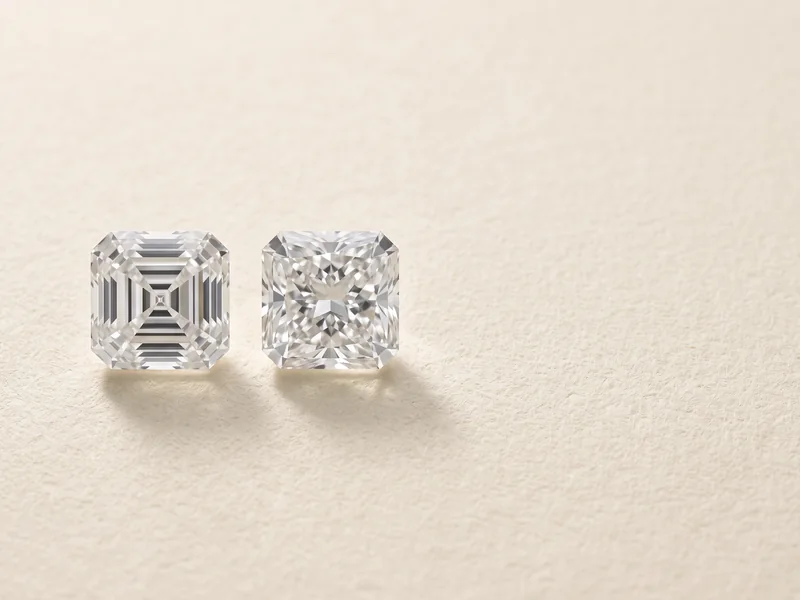
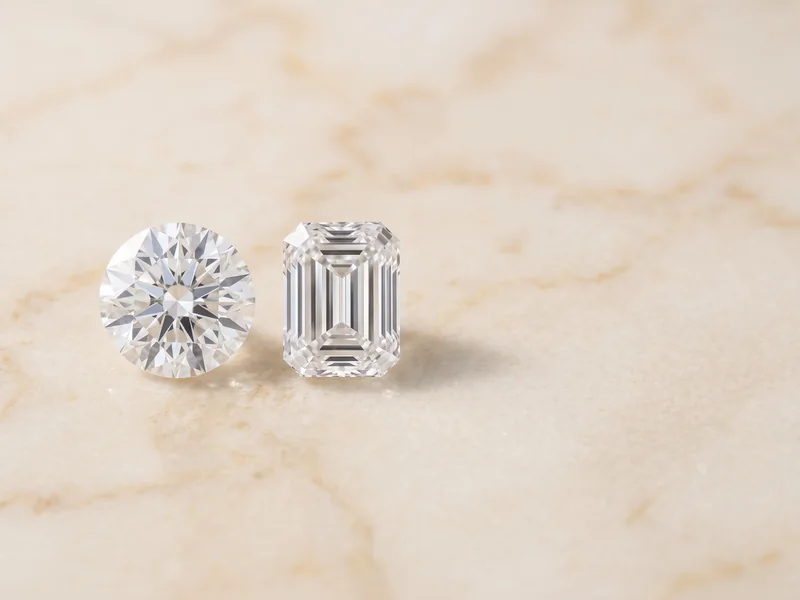
If neither feels quite right, there are close neighbours. A square radiant combines the princess's sparkle with the Asscher's clipped corners; see Asscher vs square radiant, compared and how a princess stacks up against a radiant. For a longer step cut, read the emerald and Asscher side by side, and for a softer outline, Asscher vs cushion for a vintage look.
Princess vs Asscher cut price: which costs more?
Both usually cost less per carat than a round of the same grades. The princess is efficient to cut: its shape follows the natural octahedral (eight-sided) diamond crystal closely, so much more of the rough can be kept than when cutting a round. Asschers are less common in stock and often bought at higher clarity, so for a stone you would actually be happy with, an Asscher frequently ends up costing a little more than a princess.
| 1 ct, G–H colour, VS clarity | Approximate price range (AUD) |
|---|---|
| Lab-grown princess | about $800–$2,500 |
| Lab-grown Asscher | about $900–$2,800 |
| Natural princess | about $5,000–$11,000 |
| Natural Asscher | about $5,500–$12,000 |
These are broad ranges only and move with the market and the exact grades. Lab-grown diamonds are real diamond grown in a laboratory rather than mined, with the same hardness and refractive index; they cost much less than natural and are easy to find in larger sizes. Natural diamonds are rarer. Neither should be thought of as an investment; choose the stone you want to wear. Both should come with an independent grading report, typically GIA or IGI, that states clearly whether the diamond is natural or lab-grown.
Shop princess and Asscher diamonds: natural and lab-grown
How do you choose between a princess and an Asscher diamond?
- Decide on the look. Lively and modern points to a princess; calm, deep and vintage points to an Asscher.
- Read the report. Check measurements, colour, clarity, polish, symmetry and whether the diamond is natural or lab-grown.
- Check the ratio. Divide length by width; about 1.00–1.05 keeps the stone looking square.
- Compare face-up size. Use the millimetre measurements, not just carat weight; expect a princess to look slightly larger.
- Watch a 360° video. In an Asscher, look for a clear windmill and no inclusions under the table; in a princess, check the corners and the chevron pattern.
- Plan the setting. V-claws or a bezel for a princess; corner claws, halo or Art Deco styles for an Asscher, plus a band that sits flush.
Free consultation
Talk to a gemologist
Compare stones in person or online with Raj Sood, Graduate Gemologist (GIA), AJP (GIA).
Book a consultationFAQ
Common questions
Is a princess or Asscher cut better for an engagement ring?
Neither is better overall. A princess gives more sparkle and looks slightly larger per carat, while an Asscher has a vintage step-cut look and less exposed corners. Choose the look you prefer, then the grades that suit that shape.
Does a princess or Asscher look bigger?
At the same carat weight, a princess usually looks slightly bigger because it fills the whole square, while an Asscher's clipped corners reduce its face-up area. Edge measurements are often similar, around 5.5 mm for 1 carat.
Do princess cut diamonds chip easily?
Their four sharp corners are the most exposed part, so they can chip if left unprotected. V-claws or a bezel cover the corners, and with a protective setting a princess is fine for everyday wear.
Why do Asscher diamonds need higher clarity?
Step facets act like a window into the stone, so inclusions are easier to see than in a brilliant cut. Many people choose VS2 or higher for an Asscher and check that it is eye-clean.
Is an Asscher more expensive than a princess?
Per carat at the same grades they are often close, but Asschers are less common and usually bought at higher clarity, so the stone you choose may cost a little more. Both normally cost less per carat than a round.
Can you get lab-grown princess and Asscher diamonds?
Yes. Both shapes are widely available as lab-grown diamonds, which are real diamond, cost much less than natural and are graded by labs such as IGI and GIA.

Ask a gemologist
Not sure which diamond to choose?
Raj Sood is a Graduate Gemologist (GIA) and master jeweller. Bring the stones you are considering, or send the reports, and he will tell you honestly which one is better and why.
Keep learning
Related guides
 Diamond ShapesPrincess Cut Diamonds
 Diamond ShapesAsscher Cut Diamonds
 Diamond ShapesPrincess vs Radiant Cut Diamonds
 Diamond ShapesEmerald vs Asscher Cut DiamondsDiamond ShapesUnderstanding Diamond Shapes
 Diamond ShapesAsscher-Cut Diamond Clarity GuideDiamond ShapesAsscher-Cut Diamond Windmill PatternDiamond ShapesAsscher vs Cushion Cut Diamonds
Explore more
More guides on this topic
Education