
- Education
- Diamond Shapes
- Asscher vs Cushion Cut Diamonds: Which Shape Suits You?
Diamond shapes
Asscher vs Cushion Cut Diamonds: Which Shape Suits You?
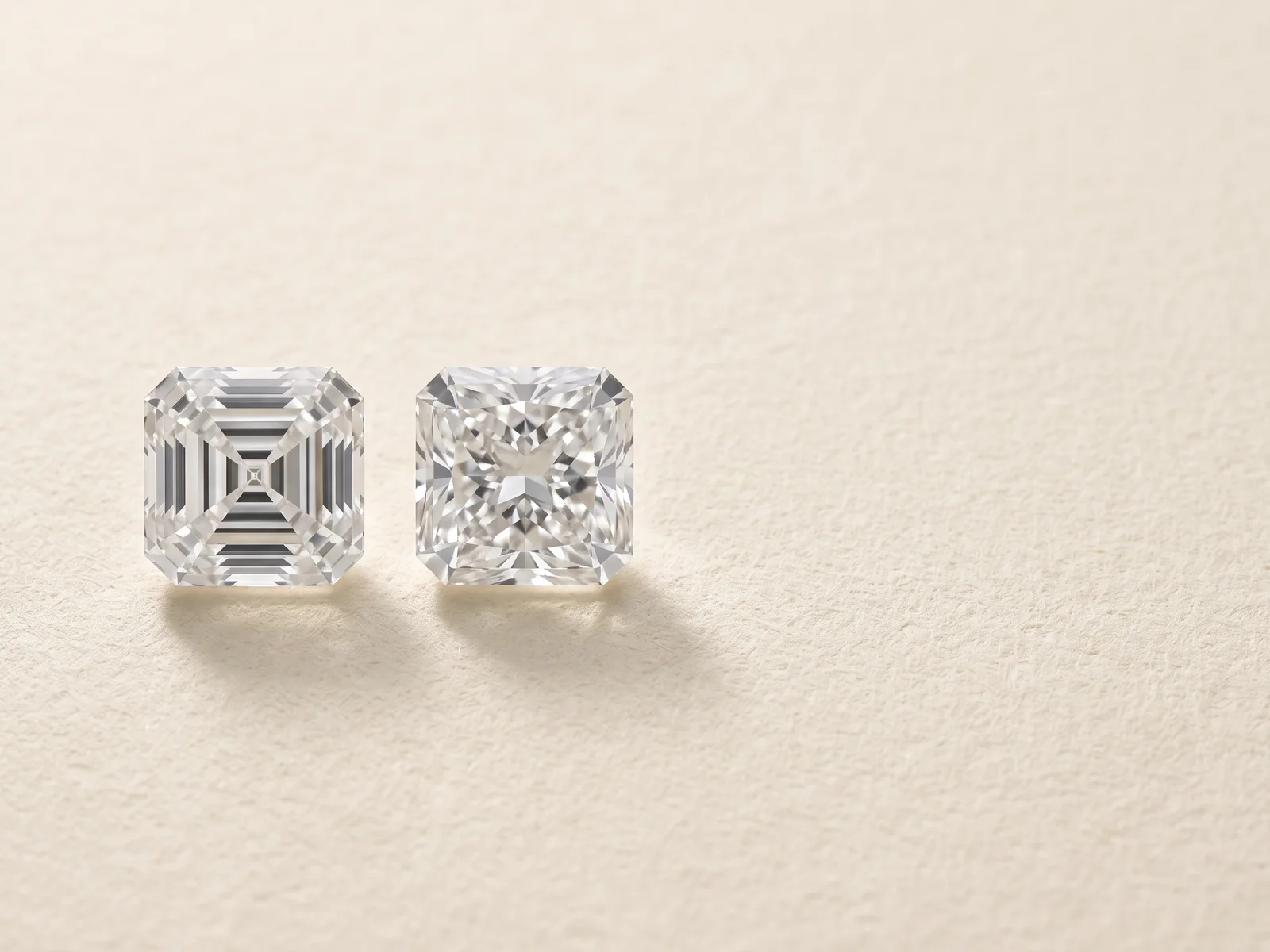
Asscher vs cushion cut is one of the closest calls in diamond shapes: both are square-ish with softened corners, yet one is cool and architectural and the other soft and sparkly. Here is how they really differ on the hand, in size, sparkle, durability and price.
 Reviewed by Raj Sood, Graduate Gemologist (GIA), AJP (GIA)Master jeweller and Graduate Gemologist (GIA) · reviewed 4 November 2026
Quick answer
An Asscher is a square step cut with cropped corners and a deep, hall-of-mirrors look; a cushion is a brilliant-faceted square or rectangle with rounded corners and more sparkle. At 1 carat both face up around 5.5 mm across, but a cushion hides inclusions better and often costs a little less, while an Asscher needs higher clarity.
Asscher vs cushion cut: what is the difference?
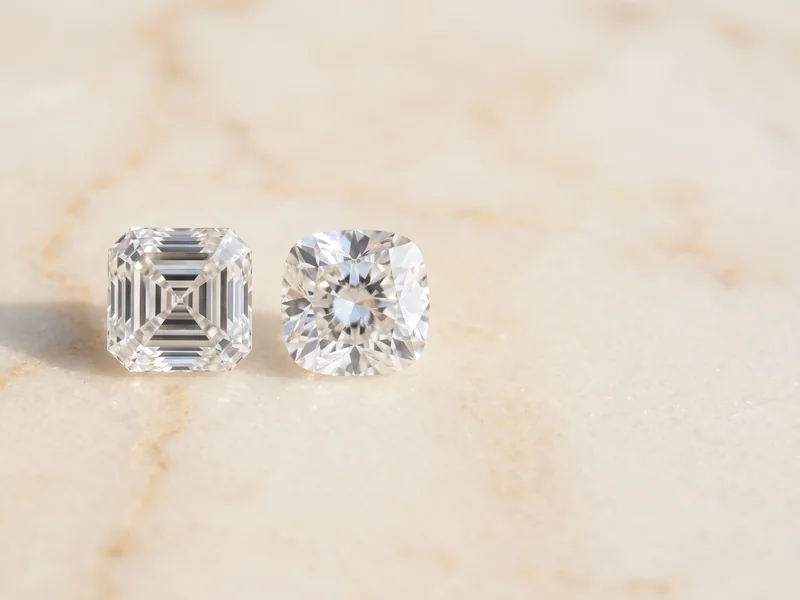
The difference comes down to how each stone is faceted. An Asscher is a step cut: its facets are long, flat and parallel, stepping down from the table (the large flat top facet) like a staircase. A cushion is a brilliant cut: its facets are small triangles and kites that scatter light in many directions. Our full guide to Asscher cut diamonds and their history and our cushion cut buying guide cover each shape on its own; this page puts them side by side.
The Asscher was designed by Joseph Asscher in Amsterdam in 1902 and became a signature of Art Deco jewellery in the 1920s and 1930s. It is a square with large cropped corners, which makes it an octagon in outline. Grading labs often describe it as a square emerald cut or cut-cornered square step cut. It belongs to the same family as the emerald and baguette, all explained in our overview of step cuts, from emerald to carré.
The cushion is older. It grew out of the old mine cut of the 18th and 19th centuries, a squarish stone with soft corners cut by hand by candlelight; our page on how the old mine cut became today's cushion traces that line. Modern cushions come as a cushion brilliant (larger, bolder flashes) or a cushion modified brilliant (extra pavilion facets, often giving a finer, crushed-ice look). Any unfamiliar term is explained in our plain-English jewellery glossary.
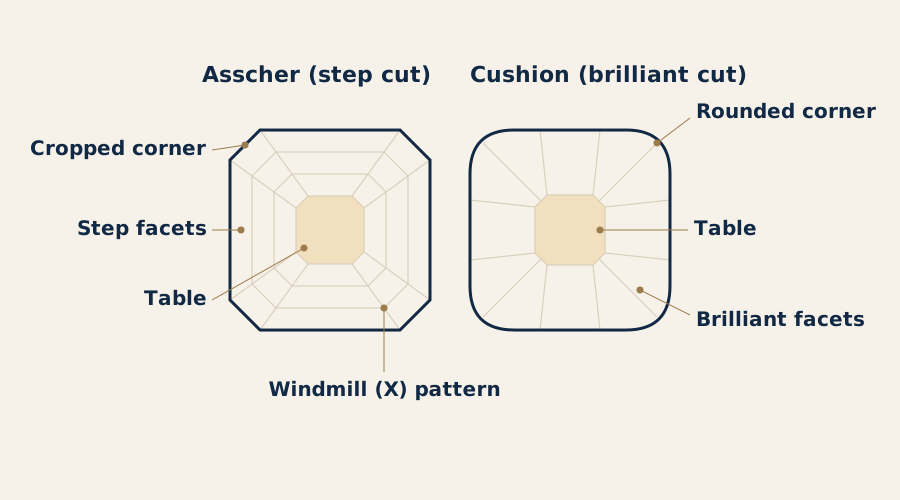
| Asscher | Cushion | |
|---|---|---|
| Facet style | Step cut, parallel facets | Brilliant or modified brilliant |
| Outline | Square with large cropped corners (octagonal) | Square or rectangle with rounded corners |
| Typical ratio | 1.00–1.05 | 1.00–1.05 square; about 1.10–1.50 elongated |
| Typical facets | About 58 (some branded versions more) | About 58–64+, varies by style |
| Look | Clear, mirror-like, high contrast | Soft, lively, lots of sparkle |
| Clarity tolerance | Low: inclusions easy to see | Higher: faceting hides inclusions |
| Colour tolerance | Shows body colour more | Can hold colour in the corners |
| Fragile points | None (corners are cropped) | None (corners are rounded) |
| Era it evokes | Art Deco, 1920s–30s | Victorian and vintage, also modern halo rings |
How do Asscher and cushion cut diamonds look on the hand?
On the hand an Asscher reads as a clean, geometric square. Because the corners are cropped so deeply, it can also look a little octagonal from a distance. Look into it and you see a hall-of-mirrors effect: concentric squares receding towards the centre, like looking down a lit corridor. It looks crisp and deliberate, and it pairs naturally with straight lines, baguettes and Art Deco detailing.
A cushion looks softer. The rounded corners and slightly curved sides give it a pillow-like outline, and the brilliant faceting means the eye sees sparkle first and outline second. On the finger a square cushion looks friendly and full; a rectangular one, covered in our guide to elongated cushions and their ratios, adds length to the finger in a way a square Asscher never will.
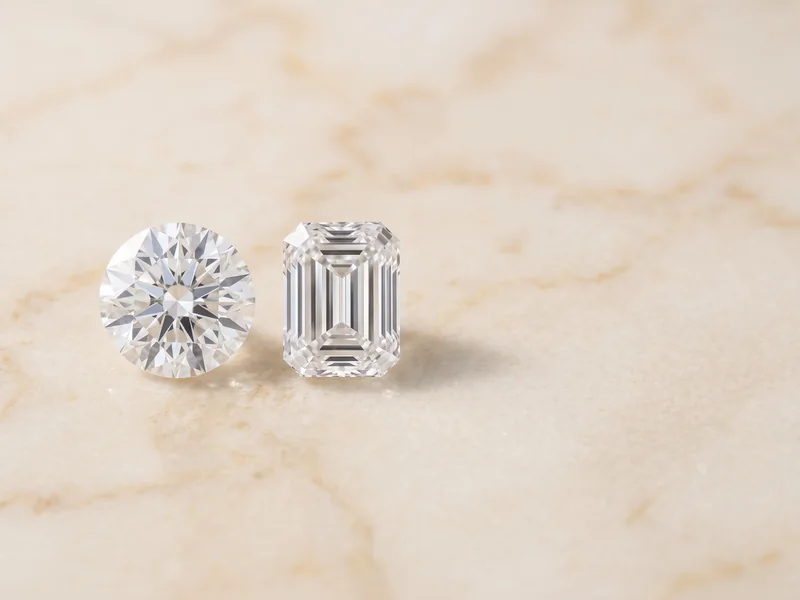
If you love the step-cut look but want length, the Asscher's rectangular sibling is the emerald cut; our emerald vs Asscher comparison shows how the two differ. To place both shapes among every other option, see our introduction to the main diamond shapes.
Related guidePrincess vs Asscher Cut DiamondsAsscher vs cushion cut: which looks bigger per carat?
Face-up size is how large the stone looks from above, measured in millimetres. Carat is weight, not size, so two stones of the same weight can look quite different depending on how much of that weight sits below the girdle (the outer edge) where you cannot see it.
| Carat weight | Square Asscher (approx. width) | Square cushion (approx. width) |
|---|---|---|
| 0.50 ct | about 4.4–4.6 mm | about 4.5–4.9 mm |
| 0.75 ct | about 5.0–5.2 mm | about 5.0–5.4 mm |
| 1.00 ct | about 5.4–5.7 mm | about 5.4–6.0 mm |
| 1.50 ct | about 6.3–6.6 mm | about 6.3–6.8 mm |
| 2.00 ct | about 6.9–7.2 mm | about 7.0–7.5 mm |
These are typical ranges for square stones of each shape. Asschers are fairly consistent because their proportions are tightly defined, usually with a total depth of about 60–68% of the width. Cushions vary much more. A well-proportioned cushion at about 61–68% depth can spread a little wider than an Asscher of the same weight, but many cushions are cut deep, at 70% or more, to save weight from the rough crystal. Those stones carry hidden weight and can face up smaller than an Asscher. Our page on cushion depth and hidden weight shows how to spot them on a report.
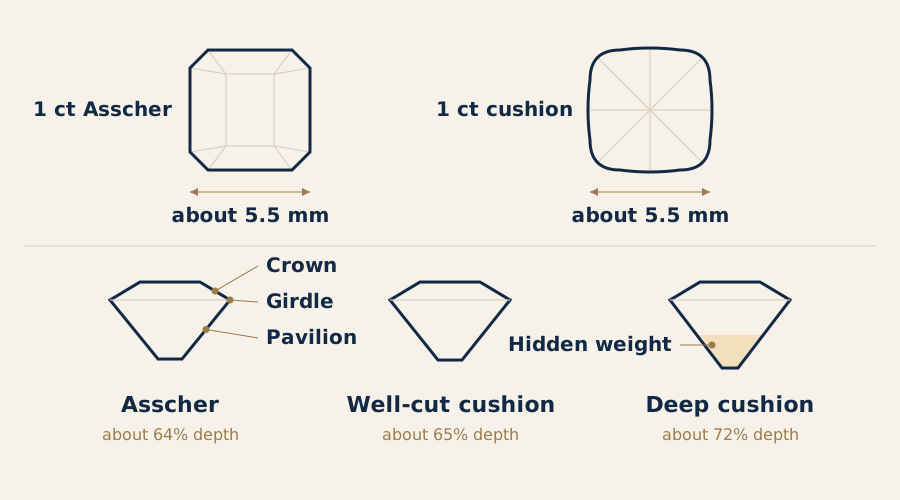
One more visual point: the Asscher's large cropped corners take away some of the square's area, so even at the same width an Asscher can look a touch smaller than a cushion with fuller corners. In practice, the difference between a well-cut Asscher and a well-cut cushion of the same weight is small. Compare the measurements in millimetres rather than assuming either shape wins.
Which has more sparkle, an Asscher or a cushion?
The cushion, in most lighting. Diamond has a refractive index of about 2.42, which bends light strongly, and a brilliant cut uses many small facets to break that light into lots of small flashes, called scintillation, plus flashes of colour called fire. A step cut uses fewer, larger facets, so it gives broader, slower flashes and strong contrast between light and dark areas. Neither is better; they are different effects.
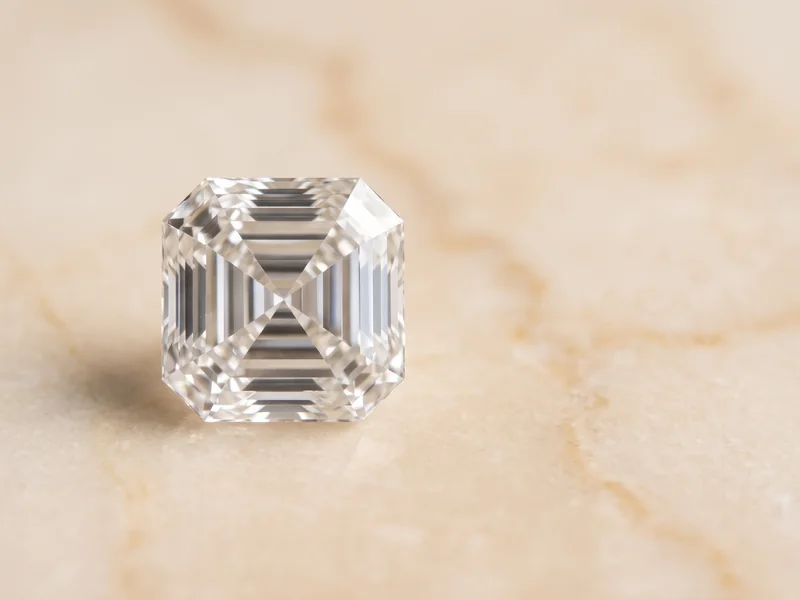
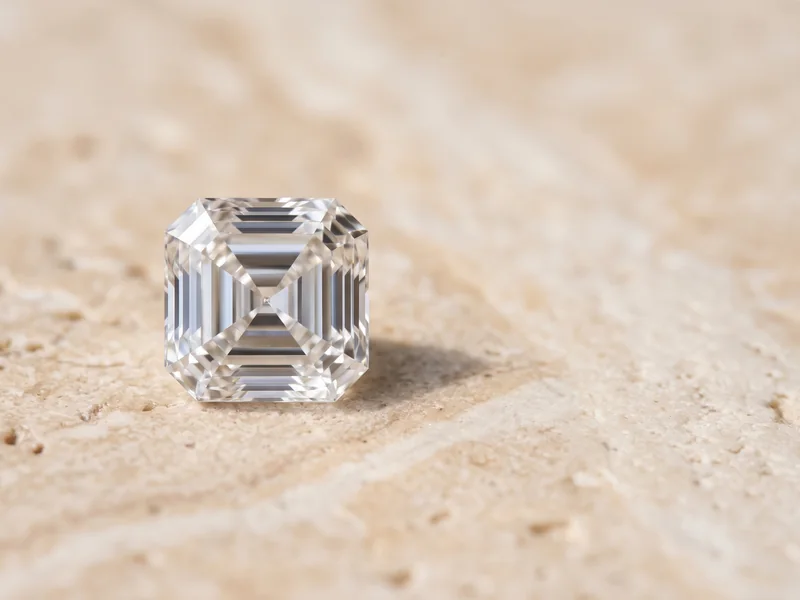
A well-cut Asscher shows a windmill pattern: four corner facets on the pavilion (the lower half) reflect through the table to form an X or pinwheel shape. A crisp, centred windmill is a sign of good proportions, and our guide to reading the Asscher windmill pattern explains what to look for.
Cushions split into two looks. A cushion brilliant shows larger, chunkier flashes, closer to an old mine cut. A cushion modified brilliant often shows a busy, glittering surface that people describe as crushed ice; see our explanation of crushed-ice cushion faceting. If you want even more sparkle in a squarish outline, the radiant is a brilliant-cut stone with cropped corners, and our radiant vs cushion guide compares the two.
Not sure which one is right?
Send us the stones you are looking at and our gemologist will tell you which to choose and why.
What colour and clarity do Asscher and cushion diamonds need?
This is where the two shapes differ most. An Asscher's open table and long, clear facets work like a window: inclusions (internal features such as crystals or tiny feathers) and body colour are both easier to see. A cushion's brilliant faceting breaks up the view and disguises small inclusions well.
- Asscher clarity: VS2 or better for most stones, and VS1 is worth considering above about 1.5 carats. Check the centre of the table closely.
- Cushion clarity: a carefully chosen SI1 is often eye-clean, meaning no inclusions visible without magnification at normal viewing distance. Crushed-ice cushions can hide a little more.
- Asscher colour: in white gold or platinum, many people prefer G or better, because step cuts show warmth.
- Cushion colour: H is usually fine in white metal; cushions can hold some warmth in the corners, so check photos in daylight.
- Yellow or rose gold: I–J can look white in either shape, since the metal warms the stone.
For a closer look at inclusions in step cuts, including where they show most, read our Asscher clarity checklist.
Are Asscher and cushion cut diamonds durable?
Both are among the more practical shapes for everyday wear. Diamond is 10 on the Mohs scale of hardness, so it resists scratching, but it can still chip along its cleavage planes if a thin edge takes a hard knock. Shapes with sharp points, such as the princess, pear and marquise, carry the most risk.
- Asscher: the cropped corners remove the sharp points a plain square would have. The corners are still the most exposed part, so claws usually sit over them.
- Cushion: rounded corners have no points at all, so a cushion is one of the more chip-resistant fancy shapes.
- Girdle thickness: on either shape, a report that lists an extremely thin girdle is a warning sign; medium to slightly thick is a sensible range.
Very deep cushions are also slightly more prone to catching on clothing because they sit higher in the setting. That is a comfort point rather than a durability risk, and a lower setting or a bezel solves it.
What settings suit an Asscher or a cushion engagement ring?
An Asscher suits settings that echo its geometry. Four claws, one on each cropped corner, are the classic choice; some people choose double claws or a V-claw on each corner for extra security. A bezel (a thin rim of metal around the edge) gives a clean modern look. Baguette or trapezoid side stones continue the step-cut lines, and a halo of small diamonds gives an Art Deco frame. Our guide to Asscher setting styles with examples goes further.
A cushion is more flexible. Four or double claws keep it open to the light, a halo makes it look larger and is very popular with cushions, and a hidden halo (a ring of small diamonds under the stone, seen from the side) adds detail without changing the face-up look. See claw, halo and hidden-halo settings for cushions.
For an Asscher vs cushion cut engagement ring, think about the wedding band too. A straight band sits neatly beside both shapes because neither has a point, but a halo on either stone widens the head and may need a slightly curved or notched band to sit flush.
How much do Asscher and cushion cut diamonds cost in Australia?
Both shapes cost less per carat than a round brilliant of the same weight, colour and clarity, because more of the rough crystal is kept and demand is lower. Our round vs cushion price and sparkle comparison shows that gap. Between the two, cushions often sit a little lower, partly because more cushions are available and partly because an Asscher needs higher clarity to look clean, which pushes the typical price up.
Both are cut from natural and laboratory-grown diamond. Lab-grown diamonds are real diamond, grown in a laboratory rather than mined, with the same hardness and refractive index; they cost much less than natural stones. Natural diamonds are rarer. Either way, ask for an independent grading report from a lab such as GIA or IGI, which states whether the stone is natural or lab-grown.
| 1 ct, G colour, VS2 | Asscher (approx. AUD) | Cushion (approx. AUD) |
|---|---|---|
| Lab-grown | about $800–$2,500 | about $800–$2,500 |
| Natural | about $7,000–$14,000 | about $6,000–$13,000 |
These are broad ranges only and move with the market and with exact grades. Within each shape, the price is driven mostly by carat, colour, clarity and cut quality. For a cushion, also check the depth: a deep stone costs you weight you cannot see.
Shop Asscher and cushion diamonds: natural and lab-grown
Who suits an Asscher, and who suits a cushion?
There is no rule, but patterns show up across the counter. An Asscher or cushion cut diamond decision usually comes down to whether you want clarity and structure or softness and sparkle.
- Choose an Asscher if: you like Art Deco and vintage geometry, clean lines and a calm, glassy look; you are happy to pay for higher clarity; you prefer a square that reads as precise.
- Choose a cushion if: you want more sparkle and a softer outline; you want the option of an elongated shape; you would rather put budget into carat than clarity; you love halo settings.
- Shorter or wider fingers: an elongated cushion adds length; a square Asscher reads compact.
- Hands-on lifestyle: both are sensible; a bezel-set cushion is about as practical as fancy shapes get.
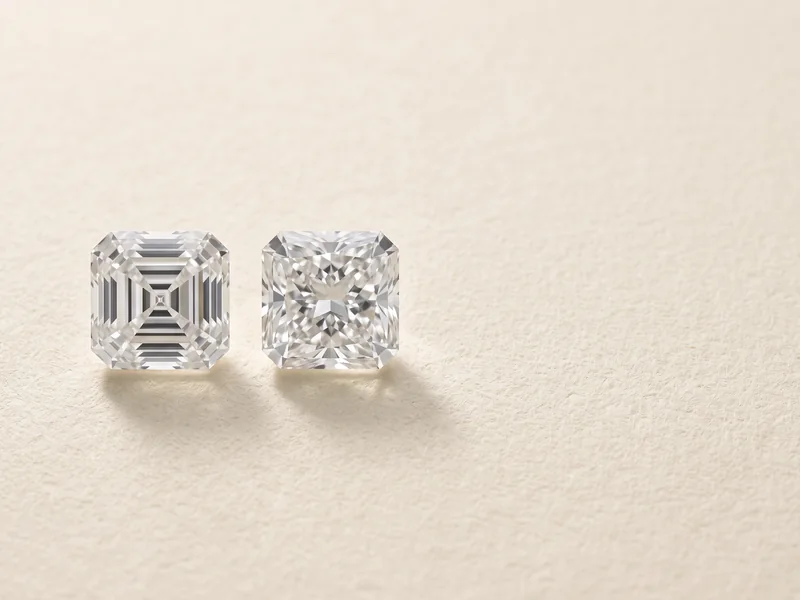
If you are still torn between square shapes, the princess is the other main option; our princess vs Asscher side-by-side covers the brilliant-cut square with sharp corners.
How do you choose between an Asscher and a cushion? Step by step
- Decide on the look. Mirror-like steps (Asscher) or scattered sparkle (cushion). Watch videos of both under the same light.
- Pick the outline. Square for either shape at a ratio of 1.00–1.05, or an elongated cushion at about 1.10–1.50.
- Read the report. Confirm shape, measurements, depth, table, colour, clarity, polish, symmetry and whether the diamond is natural or lab-grown.
- Compare millimetres, not carats. Check the face-up width; for cushions, be wary of depth above about 70%.
- Set your clarity and colour floor. Asscher: about VS2 and G in white metal. Cushion: about SI1 eye-clean and H.
- Check the pattern. For an Asscher, a centred windmill and even steps; for a cushion, even sparkle without a large dark centre.
- Plan the setting. Claws over the Asscher's corners, or a halo or hidden halo for a cushion, and make sure your band sits flush.
Free consultation
Talk to a gemologist
Compare stones in person or online with Raj Sood, Graduate Gemologist (GIA), AJP (GIA).
Book a consultationFAQ
Common questions
Which looks bigger, an Asscher or a cushion cut diamond?
At the same carat weight they look similar, around 5.5 mm across at 1 carat for square stones. A well-cut cushion can look slightly larger, but a deep cushion hides weight underneath and can look smaller than an Asscher.
Is an Asscher or a cushion more expensive?
Prices overlap, but cushions often cost a little less per carat. Asschers tend to need higher clarity to look clean, which raises the typical price.
Does an Asscher sparkle less than a cushion?
It sparkles differently. An Asscher gives broad flashes and strong contrast in a hall-of-mirrors pattern, while a cushion's brilliant facets give more small, lively flashes.
What clarity do I need for an Asscher cut diamond?
VS2 or better is a sensible starting point, and VS1 is worth considering above about 1.5 carats. The open step facets make inclusions easier to see than in a cushion.
Is an Asscher the same as a square emerald cut?
Very close. An Asscher is a square step cut with larger cropped corners and often a higher crown, and grading reports may describe it as a square emerald or cut-cornered square step cut.
Can you get lab-grown Asscher and cushion cut diamonds?
Yes. Both shapes are widely available as lab-grown diamonds, which are real diamond and cost much less than natural stones. The grading report will state that the stone is lab-grown.

Ask a gemologist
Not sure which diamond to choose?
Raj Sood is a Graduate Gemologist (GIA) and master jeweller. Bring the stones you are considering, or send the reports, and he will tell you honestly which one is better and why.
Keep learning
Related guides
 Diamond ShapesAsscher Cut Diamonds
 Diamond ShapesCushion Cut Diamonds: Brilliant, Modified & Buying Guide
 Diamond ShapesEmerald vs Asscher Cut DiamondsDiamond ShapesRadiant vs Cushion Cut DiamondsDiamond ShapesUnderstanding Diamond Shapes
 Diamond ShapesPrincess vs Asscher Cut Diamonds
 Diamond ShapesAsscher-Cut Diamond Clarity GuideDiamond ShapesAsscher-Cut Diamond Windmill Pattern
Explore more
More guides on this topic
Education