
- Education
- Diamond Shapes
- Asscher Cut Windmill Pattern: What It Is and How to Judge It
Diamond shapes
Asscher Cut Windmill Pattern: What It Is and How to Judge It
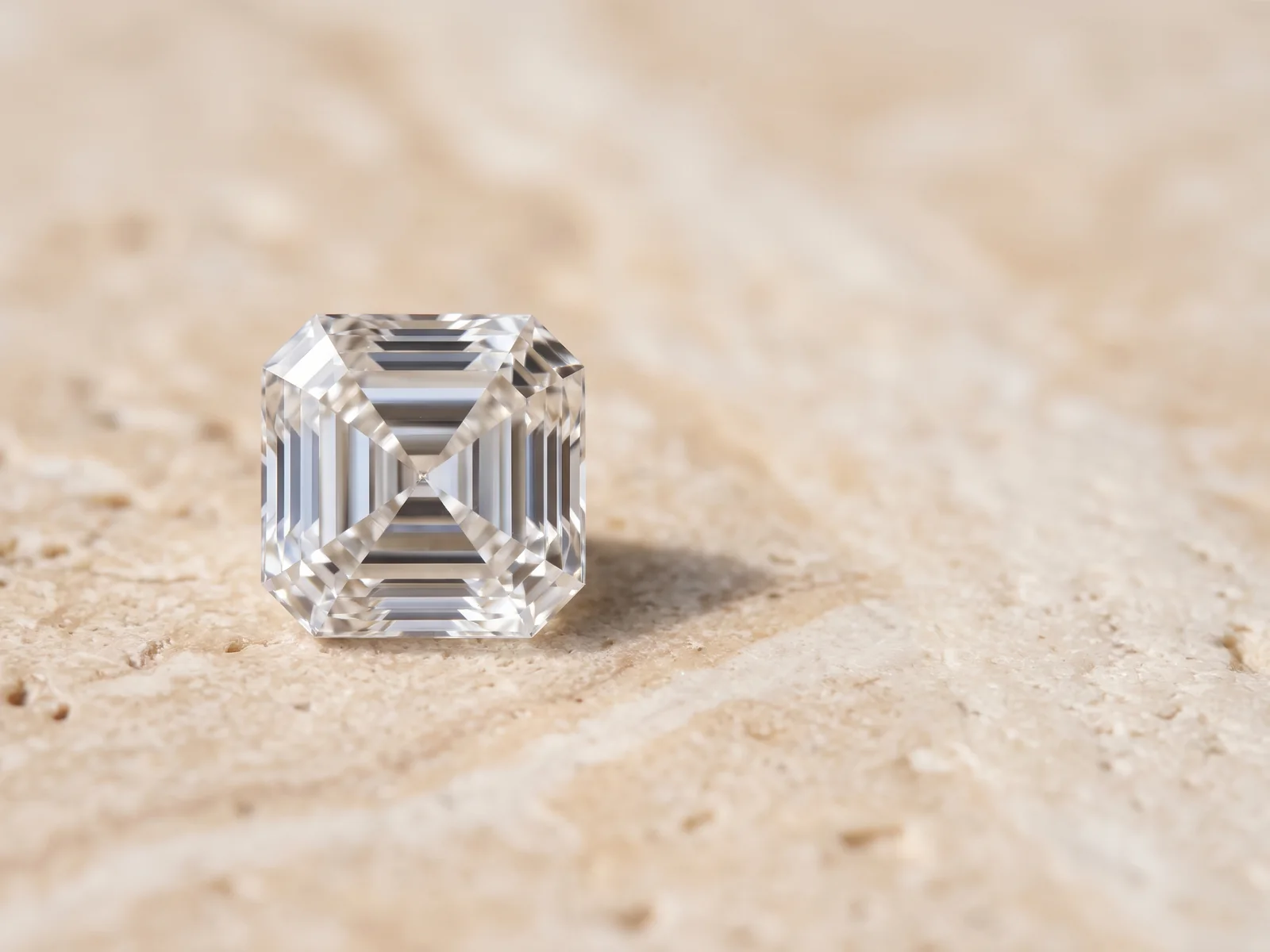
The windmill is why most people fall for an Asscher: a square of steps that seems to turn as the stone moves. Here is how the Asscher cut windmill pattern forms, what spoils it and how to check it from a grading report and a 360° video.
 Reviewed by Raj Sood, Graduate Gemologist (GIA), AJP (GIA)Master jeweller and Graduate Gemologist (GIA) · reviewed 4 November 2026
Quick answer
The Asscher cut windmill pattern is the four-bladed, pinwheel-like reflection you see when looking down into a well-cut Asscher diamond. It comes from concentric step facets, cropped corners and a high crown. To see a crisp windmill, look for a depth of about 60–68%, a table of 55–65%, even corners and a centred culet.
What is the Asscher cut windmill pattern?
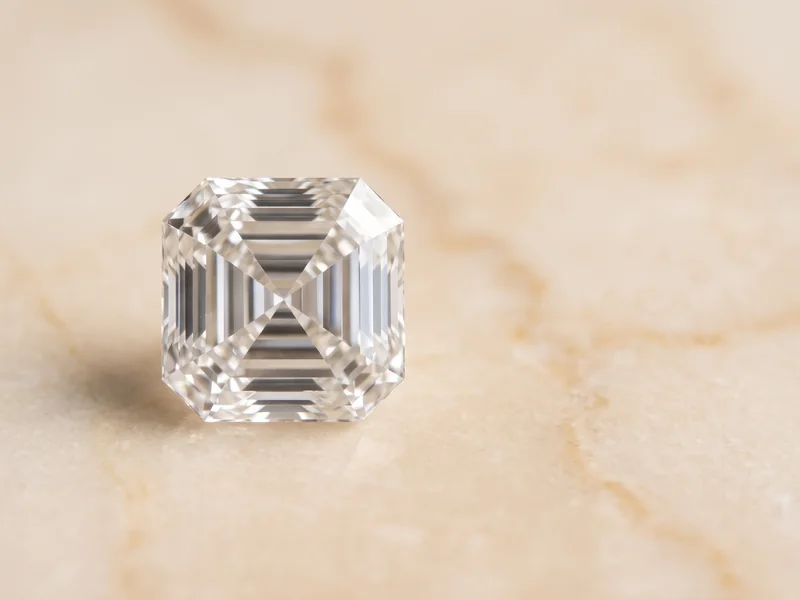
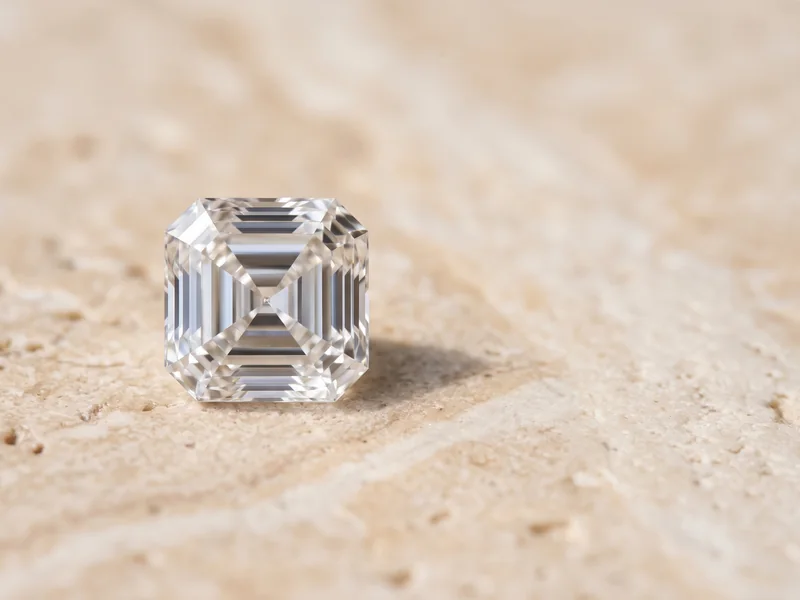
The windmill pattern is the signature look of a well-cut Asscher diamond. Look straight down through the table (the large flat facet on top) and you see a set of nested squares, like a corridor of mirrors, crossed by four diagonal lines running from the corners towards the centre. Those lines split the reflections into four blades, and as the stone tilts the blades seem to turn, much like the sails of a windmill. Some people call it a pinwheel or an X pattern; it is the same effect.
An Asscher is a square step cut with large cropped corners, which gives it an octagonal outline. Step cuts use long, flat, parallel facets arranged in rows (the steps) rather than the triangular and kite-shaped facets of a brilliant cut. Joseph Asscher of Amsterdam patented the original design in 1902, and the shape's history and buying basics are covered in our complete Asscher cut diamond guide. It belongs to the step cut family alongside the emerald, baguette and carré, and it is one of the shapes in our round-up of all 34 diamond cuts.
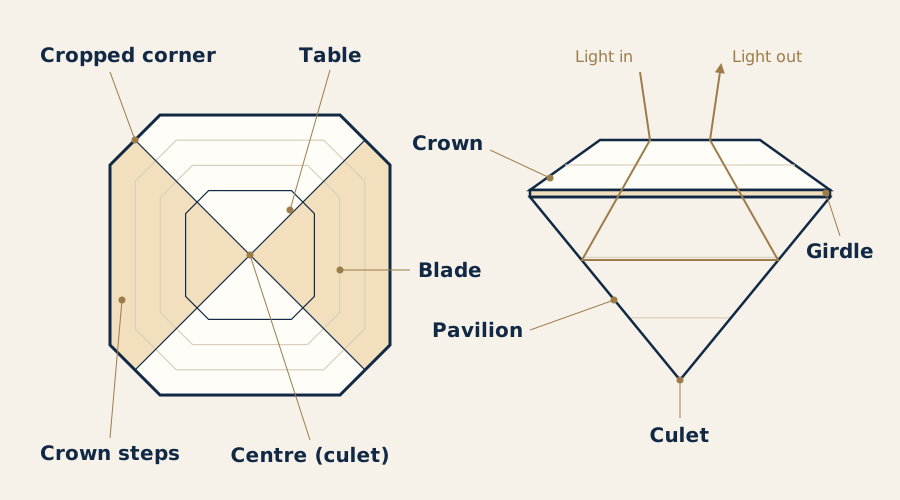
Most modern Asscher cuts have about 58 facets, though cutters vary, and the trademarked Royal Asscher cut introduced in 2001 has 74. Whatever the count, the windmill is not a single facet you can point to. It is a reflection: your eye sees the pavilion (the lower, pointed half of the stone) mirrored back up through the crown (the upper half). That is why two Asschers with identical colour and clarity grades can look completely different face-up, and why the pattern is worth understanding before you compare stones. Terms such as pavilion, crown and culet are also explained in our plain-English jewellery glossary.
Why does an Asscher diamond show a windmill?
Diamond has a refractive index of about 2.42, which means light bends sharply as it enters and is easily trapped inside. In a well-proportioned stone, light comes in through the crown, hits the pavilion facets and bounces back out through the top towards your eye. In a step cut, those pavilion facets are long trapezoids that step down in rows towards the culet (the bottom point or tiny flat facet). Where the corner facets meet the side facets, they form four sharp diagonal junction lines running from the girdle to the culet.
Seen from above, those four junction lines are reflected and doubled by the crown and table, so they appear as an X through the centre of the stone. The rows of steps reflect as concentric squares. Put the X and the squares together and the eye reads a set of blades radiating from the centre: the windmill. As you tilt the stone, different steps light up and go dark, so the blades seem to rotate.
Five things have to come together for the effect to read clearly:
- A square outline: a length-to-width ratio of about 1.00–1.05, so all four blades are the same length.
- A reasonably deep pavilion with several rows of steps, so there is enough depth for the reflections to stack up.
- A higher crown and a moderate table, which give the crown steps room to frame the pattern.
- Even cropped corners, so each blade is the same width.
- A centred culet, so the X meets in the middle and the blades look balanced.
This is a different kind of beauty from a brilliant cut. Brilliants break light into many small sparkles and flashes of colour (diamond's dispersion is about 0.044). Step cuts give fewer, broader flashes of light and dark, a strong on-off contrast that people often describe as calm or architectural. If you want to see how each outline and faceting style handles light, our guide to how each diamond shape handles light puts them side by side.
Which proportions give the clearest Asscher cut windmill pattern?
GIA and most other labs do not give fancy shapes, including the Asscher, an overall cut grade the way they do for round brilliants. The report gives polish and symmetry grades plus measurements, total depth and table percentage, and you judge the cut from those numbers and from how the stone looks. Some reports name the shape a square emerald cut or a cut-cornered square step cut rather than Asscher; the faceting is what matters. These are the ranges that usually produce a crisp windmill:
| Measure | Range for a clear windmill | What happens outside it |
|---|---|---|
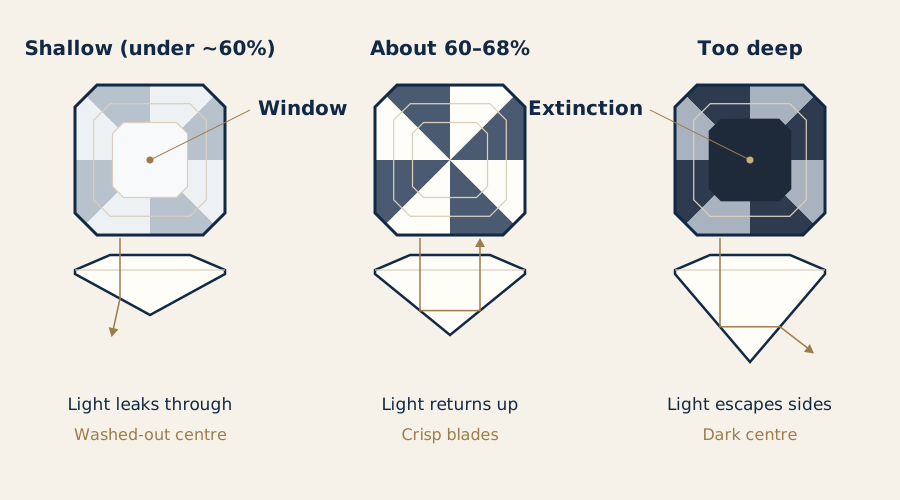
| Total depth | about 60–68% | Shallower: faint blades and a see-through window. Deeper: dark centre and smaller face-up size |
| Table | about 55–65% of the width | Larger: flatter look, weaker steps. Smaller: more contrast but can look dark |
| Crown height | relatively high, often about 10–15% | Low crown: fewer crown steps, a flatter, less layered pattern |
| Length-to-width ratio | 1.00–1.05 | Above 1.05: blades unequal, outline starts to look rectangular |
| Corners | four cropped corners of equal size | Uneven corners: blades of different widths, lopsided look |
| Culet | none to very small, centred | Off-centre: twisted windmill. Large: a visible dot in the middle |
| Girdle | thin to slightly thick | Very thick: hidden weight. Extremely thin: the corners are more exposed |
Treat these ranges as a guide rather than a pass mark. A stone at 69% depth with an excellent crown can look better than one at 64% with a flat crown and lopsided corners. The numbers help you shortlist; the face-up image and video decide. Note too that Asschers are cut deeper than most shapes, so they hold more weight underneath than, say, a round brilliant or an oval, and that affects how big they look for their carat weight (see the size table further down).
The number of steps matters as well. Most Asschers have three rows of steps on the crown and more on the pavilion. More pavilion steps give a finer, more layered windmill; fewer give bolder blades. Neither is wrong, and it is mainly what separates the look of an Asscher from a square emerald. Our page on how Asscher proportions differ from an emerald's explains why the two shapes produce such different reflections from the same faceting style.
Related guideEmerald vs Asscher Cut DiamondsWhat makes a windmill pattern look weak or lopsided?
Because the windmill is so geometric, small cutting faults show up more than they would in a brilliant. These are the problems to look for:
- Window: a pale, glassy area in the centre where light passes straight through instead of reflecting back. It usually means the pavilion is too shallow, often under about 60% total depth, and the blades fade out before they reach the middle.
- Extinction or a dark centre: a black or grey area in the middle, usually from a pavilion that is too deep or too steep. A little dark contrast defines the blades; a large dark patch swallows them.
- Off-centre culet: the X meets to one side, so the blades look twisted or bunched. This is easy to see face-up and is not always reflected in the symmetry grade.
- Uneven corners: if one cropped corner is larger than the others, one blade is wider and the outline looks irregular.
- Ratio drift: above about 1.05 the stone looks slightly rectangular, and two blades look longer than the other two.
- Large open culet: common in antique Asschers, it shows as a small dark or clear dot where the blades meet. Some people love that vintage look; just know it changes the pattern.
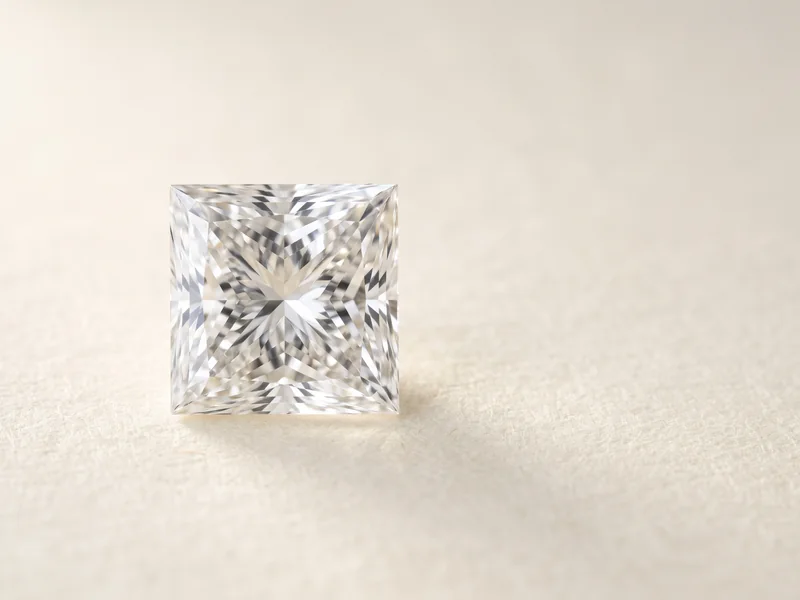
Square brilliant shapes have their own version of these problems. A princess cut, for instance, can show chevrons that are uneven or broken, which is the brilliant-cut equivalent of a twisted windmill. Our guide to chevron faults in princess cuts shows how the two patterns compare and why the checks are so similar.
Not sure which one is right?
Send us the stones you are looking at and our gemologist will tell you which to choose and why.
Do clarity and colour affect the Asscher windmill effect?
Yes, more than in most shapes. Step cuts have large, open facets and a big table, so there are fewer small reflections to hide an inclusion (an internal feature such as a crystal or feather). Worse, an inclusion near the centre can be reflected along the blades, so one small crystal may show up as several. For an eye-clean Asscher, meaning no inclusions visible without magnification at normal viewing distance, most people start at VS2, and VS1 is the safer choice above about 1.5 carats. An SI1 Asscher is occasionally eye-clean, but only after checking the actual stone or a sharp video.
Where the inclusion sits matters as much as the grade. Something tucked under a corner or near the girdle is usually invisible once the stone is set; the same inclusion under the table, where the blades meet, draws the eye straight to it. Our Asscher clarity grades that stay eye-clean page goes through the plotting diagram and what to accept in each position.
Colour works the same way. Step cuts show body colour more than brilliants, because the broad facets do not break light into enough sparkle to mask a warm tint. A warm tint also softens the contrast between the light and dark blades.
- White gold or platinum: G–H colour for most sizes; F–G above about 1.5 carats if you are sensitive to warmth.
- Yellow or rose gold: I–J can look white against the warm metal.
- Clarity: VS2 minimum for most stones, VS1 for larger ones, and avoid inclusions under the table centre.
How is the windmill different from a hall of mirrors, chevrons or crushed ice?
Every square or near-square shape has its own face-up pattern. Knowing which pattern you like is often the quickest way to choose a shape.
| Shape | Faceting | Face-up pattern | Typical ratio | Corners |
|---|---|---|---|---|
| Asscher | Step cut | Windmill: nested squares crossed by an X | 1.00–1.05 | Large cropped |
| Emerald | Step cut | Hall of mirrors: long parallel bands | 1.30–1.50 | Cropped |
| Princess | Modified brilliant | Chevrons or an X with many small flashes | 1.00–1.05 | Pointed |
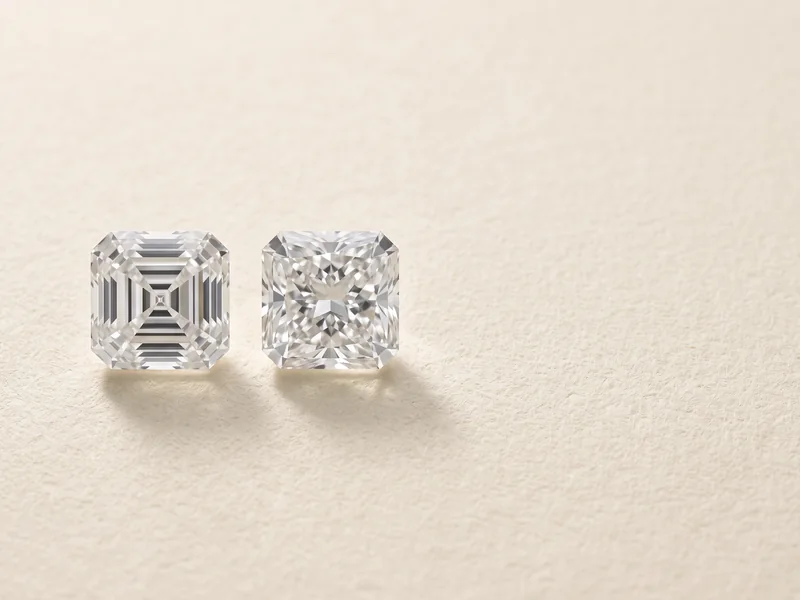
| Square radiant | Modified brilliant | Crushed ice: busy, fine sparkle | 1.00–1.05 | Cropped |
| Cushion | Modified brilliant | Crushed ice or chunky flashes | 1.00–1.10 | Rounded |
The closest relative is the emerald cut. Both are step cuts, but the emerald's rectangular outline stretches the steps into long bands, giving the hall of mirrors effect, while the Asscher's square outline pulls them into concentric squares with blades. For a full side-by-side, see emerald or Asscher: the side-by-side comparison.
If you like the square outline but want more sparkle, the princess is the obvious alternative; our princess vs Asscher comparison covers durability, price and look, and our page on what the chevron pattern in a princess looks like explains its version of the windmill. A square radiant shares the Asscher's cropped corners but uses brilliant faceting, so it looks much busier: see Asscher against the square radiant. For a softer outline with rounded corners, our Asscher vs cushion guide is the one to read.
What setting shows off an Asscher's windmill pattern?
The setting should frame the octagonal outline without covering the steps that make up the pattern. Common choices:
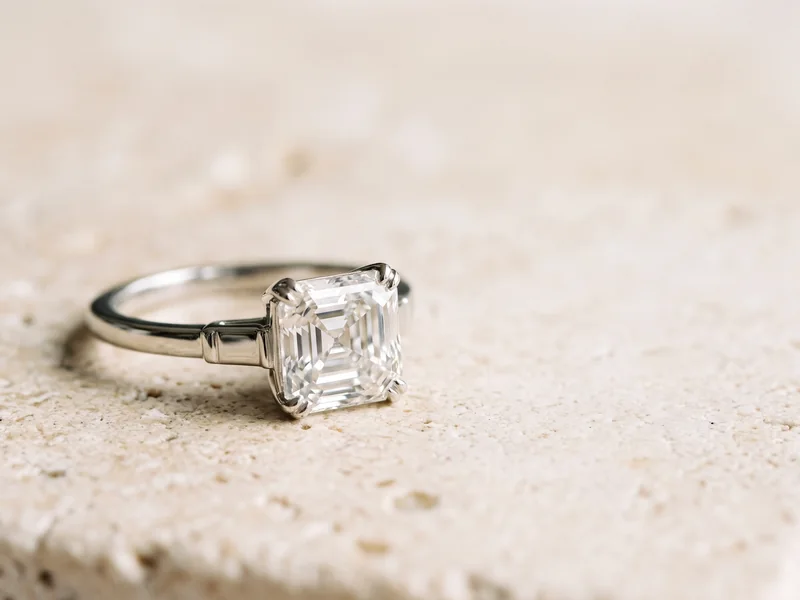
- Four claws on the corners: the classic option. Each claw sits on a cropped corner, protecting it and leaving all four sides of the step pattern open. Double claws (two per corner) give a stronger vintage look.
- Bezel or half-bezel: a thin rim of metal around the edge. Very secure, and it suits the shape's clean lines, though it hides a sliver of the outer step.
- Octagonal or square halo: small diamonds around the centre make it look larger. A halo that follows the cropped corners keeps the geometry tidy.
- Three-stone: trapezoid, baguette or smaller Asscher side stones repeat the step-cut look and suit the windmill well.
- Art Deco styles: milgrain edges and geometric shoulders echo the era when the Asscher first became popular.
Setting height matters a little too. Step cuts draw most of their light through the top, so a very tall setting is not needed for brightness, and a lower profile is more practical for everyday wear. White metals act like a mirror around the stone and sharpen the contrast of the blades; yellow and rose gold warm the reflections. Our page on settings that suit an Asscher shows each style with examples.
If you are starting from an antique Asscher with a high crown and open culet, it may need a deeper setting than a modern stone of the same weight. The background on older cuts is in Asscher history and buying basics.
How much does an Asscher cut diamond cost in Australia?
Asschers are cut from both natural and laboratory-grown diamond. A lab-grown diamond is real diamond, grown in a laboratory rather than mined, with the same hardness (10 on the Mohs scale) and refractive index. Cut to the same proportions, a lab-grown Asscher shows exactly the same windmill as a natural one. Lab-grown stones cost much less and are easier to find in larger sizes; natural Asschers are rarer, particularly above 2 carats with good proportions. Either should come with an independent grading report from a lab such as GIA or IGI that states whether the stone is natural or lab-grown.
Because Asschers are cut deep, they face up smaller than many shapes of the same weight. A 1 carat round brilliant measures about 6.4 mm across; a 1 carat Asscher is closer to 5.5 mm. Our comparison of which shapes look biggest for their carat weight sets the figures out across every main cut.
| Carat weight | Typical face-up size |
|---|---|
| 0.50 ct | about 4.4 × 4.4 mm |
| 0.75 ct | about 5.0 × 5.0 mm |
| 1.00 ct | about 5.5 × 5.5 mm |
| 1.50 ct | about 6.3 × 6.3 mm |
| 2.00 ct | about 7.0 × 7.0 mm |
| 3.00 ct | about 8.0 × 8.0 mm |
| 1 ct Asscher, G–H, VS | Approximate price range (AUD) |
|---|---|
| Lab-grown | about $1,000–$3,000 |
| Natural | about $7,000–$16,000 |
These are broad ranges only; prices move with the market and with exact grades. An Asscher usually costs less per carat than a round of the same weight, colour and clarity. Within Asschers, a crisp windmill does not appear on the report as a grade, so two stones with matching paperwork can sit at the same price while one looks far better. Comparing the mm measurements, depth and video is how you find the better one. For the pattern across all the main cuts, see our page on price differences between diamond shapes.
Shop Asscher diamonds: natural and lab-grown
How do you check an Asscher cut windmill pattern before you buy?
- Read the report. Confirm the shape name, measurements, total depth, table, polish and symmetry, and whether the diamond is natural or lab-grown.
- Work out the ratio. Divide length by width; aim for 1.00–1.05 so the blades are equal.
- Check depth and table. Shortlist stones at about 60–68% depth and 55–65% table, then judge by eye.
- Look face-up, straight on. Four even blades, an X that meets in the centre and equal cropped corners.
- Watch a 360° video. The blades should flash and turn as the stone moves, with no glassy window and no dark patch in the middle.
- Check the plotting diagram. Avoid inclusions under the table centre, where the reflections can multiply them; our guide to where inclusions hide in a step cut shows what to look for.
- Plan the setting. Choose claws or a bezel that protect the corners without covering the steps.
Free consultation
Talk to a gemologist
Compare stones in person or online with Raj Sood, Graduate Gemologist (GIA), AJP (GIA).
Book a consultationFAQ
Common questions
Do all Asscher cut diamonds have a windmill pattern?
Most well-cut Asschers do. Stones cut too shallow, with uneven corners or an off-centre culet, show a faint, broken or twisted windmill, and some barely show one at all.
What depth gives the best Asscher windmill effect?
A total depth of about 60–68% with a table of about 55–65% usually gives clear blades. Below about 60% the centre can look glassy; well above 68% it can look dark and the stone faces up smaller.
Is the windmill pattern the same as the hall of mirrors?
They are related. Both come from step facets, but an emerald cut's long outline gives parallel bands (the hall of mirrors), while an Asscher's square outline gives nested squares crossed by an X, which reads as a windmill.
Does a lab-grown Asscher show the same windmill as a natural one?
Yes. The pattern comes from the cut, not the origin, so a lab-grown Asscher cut to the same proportions shows the same windmill. The grading report will state whether the diamond is natural or lab-grown.
Why does my Asscher look dark in the middle?
Usually the pavilion is too deep or steep, so light leaks out instead of returning to your eye, or the stone has a large open culet. Lighting matters too: step cuts look darker under dim, diffuse light and come alive under spot lighting.
Should I choose an Asscher or a princess cut?
It depends on the look you want. An Asscher gives broad, calm flashes and a windmill pattern; a princess gives more sparkle and pointed corners that need protecting. Both suit a ratio of about 1.00–1.05.
Terms in this guide

Ask a gemologist
Not sure which diamond to choose?
Raj Sood is a Graduate Gemologist (GIA) and master jeweller. Bring the stones you are considering, or send the reports, and he will tell you honestly which one is better and why.
Keep learning
Related guides
 Diamond ShapesAsscher Cut Diamonds
 Engagement Rings & SettingsBest Settings for Asscher Diamonds
 Diamond ShapesAsscher-Cut Diamond Clarity Guide
 Diamond ShapesPrincess-Cut Diamond Chevron PatternsDiamond ShapesUnderstanding Diamond Shapes
 Diamond ShapesPrincess vs Asscher Cut Diamonds
 Diamond ShapesEmerald vs Asscher Cut DiamondsDiamond ShapesAsscher vs Cushion Cut Diamonds
Explore more
More guides on this topic
Education