
- Education
- Diamond Shapes
- Portuguese Cut Diamond Guide: Facets, Proportions, Colour and Settings
Diamond shapes
Portuguese Cut Diamond Guide: Facets, Proportions, Colour and Settings
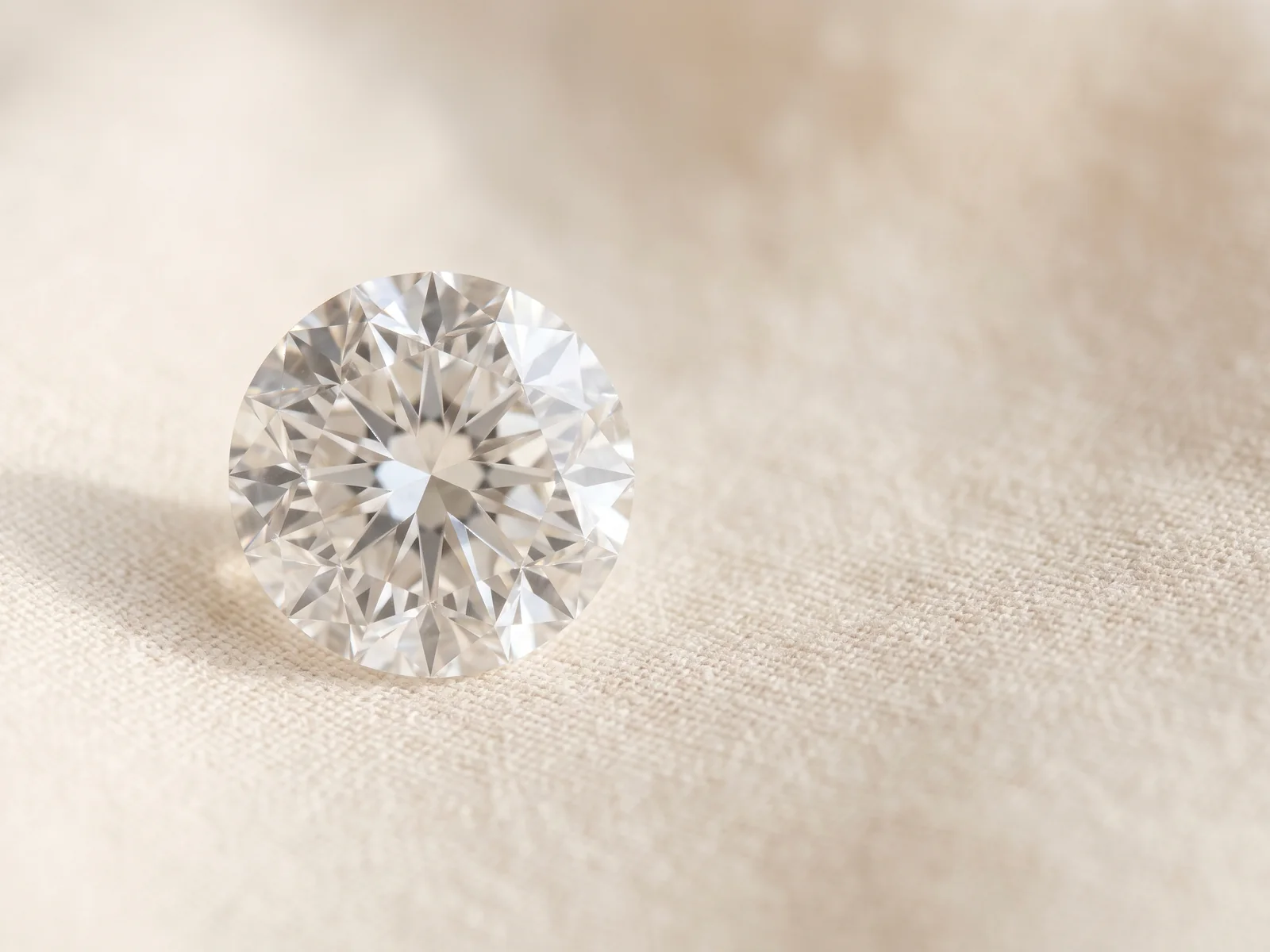
The Portuguese cut diamond is one of the rarest round cuts you can buy, with far more facets than a standard round brilliant. Here is how it differs, what to check on the report and how to set it so the extra sparkle shows.
 Reviewed by Raj Sood, Graduate Gemologist (GIA), AJP (GIA)Master jeweller and Graduate Gemologist (GIA) · reviewed 4 November 2026
Quick answer
A Portuguese cut diamond is a round modified brilliant with extra tiers of facets on the crown and pavilion, often around 100 or more in total against 57–58 on a standard round. The result is finer, busier sparkle. Look for a round outline (ratio 1.00–1.03), even facet rows, an eye-clean stone and a secure four- or six-claw setting.
What is a Portuguese cut diamond?
A Portuguese cut diamond is a round modified brilliant. Like a standard round, it has a crown (the top section above the widest edge), a girdle (the widest edge itself) and a pavilion (the cone underneath). The difference is in the faceting. Instead of one ring of kite-shaped facets on the crown and one ring of long main facets on the pavilion, a Portuguese cut adds extra tiers, or rows, of smaller diamond-shaped facets above and below the girdle.
That extra faceting is why it belongs with the round and star cuts in our guide to the round brilliant family, from round to star to Portuguese. It is one of the least common shapes in all 34 diamond cuts, explained and compared, and you will rarely see one in a shop window. The cut is far more familiar in coloured gemstones such as topaz, citrine and amethyst, where cutters use the extra rows to brighten paler material.
The history of the name is not well documented. It is often assumed to relate to the famous Portuguese Diamond held at the Smithsonian in Washington, but that stone is a cushion-shaped emerald cut, not a Portuguese cut, so treat any neat origin story with caution.
Diamond itself is 10 on the Mohs hardness scale, with a refractive index of about 2.42 and dispersion (the splitting of white light into colours) of about 0.044. Those properties are what the extra facets are working with. If you want to see where the Portuguese sits among every other outline, start with our overview of how diamond shapes are grouped, and look up any unfamiliar word in our jewellery glossary of cutting terms.
How many facets does a Portuguese cut diamond have?
There is no single fixed recipe, because each cutter adapts the pattern. The figure most often quoted for a Portuguese cut diamond is about 105 facets, and versions from roughly 80 to well over 100 exist. Compare that with the standard 57-facet round brilliant, which has 58 if it has a culet (a tiny flat facet at the very bottom point).
| Part of the stone | Standard round brilliant | Typical Portuguese cut |
|---|---|---|
| Table | 1 | 1 |
| Crown | 8 star, 8 bezel (kite), 16 upper girdle | Two or more rows of rhomboid facets plus star and girdle facets |
| Pavilion | 8 main, 16 lower girdle | Stepped rows of rhomboid facets instead of long mains |
| Culet | None or 1 | Usually none or very small |
| Total | 57–58 | Often around 100–105; varies by cutter |
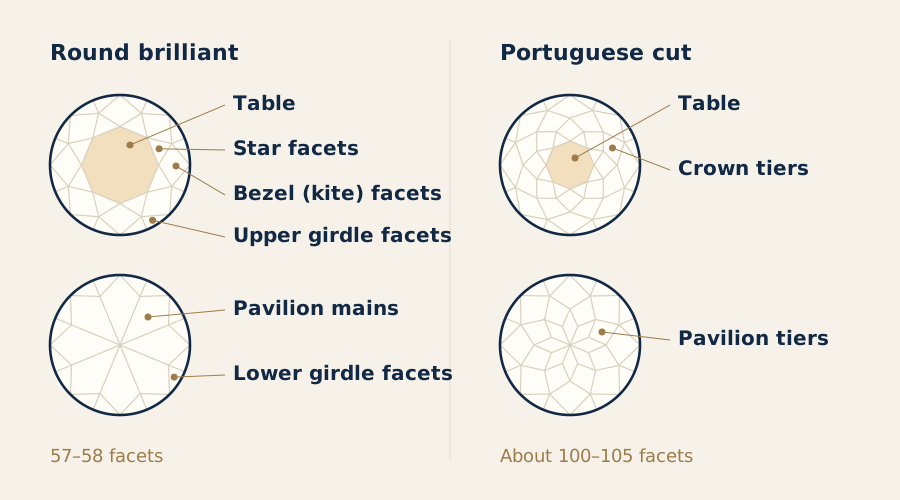
A rhomboid facet is a four-sided, diamond-shaped facet. On a Portuguese cut these sit in staggered rows, so from above you see rings of small facets stepping outward from the table. On the pavilion the long, arrow-like mains of a round brilliant are broken into shorter segments. Another many-faceted round worth comparing is the star cut, another round with extra facets, which takes a different approach to the same idea.
Portuguese cut vs round brilliant: how does the sparkle differ?
Gemmologists describe diamond light in three parts. Brightness is the white light returned to your eye. Fire is the flashes of spectral colour. Scintillation is the pattern of sparkle and dark points that moves as the stone or your head moves.
A round brilliant produces fewer, larger flashes and strong fire. A Portuguese cut breaks that light into many more, smaller flashes. The effect is a fine, busy, glittering sparkle, sometimes compared to frost or crushed ice, with smaller individual flashes of colour. Some people love that texture; others find it less crisp than a round. Neither is wrong, and the only way to know is to watch both side by side on video or in person.
Facet size matters here. In very small stones, say under 0.30 carat, the facets become so tiny that the eye cannot separate the flashes and the stone can look slightly blurred. In larger stones the pattern is easier to appreciate. For a contrast in the other direction, our guide to how rose cuts and brilliant cuts handle light differently shows what happens with far fewer, broader facets.
What are the ideal proportions and ratio for a Portuguese cut?
Most Portuguese cut diamonds have a round outline, so the length-to-width ratio (the longest measurement divided by the shortest on the report) should be close to 1.00. Anything up to about 1.03 will look round to the eye. Above that, the stone may look slightly oval, especially in a claw setting where the claws frame the outline.
Depth is where the Portuguese differs most. To fit extra tiers on the pavilion, cutters often leave it deeper than a standard round. A well-cut round brilliant usually sits around 59–63% total depth, while many Portuguese cuts run somewhere around 63–68%. A deeper stone carries more weight underneath, so it faces up a little smaller for its carat weight.
| Measurement | Standard round brilliant (well cut) | Typical Portuguese cut |
|---|---|---|
| Length-to-width ratio | 1.00–1.01 | 1.00–1.03 |
| Total depth | about 59–63% | often about 63–68% |
| Table width | about 54–58% | often about 50–58% |
| Girdle | Thin to medium | Thin to medium; avoid very thin |
| GIA overall cut grade | Yes (Excellent to Poor) | No; judged by eye and proportions |
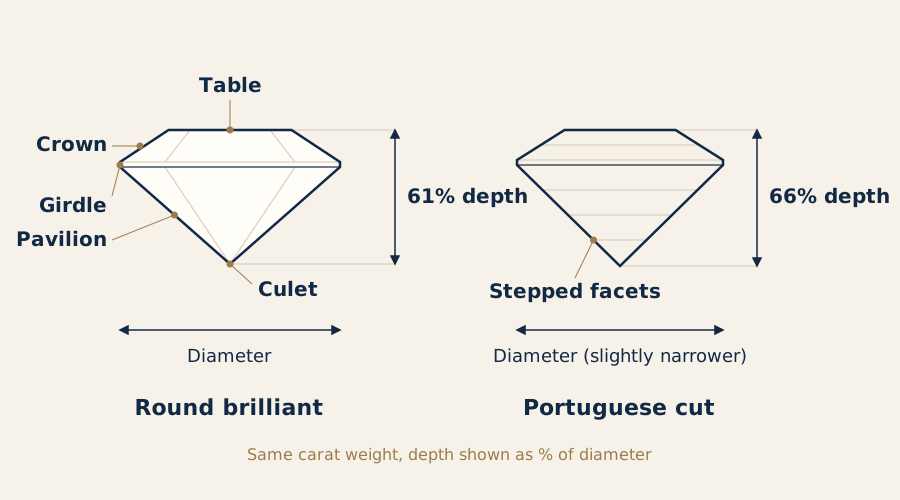
Because GIA only gives an overall cut grade to standard round brilliants, a Portuguese cut will usually be described as a round modified brilliant with polish and symmetry grades but no cut grade. Our explainer on how diamond cut grades work covers what that means, and the page on the difference between ideal and excellent cut labels explains why retail terms like "ideal" are not lab grades. For a Portuguese, Excellent or Very Good polish and symmetry are a sensible minimum.
Not sure which one is right?
Send us the stones you are looking at and our gemologist will tell you which to choose and why.
What size does a Portuguese cut diamond look?
Because many Portuguese cuts are deeper, they can look a little smaller across the top than a standard round of the same weight. The figures below are typical diameters only; always check the millimetre measurements on the report for the actual stone.
| Carat weight | Standard round (diameter) | Typical Portuguese cut (diameter) |
|---|---|---|
| 0.50 ct | about 5.1–5.2 mm | about 4.9–5.2 mm |
| 0.75 ct | about 5.8–5.9 mm | about 5.6–5.9 mm |
| 1.00 ct | about 6.4–6.5 mm | about 6.2–6.5 mm |
| 1.50 ct | about 7.3–7.4 mm | about 7.0–7.4 mm |
| 2.00 ct | about 8.0–8.2 mm | about 7.7–8.1 mm |
As a rule of thumb, 0.50 carat and above shows the fine sparkle pattern clearly in a ring. Smaller Portuguese cuts still work well as studs or in pendants, where they are seen at close range.
What colour and clarity should you choose for a Portuguese cut diamond?
A round outline with many facets tends to mix and scatter body colour, so a Portuguese cut hides a faint tint about as well as a round brilliant. The extra depth can concentrate a little colour, though, so it pays to be slightly more careful than you would with a shallow stone. In white gold or platinum, most people are happy from G or H colour. In yellow or rose gold, I or J often looks white once set, because the metal warms everything around it.
Clarity is where the cut helps. All those small facets create a busy pattern that disguises small inclusions (internal features such as crystals or feathers). The goal is an eye-clean stone, meaning nothing visible without magnification at normal viewing distance. In a Portuguese cut, a well-chosen SI1, and sometimes SI2, can be eye-clean.
- White metal: G–H colour, VS2–SI1 eye-clean.
- Yellow or rose gold: I–J colour, SI1–SI2 eye-clean if checked on video.
- Avoid: feathers (small internal cracks) that reach the girdle, and dark crystals under the table, which the facets can reflect several times.
What is the best setting for a Portuguese cut diamond ring?
A round outline is the easiest shape to set, and there are no fragile points or corners to protect. The main aim is to let light into the many facets and keep the girdle covered from knocks. Common choices for a Portuguese cut diamond ring:
- Four claws: shows the most of the stone and lets in plenty of light.
- Six claws: a rounder look and extra security if a claw wears.
- Bezel: a rim of metal around the girdle; very secure for active hands, though it reduces light from the sides.
- Halo: a ring of small diamonds that makes the centre look larger; it can compete with the fine sparkle, so view it before deciding.
- Side stones: trapezoid side stones, tapering bullet cut shoulders or shield-shaped accents add clean lines that contrast with the busy centre.
- Pendants and earrings: a Portuguese cut in a simple bezel pendant, or above faceted briolette drops, keeps the sparkle at eye level.
For the wedding band, a round Portuguese cut sits easily beside a straight band if the setting is a low or medium height basket. If the centre sits very low, or you add a halo, a slightly contoured band avoids a gap. Choose claws in the same metal as the band so the pair wear evenly.
How does a Portuguese cut compare with other diamond shapes?
| Portuguese | Round brilliant | Old European | Rose cut | Princess | |
|---|---|---|---|---|---|
| Outline | Round | Round | Round | Usually round | Square |
| Typical facets | about 80–105+ | 57–58 | 58 | about 3–24+ | about 57–76 |
| Sparkle | Fine, busy, many small flashes | Bright, larger flashes, strong fire | Broad, chunky flashes | Soft glow, little fire | Crisp, bright |
| Typical depth | Often deeper | about 59–63% | Deep, high crown | Shallow, flat base | about 65–75% |
| Fragile points | None | None | None | Thin edge | Four corners |
| Availability | Rare | Very common | Mostly antique | Uncommon | Common |
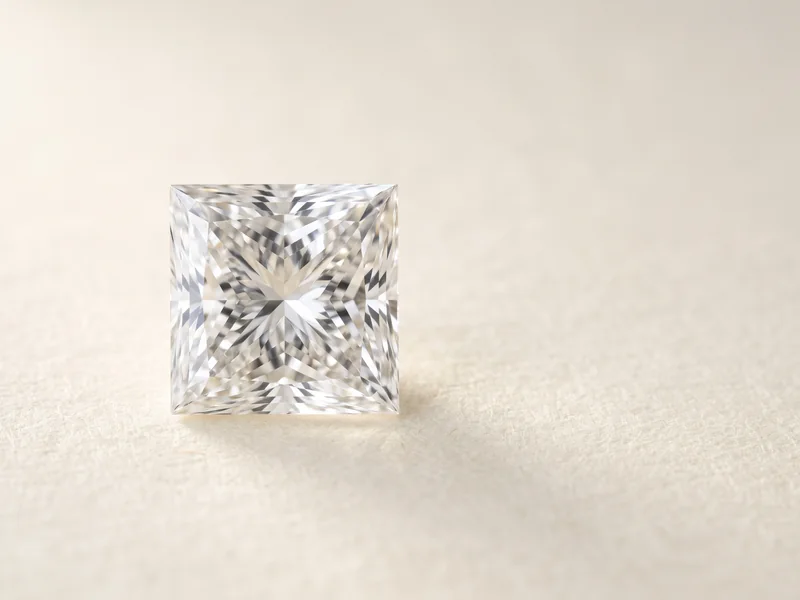
If you like a square outline, the princess cut and its brilliant faceting gives a crisper pattern with corners that need protecting. For a geometric look, octagonal cuts and six-sided hexagonal diamonds are other rare options, while the Flanders cut with its clipped corners sits between a princess and a cushion.
Related guideRound Brilliant Family: Round, Star and Portuguese CutsHow much does a Portuguese cut diamond cost in Australia, natural or lab-grown?
Portuguese cuts are available in both natural and laboratory-grown diamond. Lab-grown diamonds are real diamond, with the same hardness and refractive index, grown in a laboratory rather than mined. They cost much less than natural diamonds and are easier to find in this unusual cut, because cutters can experiment more freely with lab-grown rough. Both should come with an independent grading report from a lab such as GIA or IGI, which states whether the stone is natural or lab-grown.
| 1 ct Portuguese cut, G–H, VS | Approximate price range (AUD) |
|---|---|
| Lab-grown | about $1,000–$3,000 |
| Natural | about $6,000–$15,000 |
These are broad ranges only; prices move with the market and the exact grades. Two forces pull in opposite directions. The extra facets take longer to cut and lose a little more rough, which pushes the price up. Against that, there is no GIA cut grade and demand is small, which can keep the price at or below a round with an Excellent cut grade. What moves the price most is still carat, colour, clarity and how well the facet rows are aligned.
Shop Portuguese cut diamonds: natural and lab-grown
How do you choose a Portuguese cut diamond? Step by step
- Read the report. Confirm the shape description, measurements, colour, clarity, polish, symmetry and whether the diamond is natural or lab-grown.
- Check the ratio. Divide the larger diameter by the smaller; aim for 1.00–1.03 so it looks round.
- Check the depth. Note the total depth percentage and compare the millimetre diameter with a round of the same weight.
- Watch a 360° video. Look for even rings of facets, a bright centre and no dull or grey zones as the stone turns.
- Check for inclusions. Make sure nothing dark sits under the table and no feather reaches the girdle.
- Plan the setting. Decide between four claws, six claws or a bezel, and check the wedding band sits comfortably beside it.
Free consultation
Talk to a gemologist
Compare stones in person or online with Raj Sood, Graduate Gemologist (GIA), AJP (GIA).
Book a consultationShop this shape
FAQ
Common questions
What is a Portuguese cut diamond?
It is a round modified brilliant with extra tiers of rhomboid facets on the crown and pavilion. It usually has around 100 facets or more, compared with 57–58 on a standard round brilliant.
Is a Portuguese cut diamond more sparkly than a round brilliant?
It shows more, smaller flashes, so the sparkle looks finer and busier. A well-cut round usually shows larger flashes and stronger fire, so which looks better is a matter of taste.
Does GIA grade the cut of a Portuguese cut diamond?
No. GIA gives an overall cut grade only to standard round brilliants, so a Portuguese cut is judged on its proportions, polish, symmetry and how it looks on video or in person.
Are Portuguese cut diamonds good for engagement rings?
Yes. The round outline has no fragile points, so it suits everyday wear in a four-claw, six-claw or bezel setting. Choose 0.50 carat or more so the facet pattern is easy to see.
Can you get a lab-grown Portuguese cut diamond?
Yes. Lab-grown Portuguese cuts are available and cost much less than natural ones. The grading report will state clearly that the diamond is laboratory-grown.
Why are Portuguese cut diamonds rare?
The extra facets take more time and skill to cut, and fewer people ask for them, so few cutters produce them. The style is more common in coloured gemstones than in diamond.

Ask a gemologist
Not sure which diamond to choose?
Raj Sood is a Graduate Gemologist (GIA) and master jeweller. Bring the stones you are considering, or send the reports, and he will tell you honestly which one is better and why.
Keep learning
Related guides
 Diamond ShapesRound Brilliant Family: Round, Star and Portuguese Cuts
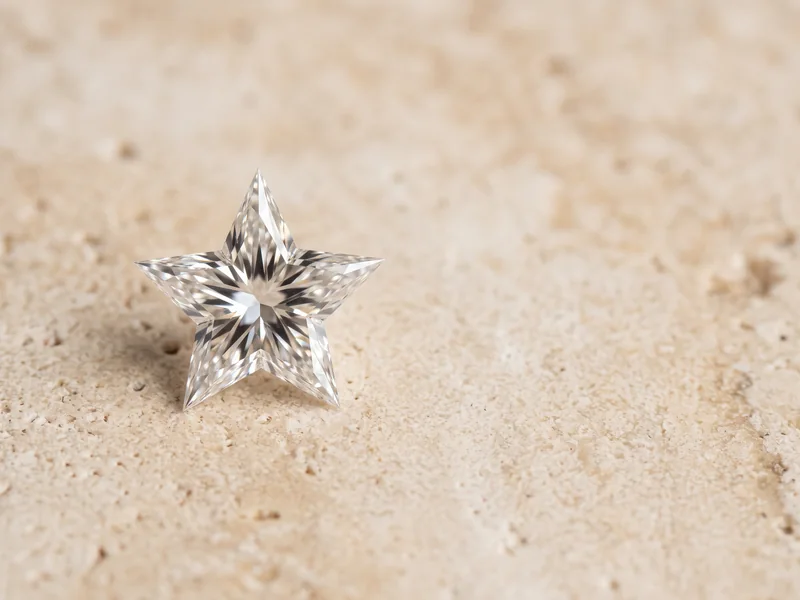 Diamond ShapesStar Cut Diamonds
 Diamond ShapesRound Brilliant Diamonds
 Diamond ShapesRose Cut vs Brilliant Cut DiamondsDiamond ShapesUnderstanding Diamond Shapes
 Diamond ShapesAll 34 Diamond Cuts: Every Shape Explained and Compared
 Diamond ShapesPrincess Cut Diamonds
 Diamond ShapesShield Cut Diamonds
Explore more
More guides on this topic
Education