
- Education
- Diamond Shapes
- Geometric Diamond Cuts: Shield, Kite, Hexagon, Pentagon and More
Diamond shapes
Geometric Diamond Cuts: Shield, Kite, Hexagon, Pentagon and More
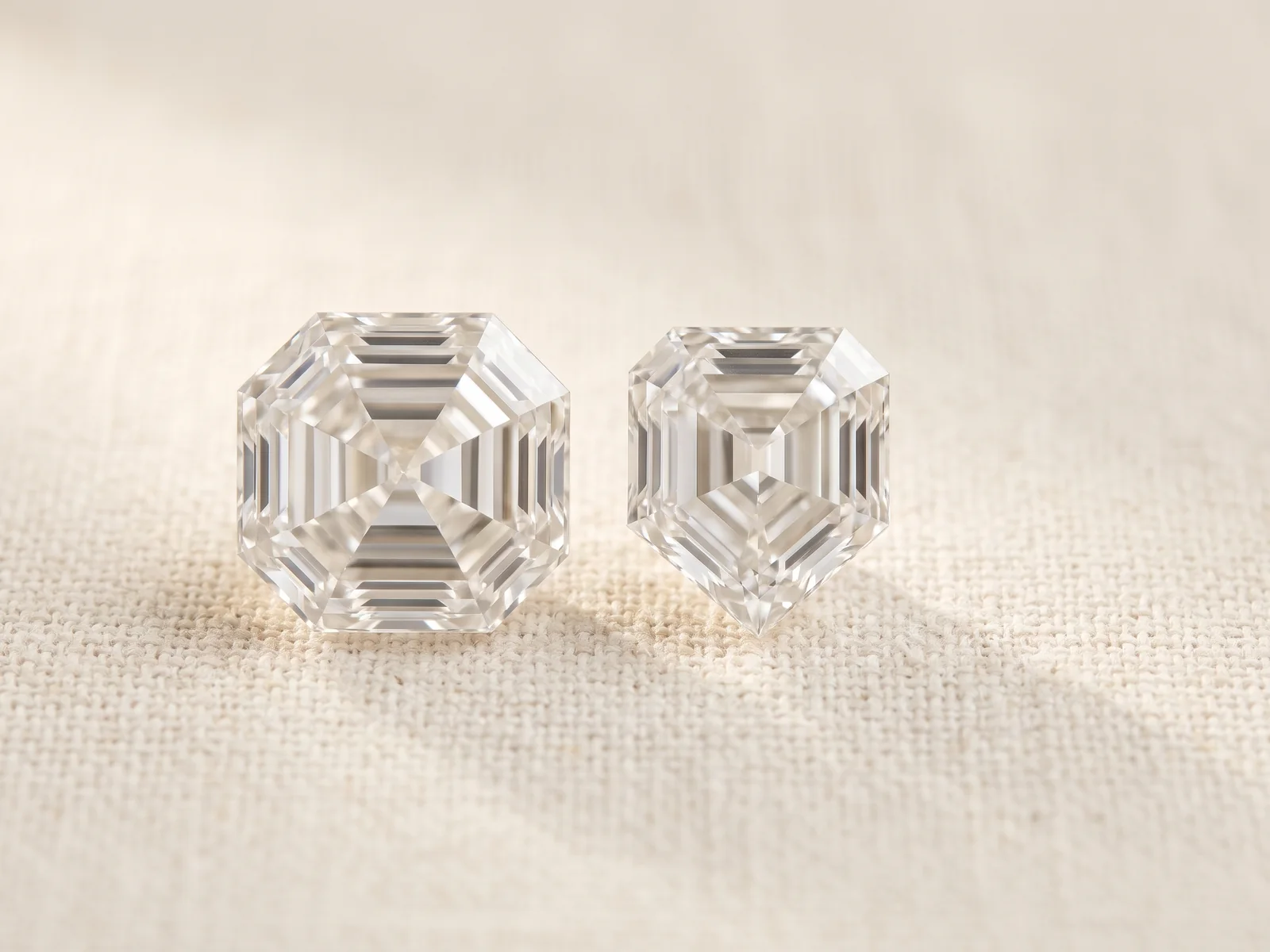
Geometric diamond cuts trade curves for straight lines and sharp corners, which gives them a crisp, architectural look. That same geometry changes how they sparkle, how they show colour and how they need to be set, so it pays to understand the family before you choose one.
 Reviewed by Raj Sood, Graduate Gemologist (GIA), AJP (GIA)Master jeweller and Graduate Gemologist (GIA) · reviewed 4 November 2026
Quick answer
Geometric diamond cuts are shapes built from straight sides and defined corners, such as the shield, kite, hexagon, pentagon, octagon, triangle, trilliant, lozenge, calf's head and half moon. Most are step cut, which shows clarity and colour clearly. Choose eye-clean stones, and a bezel or claw at every sharp corner to prevent chips.
What are geometric diamond cuts?
Geometric diamond cuts are diamonds whose outline is made mostly of straight sides meeting at corners, rather than the smooth curves of a round, oval or pear. Think of the shapes you drew in maths class: triangles, kites, pentagons, hexagons and octagons, plus a few traditional trade shapes such as the shield, lozenge and calf's head. They sit within the wider group of fancy shapes, which is everything other than a round brilliant.
It helps to separate two ideas. Shape is the outline you see from above. Cut, in the gemmologist's sense, is how the facets (the flat polished surfaces) are arranged and how well they are proportioned and polished. Our page on how diamond shape differs from cut quality explains this in more depth. A hexagon can be step cut or brilliant cut, and the two look very different in the hand.
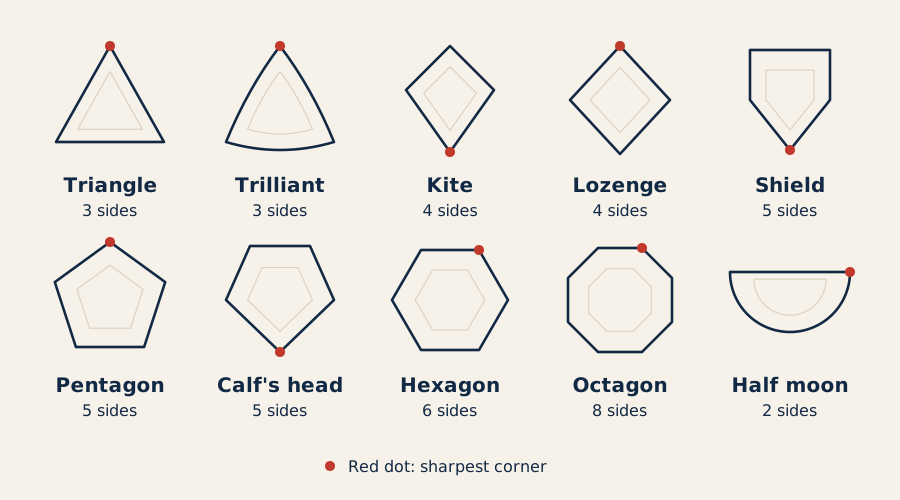
What every geometric cut shares is a set of corners, and corners matter. Diamond is 10 on the Mohs hardness scale and has a refractive index of about 2.42, but hardness is not toughness. Diamond can split along its cleavage planes, and a thin, sharp corner is the most likely place for a chip. Most of the advice on this page follows from that one fact.
Geometric shapes are a small part of the full list of 34 diamond cuts we cover, but they are one of the most distinctive. If any term here is new, our jewellery glossary of gem and setting terms defines it in plain English.
Which shapes belong to the geometric family?
Ten shapes make up the geometric family. Each has its own detailed guide, linked below, but here is what sets them apart at a glance:
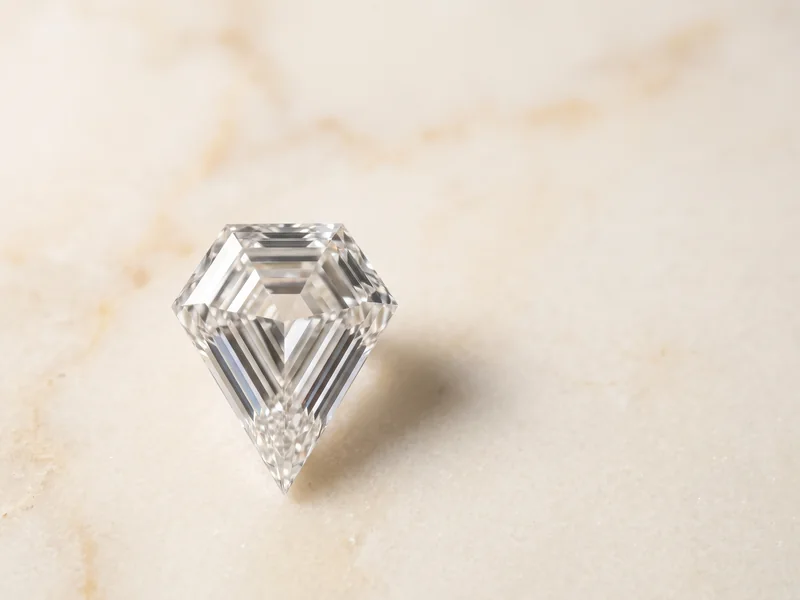
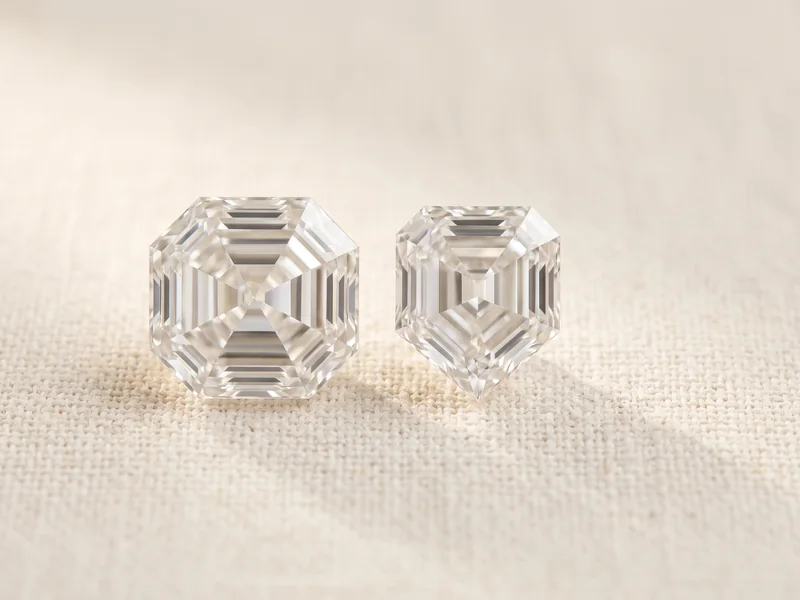
- Shield: a flat or gently angled top, straight sides and a point at the base, like a heraldic shield. Our shield cut diamonds guide shows how they work as centre stones and as side stones.
- Kite: four sides in two pairs, with a short top and a long tapering point. See the kite cut diamond guide for ratios and orientation.
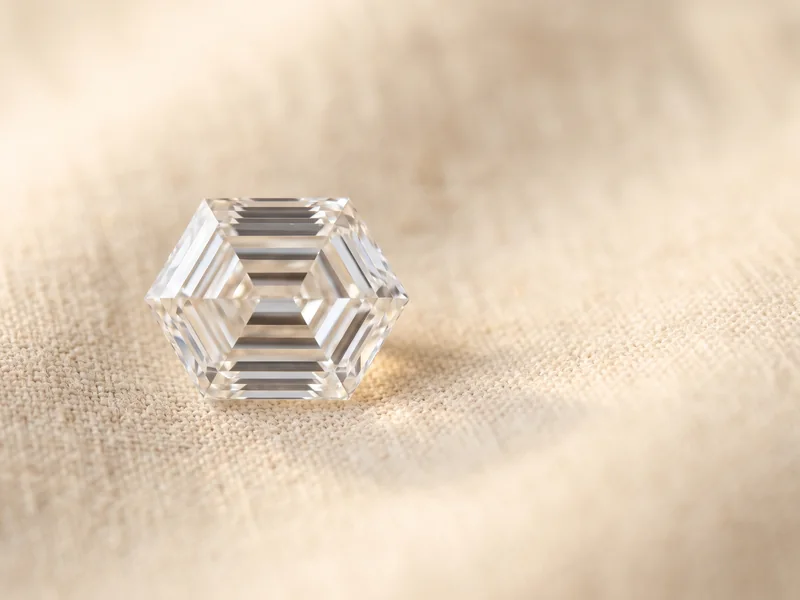
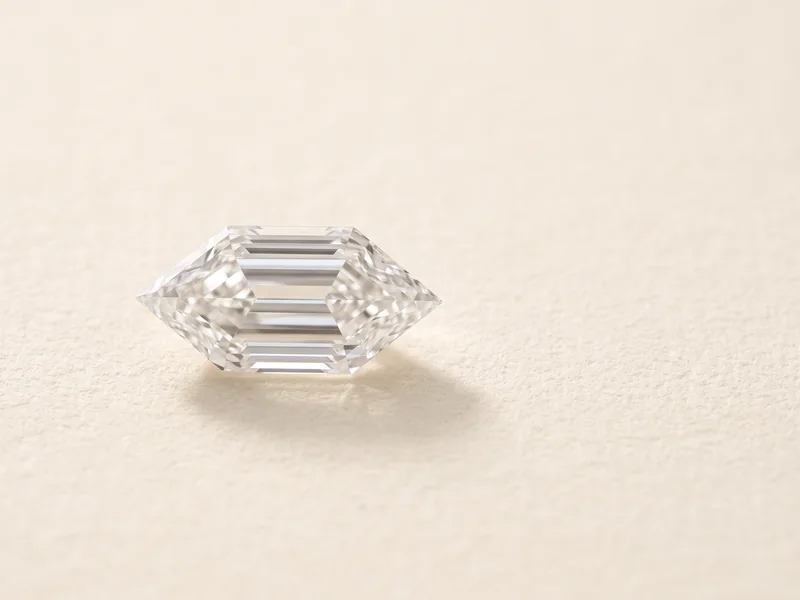
- Hexagon: six sides, either regular (all equal) or elongated. Read more on hexagonal diamonds for modern rings.
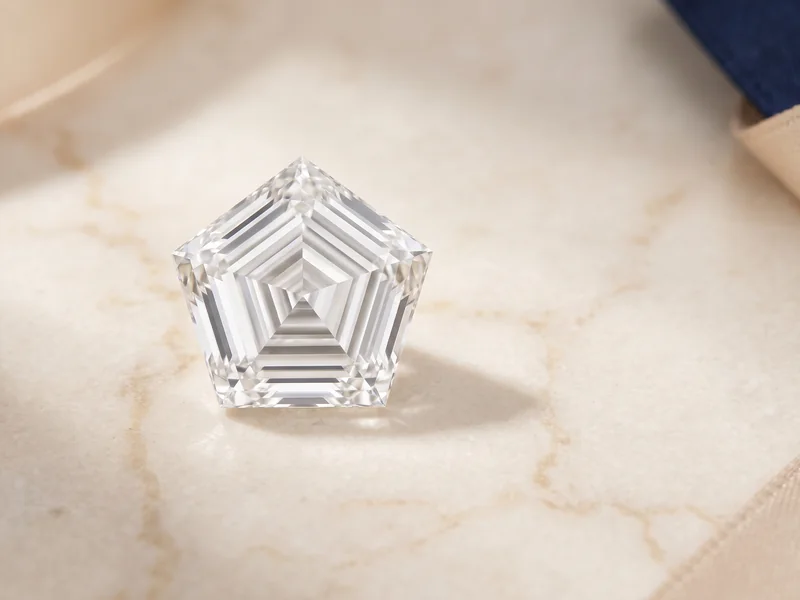
- Pentagon: five sides, often with a flat top and a point at the base. Our page on five-sided pentagonal cuts covers both orientations.
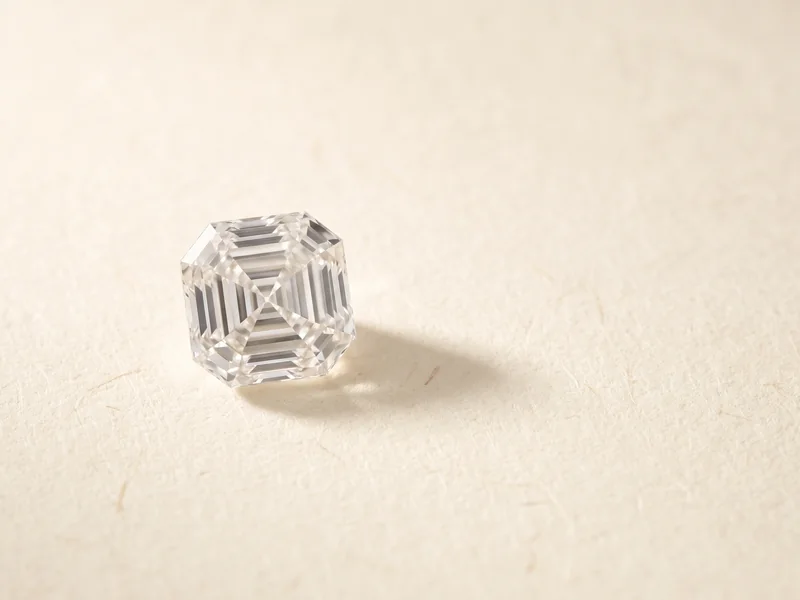
- Octagon: eight sides with wide, blunt corners, the most robust shape in the family. See eight-sided octagonal diamonds.
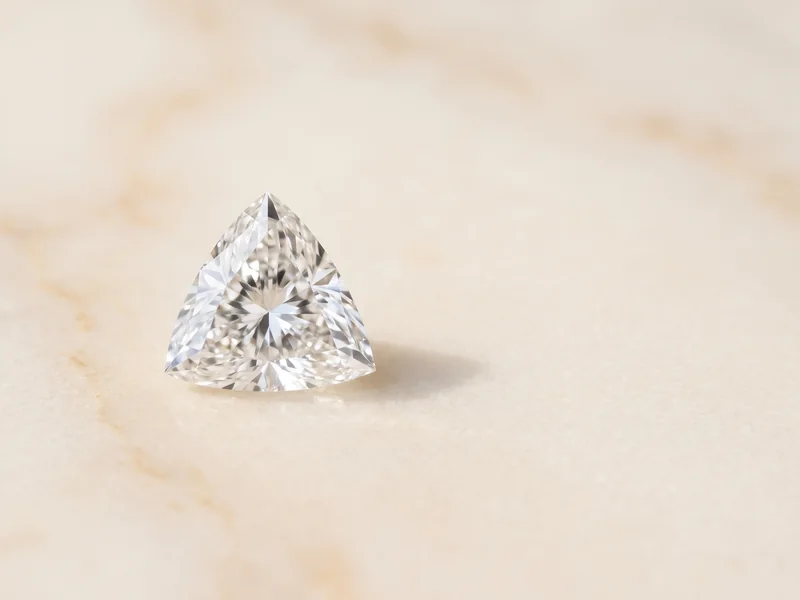
- Triangle: three straight sides, usually step cut. Compare it with the trilliant in our guide to straight-sided triangular diamonds.
- Trilliant: a triangle with brilliant faceting and often slightly curved sides. Read about the trilliant, a brilliant-cut triangle.
- Lozenge: a long, narrow rhombus with two sharp points, usually step cut. Our page on the long, rhombus-shaped lozenge cut explains east-west and north-south settings.
- Calf's head: a six-sided shape with a broad top, angled shoulders and a narrow base. The calf's head cut guide covers where it suits.
- Half moon: a straight side and a curved side, almost always used in matched pairs. See half moon diamonds as side stones.
The half moon and trilliant are borderline members because each has a curved side, but they are cut, graded and set the same way as the straight-sided shapes, so we group them here.
How do geometric diamond cuts compare side by side?
The table below compares the family on the points that matter most when you buy: the number of corners, how sharp the sharpest corner is, the usual faceting and where each shape tends to be used.
| Cut | Sides | Sharpest corner (approx.) | Usual faceting | Chip risk | Typical use |
|---|---|---|---|---|---|
| Octagon | 8 | 135° (regular) | Step | Low | Centre stone |
| Hexagon | 6 | 120° (regular) | Step, sometimes brilliant | Low | Centre stone |
| Calf's head | 6 | Varies, narrow base | Step | Medium | Centre or side stone |
| Pentagon | 5 | 108° (regular) | Step or brilliant | Low to medium | Centre stone, pendant |
| Shield | 5–7, varies | Point at base, often under 90° | Step or brilliant | Medium | Side stones, centre |
| Kite | 4 | Long point, often well under 90° | Step or brilliant | High at the point | Centre stone, toi et moi |
| Lozenge | 4 | Two long points, well under 90° | Step | High at both points | Centre (often east-west), accents |
| Triangle | 3 | 60° (equilateral) | Step | High | Side stones, earrings |
| Trilliant | 3 | About 60°, softened | Brilliant | Medium to high | Side stones, centre |
| Half moon | 1 straight, 1 curved | Two corners near 90° | Step | Medium | Matched side stones |
The pattern is simple: the more sides a shape has, the wider its corners and the less exposed it is. An octagon or hexagon can be worn every day in a well-made claw setting with little fuss. Kites, lozenges and triangles have narrow points that need a V-claw or bezel. Interior angles are for regular shapes; elongated hexagons, kites and shields vary from stone to stone, so always check the actual outline.
Are geometric diamonds step cut or brilliant cut?
Most geometric diamonds are step cut: long, flat facets arranged in parallel rows, like the steps of a staircase, following the outline of the stone. This gives a clean, mirror-like look with broad flashes of light, often called a hall-of-mirrors effect. A smaller number are brilliant cut, with many triangular and kite-shaped facets that break light into lots of small, lively sparkles. Our explainer on step cuts versus brilliant cuts goes through the optics in detail.
| Step-cut geometric | Brilliant-cut geometric | |
|---|---|---|
| Look | Clean lines, broad flashes, glassy depth | Busy, scattered sparkle |
| Shows inclusions | Easily; large open table | Hides small inclusions well |
| Shows body colour | More visible, especially at corners | Less visible |
| Typical clarity to look for | VS2 or better | SI1 eye-clean often fine |
| Common shapes | Shield, lozenge, hexagon, octagon, calf's head, half moon, triangle | Trilliant, some kites, pentagons and shields |
Neither style is better. Step cuts suit people who love sharp architecture and a calm, watery look; brilliants suit those who want maximum sparkle. The choice affects your budget, though, because a step cut usually needs a higher clarity grade to look clean.
Not sure which one is right?
Send us the stones you are looking at and our gemologist will tell you which to choose and why.
Can a geometric diamond be a centre stone, or only a side stone?
Both. Geometric shapes began life largely as accent stones, and they are still the backbone of three-stone rings. Trilliants, half moons, shields and triangles sit either side of a round, oval or emerald cut, their straight edges lining up neatly against the centre stone. Our guide to side stone cuts such as trapezoids and bullets shows how to match their size and outline to the centre.
As centre stones, hexagons, kites, pentagons, lozenges and octagons have become popular in modern geometric engagement ring designs. Kites and lozenges are often set east-west (sideways across the finger) or paired in a toi et moi ring, where two stones sit side by side. A hexagon diamond ring set north-south reads as a crisp, honeycomb-like shape, and an elongated hexagon can look larger face-up than its weight suggests.
For side stones, matching matters more than individual grades. A pair of half moons or trilliants should be cut together or carefully matched for size, outline, colour and depth, so both sides of the ring look identical.
Related guideTrilliant Cut DiamondsWhat colour and clarity suit geometric diamond cuts?
Step-cut geometric shapes have a large, open table (the flat top facet) and long facets that act like windows into the stone. Inclusions (internal features) are easier to see than in a round brilliant, so aim for VS2 or better in a step cut, or VS1 if the stone is large. A brilliant-cut trilliant or pentagon can often look clean at SI1, but check the stone itself rather than relying on the grade.
Body colour also collects in corners, where light bounces through more of the stone and travels a longer path. In white gold or platinum, most people are happy from G or H colour in a step cut. In yellow or rose gold, I or J can look white because the metal warms everything around it.
- Step cut, white metal: F–H colour, VS2 or better.
- Step cut, yellow or rose gold: H–J colour, VS2 or better.
- Brilliant cut (trilliant, some kites): G–I colour, SI1 eye-clean.
- Avoid: feathers (small internal cracks) or chips near any sharp corner.
Because GIA and IGI do not give fancy shapes an overall cut grade, the polish and symmetry grades on the report become more important. For geometric cuts, ask for Very Good or Excellent in both, and look at the outline yourself: straight sides should be truly straight and corners crisp, not rounded or uneven.
What is the best setting for geometric diamonds?
The setting's first job is to protect the corners. These are the usual choices:
- Corner claws: one claw at each corner. Ideal for hexagons, octagons and pentagons, whose corners are wide enough to hold a standard round claw.
- V-claws: V-shaped claws that wrap a sharp point. Essential for the tips of kites, lozenges, triangles and shields.
- Full bezel: a thin rim of metal around the whole edge. The most secure option for every geometric shape, and it suits their clean lines.
- Half-bezel: metal along two sides, leaving the others open to light. A good middle ground for lozenges and kites set east-west.
- Halo: a border of small diamonds that follows the outline. It frames the shape and shields the edge, though very sharp points need careful halo design.
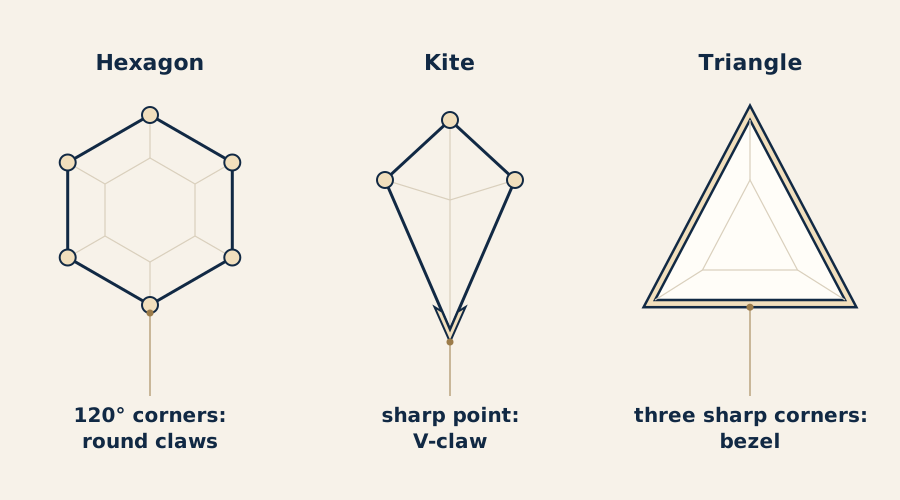
Geometric centre stones rarely fit an off-the-shelf head, because their outlines vary so much from stone to stone. Most are set in a mounting designed around the exact measurements of that diamond, and the wedding band often needs to be shaped or notched to sit flush beside a protruding point.
Are geometric cuts new, or do they have a history?
Many geometric shapes are older than they look. Step-cut shields, lozenges, triangles and calf's heads were widely used as accent stones in Art Deco jewellery of the 1920s and 1930s, when bold lines and symmetry were in fashion. Names such as calf's head and lozenge are long-standing trade terms for these outlines.
Before then, cutters worked mainly with softer, cushion-like outlines; our guide to antique cuts like the Old Mine and rose cut covers that earlier period. What has changed recently is precision. Modern laser sawing, computer-planned cutting and CAD (computer-aided design) for settings make it far easier to cut a crisp hexagon or kite and build a mounting that fits it exactly, which is why these shapes are now seen as centre stones, not just accents.
How much do geometric diamond cuts cost, natural or lab-grown?
Geometric shapes are cut from both natural and laboratory-grown diamond, and the two look identical to the eye. Lab-grown diamonds are real diamond, with the same hardness and refractive index, grown in a laboratory rather than mined. They cost much less than natural diamonds and are easier to find in unusual shapes and larger sizes. Either way, ask for an independent grading report from a lab such as GIA or IGI that states whether the stone is natural or lab-grown.
| Geometric centre stone, G–H, VS | Lab-grown (approx. AUD) | Natural (approx. AUD) |
|---|---|---|
| 0.50 ct | about $400–$1,200 | about $1,500–$4,000 |
| 1.00 ct | about $800–$2,500 | about $4,000–$12,000 |
| Matched pair of side stones, 0.20–0.30 ct each | about $300–$900 the pair | about $1,000–$3,000 the pair |
These are broad ranges only; prices move with the market and depend heavily on the exact grades and how well the outline is cut. Geometric shapes are less common than rounds, so supply in any given size is thinner and prices vary more from stone to stone. Shapes with long points, such as kites and lozenges, can also take more care to cut, while a well-matched pair of side stones costs more than two random stones of the same grades.
Shop geometric diamonds: kite, pentagonal and hexagonal, natural and lab-grown
How do you choose a geometric diamond? Step by step
- Pick the shape for your design. Decide whether you need a centre stone (hexagon, kite, pentagon, octagon, lozenge) or a matched pair of side stones (trilliant, half moon, shield, triangle).
- Read the report. Confirm the shape, millimetre measurements, colour, clarity, polish and symmetry, and whether the diamond is natural or lab-grown.
- Check the faceting style. Step cut or brilliant changes the look and the clarity grade you need: VS2 or better for step cuts, SI1 eye-clean can work for brilliants.
- Inspect the outline. Sides should be straight, corners crisp and the shape symmetrical down its centre line.
- Look closely at every corner. In a 360° video or under a loupe, check for chips, naturals or feathers near the points.
- Count the sharp corners and plan the setting. Any point under 90° needs a V-claw or bezel; confirm the mounting before you commit to the stone.
Free consultation
Talk to a gemologist
Compare stones in person or online with Raj Sood, Graduate Gemologist (GIA), AJP (GIA).
Book a consultationFAQ
Common questions
What are geometric diamond cuts?
They are diamond shapes built from straight sides and defined corners, including the shield, kite, hexagon, pentagon, octagon, triangle, trilliant, lozenge, calf's head and half moon. Most are step cut.
What is the difference between a trilliant and a triangular diamond?
A trilliant is a triangle with brilliant faceting and often slightly curved sides, so it sparkles more and hides inclusions better. A triangular cut usually has straight sides and step faceting, giving a cleaner, glassier look.
Are geometric diamonds durable enough for an engagement ring?
Yes, with the right setting. Hexagons and octagons have wide corners and are quite robust; kites, lozenges and triangles have sharp points that need V-claws or a bezel to prevent chips.
Do geometric diamonds get a cut grade?
No. GIA only gives an overall cut grade to round brilliants, so for geometric shapes you judge the cut from the polish and symmetry grades, the proportions and how the stone looks.
Can you get lab-grown geometric diamonds?
Yes. Lab-grown hexagons, kites, pentagons and other geometric shapes are widely available, cost much less than natural stones and are real diamond, graded on the same colour and clarity scales.
Which geometric diamond looks biggest for its weight?
Shallow step cuts and elongated shapes, such as elongated hexagons, kites and lozenges, tend to spread wider face-up than a deep stone of the same weight. Compare millimetre measurements on the report rather than carat alone.

Ask a gemologist
Not sure which diamond to choose?
Raj Sood is a Graduate Gemologist (GIA) and master jeweller. Bring the stones you are considering, or send the reports, and he will tell you honestly which one is better and why.
Keep learning
Related guides
Explore more
More guides on this topic
Education