
- Education
- Diamond Shapes
- Side Stone Diamond Cuts: Trapezoid, Half Moon, Bullet, Baguette and Trilliant Compared
Diamond shapes
Side Stone Diamond Cuts: Trapezoid, Half Moon, Bullet, Baguette and Trilliant Compared
Side stone diamond cuts decide whether a three-stone ring looks balanced or busy. Here is how each shape works, which centre stones it suits, and how to size and match a pair.
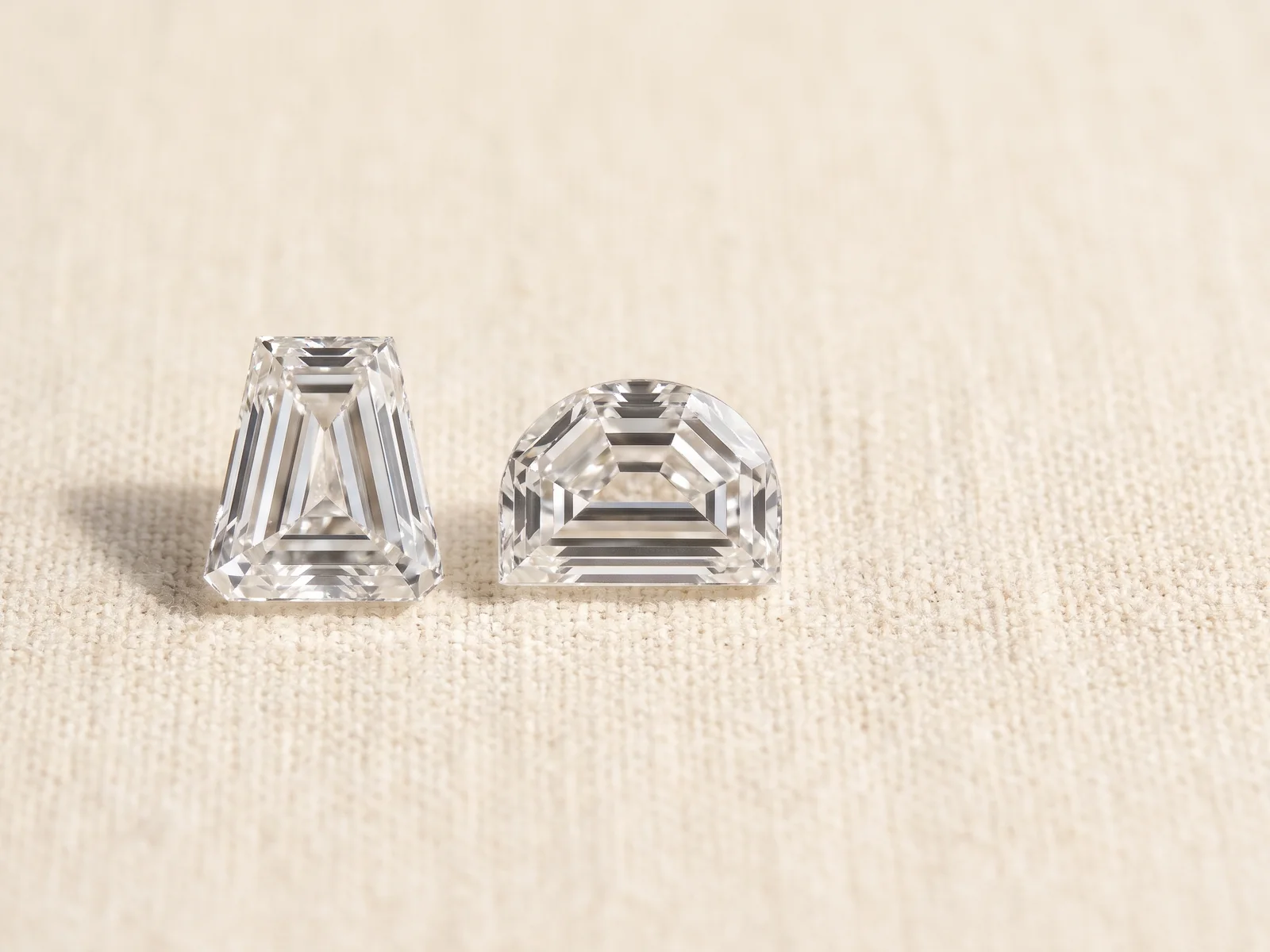
 Reviewed by Raj Sood, Graduate Gemologist (GIA), AJP (GIA)Master jeweller and Graduate Gemologist (GIA) · reviewed 4 November 2026
Quick answer
Side stone diamond cuts are small shapes, mainly baguette, tapered baguette, trapezoid, half moon, bullet and trilliant, cut to sit either side of a centre stone. Step cuts such as baguettes and trapezoids suit emerald and Asscher centres; brilliant trilliants suit rounds, ovals and cushions. Buy them as a matched pair, sized to the centre's millimetres.
What are side stone diamond cuts?
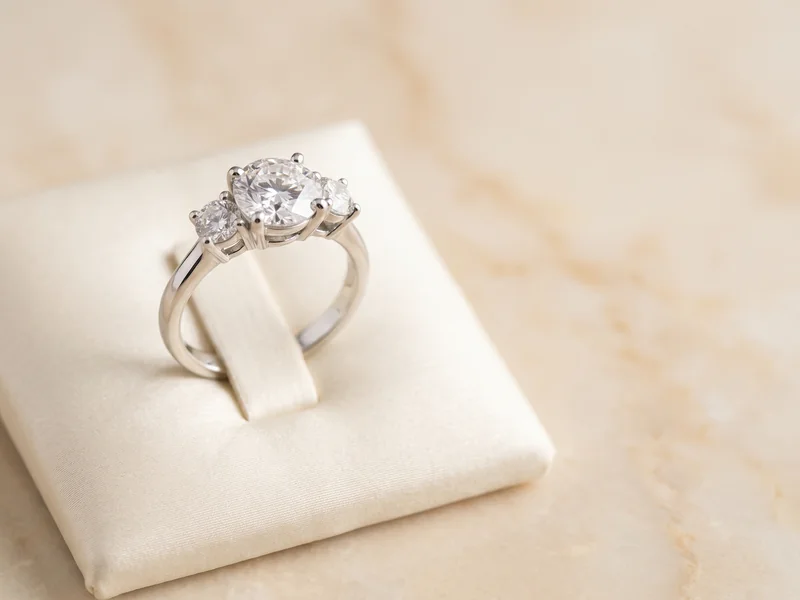
Side stone diamond cuts are shapes designed to sit beside a larger centre diamond, usually one on each side in a three-stone ring. They are rarely worn alone. Their job is to frame the centre, add width across the finger and lead the eye inwards. Most of them have at least one straight edge that can sit flush against the centre stone, which is why you see so many rectangles, triangles and half circles in this family.
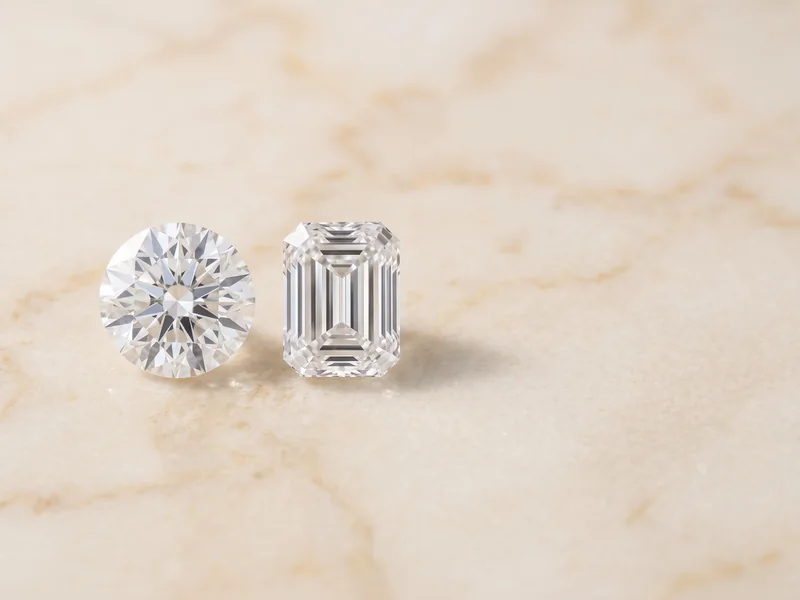
The main side stone shapes are the baguette and tapered baguette, the trapezoid, the half moon, the bullet and the trilliant. Shields, kites and lozenges also turn up as side stones, although they cross over into the geometric family. They are part of the all 34 diamond cuts we cover, and grouping them this way follows how diamond shapes are grouped by outline and faceting.
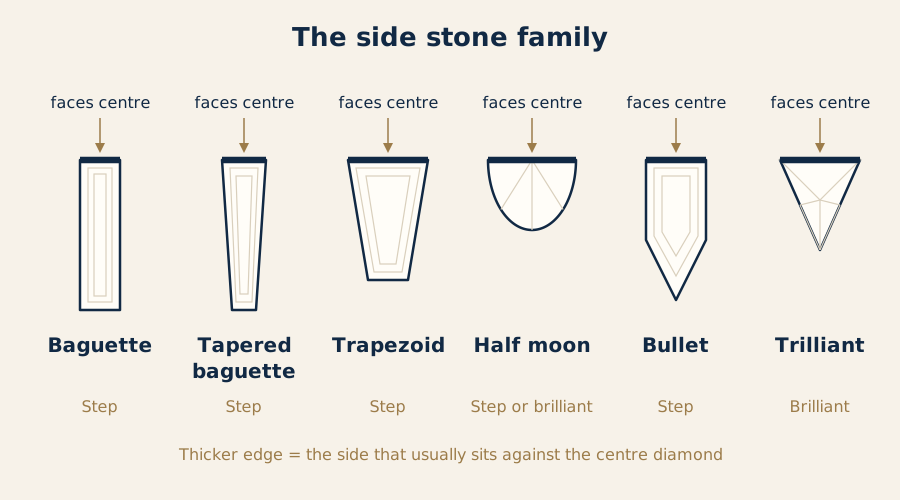
The most useful thing to know is that side stones come in two faceting styles. A step cut has long, flat facets running parallel to the edges, like steps, which gives broad flashes of light and a clean, architectural look. A brilliant cut has many small triangular and kite-shaped facets that break light into sparkle. Baguettes, trapezoids and bullets are usually step cut; trilliants are usually brilliant cut; half moons can be either. Our page on the difference between step and brilliant faceting goes deeper, and any unfamiliar term is defined in the GemTrove jewellery glossary.
Whatever the shape, a side stone is still diamond: 10 on the Mohs hardness scale, with a refractive index of about 2.42. Small stones have thin edges and sharp corners, though, so the setting matters as much as the cut.
How do side stone diamond cuts compare?
This chart puts the main side stone shapes side by side. The "suits" column is a starting point, not a rule; plenty of good rings break it on purpose.
| Cut | Outline | Faceting | Look | Usually paired with |
|---|---|---|---|---|
| Baguette | Long rectangle | Step (about 14 facets) | Clean lines, mirror-like flashes | Emerald, Asscher, round, oval |
| Tapered baguette | Rectangle narrowing at one end | Step | Slims towards the band, points to the centre | Round, oval, cushion, princess |
| Trapezoid | Four sides, two parallel | Step, sometimes brilliant | Wide and geometric, adds width | Emerald, Asscher, radiant, cushion |
| Half moon | One straight edge, one curved | Step or brilliant | Soft, rounded shoulders | Oval, cushion, emerald, round |
| Bullet | Elongated, one flat end, one point | Step | Sleek, directional | Emerald, radiant, oval |
| Trilliant | Triangle with straight or curved sides | Brilliant (about 31–50 facets) | Lively sparkle, strong outline | Round, oval, cushion, princess |
| Shield, kite, lozenge | Multi-sided geometric | Step or brilliant | Distinctive, modern | Emerald, elongated cushion, Asscher |
Two patterns stand out. First, step-cut sides match step-cut centres: an emerald cut with trapezoids reads as one continuous design because the flat flashes line up. Second, brilliant sides match brilliant centres: trilliants beside a round or oval keep the sparkle consistent. Mixing styles is possible, but you will see the contrast.
Baguette, tapered baguette or trapezoid: which step cut side stones suit you?
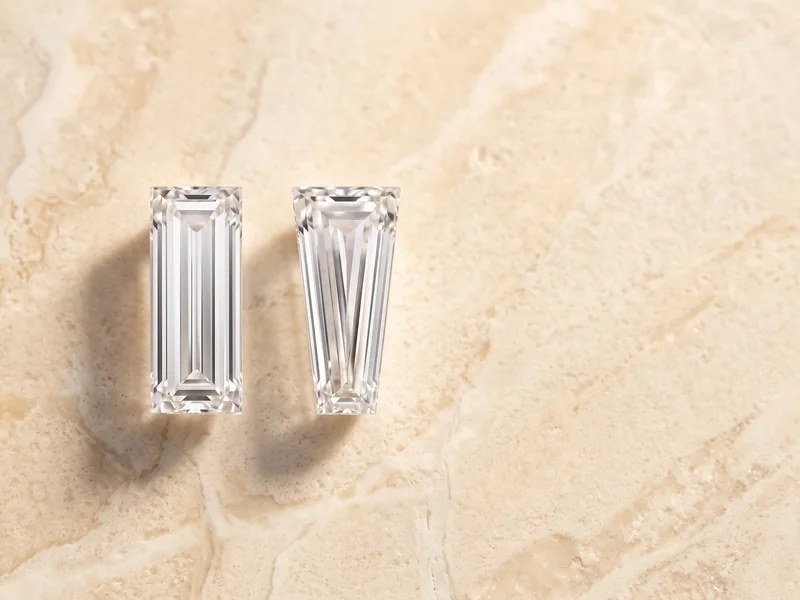
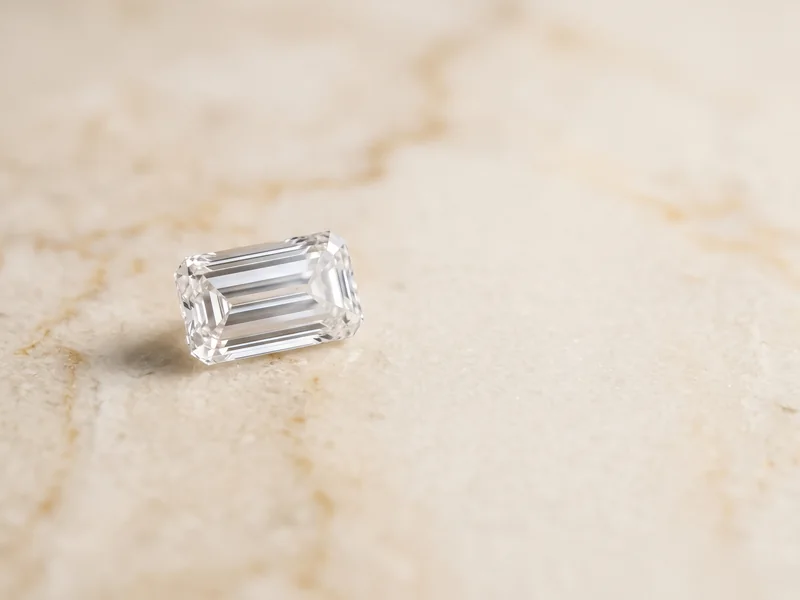
The baguette is the simplest side stone: a long rectangle, usually with about 14 step facets and no culet (no tiny flat facet at the bottom). Straight baguettes look tailored and quiet. They are often set in a row in a channel or set horizontally across the shoulders. Our classic baguette cut guide covers their proportions and grading.
Tapered baguette side stones are wider at one end than the other. The wide end sits against the centre and the narrow end runs into the band, which draws the eye towards the middle of the ring. They are one of the easiest ways to add a little length without much extra width. If you are torn between the two, see straight versus tapered baguettes for how each changes the ring's shape.
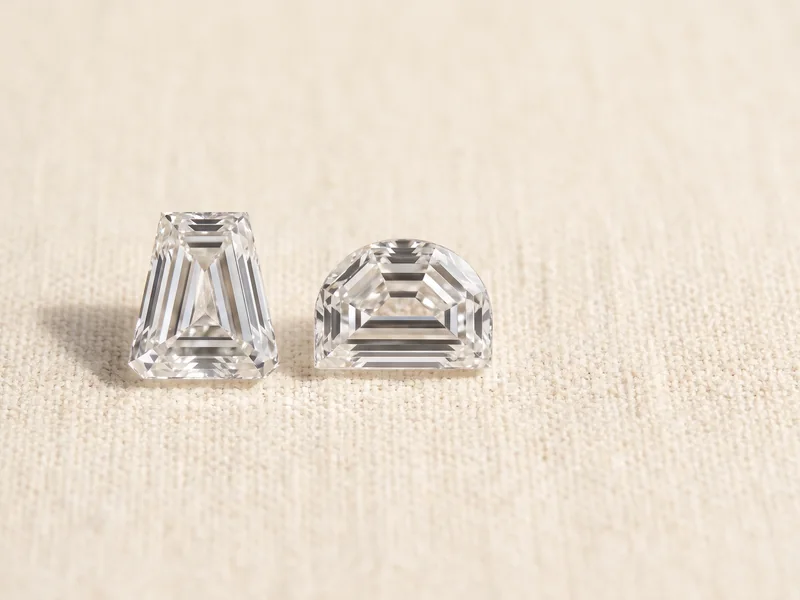
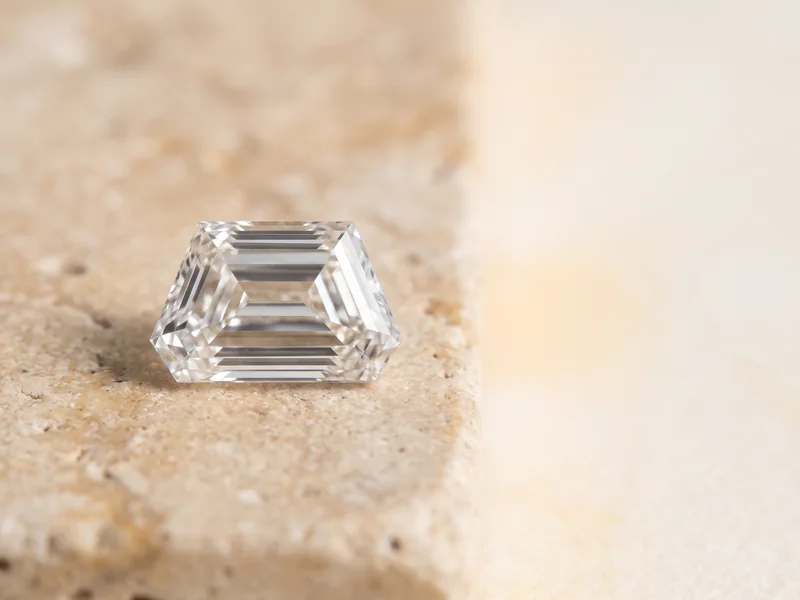
Trapezoid side stones have four sides with two parallel, and the longer parallel edge faces the centre. They are broader than tapered baguettes, so they add real width and make a centre stone look more substantial. A pair of trapezoids beside an emerald cut is one of the most balanced combinations in jewellery. Trapezoid cut diamonds explained covers the ratios and how the angle of the sides affects the look.
- Clarity: step cuts act like a window, so inclusions (internal features) show more easily. Aim for VS2 or better, or a carefully chosen eye-clean SI1.
- Colour: step cuts show body colour a little more than brilliants. Match them to the centre, or go one grade higher if the centre is a brilliant.
- Corners: sharp rectangular corners can chip; a channel setting or a claw at each corner protects them.
What are half moon and bullet side stones?
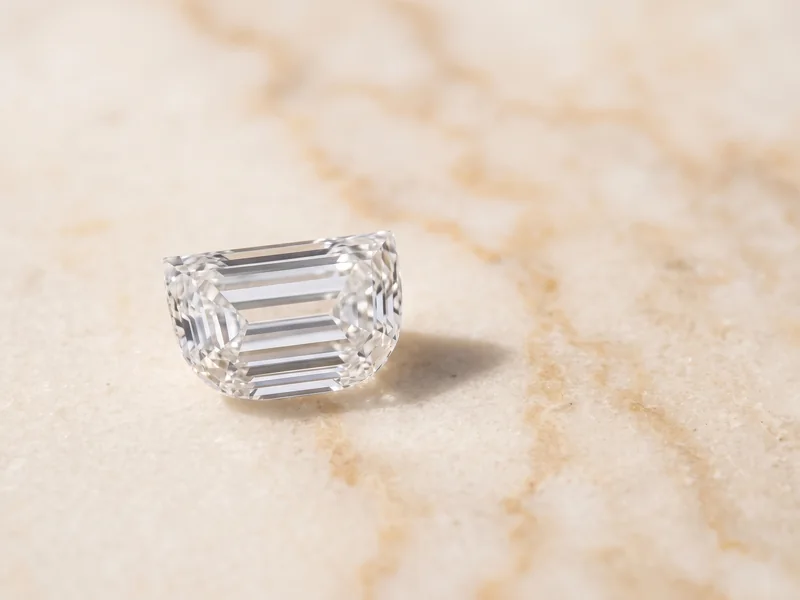
Half moon side stones have one straight edge and one curved edge, like a circle cut in half (though most are a little shallower than a true half). The straight edge sits flush against the centre stone and the curve faces outwards, which softens the shoulders of the ring. They suit ovals and cushions especially well, because the curves echo the centre. Half moons can be step cut for a calmer look or brilliant cut for more sparkle. Our page on half moon side stones in detail covers the cutting styles and which centre widths they match.
Half moons are usually wide relative to their length, so they need a centre stone with enough presence to stay dominant. As a rough guide, the straight edge of each half moon should be about 70–90% of the width of the centre side it touches; any longer and the pair starts to compete.
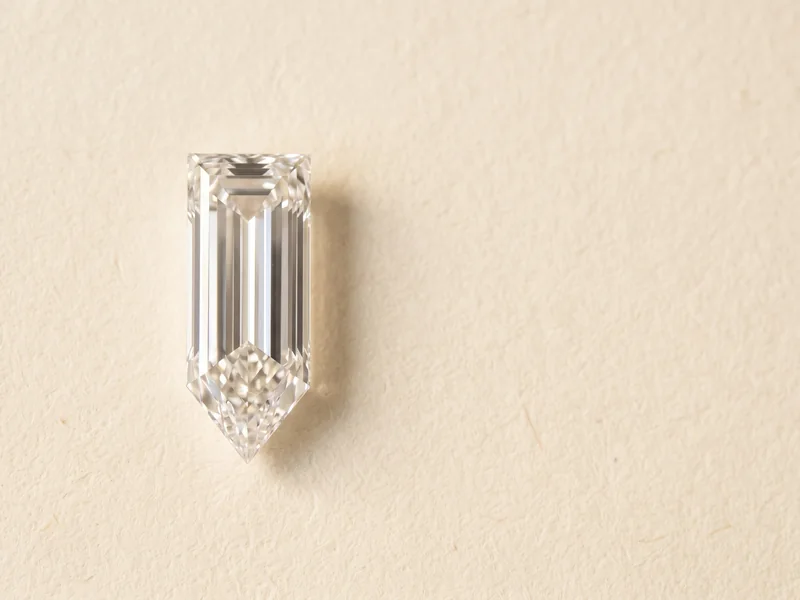
Bullet cut diamonds are elongated, step-cut stones with one flat end and one pointed end, a little like a tapered baguette with a tip. The flat end usually sits against the centre and the point leads into the band, giving a sharp, directional look that suits emerald cuts and radiants. The point is a thin edge, so it needs a V-claw or bezel. The bullet cut guide shows how the angle of the point changes the look.
Not sure which one is right?
Send us the stones you are looking at and our gemologist will tell you which to choose and why.
Are trilliant side stones a good choice?
Trilliant side stones are triangular brilliants and, for many people, the first side stone they think of. They have strong sparkle, a clear outline and, because they are cut shallow, they face up large for their weight. Trilliants used as side stones usually have straight or slightly concave sides, so they sit neatly against the centre. Trilliants cut as centre stones often have curved (convex) sides to hold more weight. Our trilliant cut diamond guide explains both.
They pair naturally with rounds, ovals, cushions and princess cuts. Beside a 1 ct round of about 6.4 mm, most people choose trilliants of about 4.5–5 mm each. The trade-off is durability: a trilliant has three sharp points, and the two outer points are exposed. A V-claw on each point, or a full or half bezel, keeps them safe.
Pear side stones are the main alternative when you want a softer outline: the rounded end faces outwards and the point faces the centre. For a full side-by-side, see trilliant or pear side stones.
What about shield, kite and lozenge side stones?
These cuts sit between the side stone family and the geometric family. They are chosen when you want the ring to look more architectural than a standard three-stone.
- Shield: a multi-sided shape, broad at the top and narrowing to a point, like a heraldic shield. It works as a larger, bolder alternative to a trapezoid. See shield cut diamonds.
- Kite: four sides with two pairs of equal-length edges, longer at one end. Used as a side stone it creates a strong diagonal. Our guide to kite-shaped side stones covers proportions.
- Lozenge: an elongated four-sided shape with two long points, like a stretched diamond on a playing card. It suits slim, modern rings. Read more about the long, slim lozenge cut.
Each of these shapes is cut individually rather than to a standard outline, so finding a true matched pair can take longer. Hexagons and pentagons belong here too; the wider geometric cut family puts them all together.
How do you size side stone diamond cuts to a centre stone?
Size side stones by millimetres, not carat weight. The centre should stay the clear focus, so the side stones are usually noticeably smaller in face-up area. These are typical starting points for a round centre; elongated centres follow the same logic using their width.
| Centre stone | Centre size | Trilliant (each) | Baguette or trapezoid (each) | Pair total weight |
|---|---|---|---|---|
| 0.50 ct round | about 5.1 mm | about 3.5–4.0 mm | about 3 × 1.5 to 4 × 2 mm | about 0.10–0.25 ct |
| 1.00 ct round | about 6.4 mm | about 4.5–5.0 mm | about 4 × 2 to 5 × 2.5 mm | about 0.25–0.60 ct |
| 1.50 ct round | about 7.3 mm | about 5.0–5.5 mm | about 5 × 2.5 to 6 × 3 mm | about 0.40–0.80 ct |
| 2.00 ct round | about 8.1 mm | about 5.5–6.5 mm | about 5 × 3 to 7 × 3.5 mm | about 0.50–1.00 ct |
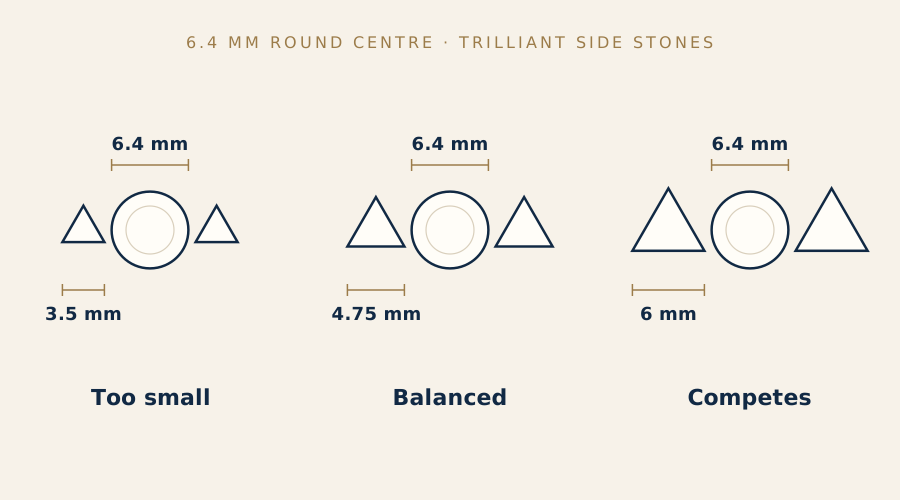
Height matters as much as width. Side stones are usually set a little lower than the centre so the ring steps down at the shoulders and a wedding band can sit closer. Before you settle on sizes, think about checking the ring's side profile, because a tall centre with flat side stones can look disconnected from the side.
Matching also covers colour and clarity. Keep side stones within one colour grade of the centre, and make sure they are eye-clean (no inclusions visible without magnification at normal distance). Small side stones often come without individual grading reports and are sold as a matched pair, so ask how the pair was graded.
Related guideSide-Stone Engagement RingsWhat settings hold side stone diamonds securely?
Because side stones have corners, points and thin edges, the setting does a lot of the work. The usual choices:
- Claw (prong) setting: a claw at each corner. Light and open, and shows the most diamond. Use V-claws on any point.
- Bezel or half bezel: a thin metal rim around all or part of the edge. The most protective option for trilliants and bullets.
- Channel setting: stones held between two metal walls with no claws between them. Ideal for a row of baguettes.
- Shared walls: the side stone sits against the centre's setting with a single thin wall between them, so the stones look almost continuous.
For a finished look and ideas on how these combine, browse side-stone engagement ring designs. If you plan to wear a wedding band alongside, tell your jeweller early: wide side stones like trapezoids and half moons can stop a straight band sitting flush.
How much do side stone diamond cuts cost, natural or lab-grown?
Side stones are cut from both natural and laboratory-grown diamond, and the two look identical to the eye. Lab-grown diamonds are real diamond grown in a laboratory rather than mined; they cost much less than natural. Many people match the side stones to the centre, natural with natural and lab-grown with lab-grown, so the ring is consistent and simple to describe and document.
| Matched pair, G–H, VS | Natural (AUD, approx.) | Lab-grown (AUD, approx.) |
|---|---|---|
| Tapered baguettes, about 0.20 ct total | $500–$1,500 | $150–$500 |
| Trilliants, about 0.50 ct total | $1,500–$4,000 | $300–$1,000 |
| Half moons, about 0.60 ct total | $2,000–$5,000 | $400–$1,200 |
These are broad ranges only and move with the market. A matched pair usually costs more than two random stones of the same weight, because the cutter has to match outline, size, colour and clarity closely, and some rough is lost doing it. Step-cut sides need higher clarity than brilliant sides, which also nudges the price up. The setting labour for fancy side stones is higher than for a simple solitaire too.
Browse side stones: half moon, trilliant and baguette, natural and lab-grown
How to choose side stones for an engagement ring, step by step
- Start with the centre. Note its shape, faceting style (step or brilliant) and millimetre size from the report.
- Pick a matching style. Step-cut sides for emerald and Asscher centres; brilliant trilliants or half moons for rounds, ovals and cushions.
- Set the size. Use the centre's width to choose side stones that stay clearly smaller, using the size table as a guide.
- Match the pair. Check both side stones are matched for outline, size, colour (within one grade of the centre) and eye-clean clarity.
- Confirm natural or lab-grown. Make sure the paperwork states which each stone is.
- Plan the setting. Protect every point with a V-claw or bezel, and check the side profile and band fit before setting.
Free consultation
Talk to a gemologist
Compare stones in person or online with Raj Sood, Graduate Gemologist (GIA), AJP (GIA).
Book a consultationFAQ
Common questions
What are the most common side stone diamond cuts?
Tapered baguettes, trapezoids, trilliants and half moons are the most common. Straight baguettes, bullets, shields and pears are also widely used.
Which side stones go with an oval diamond?
Half moons, trilliants, pears and tapered baguettes all suit ovals. Half moons and pears echo the oval's curves, while trilliants add more sparkle.
Which side stones suit an emerald cut?
Step-cut side stones such as trapezoids, baguettes and bullets suit emerald cuts best, because their flat flashes match the centre's step facets.
Do side stones need to match the centre diamond's colour?
They should be within about one colour grade of the centre so the ring looks even. Step-cut side stones show colour a little more, so some people go one grade higher.
Can you mix lab-grown side stones with a natural centre?
Yes, it can be done and must be disclosed on the paperwork. Many people prefer to keep the whole ring either natural or lab-grown for consistency.
Are trilliant side stones fragile?
Their points are thin, so they can chip if knocked. A V-claw on each point or a bezel setting protects them well for everyday wear.

Ask a gemologist
Not sure which diamond to choose?
Raj Sood is a Graduate Gemologist (GIA) and master jeweller. Bring the stones you are considering, or send the reports, and he will tell you honestly which one is better and why.
Keep learning
Related guides
 Engagement Rings & SettingsSide-Stone Engagement Rings
 Diamond ShapesTrilliant vs Pear Side Stones
 Diamond ShapesBaguette vs Tapered Baguette Diamonds
 Diamond ShapesAll 34 Diamond Cuts: Every Shape Explained and Compared
 Diamond ShapesTrapezoid Cut Diamonds
 Diamond ShapesHalf Moon Cut Diamonds
 Diamond ShapesBullet Cut Diamonds
 Diamond ShapesBaguette Cut Diamonds
Explore more
More guides on this topic
Education