
- Education
- Diamond Shapes
- Antique Diamond Cuts: Old Mine, Old European, Rose and Briolette Compared
Diamond shapes
Antique Diamond Cuts: Old Mine, Old European, Rose and Briolette Compared
Before the modern round brilliant, diamonds were shaped by hand and by eye. Antique diamond cuts carry that history in their facets, and knowing how they differ helps you judge an heirloom, a remodel or a new stone cut in an old style.
 Reviewed by Raj Sood, Graduate Gemologist (GIA), AJP (GIA)Master jeweller and Graduate Gemologist (GIA) · reviewed 4 November 2026
Quick answer
Antique diamond cuts are the hand-shaped styles used before the modern round brilliant took over in the 20th century: the Old Mine, Old European and rose cuts. They share broad facets, high crowns or domed tops and irregular outlines, giving bigger, slower flashes rather than fine sparkle. Most natural examples come from old jewellery; lab-grown versions are cut today.
What are antique diamond cuts?
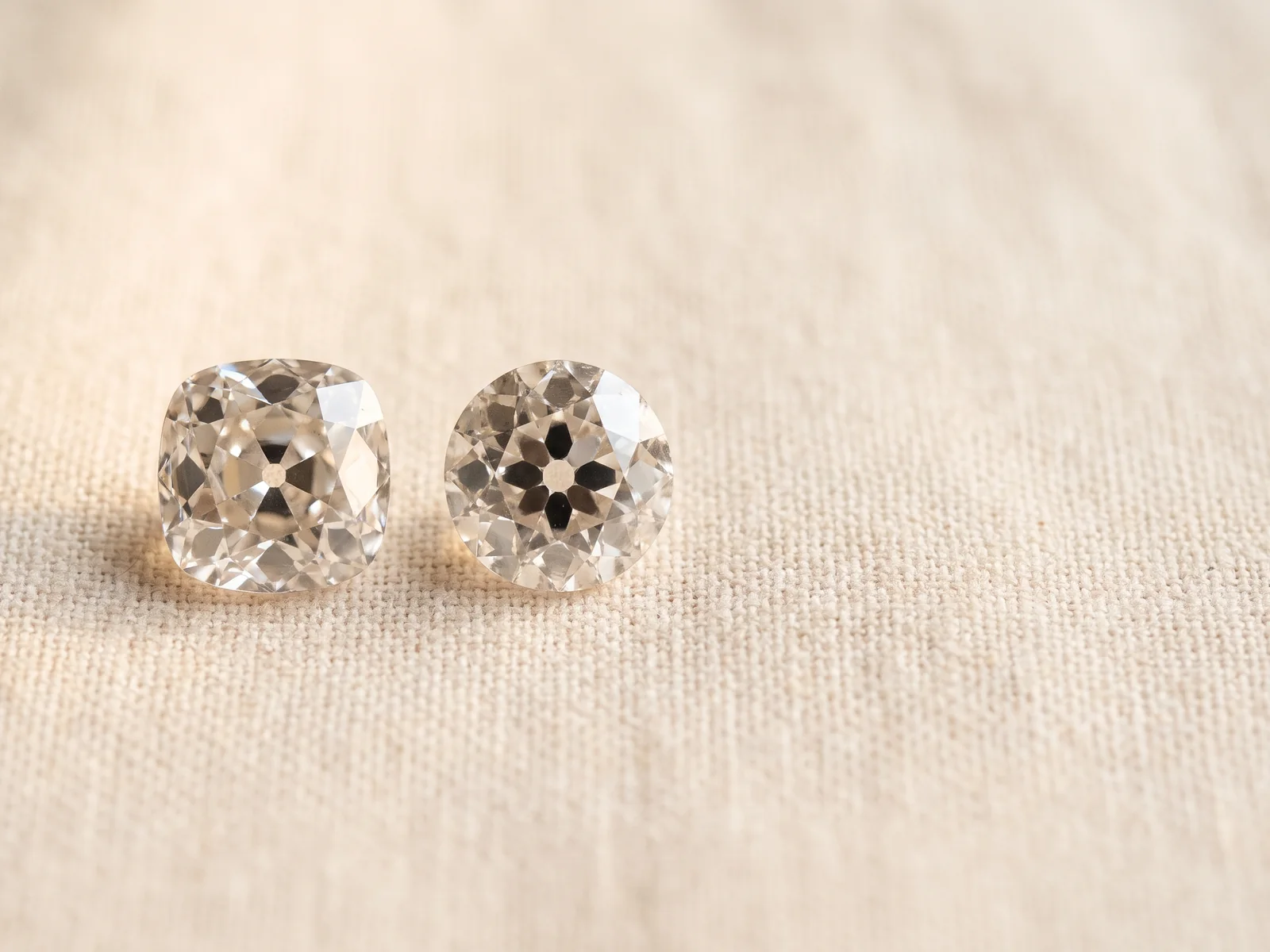
Antique diamond cuts are the cutting styles used before the modern round brilliant became the standard in the 20th century. Without today's precise measuring tools and fast polishing equipment, cutters shaped diamonds largely by hand and by eye, and their main aim was to keep as much weight from the rough crystal as possible. The result is stones with real character: broad facets, high crowns (the part above the girdle, which is the thin outer edge), small tables (the large flat top facet) and outlines that are rarely perfectly even.
Three cuts make up the core of this family. The Old Mine cut is a squarish, cushion-like brilliant cut from roughly the early 1700s to the late 1800s. The Old European cut is its round successor, popular from about the 1870s to the 1930s. The rose cut goes back to at least the 1500s and has a flat base with a domed, faceted top. The briolette, a teardrop faceted all over with no flat top, is another centuries-old style that sits naturally beside them.
Grouping cuts into families makes it easier to compare like with like. This page is one of several family overviews under our guide to all 34 diamond cuts we cover. If you are still getting used to the difference between a shape (the outline) and a cut (how the facets are arranged), start with how diamond shapes and cuts differ. Any unfamiliar term here is also defined in our glossary of jewellery terms.
A note on words. In the trade, antique usually means a piece about 100 years old or more, and vintage means old but younger than that. The cut style and the age of the stone are separate things, though: a diamond can be cut in an antique style today, from natural or lab-grown rough. Jewellers also use era names that help date a setting: Georgian (about 1714–1837), Victorian (1837–1901), Edwardian (about 1901–1915) and Art Deco (about the 1920s and 1930s).
What do antique diamond cuts have in common?
Each antique cut looks different, but they share a set of traits that come from how they were made. Once you know these, you can usually spot an older cut from across the counter.
- Hand-shaped outlines: corners, curves and girdles are often slightly uneven, because they were cut by eye rather than measured to fractions of a millimetre.
- Small tables: on Old Mine and Old European cuts the table is often around 40–50% of the stone's width, against roughly 53–60% on a modern round.
- High crowns: crown angles are often steeper than the 34–35° typical of a modern round, which pushes more light into coloured flashes.
- Open culet: the culet (a small flat facet at the very bottom) is large enough to see face-up as a little circle or octagon in the centre.
- Broad facets: fewer, larger facets than modern cuts, so the light breaks into bigger, slower flashes, often called a chunky look.
- Cut for weight: proportions followed the rough crystal, so depths vary a great deal from stone to stone.
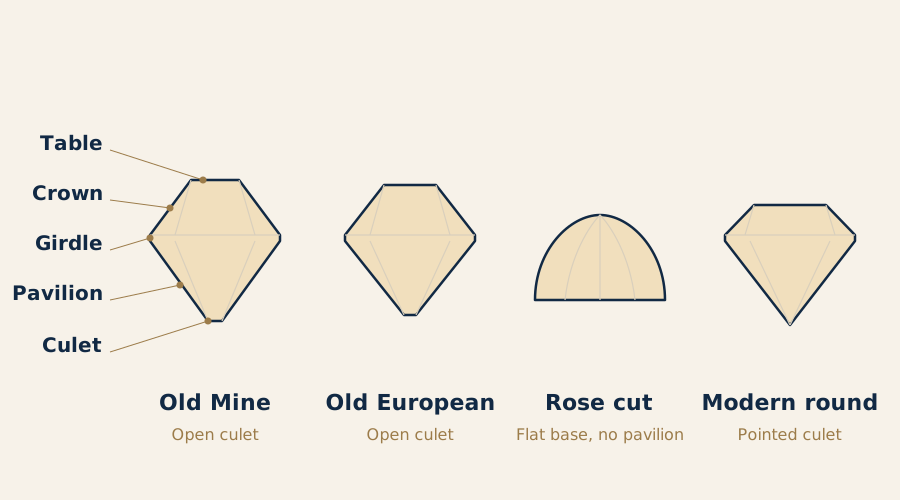
Old Mine and Old European cuts are early brilliant cuts: their triangular and kite-shaped facets radiate out from the centre, just as they do on a modern round. The rose cut is different again, with no pavilion (the lower part below the girdle) at all. If you want to understand why faceting style matters so much to the way a stone looks, our explainer on how step and brilliant faceting differ covers the basics.
What is an Old Mine cut diamond?
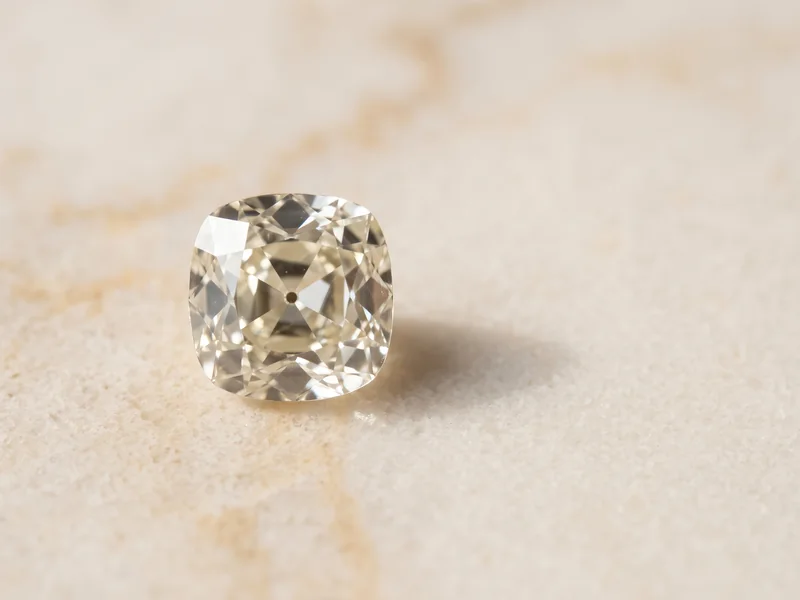
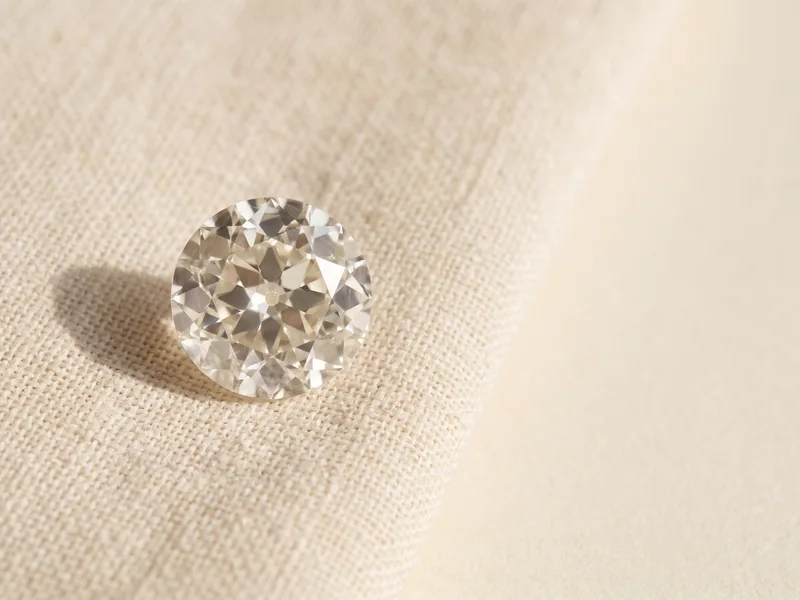
An Old Mine cut diamond is a squarish brilliant with gently rounded corners and slightly curved sides, a bit like a pillow. The name comes from the old diamond sources of India and Brazil, which supplied Europe before the large South African finds of the late 1860s and 1870s. Most Old Mine cuts have 58 facets, counting the culet.
Face-up, you will usually see a small table, a tall crown, a deep pavilion and an open culet showing as a dark or bright dot in the middle. The outline is rarely a perfect square: many lean slightly rectangular or have one corner fuller than another. That irregularity is part of the appeal, and it is also a quick way to tell a genuine older stone from a precision-cut modern one.
The Old Mine cut is the ancestor of today's cushion. A modern cushion has more facets, a larger table, a smaller or pointed culet and more even proportions, so it looks brighter and crisper but less individual. Our full Old Mine cut guide goes into proportions and grading, and we compare the two directly in Old Mine against the modern cushion. The wider square and cushion cut family puts the princess, radiant and Flanders cuts alongside it.
Because genuine Old Mine stones are limited to what survives in old jewellery, cutters now also produce Old Mine-style diamonds from new natural and lab-grown rough. These keep the high crown, small table and open culet but with more even symmetry. A lab-grown Old Mine-style diamond is real diamond, grown in a laboratory and cut in an old style; it is not an antique stone, and its grading report will say it is laboratory-grown.
Related guideOld Mine vs Cushion Cut DiamondsWhat is an Old European cut diamond?
An Old European cut diamond is a round brilliant with 58 facets, a small table, a high crown, a deep pavilion and an open culet. It appeared as cutters began using early bruting machines, which spin one diamond against another to round off the girdle, from around the 1870s. That is why Old European cuts are round where Old Mine cuts are squarish.
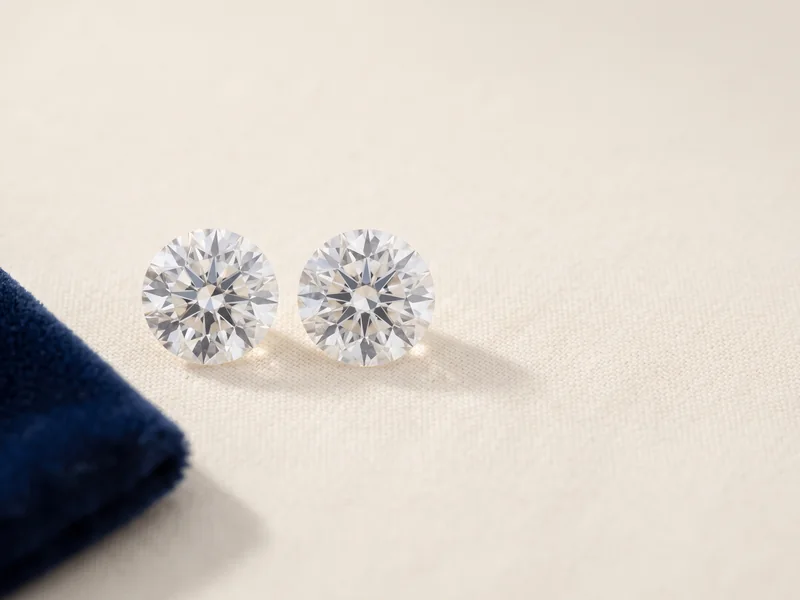
The giveaway face-up is the facet pattern. Old European cuts have short lower half facets on the pavilion, so the light reflects back as broad, petal-like wedges arranged around the culet, often described as a flower or a wagon wheel. A modern round has long, thin lower halves that break light into many small, sharp pinpoints. If you are deciding between them, our guide to round brilliant versus Old European sets the differences out in detail.
In 1919 Marcel Tolkowsky published a set of proportions designed to maximise brightness in a round diamond, and through the 1920s and 1930s cuts slowly moved towards that model. Stones from this in-between period are called transitional cuts: rounder and flatter than an Old European, with a larger table and a smaller culet, but not yet a modern brilliant. Our Old European cut diamond guide shows how to tell them apart, and the round brilliant family of cuts covers what came after.
Not sure which one is right?
Send us the stones you are looking at and our gemologist will tell you which to choose and why.
What is a rose cut diamond, and where does the briolette fit?
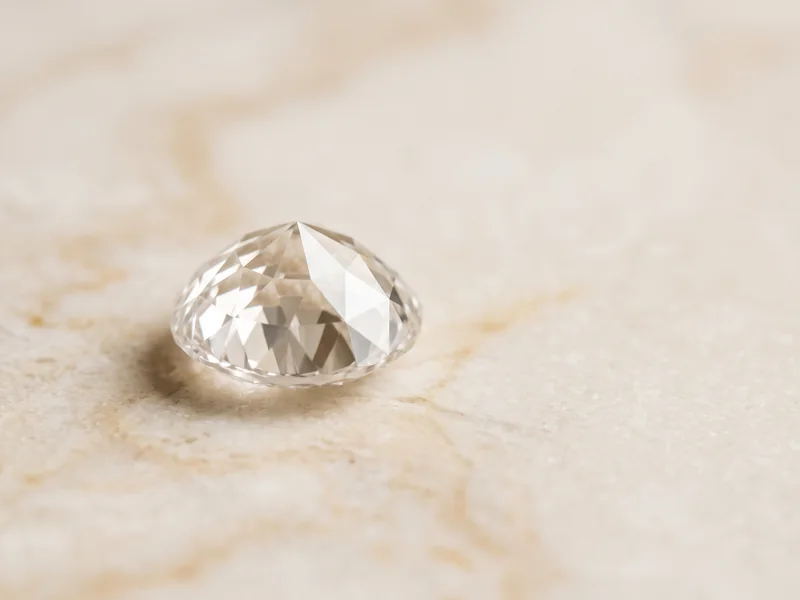
A rose cut diamond has a flat base and a domed top covered in triangular facets that rise to a point, like the opening petals of a rose. It has no pavilion, so it does not return light the way a brilliant does. Instead it has a soft, glassy glow and gentle flashes as it moves. Rose cuts were widely used from the 1500s through the Georgian and Victorian eras.
- Facet count: anywhere from 3 to 24 or more. The full Dutch rose usually has 24 facets; simpler versions have fewer.
- Height: usually shallow, so a rose cut looks large for its carat weight and sits low in a setting.
- Outline: round, oval, pear, hexagon or freeform, because the cutter followed the rough.
- Double rose: two domes placed back to back, faceted on both sides.
Rose cuts are popular again today, including in natural salt-and-pepper diamonds, which have many visible black and white inclusions (internal features) that the flat, open faceting shows off. Because a rose cut is thin at the edge, it is more exposed to chips than a deep brilliant, which affects the choice of setting. Our page on rose cut diamonds in depth covers grading, outlines and modern uses.
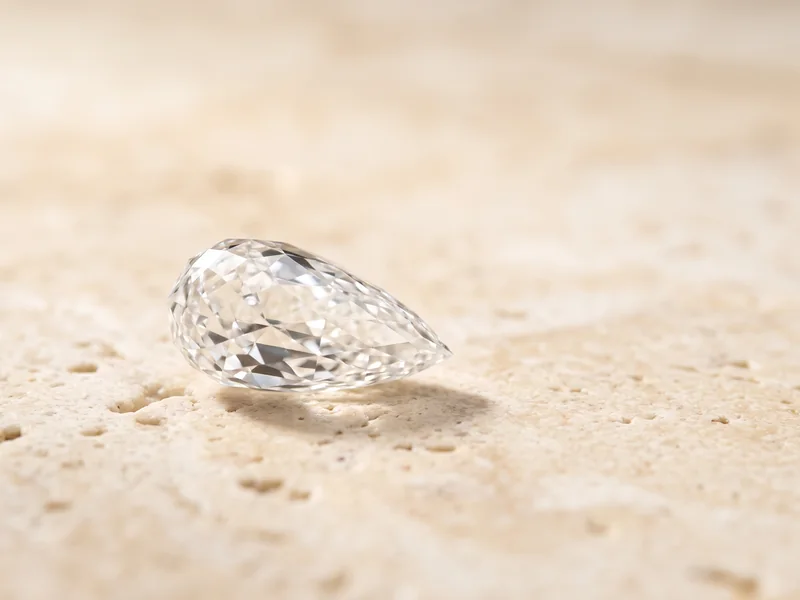
The briolette is a teardrop or elongated drop faceted all over with triangular or diamond-shaped facets, and it has no table at all. Like the rose cut, it is an old style that favours movement over brightness, and it is often drilled at the top so it can hang. See our guide to briolette drops faceted all over for earrings and pendants.
How do antique diamond cuts compare side by side?
| Old Mine | Old European | Rose cut | Briolette | Modern round | |
|---|---|---|---|---|---|
| Main era | About 1700s–1890s | About 1870s–1930s | 1500s onwards | Centuries old, still cut | 1919 design, standard from mid-1900s |
| Outline | Squarish cushion | Round | Usually round or pear, often freeform | Teardrop or drop | Precise circle |
| Facets | Usually 58 | Usually 58 | About 3–24+ | Varies, all over | 57–58 |
| Table | Small, about 40–50% | Small, about 40–50% | None (domed top) | None | About 53–60% |
| Culet | Large, open | Large, open | None (flat base) | None | None or very small |
| Look | Broad flashes, soft, irregular | Petal pattern, strong fire | Glassy glow, gentle flashes | Movement and sparkle as it swings | Bright, fine pinpoint sparkle |
| Common use | Rings, heirloom remodels | Rings, pendants | Clusters, rings, earrings | Drop earrings, pendants | Every type of jewellery |
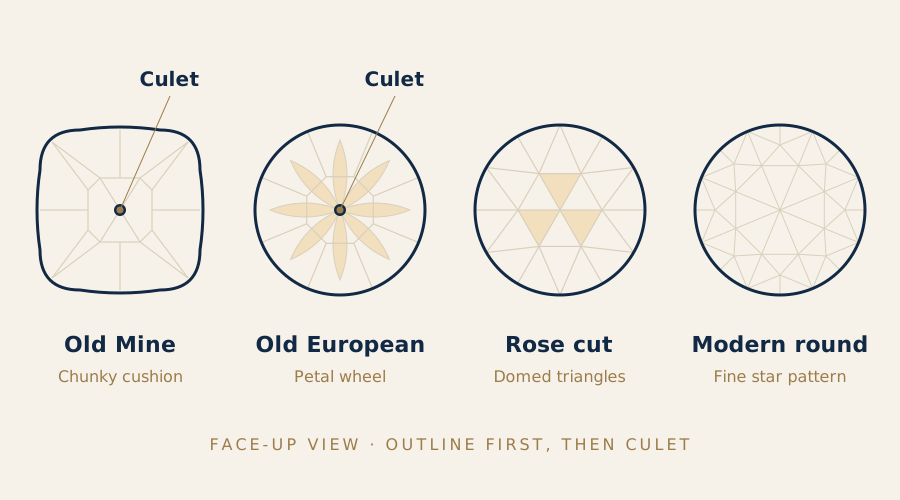
The quickest way to tell them apart is outline first, then culet. A squarish stone with a visible culet is almost always an Old Mine. A round stone with a visible culet and broad petals is an Old European. A stone that looks flat from the side with no point underneath is a rose cut. Everything else in this table helps you confirm what your eye has already told you.
These cuts are one family among several. For outlines that stretch rather than sit round or square, see the elongated cuts such as the pear and marquise; for sharper modern outlines, compare the geometric shapes like the hexagon and kite, which often borrow the rose cut's flat-backed style.
Do antique cuts sparkle less than a modern round brilliant?
They sparkle differently rather than less. Diamond light performance has three parts: brilliance (white light returned to your eye), fire (light split into rainbow colours; diamond's dispersion is about 0.044) and scintillation (the flashing pattern as the stone moves). A modern round is tuned for brilliance and fine scintillation. The high crowns and small tables of Old Mine and Old European cuts favour fire, so they show larger, slower flashes of colour, especially under a single light source such as candlelight or a pendant lamp.
Under the bright, scattered lights of a modern shop, an antique cut can look softer and a little darker than a modern round. In ordinary home light and daylight, many people find it warmer and more interesting. Diamond's refractive index of about 2.42 and its hardness of 10 on the Mohs scale are the same whatever the cut; only the way the facets handle light changes.
Colour and clarity also read differently. Many older stones are in the near-colourless to faint yellow range, around J to M, partly because cutters prioritised weight and partly because candlelight hid warmth. The broad facets and open culet can make inclusions easier to see than in a modern round, so an eye-clean stone (no inclusions visible without magnification) often means VS2 or a well-chosen SI1.
What settings suit an antique cut diamond engagement ring?
Antique cuts suit settings that respect their proportions. A high crown and deep pavilion need enough height in the setting, and the uneven outlines often need claws placed by hand rather than a standard pre-made head.
- Four or eight claws: four claws on the corners suit an Old Mine; eight fine claws hold an Old European securely and frame the round outline.
- Bezel or collet: a rim of metal around the edge protects thin girdles and is a natural fit for rose cuts.
- Milgrain and engraving: a beaded metal edge and hand engraving echo Edwardian and Art Deco work.
- Halo or cluster: small diamonds around the centre, a classic Victorian and Art Deco look.
- East-west: setting a rose cut or slightly rectangular Old Mine sideways for a modern twist.
Check the girdle carefully on any antique stone. Old girdles are often thin or uneven, and a century of wear can leave small chips that a new claw should cover. Georgian rose cuts were often set in closed backs with metal foil behind them to boost brightness; foiled pieces should not be soaked or put in an ultrasonic cleaner. Our page on settings that flatter an Old Mine stone has examples, and side stone cuts such as trapezoids and half moons covers accent stones that sit well beside older centres.
Many antique diamonds reach a jeweller as inherited pieces to be remodelled. An old stone can be recut into a modern brilliant, but that removes weight, often in the range of about 10–30%, and erases the cut's history, so most gemmologists suggest resetting rather than recutting unless the stone is damaged.
How much do antique diamond cuts cost, natural or lab-grown?
Prices depend on carat, colour, clarity, how well the stone was cut and, for genuine antiques, how scarce that size and quality is. Many antique stones were recut to modern proportions during the 20th century, so well-preserved Old Mine and Old European stones over 1 carat are limited. Lab-grown Old Mine-style diamonds are newly cut, real diamond and cost much less.
| About 1 ct | Approximate price range (AUD) |
|---|---|
| Natural Old Mine, J–K, VS–SI | about $6,000–$14,000 |
| Natural Old European, J–K, VS–SI | about $6,000–$14,000 |
| Lab-grown Old Mine-style, G–H, VS | about $1,000–$3,000 |
| Natural rose cut, about 6.5–8 mm across | about $1,500–$6,000 |
These are broad ranges only and move with the market. Natural antique cuts are usually graded on the same colour and clarity scales as modern diamonds, but labs such as GIA do not give them an overall cut grade, so judge the cut by eye. A rose cut often costs less per carat than a brilliant of similar quality because it uses flatter rough, yet it faces up larger for its weight.
Shop Old Mine cut diamonds: natural and lab-grown
How do you choose an antique cut diamond? Step by step
- Decide on the look. Squarish and soft (Old Mine), round with petals (Old European), or flat and glowing (rose cut).
- Decide natural or lab-grown. A genuine antique has history; a natural or lab-grown antique-style stone is new, more even and, if lab-grown, costs much less.
- Read the report. Confirm the shape description, measurements, colour, clarity and whether the diamond is natural or lab-grown.
- Check the culet and outline. A centred culet and a balanced outline matter more than any single grade.
- Look for chips and wear. Inspect the girdle and culet under a loupe (a 10× magnifier), especially on older stones.
- Watch it in different light. View the stone in daylight and under a single lamp to see its fire, not just under bright shop lights.
- Plan the setting. Choose claws or a bezel that suit the stone's height and protect any thin edges.
Free consultation
Talk to a gemologist
Compare stones in person or online with Raj Sood, Graduate Gemologist (GIA), AJP (GIA).
Book a consultationFAQ
Common questions
What is the difference between Old Mine and Old European cut diamonds?
Both have 58 facets, small tables, high crowns and open culets. The Old Mine is squarish like a cushion and earlier, while the Old European is round, made possible by early bruting machines from around the 1870s.
Are antique cut diamonds less sparkly than modern diamonds?
They show more fire and larger, slower flashes, while a modern round shows more white brightness and fine pinpoint sparkle. Which looks better is a matter of taste and of the light you usually wear it in.
Can you get a lab-grown Old Mine cut diamond?
Yes. Cutters now make Old Mine-style lab-grown diamonds with the same high crown and open culet. They are real diamond, grown in a laboratory, but they are new stones rather than antiques.
How can I tell if my diamond is an antique cut?
Look for a visible culet in the centre when you look straight down, a small table and broad facets. A flat-bottomed stone with a domed top is a rose cut, and a jeweller can confirm with a loupe.
Should I recut an antique diamond into a modern brilliant?
Recutting loses weight, often around 10–30%, and removes the original character. Most people reset the stone instead and only recut if it is badly chipped.
Is a rose cut diamond durable enough for an engagement ring?
Diamond is 10 on the Mohs scale, but a rose cut's thin edge can chip if knocked. A bezel or well-placed claws protect it for everyday wear.

Ask a gemologist
Not sure which diamond to choose?
Raj Sood is a Graduate Gemologist (GIA) and master jeweller. Bring the stones you are considering, or send the reports, and he will tell you honestly which one is better and why.
Keep learning
Related guides
 Diamond ShapesOld Mine Cut Diamonds
 Diamond ShapesOld European Cut Diamonds
 Diamond ShapesRose Cut Diamonds
 Diamond ShapesRound vs Old European Cut Diamonds
 Diamond ShapesBriolette Cut Diamonds
 Diamond ShapesAll 34 Diamond Cuts: Every Shape Explained and ComparedDiamond ShapesUnderstanding Diamond Shapes
 Diamond ShapesStep Cuts vs Brilliant Cuts Explained
Explore more
More guides on this topic
Education