
- Education
- Diamond Shapes
- Diamond Shapes That Hide Colour and Inclusions: A Shape-by-Shape Guide
Diamond shapes
Diamond Shapes That Hide Colour and Inclusions: A Shape-by-Shape Guide
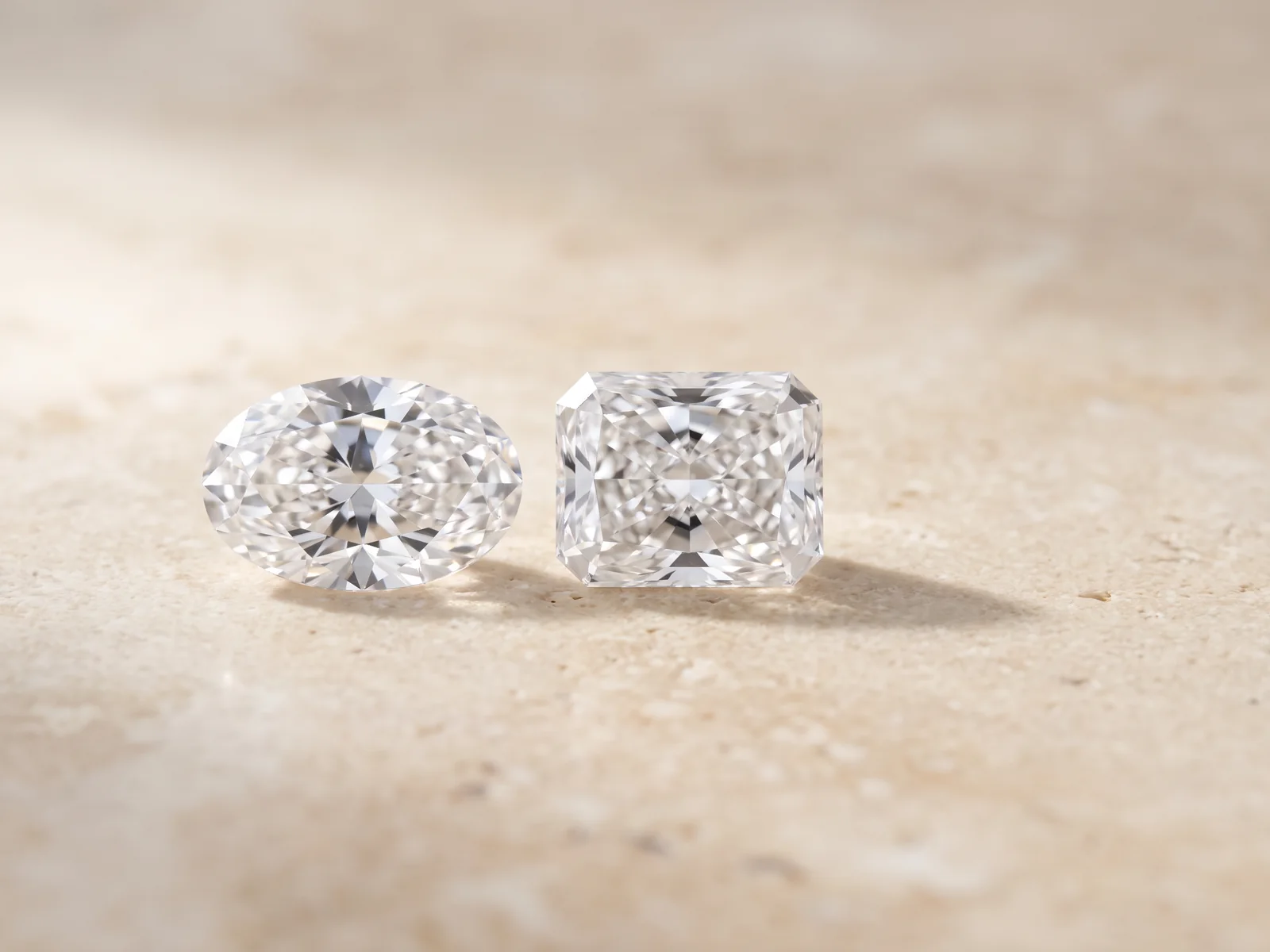
Shape changes how much colour and how many inclusions you can see in a diamond, and that changes which grades are worth paying for. Here is how the diamond shapes that hide colour and inclusions compare, with sizes, grade targets and AUD price ranges.
 Reviewed by Raj Sood, Graduate Gemologist (GIA), AJP (GIA)Master jeweller and Graduate Gemologist (GIA) · reviewed 4 November 2026
Quick answer
Brilliant-cut shapes hide colour and inclusions best, and the round brilliant masks both most effectively. Radiant, cushion, princess and oval cuts also hide inclusions well, though radiants and cushions can show more body colour. Step cuts such as emerald and Asscher show inclusions most, and pear, marquise and heart shapes collect colour at their points.
Which are the diamond shapes that hide colour and inclusions?
Every diamond has a colour grade and a clarity grade on its report, but the grade is only half the story. The shape and, more precisely, the faceting style decide how much of that colour and how many of those inclusions (internal features such as crystals, feathers and clouds) you actually see when the stone is on your hand. Two diamonds with identical grades can look quite different once one is a round and the other an emerald cut.
In short, shapes cut in the brilliant style, with many small triangular and kite-shaped facets, hide inclusions well. The round brilliant is the strongest at hiding both inclusions and colour. Shapes cut in the step style, with long rectangular facets in rows like a staircase, show inclusions most clearly. Shapes with points or sharp corners tend to show a little more colour at those tips, where the stone is thinnest. If you want a refresher on what each outline looks like before going further, our overview of the main diamond shapes sets them out side by side.
Why does this matter? Because a shape that hides inclusions lets you choose a lower clarity grade without seeing the difference, and a shape that hides colour lets you drop a colour grade or two. That money can go into a larger stone or a better setting instead. Clarity grades run from Flawless (FL) and Internally Flawless (IF) through VVS1, VVS2, VS1, VS2, SI1 and SI2 down to I1, I2 and I3. Our full guide to diamond inclusions and clarity grades explains each step, and any unfamiliar word in this article is defined in the GemTrove jewellery glossary.
Why do brilliant cuts hide inclusions better than step cuts?
Diamond has a high refractive index of about 2.42, meaning it bends light strongly, and a dispersion of about 0.044, which splits white light into flashes of colour. In a brilliant cut, light entering the top bounces between dozens of angled facets before it returns to your eye. The result is scintillation: a busy pattern of small bright and dark flashes that moves every time the stone or your head moves. That pattern is visual camouflage. A small white crystal or a faint cloud gets lost in it.
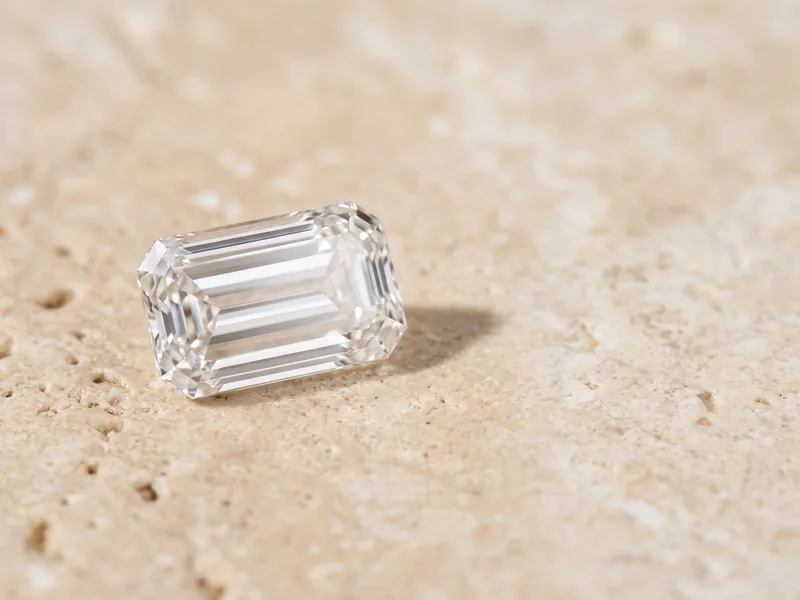
A step cut works differently. The emerald and Asscher cuts have a large, open table (the flat top facet) and long parallel facets that act more like windows than mirrors. They give broad flashes of light and dark, often called a hall-of-mirrors effect, and a calm, glassy look. That clarity of view is exactly why people love them, and exactly why inclusions show. Our article on why inclusions are easier to see in an emerald cut goes through real examples.
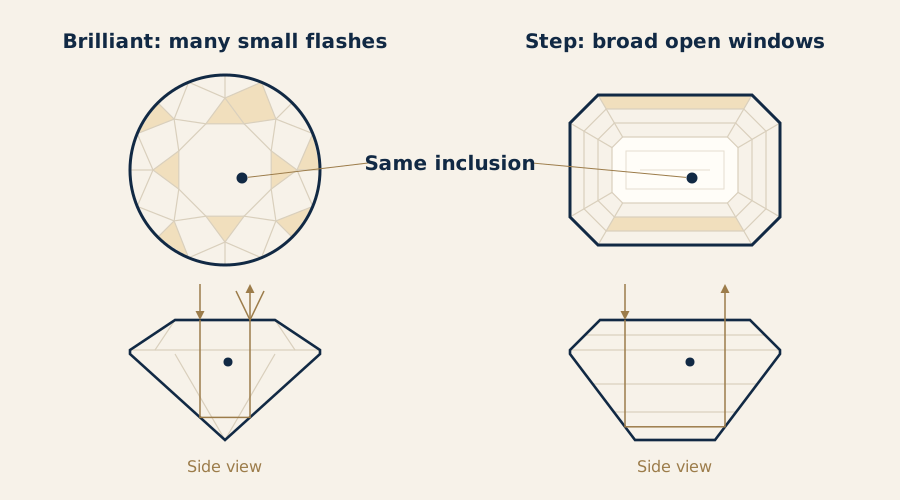
Not all inclusions behave the same way. Tiny pinpoints scattered through a brilliant are almost impossible to see without a loupe (a 10× magnifier), and our page on what pinpoint inclusions look like shows why they rarely matter. A dense cloud, made of many pinpoints grouped together, can make any shape look slightly hazy, and a step cut will show that haze more readily; see how a cloud inclusion affects brightness for what to watch for.
One caution: brilliant facets can also work against you. A dark inclusion sitting near the pavilion (the lower half of the stone) can be reflected by the facets above it, so one small spot appears as several. This is why location on the plotting diagram matters as much as the grade itself.
Which diamond shapes show the most colour?
Colour in a white diamond is graded from D (colourless) through G–J (near colourless) and on towards Z (light yellow or brown). Our guide to how the D–Z colour scale works covers the grading itself. What shape changes is where light travels through the stone and how far, and longer paths through thicker areas show more body colour (the stone's own faint tint).
- Round brilliant: a well-cut round returns so much white light that it masks body colour better than any other shape.
- Princess: faces up fairly white, but warmth can gather in the four corners.
- Oval: mostly even, with a little extra warmth towards the two ends.
- Pear, marquise and heart: colour concentrates in the points, where facets crowd together and the stone is thin.
- Cushion and radiant: deeper cuts with many facets that tend to intensify body colour. Cutters often use these shapes for fancy coloured diamonds for exactly that reason.
- Emerald and Asscher: the open table shows colour evenly across the face, so a tint is visible as a clear wash rather than hidden in the sparkle.
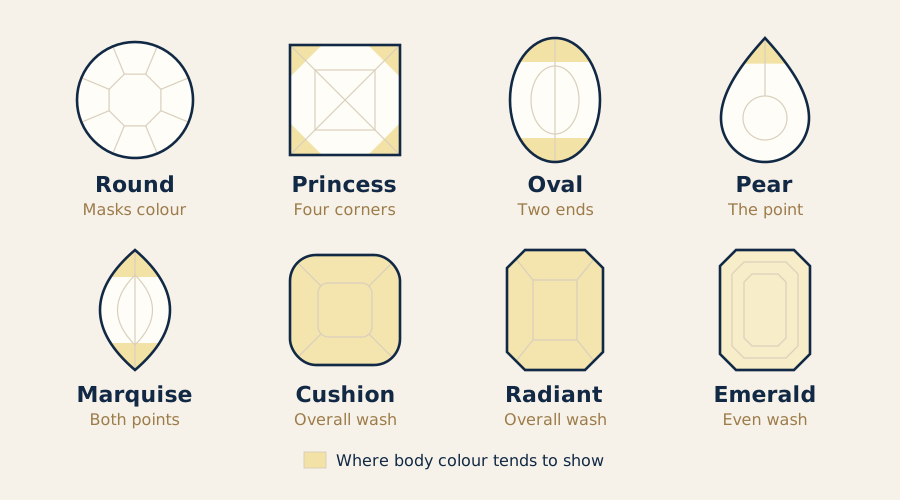
In practice that means a round can drop to H or I colour in white metal and still look white to most people, while a cushion or radiant often needs F or G to look the same. Our pages on whether an I colour diamond looks white, F colour diamonds at the top of the near-colourless range and what you get from an E colour diamond show the differences in real settings.
How do all the diamond shapes compare for hiding colour and inclusions?
The table below rates each common shape on how well it hides inclusions and colour, and gives a typical face-up size at 1 carat so you can see how big each shape looks for its weight. The sizes are typical measurements for well-proportioned stones; individual diamonds vary with depth and ratio.
| Shape | Faceting style | Hides inclusions | Hides colour | Typical 1 ct size (mm) | Price per carat vs round |
|---|---|---|---|---|---|
| Round | Brilliant | Excellent | Excellent | about 6.4–6.5 diameter | Highest |
| Oval | Modified brilliant | Very good | Good; ends can warm | about 7.7 × 5.7 | Usually lower |
| Pear | Modified brilliant | Very good | Fair to good; point shows colour | about 8.5 × 5.5 | Usually lower |
| Marquise | Modified brilliant | Very good | Fair to good; two points | about 10.0 × 5.0 | Usually lower |
| Heart | Modified brilliant | Very good | Fair to good; lobes and point | about 6.8 wide × 6.3 long | Usually lower |
| Princess | Modified brilliant | Very good | Good; corners can warm | about 5.5 × 5.5 | Usually lower |
| Cushion | Modified brilliant | Very good, especially crushed-ice style | Fair; shows warmth | about 5.5–6.0 square | Usually lower |
| Radiant | Brilliant facets in a cut-corner rectangle | Very good | Fair; concentrates colour | about 6.5 × 5.5 | Usually lower |
| Emerald | Step | Poor to fair | Fair; even wash of colour | about 7.0 × 5.0 | Usually lower |
| Asscher | Step | Poor to fair | Fair | about 5.5 × 5.5 | Usually lower |
Two shapes stand out as a compromise. The radiant combines the clean, rectangular outline of an emerald cut with brilliant faceting underneath, so a radiant cut hides inclusions far better than an emerald of the same grade. The trade-off is colour, which a radiant tends to intensify. Cushions come in two styles: the crushed-ice style, with many small splintery flashes, hides inclusions very well; the chunkier antique style, with larger facets, shows a little more.
Elongated brilliants (oval, pear, marquise and heart) often show a bow-tie, a darker band across the centre where light leaks out. A bow-tie does not change the clarity grade, but an inclusion sitting inside the dark band is easier to see than one in a bright area.
Related guideDiamond Inclusions GuideNot sure which one is right?
Send us the stones you are looking at and our gemologist will tell you which to choose and why.
Which inclusions matter most in each shape?
The type of inclusion matters as much as the shape. A clarity grade summarises size, number, position, colour and relief (how much the inclusion stands out), but two SI1 stones can contain very different things. Here is how the common types behave across shapes:
- Feathers: small internal cracks. In a round they often disappear in the sparkle, but at the point of a pear, marquise or heart, or a corner of a princess, a feather that reaches the surface can weaken the thinnest part of the stone. Read when a feather inclusion is a durability risk before choosing a pointed shape.
- Crystals: tiny minerals trapped as the diamond formed. Clear or white crystals hide easily in brilliants; in a step cut they are often visible face-up. Our page on how crystal inclusions form and how visible they are has examples.
- Knots: crystals that reach the surface. They can be felt as a small bump and may catch light in a step cut's flat facets; see why a knot sits at the surface.
- Needles: long, thin crystals. Their straight lines can be noticeable against the parallel facets of an emerald cut, less so in a brilliant; more in our guide to needle inclusions and how they read.
- Dark crystals: black or dark inclusions stand out in every shape and can be mirrored by brilliant facets. Our article answering whether black inclusions are a problem explains when they matter.
Position is the deciding factor in every shape. Inclusions under the table are the most visible because you look straight through the table. Inclusions near the girdle (the thin outer edge) are the least visible and can often be hidden under a claw, except at the points and corners, where the setting should protect rather than stress the stone.
What colour and clarity grade do you need for each shape?
These grade targets are the ones most people find look white and eye-clean (no inclusions visible without magnification at a normal viewing distance of about 25–30 cm). They are a starting point, not a rule: always judge the actual stone or a good 360° video.
| Shape | Colour in white gold or platinum | Colour in yellow or rose gold | Clarity for eye-clean |
|---|---|---|---|
| Round | H–I | J–K | SI1, sometimes SI2 (check each stone) |
| Oval, pear, marquise, heart | G–H | I–J | VS2–SI1 |
| Princess | G–H | I–J | VS2–SI1 (check the corners) |
| Cushion, radiant | F–G | H–I | VS2–SI1 |
| Emerald, Asscher | F–G | H–I | VS1–VS2 |
Size also changes the answer. Inclusions and colour are both easier to see in larger stones, because the inclusions themselves are bigger and light travels further through the diamond. A 0.50 carat round SI2 can be eye-clean where a 2 carat round SI2 usually is not. As a rough guide, step up one clarity grade once you go above about 1.5 carats in a step cut.
Fluorescence, a glow some diamonds give under ultraviolet light, can also play a part. Medium to strong blue fluorescence can make an I–K diamond look a touch whiter in daylight. In rare cases very strong fluorescence makes a stone look slightly hazy, so view fluorescent stones in natural light before deciding.
Can the setting and metal help hide colour?
Yes, and often more than people expect. Yellow and rose gold reflect warm light into the diamond, so a slightly warm stone blends in and looks white against the metal. That is why an I or J colour can look right in yellow gold while the same stone looks warmer in platinum. White gold and platinum are neutral, so they show the diamond's own colour more honestly.
- Claws: placed over the girdle, they can cover inclusions near the edge. In pear, marquise and heart shapes, a V-claw protects the point where both colour and feathers tend to sit.
- Bezels: a metal rim around the edge hides girdle-level inclusions and, in yellow gold, warms the whole stone.
- Halos: a ring of small white diamonds makes the centre look larger, but if the halo stones are much whiter than the centre, the contrast can make a warm centre look warmer.
- Two-tone settings: a white-metal head on a yellow-gold band keeps the diamond looking white while giving the warm look of yellow gold.
Are diamond shapes that hide colour and inclusions cheaper to buy?
The round brilliant hides colour and inclusions best, but it is also the most expensive shape per carat, because demand is highest and cutting a round wastes more of the rough crystal. Fancy shapes usually cost less per carat for the same grades. So there are two ways to make your budget go further: choose a round and drop a grade or two, or choose a fancy brilliant and spend the difference on size.
| 1 ct diamond, G colour, VS2 clarity | Approximate price range (AUD) |
|---|---|
| Natural round | about $9,000–$16,000 |
| Natural fancy shape (oval, pear, cushion and others) | about $6,000–$12,000 |
| Lab-grown round | about $1,000–$3,000 |
| Lab-grown fancy shape | about $800–$2,500 |
These are broad ranges and move with the market. Lab-grown diamonds are real diamond, grown in a laboratory rather than mined, with the same hardness (10 on the Mohs scale) and refractive index. They also have inclusions, and they are graded on the same colour and clarity scales, so everything in this guide applies to them. Because a lab-grown stone costs much less, many people choose a higher grade or a step cut they might not have chosen in natural. Natural diamonds are rarer and formed deep underground, most of them more than a billion years ago; both should come with an independent report from a lab such as GIA or IGI.
Watch for treatments. Some diamonds are laser-drilled to remove dark inclusions or fracture-filled to make feathers less visible. These treatments must be disclosed, and GIA does not grade fracture-filled diamonds. That is quite different from coloured gems, where treatment is standard practice, as our page on why emeralds are routinely oiled to improve clarity explains.
Browse natural and lab-grown diamonds in every shape
How do you choose a diamond that hides colour and inclusions? Step by step
- Pick your shape first. Decide whether you want brilliant sparkle or the calm, open look of a step cut, because that sets how strict your grades must be.
- Set a grade target for that shape. Use the table above: SI1 and H–I can work in a round; aim for VS1–VS2 and F–G in an emerald or Asscher.
- Match colour to metal. Drop one or two colour grades for yellow or rose gold; stay a little higher for platinum or white gold.
- Read the plotting diagram. Find where each inclusion sits. Favour stones with inclusions near the girdle, away from the table, points and corners.
- Watch a 360° video or view the stone in person. Check for inclusions you can see face-up, dark crystals mirrored in the facets and warmth at the points.
- Confirm natural or lab-grown and any treatment. The report should state the origin and disclose laser drilling or fracture filling.
- Plan the setting. Choose claws or a bezel that cover edge inclusions and protect any points before you commit.
Free consultation
Talk to a gemologist
Compare stones in person or online with Raj Sood, Graduate Gemologist (GIA), AJP (GIA).
Book a consultationShop this shape
FAQ
Common questions
Which diamond shape hides inclusions best?
The round brilliant hides inclusions best, because its many angled facets create a busy sparkle that disguises small crystals and clouds. Crushed-ice cushions, radiants, princess cuts and ovals are close behind.
Do oval diamonds hide inclusions?
Yes. An oval is a modified brilliant, so it hides inclusions well, and VS2 or SI1 is often eye-clean. Check that no inclusion sits inside the bow-tie, where it is easier to see.
Which diamond shape shows colour the most?
Cushions and radiants tend to intensify body colour, and pear, marquise and heart shapes show warmth at their points. Emerald and Asscher cuts show colour as an even wash across the open table.
Why do inclusions show more in an emerald cut diamond?
Emerald cuts use step faceting, with a large open table and long parallel facets that act like windows. There is less broken-up sparkle to hide inclusions, so most people choose VS1 or VS2.
Can I choose a lower colour grade if I set the diamond in yellow gold?
Usually, yes. Yellow and rose gold reflect warm light into the stone, so an I or J colour diamond often looks white in yellow gold, while in platinum you might want G or H.
Do lab-grown diamonds have inclusions?
Yes. Lab-grown diamonds can contain metallic inclusions, dark pinpoints and clouds from their growth process. They are graded on the same clarity scale as natural diamonds, so the same shape advice applies.

Ask a gemologist
Not sure which diamond to choose?
Raj Sood is a Graduate Gemologist (GIA) and master jeweller. Bring the stones you are considering, or send the reports, and he will tell you honestly which one is better and why.
Keep learning
Related guides
 Diamond 4Cs & GradingDiamond Inclusions Guide
 Diamond 4Cs & GradingDiamond Colour Grading
 Diamond ShapesEmerald-Cut Diamond Clarity: Why Inclusions Show More
 Diamond 4Cs & GradingWhat Is a Feather Inclusion in a Diamond?Diamond 4Cs & GradingWhat Is a Cloud Inclusion in a Diamond?Diamond 4Cs & GradingCrystal Inclusions in DiamondsDiamond 4Cs & GradingKnot Inclusions in Diamonds
Explore more
More guides on this topic
Education