
- Education
- Diamond Shapes
- Square and Cushion Diamond Cuts: Princess, Radiant, Cushion and Flanders Compared
Diamond shapes
Square and Cushion Diamond Cuts: Princess, Radiant, Cushion and Flanders Compared
Square and cushion diamond cuts look alike in a photo but behave very differently on the hand. The corners, the facet pattern and the depth decide how bright the stone looks, how much colour it shows and how well it survives everyday wear.
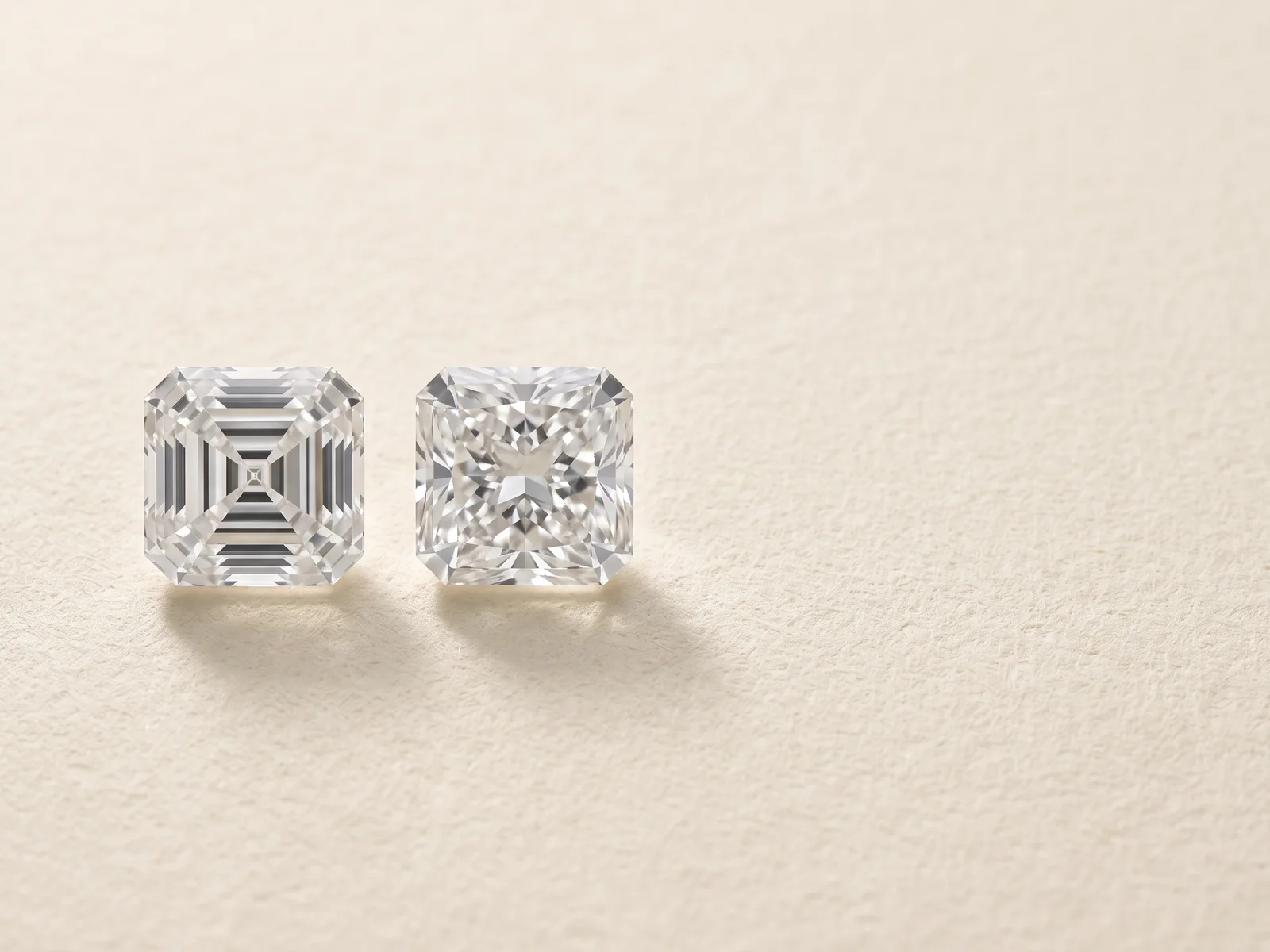
 Reviewed by Raj Sood, Graduate Gemologist (GIA), AJP (GIA)Master jeweller and Graduate Gemologist (GIA) · reviewed 4 November 2026
Quick answer
Square and cushion diamond cuts are four related shapes with a square or near-square outline. The princess has sharp corners, the radiant and Flanders have cropped corners, and the cushion has softly rounded corners. All are brilliant-style cuts that sparkle; they differ in corner durability, facet pattern, how much colour they show and price.
What are square and cushion diamond cuts?
Square and cushion diamond cuts are the group of shapes whose outline is square, or close to it, when you look down on the stone. Four cuts belong here: the princess, the radiant (in both square and rectangular forms), the cushion and the less common Flanders. We group them as one family because people tend to compare them against each other, and because they share the same strengths and the same weak points. Our page on every one of the 34 diamond cuts shows where this family sits among the rest.
What they share is a brilliant-style facet pattern. A brilliant cut uses many triangular and kite-shaped facets that break light into lots of small, lively flashes, the same idea behind the round brilliant. The opposite approach is the step cut, which uses long, flat, parallel facets like stairs, as in the emerald and Asscher cuts. If that distinction is new to you, our explainer on how step cuts and brilliant cuts handle light covers it in plain terms.
What separates the four is mostly the corners. A princess has sharp, pointed corners. A radiant and a Flanders have their corners trimmed off, which jewellers call cropped or cut corners. A cushion has corners rounded like a pillow, which is where the name comes from. Those small differences change how the stone looks, how it must be set and how much it costs.
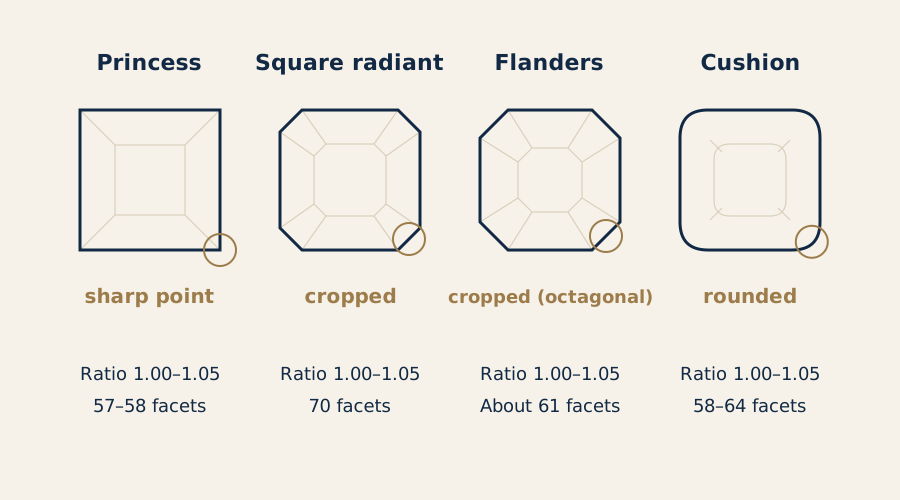
All four are diamond, so the material facts are the same: 10 on the Mohs hardness scale and a refractive index of about 2.42, which is why brilliant faceting sparkles so strongly in diamond. Hardness is resistance to scratching, not to knocks, and diamond can chip along its cleavage planes when a thin edge is struck. That matters most for the princess. For a wider look at how outlines compare, see our introduction to diamond shapes, and any unfamiliar term is defined in the GemTrove jewellery glossary.
How do square and cushion diamond cuts compare side by side?
This chart sets out the main differences. Numbers are typical ranges, not rules; individual cutters vary, so always read the grading report for the stone you are looking at.
| Princess | Square radiant | Cushion | Flanders | |
|---|---|---|---|---|
| Corners | Sharp, pointed | Cropped | Rounded | Cropped (octagonal outline) |
| Facets (typical) | 57–58 | 70 | 58–64, more on modified | About 61 |
| Ratio for a square look | 1.00–1.05 | 1.00–1.05 | 1.00–1.05 (elongated up to about 1.35) | About 1.00–1.05 |
| Look | Crisp, bright, X-shaped pattern | Lively, fine sparkle | Soft; chunky or crushed ice | Brilliant with clean cropped corners |
| Corner risk | High: needs protecting | Low | Low | Low |
| Shows body colour | Moderate | Can concentrate colour | More, especially in the corners | Moderate |
| Typical total depth | About 65–75% | About 61–69% | About 61–70% | Varies by cutter |
| Availability | Very common | Common | Very common | Uncommon |
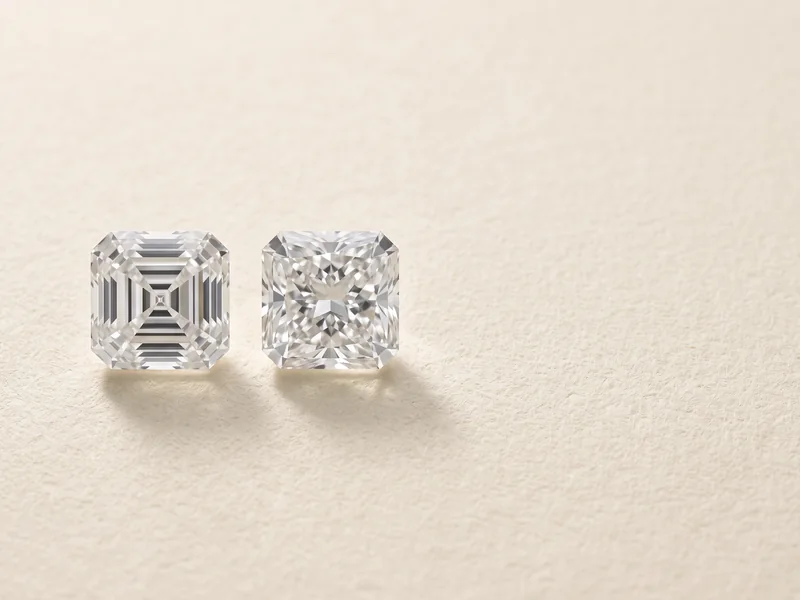
Two square relatives sit just outside this family because they are step cuts: the Asscher, with its deep, cropped-corner steps, and the carré, a plain square step cut. They give a calmer, mirror-like look rather than sparkle. Our guide to the carré square step cut covers that option, and the Asscher vs square radiant comparison shows how a step-cut square differs from a brilliant one with the same outline.
The comparison people ask about most is the radiant against the cushion, because both have softened corners and both sparkle. We have given that pairing its own page.
Related guideRadiant vs Cushion Cut DiamondsWhat is a princess cut diamond?
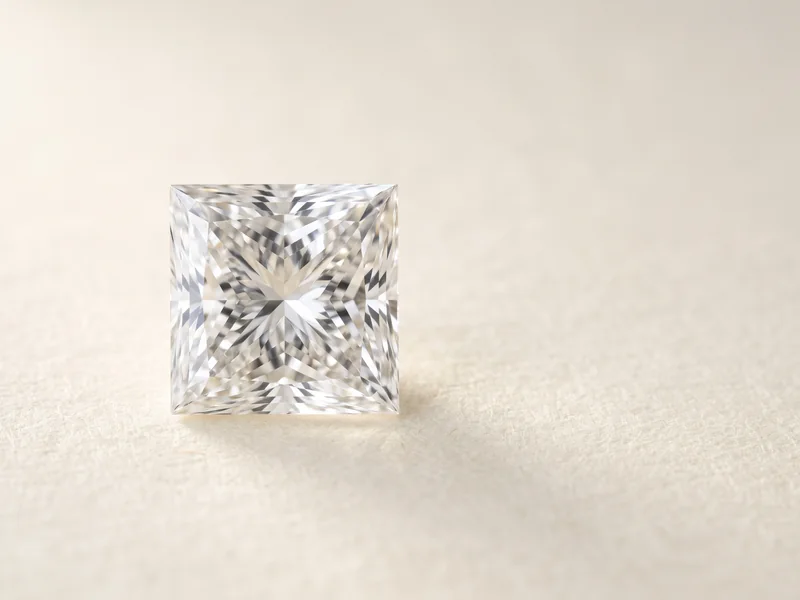
The princess is a square modified brilliant with four sharp corners. The modern version was developed around 1980, building on earlier square brilliant designs from the 1960s. Most princess diamonds have 57 or 58 facets, arranged so that, face-up, you see a cross or X pattern running corner to corner. It suits people who want a clean, geometric look that still sparkles like a round.
The princess is efficient to cut. A natural diamond crystal is often an octahedron, two pyramids base to base, and a square outline keeps a large share of that rough. That is one reason a princess usually costs less per carat than a round of the same grades. It is also cut quite deep, often 65–75% total depth, so a 1 carat princess measures only about 5.5 mm across, smaller face-up than a round of the same weight (about 6.4 mm).
The weak point is the corners. Each one comes to a thin point, and a knock against a door frame or benchtop can chip it. A well-made princess has a girdle (the thin outer edge) that is not extremely thin at the corners, and it should be set with claws or a bezel that cover each point. Our princess cut diamond guide goes through ratio, depth, table and corner checks in detail.
What is a radiant cut, and how is a square radiant different?
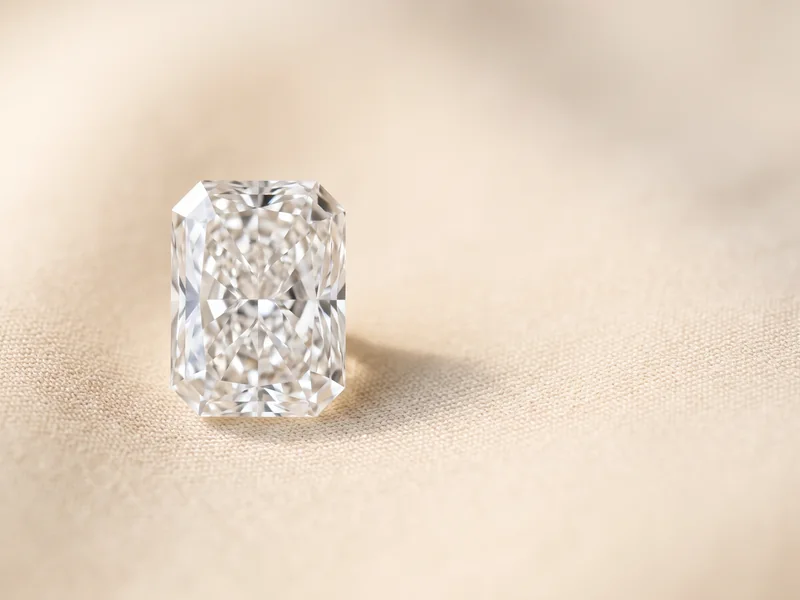
The radiant was introduced in 1977 as the first cut to put full brilliant faceting on both the crown (top) and the pavilion (bottom) of a cropped-corner, rectangular outline. A standard radiant has 70 facets. The result is a stone with the clean, faceted corners of an emerald cut but the busy, fine sparkle of a brilliant, often described as a crushed ice look.
Radiants come in two broad outlines. A square radiant has a length-to-width ratio of about 1.00–1.05; a rectangular radiant sits around 1.20–1.35 or longer. The cropped corners make the radiant much more durable than a princess, because there is no sharp point to catch. Read our radiant cut diamond guide for rectangular stones and the dedicated page on choosing a square radiant if you want the square version.
Radiants are also popular for coloured diamonds. The dense faceting tends to concentrate and deepen body colour, which is welcome in a fancy yellow or pink but means a colourless radiant can look slightly warmer than a princess of the same colour grade.
Not sure which one is right?
Send us the stones you are looking at and our gemologist will tell you which to choose and why.
What is a cushion cut diamond: chunky or crushed ice?
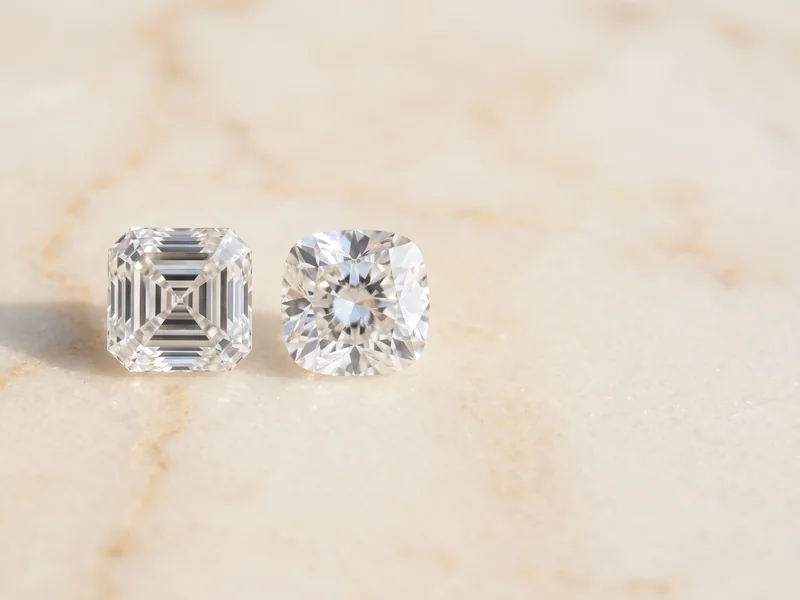
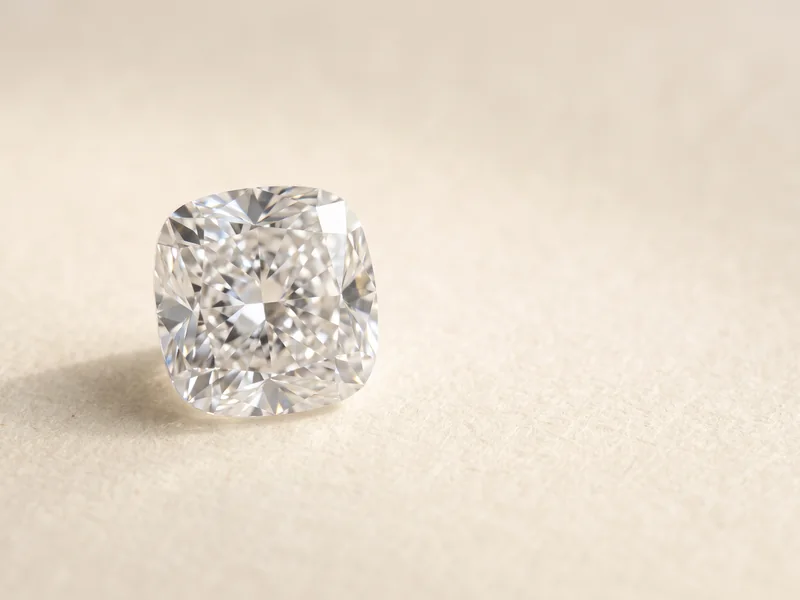
The cushion is the oldest shape in the family. It descends from the old mine cut of the 1700s and 1800s, which was cut by hand to follow the rough crystal and had rounded corners and large facets. Today's cushion is a square or rectangular brilliant with rounded corners and slightly curved sides. Our full cushion cut buying guide is the place to start.
Grading reports describe two main types, and they look quite different:
- Cushion brilliant: larger, broader facets that give bold, separate flashes of light, often called chunky facets. Closest to the antique look.
- Cushion modified brilliant: an extra row of facets on the pavilion breaks light into many tiny sparkles, known as crushed ice. It looks glittery but can blur the facet pattern.
- Hybrid styles: some cutters blend the two; the report wording will still say one or the other, so a video matters.
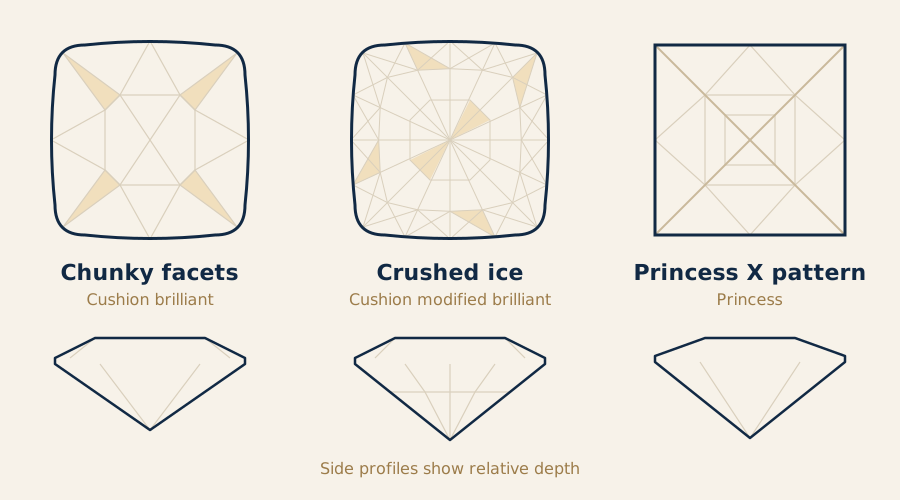
Neither type is better; it is a matter of taste. See chunky facets versus crushed ice side by side and the page on the cushion modified crushed ice cut. Cushions also come square (ratio about 1.00–1.05) or elongated (about 1.15–1.35); our guide to square versus elongated cushions shows how each looks on the finger.
What is a Flanders cut diamond?
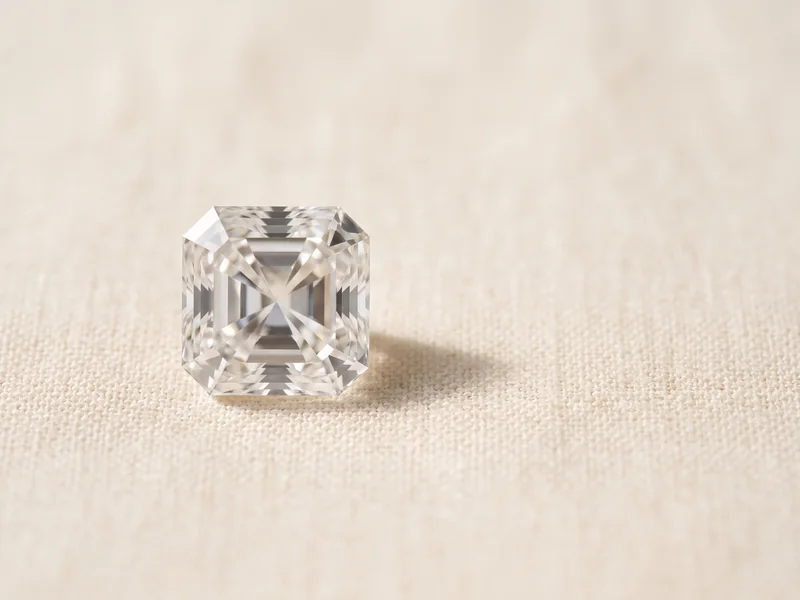
The Flanders brilliant was developed in Antwerp, in the Flanders region of Belgium, in the 1980s. It is a square brilliant with cropped corners, giving an octagonal outline, and usually around 61 facets. Face-up it sits between a princess and a square radiant: the outline is close to a radiant's, but the facet pattern is simpler and the sparkle a little bolder.
Flanders diamonds are uncommon in today's market, so you will see far fewer of them than princess, radiant or cushion stones, and less standard information on ideal proportions. That makes careful comparison of the report and a video more important. Our page on the Flanders brilliant and its history covers what to look for.
Which square cut hides colour and inclusions best?
Body colour is the faint yellow or brown tint in a colourless diamond, graded from D (colourless) down the alphabet. Square shapes tend to collect colour in the corners, where light travels a longer path. The cushion usually shows the most, particularly deep cushions with a small table, and the radiant can concentrate colour too. The princess tends to face up a little whiter. Our explainer on why cushions can look warmer than their grade has examples.
- Princess in white metal: H colour or better usually looks white.
- Cushion or radiant in white metal: many people go one grade higher, G or better.
- Any of the four in yellow or rose gold: I–J can look white against the warm metal.
- Clarity: brilliant faceting hides small inclusions well, so eye-clean VS2–SI1 is usually enough. Avoid feathers (small internal cracks) near princess corners.
Depth also changes how big the stone looks. Cushions in particular can carry a lot of weight under the girdle, so two 1 carat cushions can differ by half a millimetre across. Our page on cushion depth and hidden weight explains how to spot it on the report. Typical face-up sizes for square stones:
| Carat weight | Princess (approx.) | Square cushion (approx.) | Round, for reference |
|---|---|---|---|
| 0.50 ct | 4.4 mm | 4.6–4.8 mm | 5.1 mm |
| 0.75 ct | 5.0 mm | 5.1–5.3 mm | 5.8 mm |
| 1.00 ct | 5.5 mm | 5.5–5.8 mm | 6.4 mm |
| 1.50 ct | 6.3 mm | 6.3–6.6 mm | 7.3 mm |
| 2.00 ct | 6.9 mm | 6.9–7.2 mm | 8.1 mm |
What setting suits a princess, radiant or cushion diamond?
The rule is simple: protect any point. For a princess, that means a claw at each corner, ideally a V-claw (a V-shaped claw that wraps the corner), or a bezel (a thin rim of metal around the edge). Radiant, cushion and Flanders stones have no sharp corners, so four ordinary claws, double claws, a halo or a bezel all work.
- Solitaire: four claws square to the edges, or set on the diagonal so the stone reads as a diamond shape (a kite or 'compass' setting).
- Halo: a ring of small diamonds around a cushion or square radiant makes it face up larger and shields the edge.
- Three-stone: square stones pair neatly with trapezoid or baguette side stones.
- Wedding band: the straight sides of a princess or radiant sit flush against a straight band; a halo may need a low or contoured band.
How much do square and cushion cut diamonds cost, natural or lab-grown?
All four cuts are available in natural and laboratory-grown diamond. Lab-grown diamonds are real diamond with the same hardness and refractive index, grown in a laboratory rather than mined; they cost much less than natural and are easier to find in larger sizes. Natural diamonds are rarer. Either way, ask for an independent grading report from a lab such as GIA or IGI, which will state clearly whether the stone is natural or lab-grown.
| 1 ct, G–H colour, VS clarity | Lab-grown (approx. AUD) | Natural (approx. AUD) |
|---|---|---|
| Princess | $1,000–$3,000 | $5,000–$12,000 |
| Square radiant | $1,000–$3,000 | $5,500–$13,000 |
| Cushion | $1,000–$3,000 | $5,000–$13,000 |
| Flanders | Limited supply; ask | Limited supply; ask |
| Round, for reference | $1,200–$3,500 | $8,000–$18,000 |
These are broad ranges only, and prices move with the market. As a pattern, square and cushion cuts usually cost less per carat than a round of the same grades, partly because more of the rough crystal is kept. Within each cut, carat, colour, clarity and cut quality move the price most, and deep stones cost more per millimetre of face-up size.
Shop princess, radiant and cushion diamonds: natural and lab-grown
How do you choose between square and cushion cuts? Step by step
- Decide on the look. Sharp and geometric (princess), fine sparkle with clean corners (radiant or Flanders), or soft and classic (cushion).
- Think about wear. If your hands are busy, a cropped or rounded corner is more forgiving than a princess point.
- Check the ratio. Divide length by width on the report; 1.00–1.05 reads square, higher reads rectangular.
- Read depth and size. Compare millimetre measurements, not just carat, especially with cushions.
- Match colour to metal. Allow a grade higher for cushions and radiants in white metal.
- Watch a video. For cushions, confirm whether you like chunky facets or crushed ice; for princesses, check the corners are free of inclusions.
- Plan the setting. Confirm V-claws or a bezel for a princess before you commit to the stone.
Free consultation
Talk to a gemologist
Compare stones in person or online with Raj Sood, Graduate Gemologist (GIA), AJP (GIA).
Book a consultationFAQ
Common questions
Is a princess or cushion cut better for an engagement ring?
Neither is better overall. A princess is sharper and usually faces up a little whiter, while a cushion is softer, has no fragile corners and suits a vintage look.
What is the difference between a radiant and a princess cut?
A princess has sharp, pointed corners and usually 57–58 facets. A radiant has cropped corners and about 70 facets, so it is more durable and has a finer, crushed ice sparkle.
Does a cushion cut diamond look smaller than a round?
Usually yes. Cushions are often cut deeper, so a 1 carat square cushion measures about 5.5–5.8 mm across against roughly 6.4 mm for a round.
Do princess cut diamonds chip easily?
Their corners are the most exposed part, so they can chip if knocked. Claws or a bezel covering each corner protect them well for everyday wear.
What is a crushed ice cushion?
It is a cushion modified brilliant with an extra row of pavilion facets, which breaks light into many small sparkles. A cushion brilliant has larger, chunkier facets instead.
Can you get lab-grown princess, radiant and cushion diamonds?
Yes. All three are widely available lab-grown and cost much less than natural stones. Labs such as IGI grade them on the same colour and clarity scales, though GIA now uses simpler descriptive terms on its lab-grown reports.

Ask a gemologist
Not sure which diamond to choose?
Raj Sood is a Graduate Gemologist (GIA) and master jeweller. Bring the stones you are considering, or send the reports, and he will tell you honestly which one is better and why.
Keep learning
Related guides
 Diamond ShapesPrincess Cut Diamonds
 Diamond ShapesRadiant Cut Diamonds
 Diamond ShapesCushion Cut Diamonds: Brilliant, Modified & Buying Guide
 Diamond ShapesFlanders Cut Diamonds
 Diamond ShapesSquare Radiant Cut Diamonds
 Diamond ShapesCushion Modified (Crushed Ice) Cut Diamonds
 Diamond ShapesAll 34 Diamond Cuts: Every Shape Explained and ComparedDiamond ShapesUnderstanding Diamond Shapes
Explore more
More guides on this topic
Education