
- Education
- Diamond Shapes
- Cushion Diamond Depth and Hidden Weight: How to Read the Numbers
Diamond shapes
Cushion Diamond Depth and Hidden Weight: How to Read the Numbers
Two cushion diamonds can both weigh 1 carat and still look different sizes on the hand. Cushion diamond depth is usually the reason, so here is how to read it on a report, spot hidden weight and choose a stone whose weight sits where you can see it.
 Reviewed by Raj Sood, Graduate Gemologist (GIA), AJP (GIA)Master jeweller and Graduate Gemologist (GIA) · reviewed 4 November 2026
Quick answer
Cushion diamond depth is the stone's height from table to culet as a percentage of its width. Most well-cut cushions sit around 61–68%. Above about 70%, extra weight hides in the pavilion or a thick girdle, so a 1 carat stone can face up like a 0.90 carat one and look darker in the centre.
What is cushion diamond depth?
Depth is the total height of a diamond, measured from the table (the large flat facet on top) down to the culet (the point or tiny facet at the very bottom). On a grading report it appears twice: as a measurement in millimetres, the third number in the measurements line (for example 5.80 × 5.75 × 3.70 mm), and as a depth percentage, which is that height divided by the width. If those two figures are new to you, our explainer on how table and depth percentages are measured goes through the maths.
A cushion is a square or slightly rectangular diamond with rounded corners and gently curved sides, a shape that grew out of the old mine cuts of the 1800s. Our story of how antique cuts evolved into the modern brilliant traces that line. Most modern cushions are brilliant cut, with kite and triangle facets that throw back light the way a round does. Our complete cushion cut guide covers the shape's history, faceting styles and grading in full; this page focuses on one number that matters more in cushions than in almost any other shape.
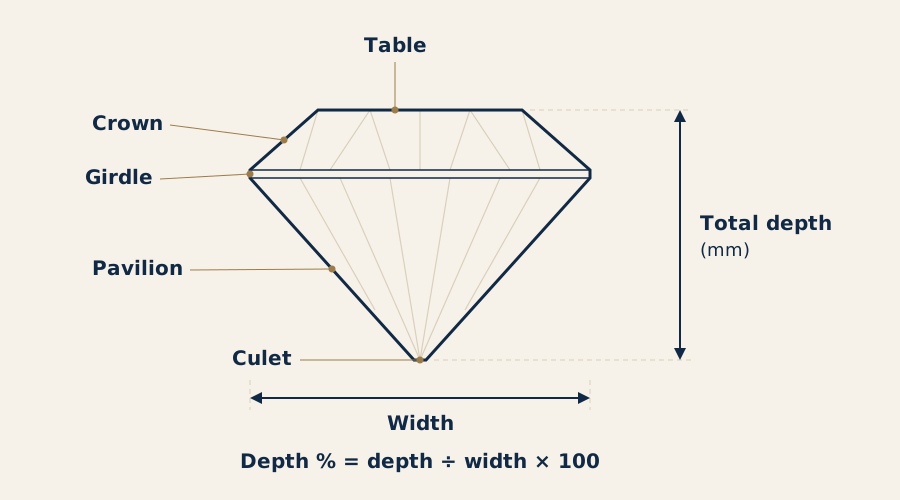
Every diamond has three height zones: the crown (the faceted top above the girdle), the girdle (the thin outer edge where the stone is widest) and the pavilion (the cone-shaped underside). Depth percentage is the sum of all three. Any of these terms is also defined in our plain-English jewellery glossary.
What is hidden weight in a cushion diamond?
Hidden weight is carat weight that sits below the girdle or inside an overly thick edge, where it adds to the number on the report but not to the size you see from above. Diamonds are sold by weight, so a heavier stone of the same face-up size simply costs more.
Cushions are especially prone to it for two reasons. First, cushion rough is often cut from chunky crystals, and the cutter's job is to keep as much of that crystal as possible. Second, GIA does not give cushions an overall cut grade the way it does for round brilliants, so there is no single grade that penalises a deep stone. A cushion at 74% depth can carry Excellent polish and symmetry on its report and still face up noticeably small.
Price thresholds make the pull stronger. Diamond prices step up at round weights such as 0.50, 0.70, 1.00, 1.50 and 2.00 carats. If keeping a bit of extra pavilion takes a stone from 0.96 to 1.01 carats, the polished diamond moves into a higher price bracket, even though it looks no bigger. The same pressure exists across the square and cushion family, from princess to Flanders, but cushions show the widest spread of depths.
What is the ideal depth for a cushion cut diamond?
There is no official ideal, because cushions vary so much in outline and faceting. As a working guide, most well-cut square cushions sit between about 61% and 68% depth, with a table of about 58–68% of the width. The stone's real-life look matters more than any single figure, but the bands below are a reliable first filter.
| Depth % | What you typically see | Verdict |
|---|---|---|
| Under 60% | Wide spread, but light can leak out the bottom, leaving a glassy, washed-out window in the centre | Check the video carefully |
| 60–64% | Large face-up size with good brightness when the angles are right | Strong choice for spread |
| 64–68% | Balanced size and sparkle; very common in well-cut cushions | Strong choice for most rings |
| 68–70% | Slightly smaller face-up; often fine in crushed-ice styles | Acceptable, compare mm sizes |
| Over 70% | Weight sitting below the girdle, smaller face-up size, sometimes a dark centre | Hidden weight likely |
Rectangular cushions follow the same logic, but depth is calculated against the narrower width, so an elongated stone often shows a slightly higher percentage for the same proportions. If you are looking at elongated cushions with ratios above 1.10, allow a point or two of extra depth before you rule a stone out.
How does cushion diamond depth change face-up size?
Face-up size is the width and length you see from above, which is what people notice on the hand. For the same carat weight, a deeper cushion is narrower across the top. The table below shows a 1.00 carat square cushion at different depths, calculated with a standard cushion weight formula.
| 1.00 ct square cushion at | Approximate face-up size | Looks like a 64% cushion of |
|---|---|---|
| 60% depth | about 5.9 × 5.9 mm | about 1.08 ct |
| 64% depth | about 5.8 × 5.8 mm | 1.00 ct |
| 68% depth | about 5.6 × 5.6 mm | about 0.94 ct |
| 72% depth | about 5.5 × 5.5 mm | about 0.89 ct |
| 76% depth | about 5.4 × 5.4 mm | about 0.84 ct |
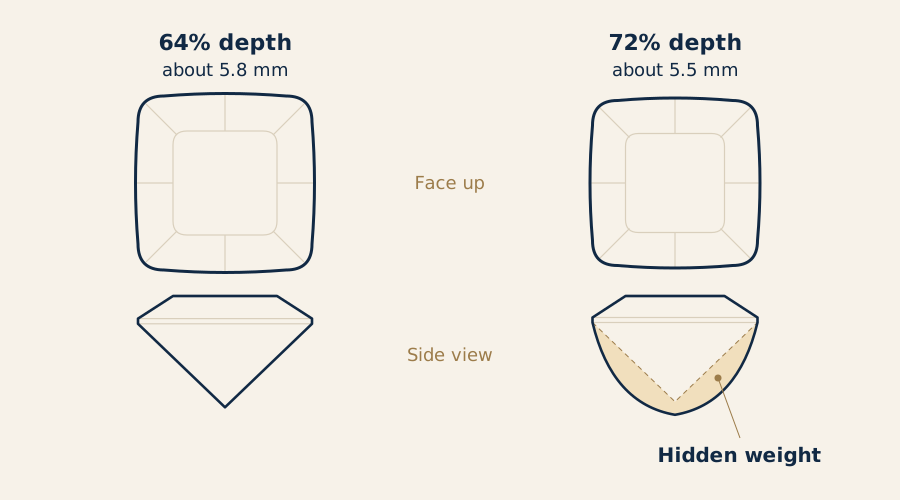
A few tenths of a millimetre sounds small, but face-up area depends on width times length. A 5.5 mm cushion shows roughly a tenth less surface than a 5.8 mm one, which is about the difference between a 0.90 and a 1.00 carat stone. As a reference, at about 64% depth a square cushion measures roughly:
- 0.50 ct: about 4.6 mm
- 0.75 ct: about 5.2 mm
- 1.00 ct: about 5.8 mm
- 1.50 ct: about 6.6 mm
- 2.00 ct: about 7.3 mm
- 3.00 ct: about 8.3 mm
A round brilliant of 1.00 carat is about 6.4 mm across, so cushions already face up a little smaller than rounds by weight; a deep cushion widens that gap. Our comparison of round versus cushion, millimetre for millimetre sets out the full chart, and our ranking of which shapes face up largest for their weight puts cushions alongside every other cut.
Related guideRound vs Cushion Cut DiamondsNot sure which one is right?
Send us the stones you are looking at and our gemologist will tell you which to choose and why.
Where do cutters hide weight in a cushion?
Depth percentage tells you a stone is deep, but not where the extra height sits. A grading report gives clues for each zone:
- Deep or bulging pavilion: the most common place. A pavilion that swells outward below the girdle, sometimes called a belly, adds weight without adding width. Look for a pavilion depth well above about 45–50% where the report or the cutter's data gives it.
- Thick girdle: reports describe the girdle from Extremely Thin to Extremely Thick. Thin to Slightly Thick is normal. Very Thick or Extremely Thick adds a band of weight around the edge that you never see face-up once the stone is set.
- High crown: a tall crown adds height on top. It can help fire (flashes of colour), so a slightly high crown is not always bad, but combined with a deep pavilion it pushes total depth past 70%.
- Small table with a large culet: a narrow table plus a visible culet often goes with old-style, chunky cutting that keeps weight from the rough.
These same zones exist in every shape, which is why proportion rules differ so much between cuts. Our guide to how every diamond shape is built explains how each outline handles light and weight differently, and the cushion is one of the shapes in our tour of all 34 diamond cuts.
Does a deep cushion diamond look darker?
Often, yes. When the pavilion is too steep, light entering the top hits the pavilion facets at an angle that lets it escape out the sides or reflects it in a way that never reaches your eye. The result is a dull or dark area under the table. In shallow cushions the opposite happens: light falls straight through, leaving a window, a see-through patch in the centre.
Cushions come in two broad faceting styles, and depth behaves differently in each. A chunky or antique-style cushion has larger, bolder facets and broad flashes of light, much like an old mine cut. A crushed ice cushion (sold as a cushion modified brilliant) has an extra row of pavilion facets that break light into many small sparkles. Crushed ice cushions are often cut a little deeper and can carry 68–70% well, though very deep ones can look milky or blurred. Our page on crushed ice and chunky cushion faceting shows the difference.
Diamond has a refractive index of about 2.42, which bends light strongly and gives brilliant cuts their return of light, but only if the pavilion angles are right. Hardness (10 on the Mohs scale) does not change any of this: a deep cushion is just as durable as a shallow one, it simply shows less of itself.
How does cushion depth compare with round, radiant, princess and Asscher?
Each shape has its own normal depth range, so a percentage that is too deep for one is perfectly normal for another. Typical ranges for well-cut stones:
| Cushion | Round brilliant | Radiant | Princess | Asscher | |
|---|---|---|---|---|---|
| Typical depth | 61–68% | 59–62.5% | 61–67% | 68–75% | 60–68% |
| Typical table | 58–68% | 53–58% | 61–69% | 67–74% | 60–68% |
| GIA overall cut grade | No | Yes | No | No | No |
| Hidden weight risk | High | Low (cut grade penalises it) | Medium | Medium | Medium |
| 1 ct face-up size | about 5.8 mm | about 6.4 mm | about 5.9 × 5.6 mm | about 5.5 mm | about 5.5 mm |
Radiants share the cushion's square-to-rectangular outline but have cropped corners and a more mixed faceting pattern; see radiant and cushion side by side. Asschers are step cut, with long parallel facets that show depth problems as dark or glassy areas instead of a crisp hall-of-mirrors effect; our Asscher vs cushion comparison explains how. Round brilliants are the only shape with tight, graded proportion rules, which is why rounds rarely carry hidden weight.
Is a deep cushion diamond cheaper, natural or lab-grown?
Per carat, a deep cushion can be priced a little below a well-proportioned one of the same grades, but you are still paying for weight you cannot see. The fairer comparison is price per millimetre of face-up width. A 0.92 carat cushion at 64% can face up about the same as a 1.01 carat at 72%, and the lighter stone sits below the 1 carat price step.
Cushions are cut from both natural and lab-grown (laboratory-grown) diamond. Lab-grown diamonds are real diamond with the same hardness and refractive index, grown in a laboratory rather than mined, and they cost much less than natural. Because lab-grown rough is less costly per carat, there is less financial reason to keep extra weight, but deep lab-grown cushions still exist, so check the same numbers. Both types should come with an independent report from a lab such as GIA or IGI that states whether the stone is natural or lab-grown.
| 1 ct cushion, G–H, VS, 61–68% depth | Approximate price range (AUD) |
|---|---|
| Lab-grown | about $1,000–$3,000 |
| Natural | about $6,000–$14,000 |
These are broad ranges only and move with the market and the exact grades. Depth also affects how bright the stone looks, which in turn affects value; our explainer on what depth does to light return covers that side, and our page on how prices differ between diamond shapes shows where cushions sit against rounds and other cuts.
Shop cushion diamonds: natural and lab-grown
Which settings suit a deep cushion diamond?
Depth matters for the ring as well as the stone. A 1 carat cushion at 72% is about 4.0 mm tall from table to culet, compared with about 3.7 mm at 64%. That extra height means the head (the part holding the diamond) sits higher on the finger, or needs a deeper basket underneath.
- Four claws: the classic cushion setting, with one claw at each rounded corner. Works at any depth; the gallery underneath can be shaped around a deeper pavilion.
- Halo: a ring of small diamonds around the cushion adds visible width, which can make up for a stone that faces up slightly small.
- Bezel: a rim of metal around the girdle. Secure, and it hides a thick girdle, but it needs to be deep enough to clear the pavilion.
- Low-profile basket: keeps the ring closer to the finger, which suits stones under about 66% depth best.
Browse settings that suit a cushion's height for examples. If you want a ring that sits close to a wedding band, a shallower stone gives the designer more room; our page on low-profile cushion ring designs covers how that works.
How do you check a cushion diamond's depth before you buy? Step by step
- Read the measurements line. Note length, width and depth in millimetres, and confirm whether the diamond is natural or lab-grown.
- Check depth percentage. Aim for about 61–68% in a square cushion; look closely at anything above 70%.
- Check the table. About 58–68% of the width is typical; a very small table with high depth suggests old-style, weight-keeping cutting.
- Look at the girdle. Thin to Slightly Thick is normal. Very Thick or Extremely Thick usually means hidden weight.
- Compare millimetres, not carats. Line up stones of similar weight by face-up width and length; the smallest is carrying weight underneath.
- Watch a 360° video. Look for a dark centre (too deep) or a glassy window (too shallow) as the stone turns.
- Plan the setting height. Check that the head or basket suits the stone's millimetre depth. If any report term is unclear, see our definitions of girdle, culet and pavilion.
Free consultation
Talk to a gemologist
Compare stones in person or online with Raj Sood, Graduate Gemologist (GIA), AJP (GIA).
Book a consultationFAQ
Common questions
What is a good depth percentage for a cushion cut diamond?
Most well-cut square cushions sit between about 61% and 68% depth. Crushed ice styles can carry up to about 70% well, but above that weight is usually hiding below the girdle.
Why does my 1 carat cushion look smaller than a 1 carat round?
Cushions face up smaller than rounds by weight: about 5.8 mm against 6.4 mm at 1 carat. A deep cushion narrows that again, to about 5.5 mm at 72% depth.
Is a deep cushion diamond bad?
Not always, but it shows less of what you pay for. A deep cushion faces up smaller, can look darker in the centre and needs a taller setting, so compare millimetre sizes before you decide.
Does GIA give cushion diamonds a cut grade?
No. GIA gives an overall cut grade only to standard round brilliants, so for cushions you judge the cut from depth, table, girdle, polish, symmetry and how the stone looks in video.
What does a thick girdle mean on a cushion diamond?
The girdle is the outer edge of the stone. Very Thick or Extremely Thick girdles add weight around the edge that you cannot see once the diamond is set.
Do lab-grown cushion diamonds have hidden weight too?
They can. Lab-grown cushions are real diamond and are cut by the same methods, so check depth, girdle and millimetre sizes on the report just as you would for a natural stone.
Terms in this guide

Ask a gemologist
Not sure which diamond to choose?
Raj Sood is a Graduate Gemologist (GIA) and master jeweller. Bring the stones you are considering, or send the reports, and he will tell you honestly which one is better and why.
Keep learning
Related guides
 Diamond ShapesCushion Cut Diamonds: Brilliant, Modified & Buying Guide
 Diamond Anatomy & LightDiamond Table and Depth Explained
 Engagement Rings & SettingsBest Settings for Cushion DiamondsDiamond ShapesElongated Cushion Cut DiamondsDiamond ShapesUnderstanding Diamond ShapesDiamond ShapesRadiant vs Cushion Cut DiamondsDiamond ShapesRound vs Cushion Cut Diamonds
 Diamond ShapesSquare and Cushion Cuts: Princess, Radiant, Cushion and Flanders
Explore more
More guides on this topic
Education