
- Education
- Diamond Shapes
- Cushion Cut Diamond Colour: Why Cushions Show More Body Colour
Diamond shapes
Cushion Cut Diamond Colour: Why Cushions Show More Body Colour
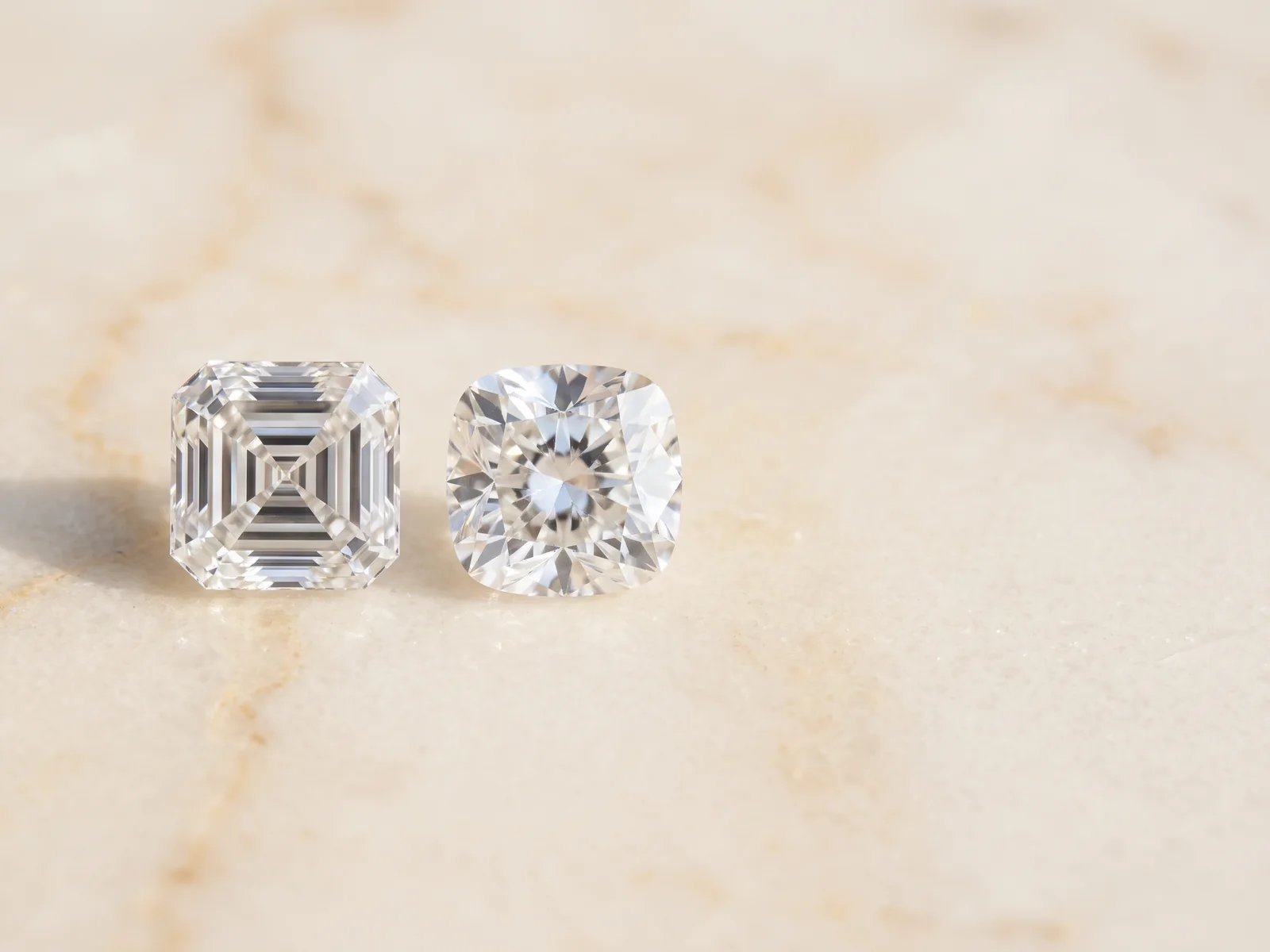
Two diamonds can carry the same colour grade and still look different on the hand. Cushion cut diamond colour is the classic example, and knowing why helps you choose the right grade without paying for whiteness you will never see.
 Reviewed by Raj Sood, Graduate Gemologist (GIA), AJP (GIA)Master jeweller and Graduate Gemologist (GIA) · reviewed 4 November 2026
Quick answer
Cushion cut diamond colour often looks warmer than the same grade in a round because cushions are usually cut deeper, with a smaller table, and light travels further through the stone. Colour also gathers in the rounded corners. In white metal, choose H or better for a white look; in yellow gold, I–K can work, and I–J in rose gold.
What is body colour in a diamond?
Body colour is the faint tint a diamond carries in its crystal, as opposed to the flashes of spectral colour (fire) you see when it moves. In most natural white diamonds that tint is a pale yellow or, less often, brown, and it comes mainly from tiny amounts of nitrogen trapped in the carbon lattice as the crystal grew. The less tint, the rarer the stone and the higher its grade.
GIA and most other labs grade body colour on the D–Z scale. D, E and F are colourless; G, H, I and J are near-colourless; K to M show a faint tint; and further down the scale the yellow becomes obvious. Each step is small. Most people cannot pick a one-grade difference between two loose stones unless they sit side by side under controlled light.
Here is the part that matters for cushions. Labs grade colour with the diamond upside down, looking through the side of the pavilion (the lower half) against a white tray. That view strips out sparkle and shows the true tint. But you wear a diamond face-up, looking down through the table, and face-up colour depends on the shape and the cut as much as on the grade. If any of these terms are new, our glossary of jewellery terms explains them, and the complete cushion cut buying guide covers the shape from every angle.
Why does cushion cut diamond colour show more than a round?
A round brilliant is cut to a tightly studied set of proportions that sends light back out through the top quickly, in short, bright paths. All that white light and contrast tends to wash over a faint tint. A cushion works differently, for four reasons.
- Depth. Many cushions are cut at a total depth of about 61–70%, against roughly 59–63% for a well-cut round. Much of that is because cushion rough is often cut to keep weight. A deeper stone means light travels further through the diamond before it comes back to your eye, and the further it travels, the more of the tint it picks up.
- Smaller table. Cushions often have a smaller table and higher crown. Light is gathered and bent more inside the stone rather than reflected straight back.
- Corners. The four rounded corners are where the stone is thickest relative to its edge and where facets crowd together. Tint collects there, so a warm cushion often looks whiter in the centre and warmer in the corners.
- Larger, broader facets. Classic cushions have fewer, wider facets than a round. Broad flashes show the colour of the stone itself more honestly, where a round's dense scatter of light hides it.
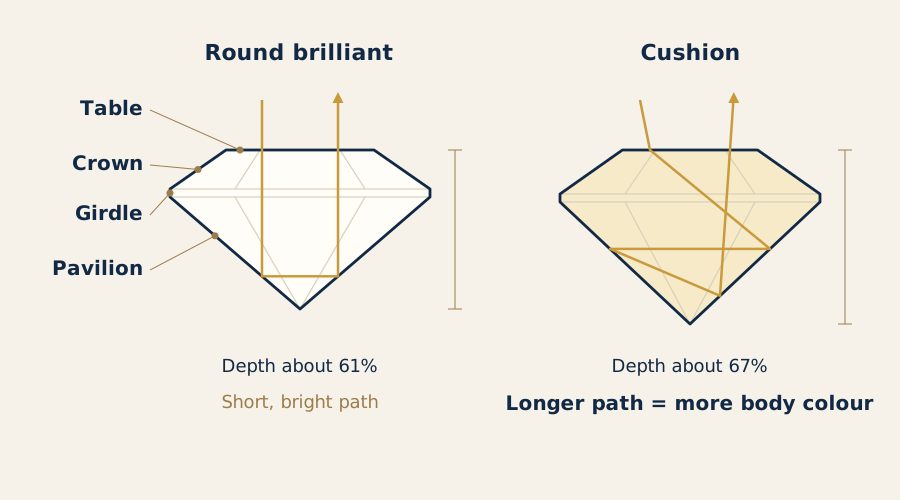
Gemmologists call this the path length effect: the longer the journey through a slightly yellow crystal, the more yellow light reaches your eye. It is the same reason a thick glass of weak cordial looks darker than a thin one. It is also why cushions are the go-to shape for fancy yellow diamonds: the cut that is a slight drawback in a white stone concentrates colour beautifully in a coloured one.
In practice, many gemmologists find a cushion looks about half a grade to a full grade warmer face-up than a round of the same report grade. Our guide to how rounds and cushions differ in sparkle and price puts the two side by side, and the overview of how each diamond shape handles light explains why rounds sit at one end of the colour spectrum and step cuts at the other.
Do crushed ice and chunky cushions show colour differently?
Not every cushion is faceted the same way, and the facet style changes how the tint reads. The grading report usually names the shape as Cushion Brilliant or Cushion Modified Brilliant; the second name usually means an extra row of facets on the pavilion.
| Cushion style | How it looks | How body colour tends to show |
|---|---|---|
| Cushion brilliant (often called chunky or antique style) | Larger, broader facets and bold flashes, a little like an old mine cut | Colour shows in patches, mostly at the corners; the centre often stays brighter |
| Modified brilliant (often called crushed ice) | An extra row of small pavilion facets; a busy, glittery pattern like crushed ice | Colour is spread more evenly across the face, so a warm tint can read across the whole stone |
| Hybrid or mixed patterns | A mix of the two; varies by cutter | Depends on the stone; judge it on video |
| Old mine (antique cushion) | High crown, small table, often an open culet | Warm tones are common and accepted as part of the antique look |
Crushed ice cushion colour is a frequent question. Because the tiny facets mix light inside the stone rather than sending it straight back, many people find crushed ice cushions look slightly warmer overall than chunky cushions of the same grade, and they can also look a little less crisp in larger sizes. Neither style is right or wrong; it comes down to the look you prefer and choosing the colour grade to suit it.
The chunky look has its roots in the antique cuts: our comparison of old mine cuts, the cushion's ancestor shows how the high crown and small table came about. To see where the cushion sits among its square-ish relatives, read about the square and cushion family, from princess to Flanders.
Do elongated cushions show more colour?
Yes, a little. A square cushion has a length-to-width ratio of about 1.00–1.05, while an elongated cushion sits around 1.15–1.30 or more. When a stone is stretched, the two narrow ends act a bit like the corners of a square cushion: light travels further along the length, and tint gathers at the ends. You may see a stone that looks white across the middle and faintly warm at each end.
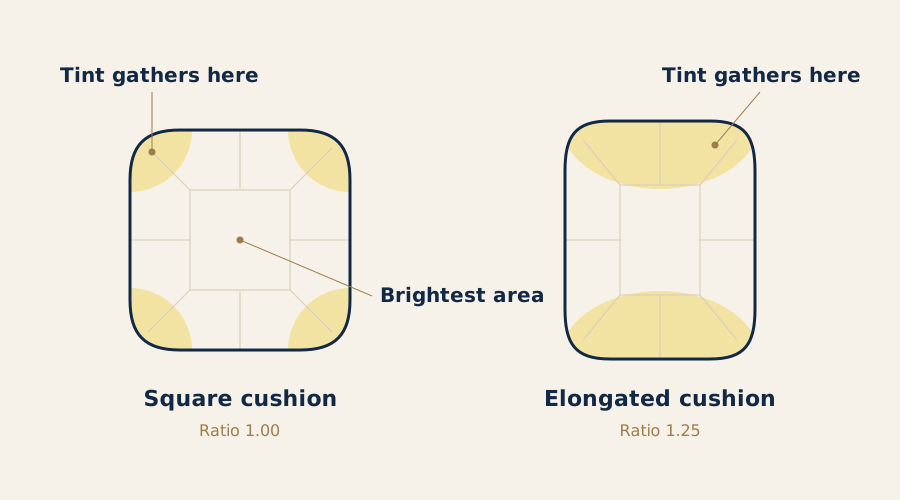
Size makes it more noticeable. In a 0.70 carat cushion the difference is subtle; in a 2 carat stone, which is around 7–7.5 mm across in a square shape, there is simply more diamond for light to travel through, and the warmth becomes easier to see. As a rule of thumb, go one grade higher for a cushion above about 2 carats than you would for a 1 carat stone. It is the same size-versus-appearance question that comes up with other fancy shapes, explained in our guide on how size changes what you see in a fancy shape.
If you are drawn to the longer outline, our page on elongated cushions and their ratios covers the ratios, how they look on different fingers and how they compare with ovals.
Not sure which one is right?
Send us the stones you are looking at and our gemologist will tell you which to choose and why.
What is the best colour grade for a cushion cut diamond?
There is no single best grade; it depends mainly on the metal touching the stone, the size and how sensitive you are to warmth. Here is a practical starting point for a 1 carat cushion.
| Setting | Colour range most people are happy with | Notes |
|---|---|---|
| Platinum or white gold solitaire | G–H | Choose F–G if you are sensitive to warmth or the stone is above 2 ct |
| White gold halo of very white small diamonds | G or better | A white halo can make a warmer centre look warmer by contrast |
| Yellow gold | I–K | Yellow metal reflects into the stone and makes warmth look natural |
| Rose gold | I–J | Pink metal masks a faint yellow tint well |
| Two-tone (white claws on a yellow band) | H–I | White claws keep the stone looking white from above |
Fluorescence is worth a mention. Some natural diamonds glow blue under ultraviolet light, which is present in daylight. In the I–K range, faint to medium blue fluorescence can make a cushion look a touch whiter face-up outdoors and often lowers the price. Very strong fluorescence occasionally gives a slightly hazy look, so check a video in daylight before choosing a stone with it.
Clarity and colour interact too. A crushed ice cushion hides small inclusions well, so you can often choose an eye-clean SI1 and put the saving into colour instead. The trade-offs between the cushion brilliant and modified styles are set out in our guide to choosing between cushion brilliant and modified cushions.
How does cushion colour compare with radiant, Asscher, round and oval?
| Cushion | Round | Radiant | Asscher | Oval | |
|---|---|---|---|---|---|
| Typical total depth | 61–70% | 59–63% | 61–68% | 60–68% | 58–63% |
| How much body colour shows | More | Least | More | Most (step cut) | Moderate |
| Where tint gathers | Corners | Spread evenly, hard to see | Corners | Across the open table | The two ends |
| Usual starting grade in white metal | G–H | H–I | G–H | F–G | G–H |
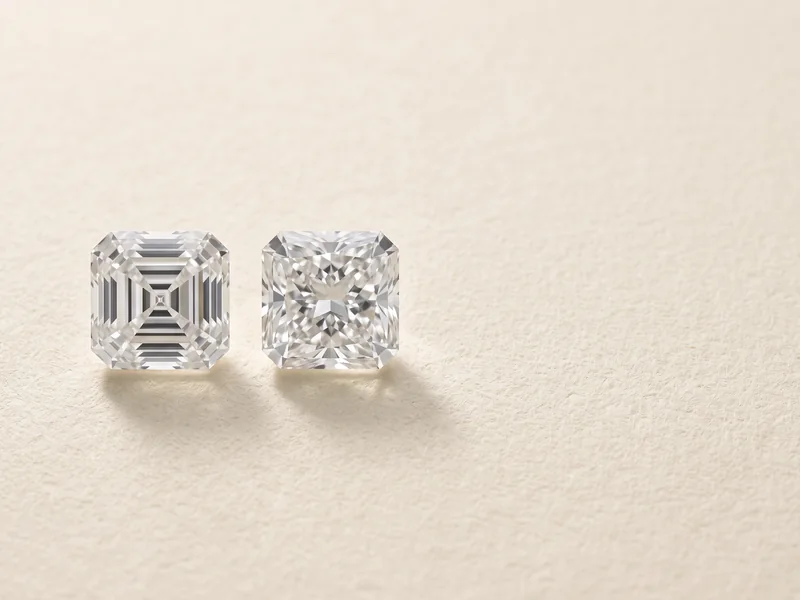
Rounds are the most forgiving shape for colour; step cuts like the Asscher, with their large open table and long parallel facets, are the least forgiving. Cushions and radiants sit in between. The radiant is the cushion's closest rival here: it also has cut corners and a deep pavilion, but its sharper, more brilliant pattern can hide tint slightly better. See radiant vs cushion side by side for the full comparison, and the Asscher vs cushion comparison if you are weighing a step cut.
Ovals behave a lot like elongated cushions, with warmth showing at the two narrow ends; our guide to oval diamonds and their bow-tie and colour quirks explains why. If the whitest possible look matters more to you than the soft cushion outline, a round is the safer choice; our page on round or cushion for a whiter look weighs up what you gain and give up.
Related guideRadiant vs Cushion Cut DiamondsCushion cut diamond colour in yellow gold, rose gold and platinum: what works?
The metal around a diamond reflects into it. White metals keep a white stone looking white but make any warmth stand out by contrast. Yellow gold does the opposite: it adds warmth to everything, so a J cushion in yellow gold can look as white to most eyes as an H cushion would in platinum, and a D colour stone in yellow gold will pick up some warmth anyway.
A popular middle path is a white gold or platinum head (the claws and basket holding the stone) on a yellow or rose gold band. The stone sees white metal from above, while the hand sees warm gold. Halos need thought too: a halo of very white small diamonds around a warm centre makes the centre look warmer, so match the halo colour to the centre, or choose a slightly higher centre grade. Our guide to settings that suit a cushion centre stone shows these options in practice, from halos and bezels to classic claw solitaires.
Do lab-grown cushion diamonds show colour the same way?
Yes. A laboratory-grown diamond is real diamond with the same refractive index (about 2.42) and hardness (10 on the Mohs scale) as a natural one, so a deep lab-grown cushion carries any tint in exactly the same way. What differs is the kind of tint. Lab-grown cushion cut diamond colour is usually in the D–H range, because growers can control nitrogen, but the tint you do see may be faintly brown or grey rather than yellow. Some lab-grown diamonds are also treated after growth to improve colour, and the grading report should say so.
Lab-grown diamonds cost much less than natural diamonds, so many buyers choose a higher colour grade in lab-grown than they would in natural. With natural cushions, the price difference between grades is larger, and choosing the right grade for your metal is where the real value lies. Cushions in general usually cost noticeably less per carat than rounds of the same grades; our comparison of price per carat across diamond shapes sets out the pattern.
| 1 ct cushion, VS2 clarity | Approximate price range (AUD) |
|---|---|
| Natural, F–G | about $7,000–$13,000 |
| Natural, H–I | about $5,000–$9,000 |
| Natural, J–K | about $3,500–$6,500 |
| Lab-grown, D–G | about $800–$2,500 |
These are broad ranges only and move with the market, the exact grades and the cut quality. Always check the report states clearly whether a diamond is natural or lab-grown.
Browse cushion diamonds: natural and lab-grown
How do you check a cushion diamond's colour before you choose? Step by step
- Read the report. Note the colour grade, fluorescence, depth percentage and table, and whether the stone is natural or lab-grown.
- Check the depth. A cushion much deeper than about 70% will usually look warmer and smaller face-up for its weight; see which shapes face up largest for their carat weight.
- Decide your metal first. Choose the colour range from the metal table: G–H for white metal, I–K for yellow gold, I–J for rose gold.
- Watch a face-up video. Look at the corners (or the ends of an elongated cushion) and see whether the tint is even or concentrated.
- Compare on white. If you can, view the stone face-up on a white card in daylight beside a known grade.
- Weigh fluorescence. In I–K stones, faint to medium blue can help; check strong fluorescence for haziness.
- Plan the setting. Match halo diamonds to the centre stone, or consider white claws on a gold band. Unsure of a report term? Look up definitions of fluorescence and other report terms.
Free consultation
Talk to a gemologist
Compare stones in person or online with Raj Sood, Graduate Gemologist (GIA), AJP (GIA).
Book a consultationFAQ
Common questions
Why do cushion cut diamonds look yellow?
Cushions are often cut deeper than rounds, with a smaller table, so light travels further through the stone and picks up more of its natural tint. The tint tends to gather in the corners, which is why a cushion can look warmer than a round of the same grade.
What colour should a cushion cut diamond be in white gold?
Most people are happy with G–H in white gold or platinum. If you are sensitive to warmth, or the stone is over about 2 carats, consider F–G.
Is an H colour cushion cut diamond good?
For most people an H cushion looks white face-up in white metal, especially under 2 carats. In yellow or rose gold you can usually go lower without seeing a difference.
Does a crushed ice cushion show more colour?
Often slightly, because the extra small facets mix light inside the stone and spread any tint across the whole face. A chunky cushion tends to show colour mostly at the corners instead.
Do lab-grown cushion diamonds have a yellow tint?
Most lab-grown cushions are graded D–H, so a yellow tint is uncommon, though some show a faint brown or grey. The report will state that the stone is lab-grown and whether its colour has been treated after growth.
Can I choose a lower colour grade for a cushion in yellow gold?
Yes. Yellow gold reflects warmth into the stone, so an I–K cushion usually looks white to most eyes in a yellow gold setting.

Ask a gemologist
Not sure which diamond to choose?
Raj Sood is a Graduate Gemologist (GIA) and master jeweller. Bring the stones you are considering, or send the reports, and he will tell you honestly which one is better and why.
Keep learning
Related guides
 Diamond ShapesCushion Cut Diamonds: Brilliant, Modified & Buying GuideDiamond ShapesElongated Cushion Cut Diamonds
 Engagement Rings & SettingsBest Settings for Cushion DiamondsDiamond ShapesRound vs Cushion Cut DiamondsDiamond ShapesUnderstanding Diamond ShapesDiamond ShapesRadiant vs Cushion Cut Diamonds
 Diamond ShapesSquare and Cushion Cuts: Princess, Radiant, Cushion and FlandersDiamond ShapesAsscher vs Cushion Cut Diamonds
Explore more
More guides on this topic
Education