
- Education
- Diamond Shapes
- Cushion Modified Diamond Guide: Crushed Ice Cut, Ratio, Colour and Settings
Diamond shapes
Cushion Modified Diamond Guide: Crushed Ice Cut, Ratio, Colour and Settings
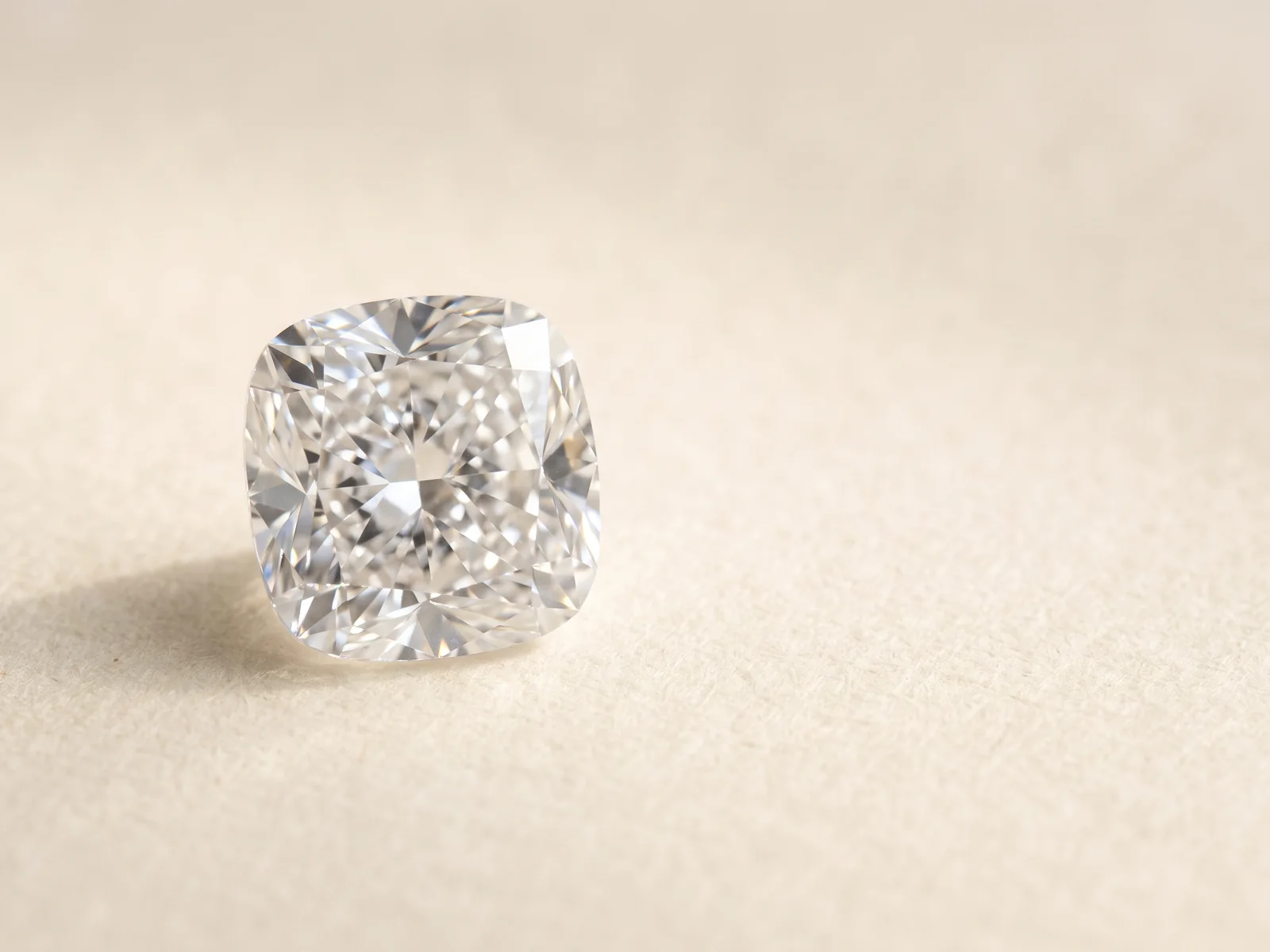
A cushion modified diamond is the version of the cushion most people see in shops today, and it sparkles very differently from an antique-style cushion. Here is how to tell the patterns apart and what to check before you choose one.
 Reviewed by Raj Sood, Graduate Gemologist (GIA), AJP (GIA)Master jeweller and Graduate Gemologist (GIA) · reviewed 4 November 2026
Quick answer
A cushion modified diamond is a cushion cut with an extra row of pavilion facets, which breaks light into many small flashes known as crushed ice. Look for a ratio of 1.00–1.05 for a square or 1.15–1.30 for an elongated stone, a depth of about 61–68%, and an eye-clean stone in a colour suited to the metal.
What is a cushion modified diamond?
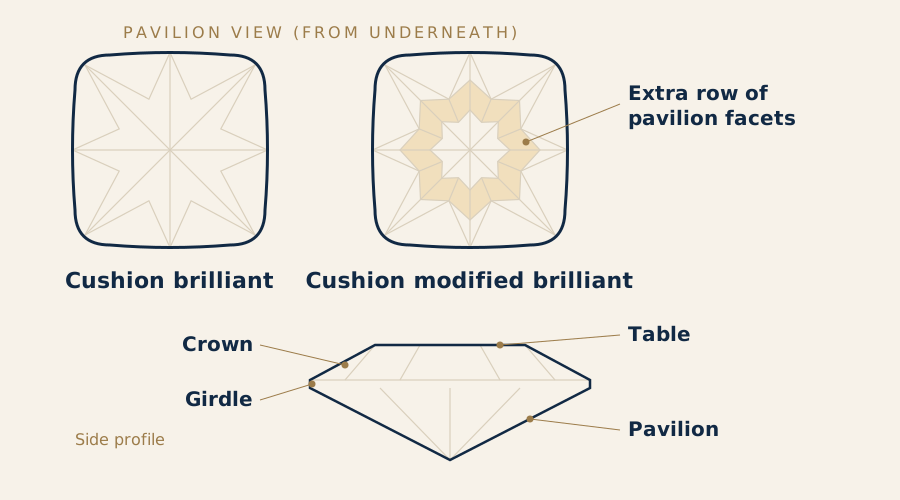
A cushion modified diamond is a cushion cut with an extra row of facets on the pavilion (the lower, pointed half of the stone, below the girdle). GIA grading reports call it a cushion modified brilliant, to separate it from the plain cushion brilliant, which has a simpler pavilion with fewer, broader facets. Both share the same outline: a square or rectangle with rounded corners and softly curved sides, like a pillow. Our full cushion cut buying guide covers both versions; this page focuses on the modified one.
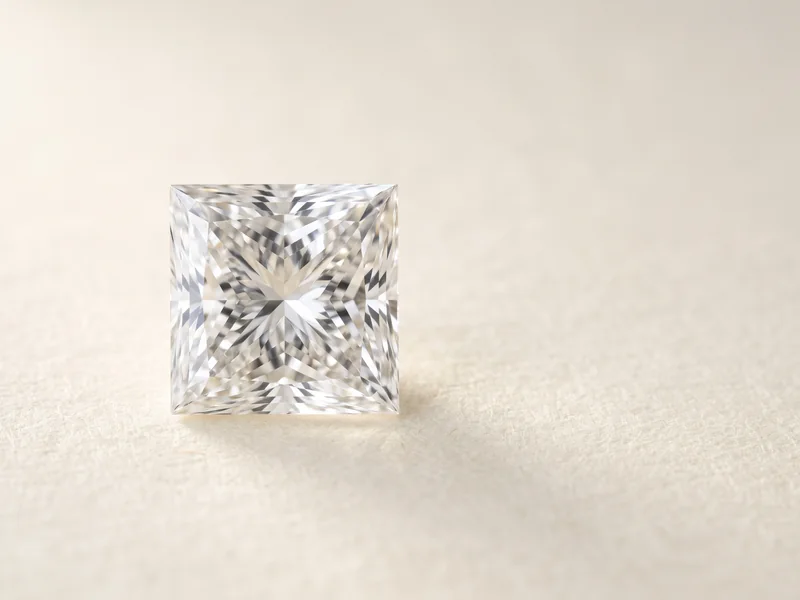
That extra row of facets is what gives many cushion modified diamonds the crushed ice look: a scatter of small, needle-like flashes across the whole stone, rather than the larger, blockier flashes of an antique-style cushion. People in the trade compare it to shaved ice or glitter in a glass of water. Facet counts vary from cutter to cutter, but a cushion brilliant usually has somewhere around 58–64 facets, and a modified cushion adds more on the pavilion, often taking the total into the 60s or 70s.
Diamond is 10 on the Mohs hardness scale, with a refractive index of about 2.42 and a dispersion (the splitting of white light into colours) of about 0.044. The cushion's rounded corners are a real practical advantage here: diamond can still chip along its cleavage planes if a thin edge takes a knock, and a cushion has no sharp corners or points to expose. That makes it one of the more forgiving fancy shapes for everyday wear.
The cushion belongs to the square and cushion family alongside princess, radiant and Flanders, and you will find it among every one of the 34 diamond cuts compared on our site. If any term on this page is new to you, our plain-English jewellery glossary explains it.
Crushed ice vs chunky cushion: what is the difference?
Cushions fall into three broad facet patterns. The name on the report only tells you part of the story, because the same cushion modified brilliant label can cover both a full crushed ice stone and a hybrid that sits between the two looks.
| Cushion brilliant (chunky) | Cushion modified: hybrid | Cushion modified: crushed ice | |
|---|---|---|---|
| Pavilion facets | Fewer, broad mains | Mains plus some extra facets | Extra row of small facets |
| Flash size | Large, bold flashes | Medium, mixed flashes | Many small, pinpoint flashes |
| Face-up look | Clear pattern, a little like an old mine cut | Defined pattern with more glitter | Soft glitter with little visible pattern |
| Hides small inclusions | Less well | Well | Very well |
| Shows body colour | Less | Moderate | More |
| GIA report wording | Cushion brilliant | Cushion modified brilliant | Cushion modified brilliant |
Neither pattern is better; they suit different eyes. Chunky cushions read as bolder and more vintage, with flashes you can see from across the room. A crushed ice cushion looks busier and softer, with a constant fizz of light, and many people find it looks bright even in dull indoor lighting. Our side-by-side photos of chunky and crushed ice cushions show the difference better than any description. You will see the same crushed ice effect in radiant cuts too, since radiants use a similar pavilion approach.
The chunky look is the older one. The cushion descends from the old mine cut, a hand-cut shape of the 18th and 19th centuries with a high crown, a small table and broad facets. Our page on how the modern cushion grew out of the old mine cut traces that history. The extra-facet cushion modified is a much more modern development, driven by cutters wanting more brightness and more weight kept from the rough crystal.
Related guideCushion Diamond Chunky Facets vs Crushed IceWhat is the best length-to-width ratio for a cushion modified diamond?
The length-to-width ratio compares the longer side of the stone with the shorter side. Divide the length by the width from the measurements on the grading report. A ratio of 1.00 is a perfect square; a higher number means a more rectangular stone.
| Ratio | How it looks | Suits |
|---|---|---|
| 1.00–1.05 | Square to the eye | Classic square solitaires and halos |
| 1.05–1.15 | Slightly rectangular, can look like a slightly off square | A matter of taste; check it looks intentional |
| 1.15–1.30 | Clearly elongated, the popular rectangular cushion | Lengthening the look of the finger |
| Above 1.30 | Long and narrow | East-west settings and distinctive looks |
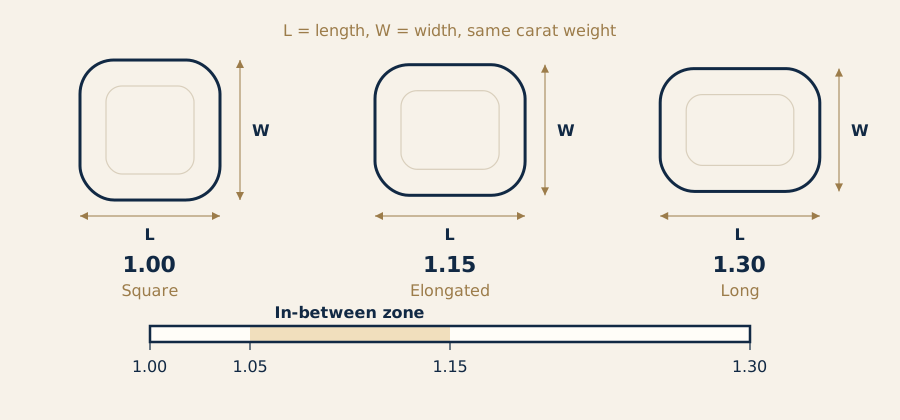
The awkward zone is roughly 1.05–1.15: the stone is not square enough to read as square, and not long enough to read as rectangular. If you like the longer shape, our guide to rectangular, elongated cushion shapes goes into ratios above 1.15 in detail. Elongated crushed ice cushions can also show a faint bow-tie (a dark band across the middle where light leaks out); watch for one that stays dark as the stone moves.
GIA does not give cushions an overall cut grade the way it does for rounds, so you judge the cut from proportions and appearance. As a rough guide, many well-cut cushion modified diamonds sit at a total depth of about 61–68% and a table (the flat top facet) of about 55–65% of the width, with a thin to slightly thick girdle and no culet or a very small one. Our cushion proportions chart with depth and table ranges lays these out by look.
How big does a cushion modified diamond look for its carat weight?
Cushions face up smaller than most shapes of the same weight, because they are often cut deep to keep weight from the rough crystal. A cushion modified at 72% depth carries a lot of weight in its pavilion that you cannot see from above. Cutters call this hidden weight: you pay for carats that do not add to the face-up size (the size you see looking down at the ring). Our article on why deep cushions carry hidden weight shows how much difference a few percent of depth makes.
| Carat weight | Typical square cushion (width × length) |
|---|---|
| 0.50 ct | about 4.6 × 4.6 mm |
| 0.75 ct | about 5.1 × 5.1 mm |
| 1.00 ct | about 5.5 × 5.5 mm |
| 1.50 ct | about 6.4 × 6.4 mm |
| 2.00 ct | about 7.0 × 7.0 mm |
| 3.00 ct | about 8.0 × 8.0 mm |
These are typical figures for a square stone at around 64–66% depth; deeper stones will measure smaller. An elongated 1 ct cushion modified at about 1.20 ratio is typically around 6.3 × 5.2 mm. By comparison, a 1 ct round brilliant measures about 6.4 mm across, so a square cushion of the same weight looks noticeably smaller face-up. When you compare stones, compare the millimetre measurements on the report, not just the carat weight.
Not sure which one is right?
Send us the stones you are looking at and our gemologist will tell you which to choose and why.
What colour and clarity should you choose for a crushed ice cushion?
Crushed ice cushions tend to show more body colour (the faint natural yellow or brown tint in a white diamond) than rounds. The many small facets and the deep pavilion keep light travelling longer inside the stone, and the corners collect warmth. Our explanation of why cushions hold more body colour than rounds goes into the optics. In white gold or platinum, most people are comfortable from G colour or better in a crushed ice stone, compared with H in many rounds. In yellow or rose gold, H to I usually looks white against the warm metal.
That same colour-holding quality is why the cushion modified is a popular cut for fancy coloured diamonds, such as yellows and pinks. A cutter can deepen the apparent colour by choosing this pattern, so a fancy yellow cushion can often reach a stronger colour grade than a round cut from similar rough.
Clarity is where crushed ice helps you. The busy pattern breaks up the view through the stone and hides small inclusions (internal features) well, so many VS2 and SI1 stones, and some SI2 stones, are eye-clean: no inclusions visible without magnification at normal viewing distance. Do check the plotting diagram on the report for anything near the corners or girdle, where a claw may sit.
- White metal: F–G colour, VS2–SI1 eye-clean.
- Yellow or rose gold: H–I colour, VS2–SI1 eye-clean, some SI2 stones work.
- Watch for: a foggy or slushy look in very crushed ice stones, where the flashes blur into a grey haze rather than separate points of light.
- Avoid: large feathers (small internal cracks) reaching the surface near a corner.
What is the best setting for a cushion modified diamond ring?
Because a cushion has rounded corners and no points, you have more freedom with the setting than with a princess or pear. The common choices for a cushion modified diamond ring:
- Four claws: one at each corner, the classic solitaire. Double claws (two small claws at each corner) look finer and add security.
- Halo: a ring of small diamonds around the centre stone. Cushions and halos are a long-standing pairing, and a halo makes a compact square cushion look larger.
- Hidden halo: small diamonds set under the centre stone, visible from the side only.
- Bezel: a thin rim of metal around the edge; very secure and low-profile, though it hides a little of the outline.
- Three-stone: trapezoid, half-moon or smaller cushion side stones either side of the centre.
- East-west: an elongated cushion set sideways across the finger, for a more unusual look.
For the wedding band, a solitaire on a low basket usually lets a straight band sit flush against it. A halo or a wide cushion often needs a slight gap, a contoured band or a setting designed with the band in mind from the start. See our cushion setting styles with examples for photos of each option.
How does a cushion modified compare with radiant, princess and round diamonds?
| Cushion modified | Cushion brilliant | Radiant | Princess | Round | |
|---|---|---|---|---|---|
| Outline | Square or rectangle, rounded corners | Square or rectangle, rounded corners | Square or rectangle, cut corners | Square, sharp corners | Circle |
| Facet look | Crushed ice or hybrid | Chunky, bold flashes | Crushed ice or hybrid | Brilliant, cross pattern | Brilliant, arrows pattern |
| Typical depth | 61–68%, often deeper | 60–68% | 61–67% | 68–75% | 59–63% |
| Face-up size per carat | Smaller | Smaller | Moderate | Smaller | Larger |
| Vulnerable edges | None | None | Few | Four sharp corners | None |
| Price per carat | Usually well below a round | Similar to modified | Usually below a round | Usually below a round | Highest |
The closest relative is the radiant, which uses a similar pavilion but has cut corners instead of rounded ones; see our radiant vs cushion comparison and the square radiant, the cushion's closest cousin with cut corners. If you are weighing up classic sparkle, read round and cushion compared for sparkle and price.
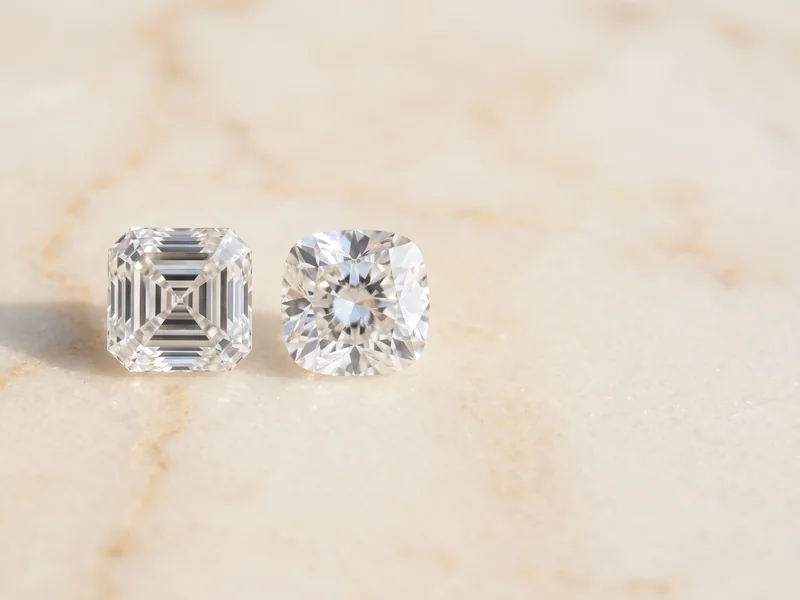
For something crisper, the step-cut Asscher against the cushion shows a hall-of-mirrors look with no glitter at all, while princess cut diamonds with sharp corners give a more modern, geometric square. To see every shape in one place, start with our introduction to diamond shapes.
How much does a cushion modified diamond cost in Australia?
Cushion modified diamonds are cut from both natural and laboratory-grown diamond, and the two look identical to the eye. A lab-grown diamond is real diamond, grown in a laboratory rather than mined, with the same hardness and refractive index; it costs much less and larger sizes are easy to find. Natural cushions are rarer. Both should come with an independent grading report from a lab such as GIA or IGI, and the report must state whether the stone is natural or lab-grown.
| Cushion modified, G–H, VS | Approximate price range (AUD) |
|---|---|
| 1 ct lab-grown | about $800–$2,500 |
| 1 ct natural | about $5,000–$12,000 |
| 2 ct lab-grown | about $1,800–$5,000 |
| 2 ct natural | about $15,000–$40,000 |
These are broad ranges only; prices move with the market and with the exact grades. A cushion usually costs less per carat than a round of the same weight, colour and clarity, because more of the rough crystal can be kept and demand is lower. Within cushions, a deeper stone may look cheaper per carat but give you less face-up size, so compare price against millimetres as well as carats. Crushed ice and chunky cushions of similar grades are generally priced in the same range.
Browse cushion modified diamonds: natural and lab-grown
How do you choose a cushion modified diamond? Step by step
- Read the report. Confirm cushion modified brilliant, the measurements, colour, clarity, polish and symmetry, and whether the stone is natural or lab-grown.
- Work out the ratio. Divide length by width; choose about 1.00–1.05 for a square or 1.15–1.30 for a rectangle.
- Check the depth. Aim for roughly 61–68%; above about 70% means hidden weight and a smaller face-up size.
- Decide on the pattern. Watch a 360° video and decide whether you prefer crushed ice, hybrid or chunky flashes.
- Match colour to metal. F–G in white metal, H–I in yellow or rose gold, and check the corners for warmth.
- Confirm it is eye-clean. Look at the plotting diagram and the video for anything near a corner.
- Plan the setting and band together. Choose claws, halo or bezel, and check how the wedding band will sit.
Free consultation
Talk to a gemologist
Compare stones in person or online with Raj Sood, Graduate Gemologist (GIA), AJP (GIA).
Book a consultationFAQ
Common questions
What is the difference between a cushion brilliant and a cushion modified brilliant?
A cushion modified brilliant has an extra row of facets on the pavilion, which usually gives smaller, glittering flashes. A cushion brilliant has fewer, broader pavilion facets and a bolder, chunkier look.
Is every cushion modified diamond crushed ice?
No. The same report name covers full crushed ice stones and hybrids with a more defined pattern. Watch a video to see which look a particular stone has.
Do crushed ice cushions hide inclusions?
Yes, the busy facet pattern hides small inclusions well, so many VS2 and SI1 stones look clean to the eye. Check the corners and girdle, where an inclusion is easier to spot or may sit under a claw.
Why does a cushion modified diamond look smaller than a round?
Cushions are often cut deep, so more of the weight sits in the pavilion where you cannot see it. A 1 ct square cushion is typically about 5.5 mm wide, against about 6.4 mm for a 1 ct round.
What colour should I choose for a crushed ice cushion?
Crushed ice cushions show body colour more than rounds, so in white gold or platinum many people choose G or better. In yellow or rose gold, H to I usually looks white.
Can you get a lab-grown cushion modified diamond?
Yes. Lab-grown cushion modified diamonds are widely available, cost much less than natural ones and are real diamond, graded by labs such as IGI and GIA.

Ask a gemologist
Not sure which diamond to choose?
Raj Sood is a Graduate Gemologist (GIA) and master jeweller. Bring the stones you are considering, or send the reports, and he will tell you honestly which one is better and why.
Keep learning
Related guides
 Diamond ShapesCushion Cut Diamonds: Brilliant, Modified & Buying GuideDiamond ShapesCushion Diamond Chunky Facets vs Crushed Ice
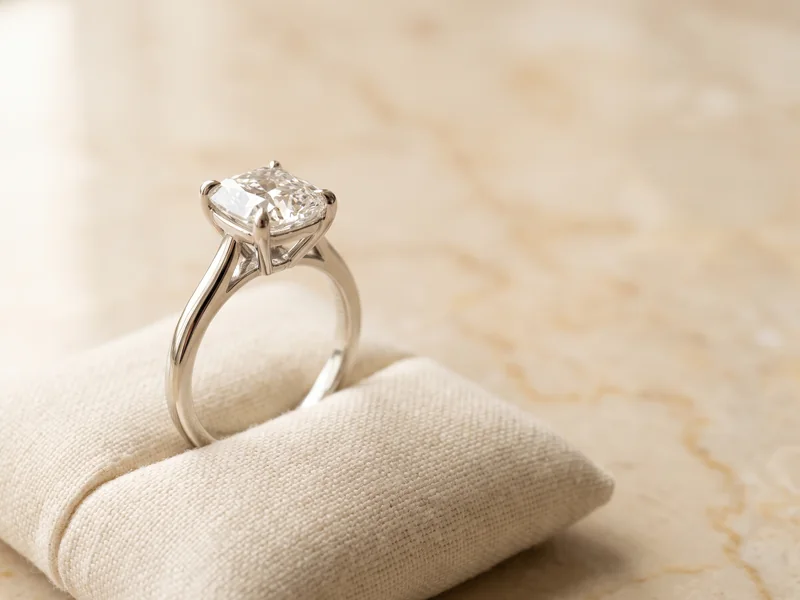 Engagement Rings & SettingsBest Settings for Cushion Diamonds
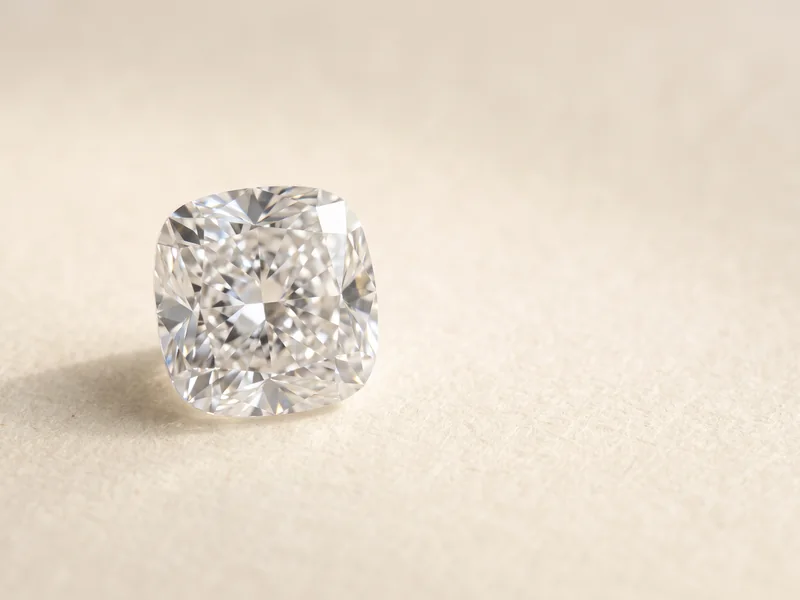 Diamond Anatomy & LightIdeal Proportions Chart: Cushion DiamondsDiamond ShapesUnderstanding Diamond Shapes
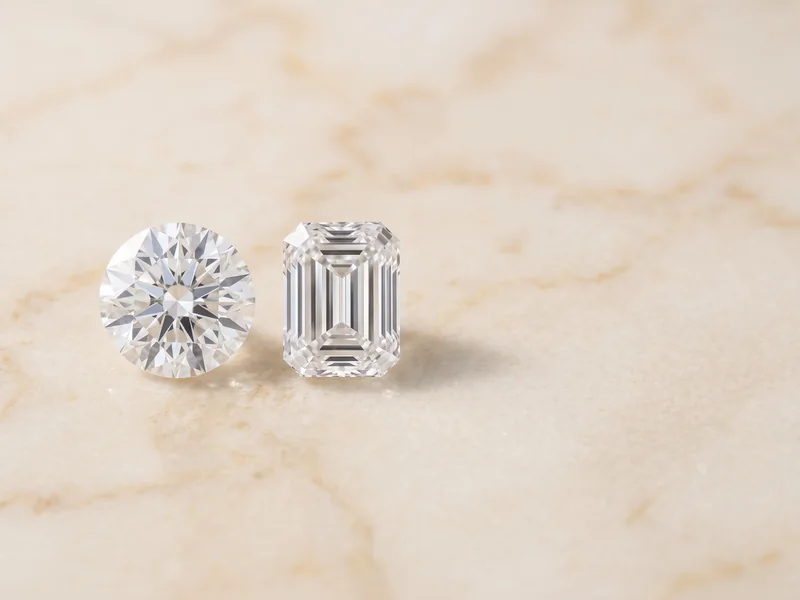 Diamond ShapesAll 34 Diamond Cuts: Every Shape Explained and Compared
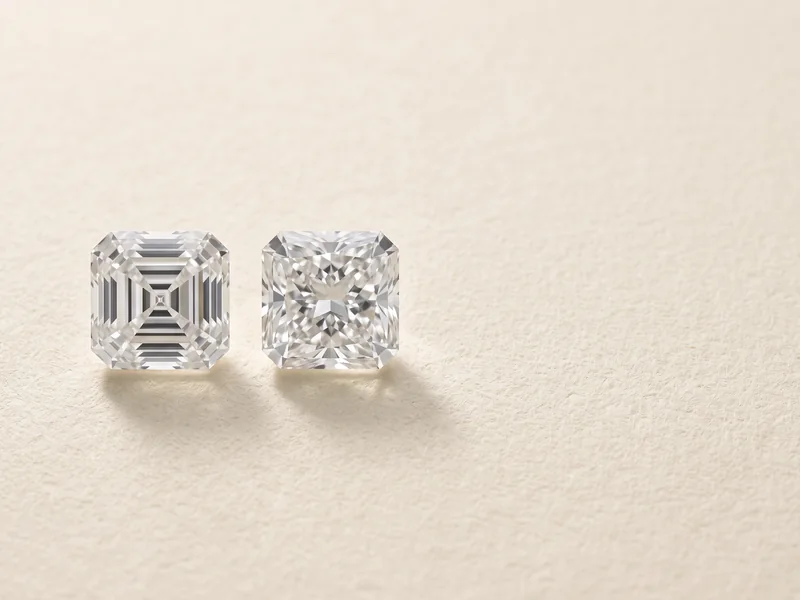 Diamond ShapesSquare and Cushion Cuts: Princess, Radiant, Cushion and Flanders
 Diamond ShapesPrincess Cut Diamonds
Explore more
More guides on this topic
Education