
- Education
- Diamond Shapes
- Chunky vs Crushed Ice Cushion Diamonds: How to Tell Them Apart and Choose
Diamond shapes
Chunky vs Crushed Ice Cushion Diamonds: How to Tell Them Apart and Choose
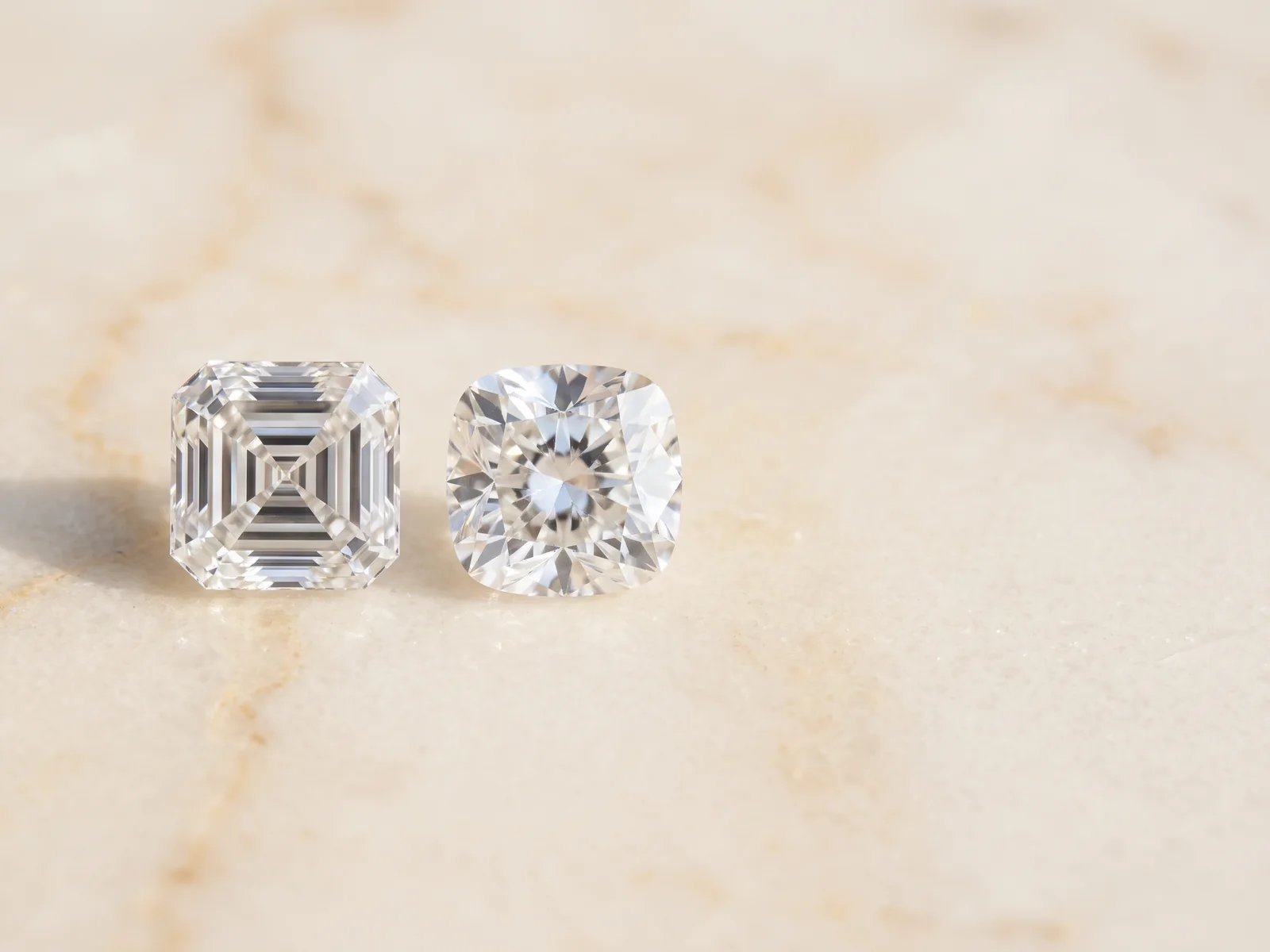
Two cushion diamonds with identical grades can look completely different: one throws big, bold flashes, the other glitters like crushed ice. Here is how the chunky vs crushed ice cushion difference works, how to spot it and which one suits you.
 Reviewed by Raj Sood, Graduate Gemologist (GIA), AJP (GIA)Master jeweller and Graduate Gemologist (GIA) · reviewed 4 November 2026
Quick answer
In the chunky vs crushed ice cushion choice, chunky cushions have larger, broader pavilion facets that throw bold flashes of light, like an old mine cut. Crushed ice cushions have an extra row of small facets that break light into glittery sparkle. Neither is better; check a 360° video, because the report name does not always predict the look.
Chunky vs crushed ice cushion: what is the difference?
A cushion cut is a square or rectangular diamond with softly rounded corners and gently curved sides, a little like a pillow. Underneath that outline, cutters use two quite different ways of arranging the facets (the small flat polished surfaces). The result is two looks that share a name but not a personality. If you are new to the shape itself, start with our complete cushion cut buying guide and come back here for the facet detail.
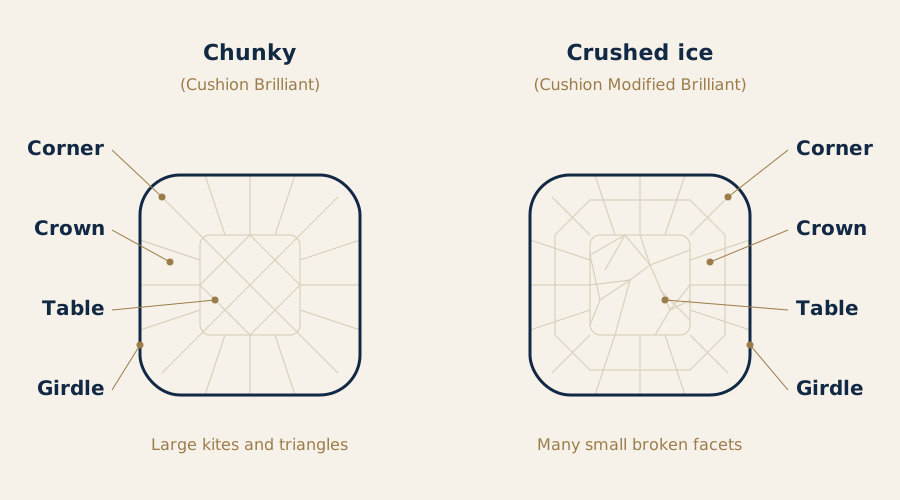
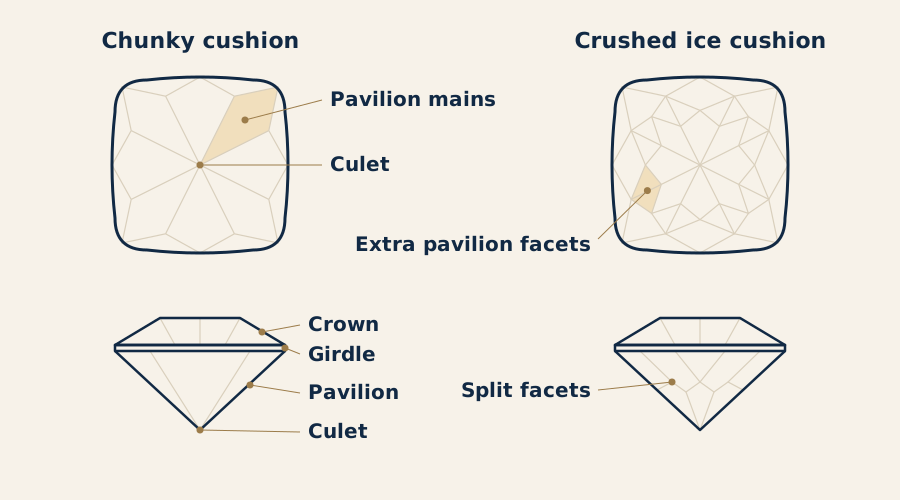
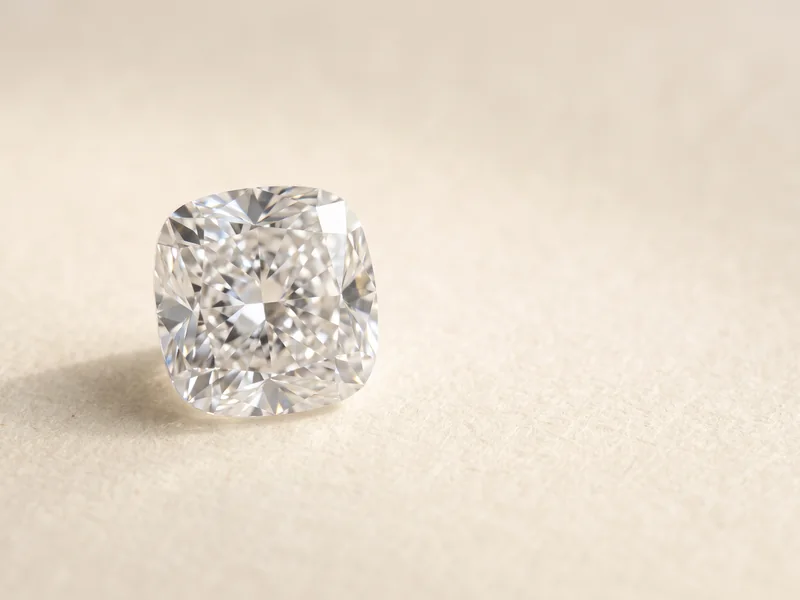
Chunky cushions, often called antique-style cushions, have fewer, larger facets on the pavilion (the lower, pointed part of the diamond). Each facet is big enough to act like a small mirror, so the stone returns broad, distinct flashes of white light and darker contrast. Look down through the table (the large flat top facet) and you can usually pick out individual kite and triangle shapes.
Crushed ice cushions add an extra row of small facets on the pavilion, splitting the big mirrors into many little ones. Light is broken into fine, scattered pinpoints, so the centre of the stone looks like a glass of crushed ice or glitter rather than a clear pattern. Any facet word you have not met before is explained in our plain-English jewellery glossary.
| Chunky (antique-style) | Crushed ice | |
|---|---|---|
| Pavilion facets | Fewer, larger mains | Extra row of small facets |
| Sparkle | Bold, distinct flashes with clear contrast | Fine, glittery pinpoints |
| Pattern under the table | Visible kites, triangles and arrows | Busy, mosaic-like, no clear pattern |
| Resembles | Old mine cut | Radiant cut with a softer outline |
| Shows inclusions | More easily, through the large facets | Less easily; the glitter disguises them |
| Shows body colour | Usually less | Usually more; the pattern holds colour |
| Common GIA name | Cushion Brilliant | Cushion Modified Brilliant |
Why do cushion diamonds have two facet patterns?
The chunky look is the older one. The cushion grew out of the old mine cut, a squarish, hand-cut diamond common from the 1700s to the late 1800s, with a high crown, a small table, a tall pavilion and often a visible culet (a tiny flat facet at the bottom). Those stones were made to be worn by candlelight, and their large facets made broad, lively flashes in soft light. Today's chunky cushions keep that big-facet character with modern precision and symmetry. Our page on how antique cuts evolved into the modern round brilliant traces the same family tree.
The crushed ice pattern came later, as cutters borrowed ideas from modern brilliant and radiant cutting. Adding facets to the pavilion lets a cutter keep more weight from a rough crystal, hide small inclusions and push light around in a busier pattern. It also suits coloured diamonds: fancy yellow cushions, for example, are very often cut with a crushed ice pavilion, because the extra facets help hold and spread the colour across the face of the stone.
Neither pattern is a modern improvement on the other. They are simply two ways of handling light. To see where the cushion sits among the other cuts, read how every diamond shape developed or browse the full list of 34 diamond cuts, and for the most common head-to-head decision, see how cushions compare with round brilliants.
Diamond itself does not change between the two. It is 10 on the Mohs hardness scale, with a refractive index of about 2.42 and a dispersion (the splitting of light into rainbow colours, often called fire) of about 0.044. The facet pattern decides how that light comes back to your eye: as a few large flashes of white and colour, or as many small ones.
How can you tell a chunky cushion from a crushed ice one?
This is where most people get caught. The grading report gives a shape name, and GIA uses two for cushions: Cushion Brilliant and Cushion Modified Brilliant. In broad terms, a cushion brilliant has the classic 58-facet layout, with large pavilion mains, and is more likely to look chunky. A cushion modified brilliant has extra pavilion facets and is more likely to look crushed ice.
But the name describes the facet arrangement on paper, not how the stone actually looks. Plenty of cushion modified brilliants show a chunky, defined pattern, and some cushion brilliants look fairly busy. Many stones are hybrids: chunky in the centre with crushed ice towards the corners, or the reverse. So the report is a starting point, never the final answer. Our guide to cushion modified brilliant naming and looks goes further into the detail.
- Look under the table: in a still photo or paused video, can you trace distinct kite, triangle or arrow shapes? That points to chunky. A scattered, sugary mosaic points to crushed ice.
- Count the flashes: as the stone rocks, chunky cushions switch between a few large bright and dark areas. Crushed ice twinkles everywhere at once in small points.
- Check the corners: some cushions show a crisp chunky pattern in the middle but a busier crushed ice look at the corners. That is a hybrid.
- Ask for the pavilion view: a photo from the side or underneath shows the main facets running to the culet. Long, unbroken mains mean chunky; split, stepped facets mean crushed ice.
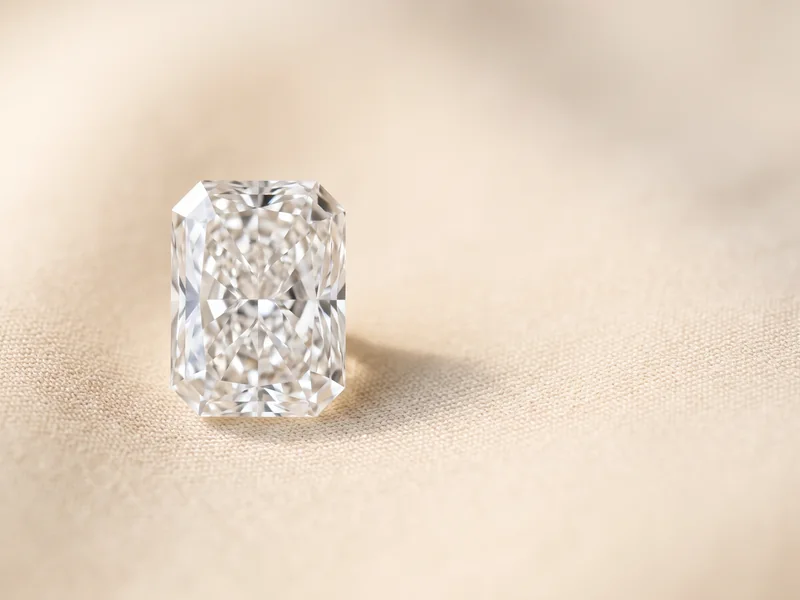
Radiant cuts face exactly the same question, and the checks are almost identical. If you are weighing up both shapes, read the same crushed ice debate in radiant cuts.
Does a crushed ice cushion hide inclusions or show more colour?
Usually both, which is the main practical trade-off. The small, busy facets of a crushed ice cushion scatter light so thoroughly that small inclusions (internal features such as crystals or feathers) are hard to pick out. The same busy pattern tends to hold and spread body colour, so a slightly warm stone can look a touch warmer than it would as a chunky cushion.
A chunky cushion works the other way. Its large facets are like windows, so you can see further into the stone and inclusions are easier to spot. On the other hand, the bold white flashes tend to mask a faint warm tint a little better. This is similar to the difference between step cuts and brilliant cuts, covered in our Asscher vs cushion comparison, although a chunky cushion is still a brilliant style and far more forgiving than an Asscher.
- Chunky, white metal: about G–H colour; VS2 or better, or a carefully checked SI1.
- Crushed ice, white metal: about F–G colour if you are sensitive to warmth; SI1, and sometimes SI2, can be eye-clean.
- Either pattern in yellow or rose gold: I–J colour can look white against the warm metal.
- Always: check that any inclusion near a corner does not reach the surface, and that the stone is eye-clean (no inclusions visible without magnification at normal viewing distance).
Crushed ice cushions in larger sizes, roughly 2 carats and up, can sometimes look a little soft or foggy in the centre, because the facets are so small that the pattern loses definition. That is not a flaw on the report; it is a matter of taste, and a video will show it straight away.
Not sure which one is right?
Send us the stones you are looking at and our gemologist will tell you which to choose and why.
Which looks bigger: a chunky or crushed ice cushion?
The facet pattern does not change the face-up size (the size you see from above). That is decided by the carat weight, the depth and the outline. Cushions are generally cut deeper than rounds, often with a total depth around 61–68% and a table around 55–68% of the width, so they carry more weight underneath and look a little smaller per carat than a round of the same weight. Our comparison of which shapes look biggest for their carat weight puts the numbers side by side.
| Carat weight | Typical square cushion size (mm) |
|---|---|
| 0.50 ct | about 4.6 × 4.6 mm |
| 0.75 ct | about 5.1 × 5.1 mm |
| 1.00 ct | about 5.5 × 5.5 mm |
| 1.50 ct | about 6.3 × 6.3 mm |
| 2.00 ct | about 7.0 × 7.0 mm |
These are typical figures only. Two 1 carat cushions can differ by 0.3 mm or more across the face depending on depth. Compare the millimetre measurements on the report, not just the carat weight.
Where the pattern does play a part is perceived size. Crushed ice stones sparkle across the whole face, so the edges stay bright and the stone can look full to its outline. Chunky stones have more contrast, with darker areas between the flashes; in a well-cut chunky cushion that contrast gives depth, but in a poorly cut one it can make the stone look smaller and darker than its measurements suggest.
What about elongated and hybrid cushions?
The length-to-width ratio compares the length of the stone with its width; divide one by the other from the report's measurements. Both chunky and crushed ice patterns come in square and rectangular outlines.
| Ratio | Outline | Notes |
|---|---|---|
| 1.00–1.05 | Square | The classic cushion; chunky patterns look most like an old mine cut here |
| 1.05–1.15 | Slightly rectangular | Reads square on the hand but with a little length |
| 1.15–1.30 | Elongated | Slimmer on the finger; crushed ice versions can look close to a radiant |
| Above 1.30 | Long rectangle | Less common; check the corners stay soft and rounded |
Elongated cushions are often cut as crushed ice, though chunky elongated stones exist and have a distinctly vintage feel. Our guide to elongated cushion shapes and ratios covers the longer outlines in detail, and the wider family of elongated diamond cuts shows the alternatives.
A crushed ice elongated cushion and a crushed ice radiant can look surprisingly alike. The difference is the outline: the radiant has cut, angular corners and straighter sides, while the cushion's corners are rounded and its sides curve outwards. See radiant vs cushion side by side if you are torn between them, and crushed ice cushions in more depth for how hybrids are described by sellers.
What setting suits a chunky or crushed ice cushion ring?
Cushions are one of the more durable fancy shapes because they have no sharp points: the rounded corners are much less likely to chip than the corners of a princess cut. The facet pattern does change the look of each setting, though.
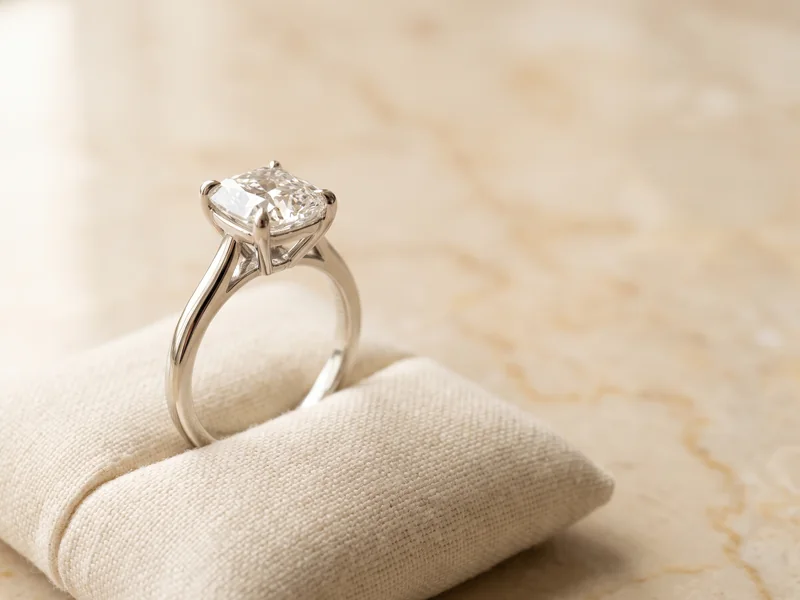
- Four claws: one on each corner. Keeps the outline clean and lets a chunky pattern show its full contrast.
- Double claws (eight in total): extra security on each corner, popular for larger stones and a classic match for antique-style chunky cushions.
- Halo: a ring of small diamonds around the centre. Pairs naturally with crushed ice, because the halo's fine sparkle blends with the stone's own glitter and makes it look larger.
- Bezel: a thin rim of metal around the edge. Very secure; it slightly softens a crushed ice stone's outline but suits a bold chunky one well.
- Vintage-style mounts: milgrain edges and engraving suit chunky cushions, echoing the old mine cut they came from.
Because cushions are usually deep, the setting height matters for comfort and for how the ring sits against a wedding band. For examples of each option, see setting styles that suit cushions, and for the shape basics behind them, cushion outline, ratio and grading basics.
Chunky vs crushed ice cushion: which costs more, natural or lab-grown?
Both patterns are cut from natural and laboratory-grown diamond. Lab-grown diamonds are real diamond, grown in a laboratory rather than mined, with the same hardness and refractive index; they cost much less than natural and are easy to find in larger sizes. Natural cushions are rarer. Either should come with an independent grading report from a lab such as GIA or IGI, and the report will state whether the stone is natural or lab-grown.
| 1 ct cushion, G–H, VS | Approximate price range (AUD) |
|---|---|
| Lab-grown | about $1,000–$3,000 |
| Natural | about $6,000–$14,000 |
These are broad ranges only; prices move with the market and the exact grades. There is no fixed price gap between chunky and crushed ice. Grade for grade they usually sit in a similar range, although well-cut, clearly chunky antique-style cushions are in steady demand and can be priced a little higher by some sellers. Because crushed ice hides inclusions well, you may also be able to choose a lower clarity grade and still get an eye-clean stone. Cushions as a whole usually cost less per carat than round brilliants; our price differences between diamond shapes page and overview of all diamond shapes show where they sit.
Browse cushion and cushion modified diamonds: natural and lab-grown
How do you choose between chunky and crushed ice? Step by step
There is no right answer, only the look you prefer. Chunky suits people who like bold, defined flashes and a vintage character; crushed ice suits people who like all-over glitter and a softer, brighter face. Work through these steps with each stone you shortlist.
- Read the report. Note the shape name (Cushion Brilliant or Cushion Modified Brilliant), measurements, colour, clarity, polish and symmetry, and whether the diamond is natural or lab-grown.
- Work out the ratio. Divide length by width; about 1.00–1.05 for square, 1.15 or more for elongated.
- Watch a 360° video. Pause face-up and look for a defined pattern (chunky) or a glittery mosaic (crushed ice), then check the corners for a hybrid look.
- Match colour and clarity to the pattern. A little higher colour for crushed ice in white metal; a little higher clarity for chunky.
- Compare face-up size. Use the millimetre measurements, as deep cushions can look small for their weight.
- Choose the setting last. Four or double claws for a chunky stone, a halo or claws for crushed ice; see halo and claw options for cushions.
Free consultation
Talk to a gemologist
Compare stones in person or online with Raj Sood, Graduate Gemologist (GIA), AJP (GIA).
Book a consultationFAQ
Common questions
Is a crushed ice cushion bad?
No. It is a different look, not a lower quality. Crushed ice cushions give fine, all-over sparkle and hide small inclusions well; some people simply prefer the bolder flashes of a chunky cushion.
Which sparkles more, a chunky or crushed ice cushion?
Crushed ice gives more, smaller points of sparkle, while chunky gives fewer but larger and brighter flashes with more contrast. Which looks livelier is a matter of taste, so compare both in video or in person.
Does the GIA report say chunky or crushed ice?
No. GIA uses Cushion Brilliant or Cushion Modified Brilliant, which describe the facet arrangement. Cushion modified brilliants are more often crushed ice, but not always, so check the stone itself.
Is every cushion modified brilliant crushed ice?
No. Many cushion modified brilliants look chunky or are hybrids with a mix of both patterns. The only reliable way to tell is a clear photo or 360° video.
Are crushed ice cushions cheaper than chunky ones?
Grade for grade they are usually in a similar price range. Well-cut antique-style chunky cushions can be priced a little higher, and crushed ice may let you choose a lower clarity grade that still looks eye-clean.
Can you get lab-grown chunky or crushed ice cushions?
Yes. Lab-grown cushions are cut in both patterns and cost much less than natural cushions. The grading report will state that the diamond is laboratory-grown.

Ask a gemologist
Not sure which diamond to choose?
Raj Sood is a Graduate Gemologist (GIA) and master jeweller. Bring the stones you are considering, or send the reports, and he will tell you honestly which one is better and why.
Keep learning
Related guides
 Diamond ShapesCushion Cut Diamonds: Brilliant, Modified & Buying Guide
 Diamond ShapesCushion Modified (Crushed Ice) Cut Diamonds
 Engagement Rings & SettingsBest Settings for Cushion DiamondsDiamond ShapesElongated Cushion Cut DiamondsDiamond ShapesUnderstanding Diamond Shapes
 Diamond ShapesRadiant Diamond Crushed-Ice vs Brilliant Facet PatternsDiamond ShapesRadiant vs Cushion Cut DiamondsDiamond ShapesRound vs Cushion Cut Diamonds
Explore more
More guides on this topic
Education