
- Education
- Diamond Anatomy & Light
- Diamond Bow Tie Effect: What It Is and How Much Is Too Much
Diamond Anatomy & Light
Diamond Bow Tie Effect: What It Is and How Much Is Too Much
The bow tie is the one thing a certificate will never tell you about an oval, pear or marquise, and it can make two stones with identical grades look completely different. Here is what causes it, which shapes get it, and how to tell a harmless bow tie from a problem.
 Reviewed by Raj Sood, Graduate Gemologist (GIA), AJP (GIA)Master jeweller and Graduate Gemologist (GIA) · reviewed 4 November 2026
Quick answer
The diamond bow tie effect is a dark band across the centre of elongated brilliants such as ovals, pears, marquise and hearts. It comes from the cut, not a flaw: some facets reflect your head or leak light. A faint bow tie that shifts as the stone moves is normal; a dark, fixed one is not.
What is the diamond bow tie effect?
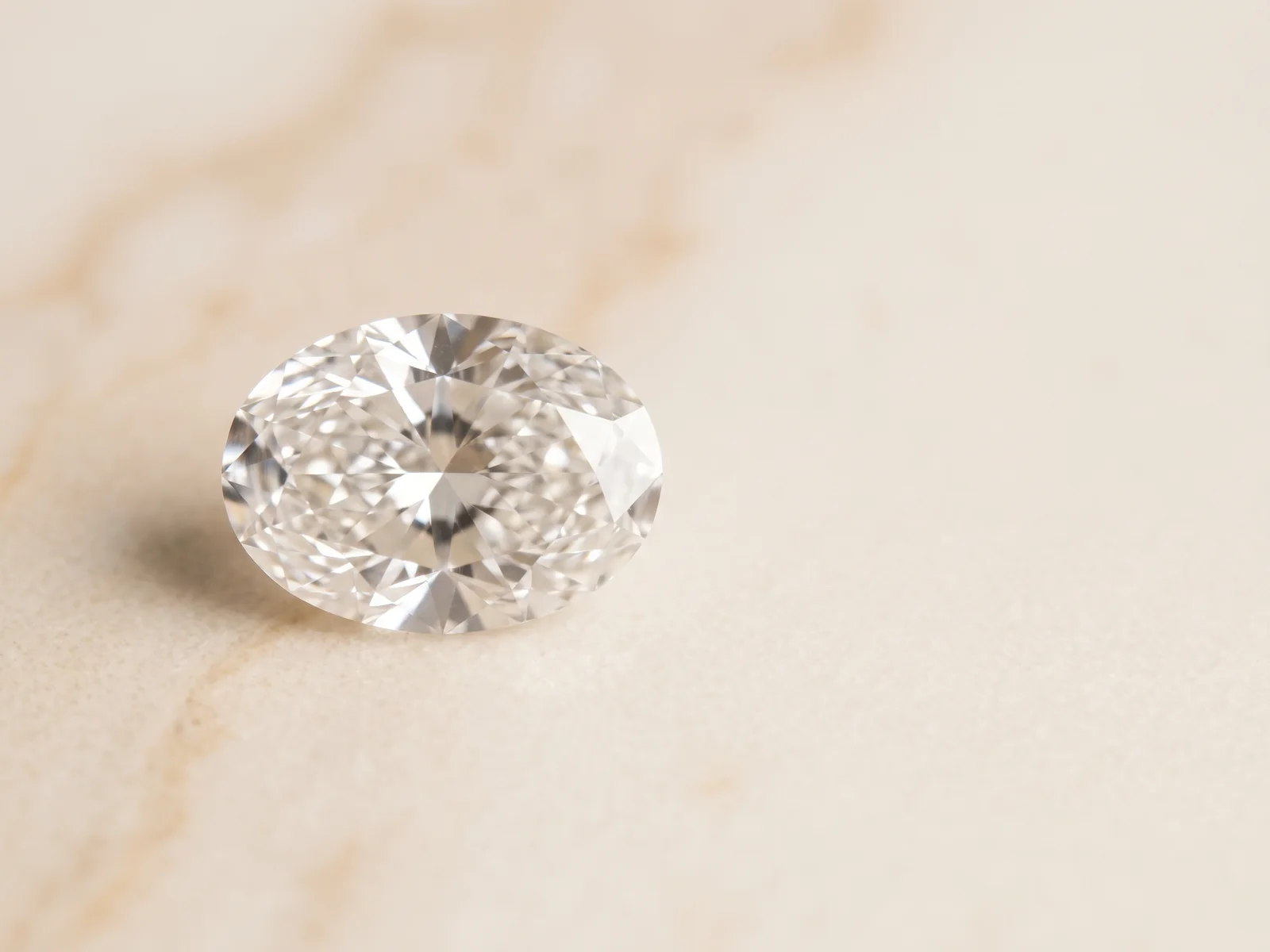
The bow tie effect is a darker area, shaped like a bow tie or a pair of wedges, that runs across the middle of an elongated diamond. In an oval held lengthways it sits across the width, with the knot at the centre and the two wings reaching out towards the sides. It is not an inclusion, a crack or a colour problem. It is simply a part of the stone that, from where you are looking, sends less light back to your eye than the rest.
To see why, it helps to know the parts of a diamond. Light enters through the top (the crown and table), bounces off the angled facets underneath (the pavilion) and comes back out through the top. When it comes back strongly you see brilliance, the white sparkle; when it splits into colours you see fire. Our guide to brilliance, fire and scintillation explains each one. Where the return is weak, you see dark.
Almost every oval, pear, marquise and heart has some bow tie. The question is never whether a stone has one, but how dark it is, how big it is and whether it moves. A soft, shifting bow tie adds contrast and can actually make the sparkle look livelier. A solid black band that stays put as the stone turns makes the centre look dead, and the centre is exactly where the eye goes first.
What causes a bow tie in a diamond?
In a round brilliant, every pavilion facet sits at roughly the same angle to the centre, typically about 40.6° to 41°, so light behaves the same way all the way round. A round can be cut so that almost the whole face returns light evenly. Our guide to crown and pavilion angles shows why those numbers matter.
An elongated stone cannot do that. The pavilion has to slope from the girdle down to the same point at the bottom (near the culet) from every direction, but the stone is longer one way than the other. Along the short axis the slope is effectively steeper; along the long axis it is shallower. No single pavilion angle can be ideal in both directions at once, so somewhere across the middle there is a strip of facets working at a less efficient angle.
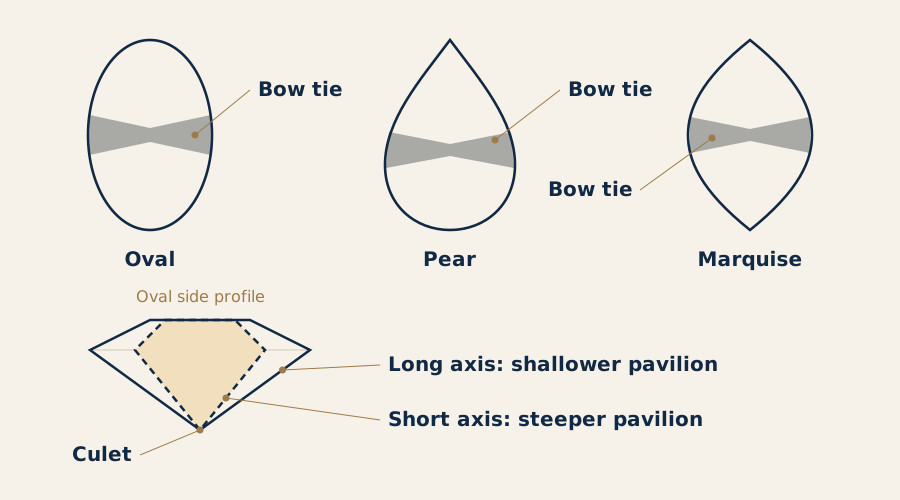
Those facets produce dark in two different ways:
- Obstruction (head shadow): the facets reflect the area directly above the stone, which is usually your own head and shoulders. In a round this shadow is broken into small, scattered flecks; in an elongated stone the facets across the width line up, so the shadow gathers into one band. This is the most common cause, and it is why a bow tie looks stronger when you lean in close.
- Light leakage: if the angles are far enough off, light passes straight out through the pavilion instead of reflecting back up. That area looks grey or see-through rather than black, and it costs the stone real brightness.
So the shape of the stone sets up the bow tie, and the cutter's choices decide how strong it is. A skilled cutter can adjust the pavilion facets, their number and their angles across the width to break the bow tie up. A cutter chasing maximum carat weight from the rough may not bother.
Bow tie vs light leakage, extinction, nailhead and fisheye: what is the difference?
The bow tie is one of several cut-related light effects, and they are often confused. Some are dark, some are see-through, and they appear in different places on the stone.
| Effect | What you see | Where it appears | Main cause |
|---|---|---|---|
| Bow tie | Dark band shaped like a bow tie | Across the centre of elongated brilliants | Pavilion angles vary along the length; head shadow or leakage |
| Light leakage | Grey or glassy, see-through areas | Anywhere, often the centre or edges | Pavilion too shallow or too steep, so light exits underneath |
| Extinction | Scattered dark zones, often at the ends | Ends and edges of fancy shapes | Facets reflecting dark surroundings or obstruction |
| Nailhead | Large dark centre, like the head of a nail | Centre of rounds and other brilliants | Pavilion too deep (steep) |
| Fisheye | Pale grey ring just inside the edge | Around the table, like a reflection of the girdle | Pavilion too shallow |
| Windowing | Washed-out, see-through patch | Centre of the stone | Shallow pavilion letting light pass straight through |
Our guides to light leakage, extinction and dark zones, the nailhead effect and the fisheye ring go into each one. Windowing is the opposite of a bow tie in appearance: a window looks pale and empty, a bow tie looks dark. Both can exist in the same stone.
The practical difference that matters most: a bow tie caused by head shadow is contrast, and some contrast is good. A bow tie caused by leakage is lost light. On a video they can look similar, which is why reflector images (below) are so useful.
Which diamond shapes have a bow tie effect?
Any brilliant-style shape that is longer than it is wide can show a bow tie. Step cuts and rounds generally do not, although they have their own light patterns.
| Shape | Bow tie? | Where it sits | Typical ratio range |
|---|---|---|---|
| Oval | Common | Across the middle, side to side | 1.30–1.50 |
| Pear | Common | Across the widest part, below the rounded end | 1.45–1.75 |
| Marquise | Very common, often the strongest | Across the centre between the two points | 1.75–2.15 |
| Heart | Often, usually mild | Across the belly, just below the lobes | 0.90–1.10 |
| Elongated radiant | Sometimes, often softened | Across the centre | 1.20–1.50 |
| Elongated cushion | Sometimes | Across the centre | 1.15–1.50 |
| Round brilliant | No (in a well-cut stone) | — | 1.00–1.01 |
| Emerald and Asscher | No; shows broad flashes instead | — | Emerald 1.30–1.50 |
Ovals are where most people first meet the bow tie, and ovals cut between about 1.30 and 1.50 usually manage it reasonably well. Marquise stones are long and narrow, so the difference between the long-axis and short-axis angles is greatest, and the bow tie is often the most obvious. In a pear, the band sits across the shoulders of the stone, and a strong one can make the rounded end look disconnected from the point.
Do radiant diamonds have a bow tie? Elongated radiants can, because their pavilion is brilliant-faceted. Their many small facets (often described as a crushed-ice look) tend to break it up, so it is usually softer than in an oval of the same ratio. Square radiants rarely show one.
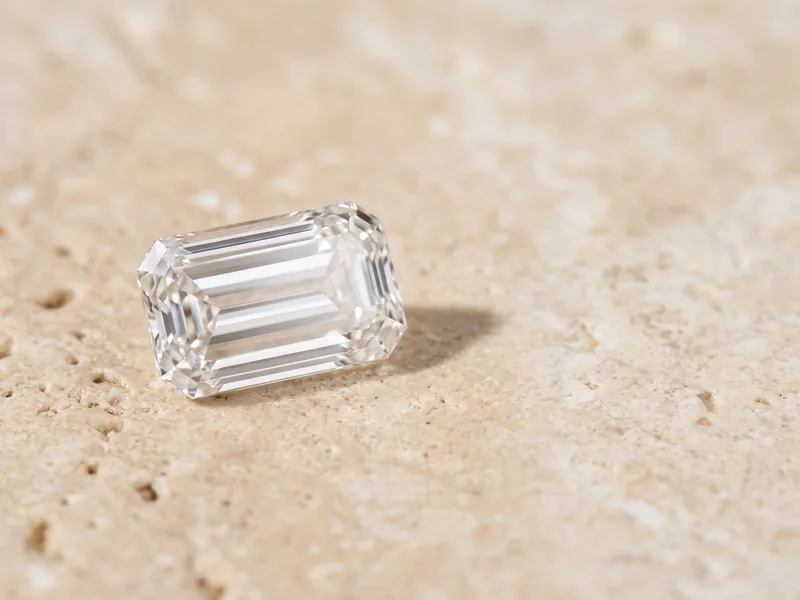
Step cuts such as the emerald have long, flat facets that give broad flashes of light and dark rather than a bow tie. That pattern is called the hall-of-mirrors pattern in emerald cuts, and a good one is what you want.
Not sure which one is right?
Send us the stones you are looking at and our gemologist will tell you which to choose and why.
How much bow tie is too much?
This is the real question for any oval, pear or marquise buyer, and the honest answer is that it is partly personal. Some people like strong contrast; others want an even, bright face. What everyone agrees on is that movement matters more than size. Use this as a guide when watching a video or looking at the stone in person:
| Level | What it looks like | Verdict |
|---|---|---|
| Minimal | Faint grey hint, only visible at certain angles | Excellent; very hard to find in marquise |
| Mild | Soft band that appears and disappears with a small tilt | Normal and acceptable for almost everyone |
| Moderate | Clear band, still breaks up as the stone moves | Acceptable if the rest of the stone is bright; look at alternatives |
| Strong | Dark, sharp-edged band covering much of the width, present in every position | Usually a pass; the centre will look dark on the hand |
A rough rule many gemmologists use: if the bow tie stays black through a full rotation, or if it is the first thing you notice from arm's length, it is too much. If you have to look for it, it is fine.
Lighting changes what you see. Under a single bright spotlight, contrast exaggerates the bow tie. Under diffuse office light or overcast daylight it softens. Look at the stone in more than one light before deciding, and remember that on the hand you view it from 30 to 40 centimetres away, not from 5 centimetres under a loupe.
Can you predict a bow tie from the diamond's proportions?
Only loosely. GIA does not give ovals, pears, marquise or hearts an overall cut grade, and the report gives you depth, table, girdle and measurements, but not the individual pavilion angles across the stone. Two ovals with identical numbers can have very different bow ties, because the facet arrangement underneath is not recorded.
That said, proportions can rule out the worst stones. For an oval, a depth of about 58–62% and a table of about 53–63% is a sensible starting window; our oval proportions chart sets out the full ranges. Very deep stones (above about 66%) tend to show darker, larger bow ties and also look smaller for their weight. Very shallow stones (below about 56%) are more likely to window than to bow tie.
- Depth: extremes in either direction make light problems more likely.
- Ratio: the more elongated the stone, the bigger the angle difference between the two axes, so longer stones generally need better cutting to control the bow tie.
- Girdle: a very thick girdle adds weight without adding light; see girdle thickness for what is reasonable.
- Spread: stones cut deep to save weight often show more bow tie and less face-up spread, a double cost.
Use the numbers to make a shortlist, then judge the stone itself.
How do ASET and Idealscope images show a bow tie?
Reflector scopes turn light behaviour into colours, so you can see the cause of a dark area rather than just the dark area. Our guide to how ASET and Idealscope images work covers them in detail; here is how to read a bow tie on each.
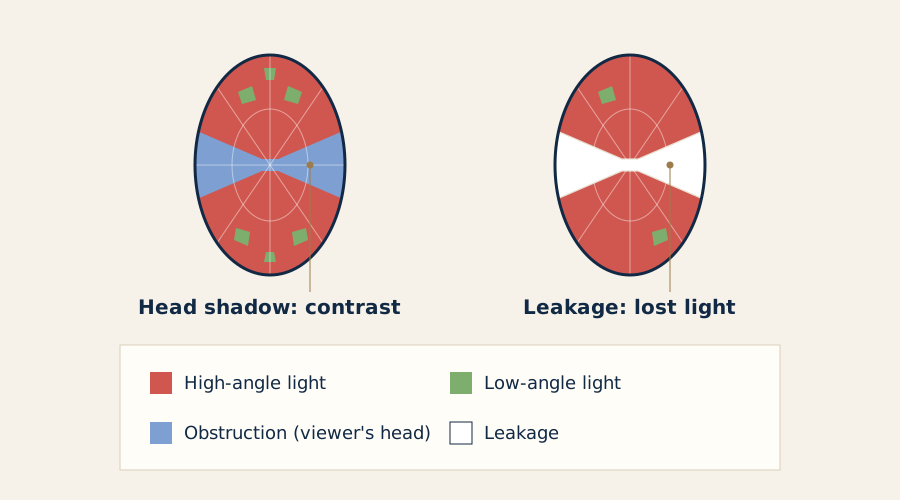
- ASET (Angular Spectrum Evaluation Tool): red shows light coming from high angles, the brightest return; green shows light from lower angles; blue shows obstruction, mostly your head; white or transparent shows leakage. A bow tie that appears blue is head shadow and is mostly contrast. A bow tie that shows white is leakage, which is lost brightness.
- Idealscope: red shows strong light return, black shows obstruction or contrast, and white or pale pink shows leakage. A black bow tie is head shadow; a washed-out one is leakage.
What you want in an oval or pear on ASET is mostly red, with green and blue spread evenly in small pieces rather than gathered into one solid band. The hearts and arrows viewer is a different tool: it checks facet symmetry in rounds and some squares, and it will not tell you much about a bow tie. For a wider view of how these tools fit together, see our light performance guide.
Related guideASET and Idealscope Images ExplainedDo lab-grown diamonds have less bow tie than natural diamonds?
No. The bow tie comes from the cut, not from where the diamond was formed. Laboratory-grown and natural diamonds have the same optical properties, including the same refractive index of about 2.42, so a lab-grown oval and a natural oval cut to the same proportions will show the same bow tie.
There is one practical difference. Lab-grown rough is less expensive, so some cutters are freer to cut for light rather than for weight. Others cut lab-grown stones quickly and in large volumes. In both natural and lab-grown, cutting quality varies stone by stone, which is why same-carat diamonds can look so different side by side. A stone with good transparency and no haziness will also show crisper contrast, which can make a mild bow tie look more like sparkle and less like a shadow.
Browse natural and lab-grown diamonds in our stock
Price follows the bow tie loosely. Ovals, pears and marquise with very little bow tie are in demand and can cost more than average stones of the same grades, in both natural and lab-grown. A stone with a strong bow tie may be priced lower for that reason, but it is not a bargain if the centre looks dark on the hand.
How to check a diamond for a bow tie: step by step
- Shortlist on the report. Check depth, table, girdle and the length-to-width ratio (divide length by width). Rule out extreme depths before you look at any images.
- Watch a 360° video. Pause face-up and watch the centre as the stone rotates. Note whether the dark band moves and breaks up, or stays solid.
- Ask for a reflector image. An ASET or Idealscope image tells you whether the dark band is head shadow (blue or black) or leakage (white or pale).
- Compare two or three stones. The bow tie is easiest to judge side by side. Choose the one where your eye goes to the sparkle, not the centre.
- View it at real distance and light. Look from 30–40 centimetres, in daylight and under indoor lights. What matters is how it looks on the hand, not under a loupe.
- Do not overpay for a label. Terms like ideal or super ideal on fancy shapes are not GIA grades. The same goes for what hearts and arrows grading is worth in rounds: judge the light, not the marketing.
Free consultation
Talk to a gemologist
Compare stones in person or online with Raj Sood, Graduate Gemologist (GIA), AJP (GIA).
Book a consultationShop this shape
FAQ
Common questions
Is a bow tie in a diamond a flaw?
No. It is a light effect caused by the cut of elongated shapes, not an inclusion or damage. A faint, moving bow tie is normal; only a dark, fixed one is a cutting weakness.
Do all oval diamonds have a bow tie?
Nearly all ovals show at least a slight bow tie at some angle. Well-cut ovals keep it soft and moving, so you notice the sparkle rather than the band.
Does a bow tie show up on a GIA report?
No. GIA reports do not grade or mention the bow tie, and fancy shapes get no overall cut grade. You need a video, a reflector image or the stone in front of you.
Can a setting hide a bow tie?
Not really. A halo can draw the eye outward and claws cover a little of the edge, but the bow tie sits in the centre of the stone, which no setting covers.
Do round diamonds get a bow tie?
A well-cut round does not, because its pavilion angles are the same all the way round. Poorly cut rounds can show other dark effects such as a nailhead.
Which shape has the worst bow tie?
Marquise stones usually show the strongest bow tie because they are the most elongated, followed by pears and ovals. Careful cutting can keep it mild in any of them.

Ask a gemologist
Not sure which diamond to choose?
Raj Sood is a Graduate Gemologist (GIA) and master jeweller. Bring the stones you are considering, or send the reports, and he will tell you honestly which one is better and why.
Keep learning
Related guides
 Diamond Anatomy & LightExtinction and Dark Zones in Diamonds
 Diamond Anatomy & LightASET and Idealscope Images ExplainedDiamond Anatomy & LightWhat Is Light Leakage in a Diamond?
 Diamond Anatomy & LightIdeal Proportions Chart: Oval DiamondsDiamond Anatomy & LightAnatomy of a diamond: table, crown, girdle, pavilion and culet explained
 Diamond Anatomy & LightNailhead Effect in DiamondsDiamond Anatomy & LightFisheye Effect in Diamonds
 Diamond ShapesEmerald-Cut Diamond Hall-of-Mirrors Effect
Explore more
More guides on this topic
Education