
Gemstones
Labradorite Guide: Colour Flash, Hardness, Value and Care
Labradorite looks grey one moment and electric blue the next. Knowing why it flashes, how tough it really is and what moves its value helps you choose a stone that looks alive on the hand and lasts.
 Reviewed by Raj Sood, Graduate Gemologist (GIA), AJP (GIA)Master jeweller and Graduate Gemologist (GIA) · reviewed 4 November 2026
Quick answer
Labradorite is a feldspar gemstone known for labradorescence, a metallic flash of blue, green, gold or orange that moves as the stone turns. It is 6–6.5 on the Mohs scale with two cleavage directions, so it suits pendants and earrings best; in rings, choose a protective bezel setting and remove it for rough work.
What is labradorite?
Labradorite is a member of the plagioclase feldspar group. Feldspars are the most common minerals in the Earth's crust, and plagioclase is a series that runs from sodium-rich albite at one end to calcium-rich anorthite at the other. Labradorite sits towards the calcium side of the middle, with roughly 50–70% of the anorthite component. It takes its name from Labrador, on Canada's Atlantic coast, where it was described by Moravian missionaries in the 1770s.
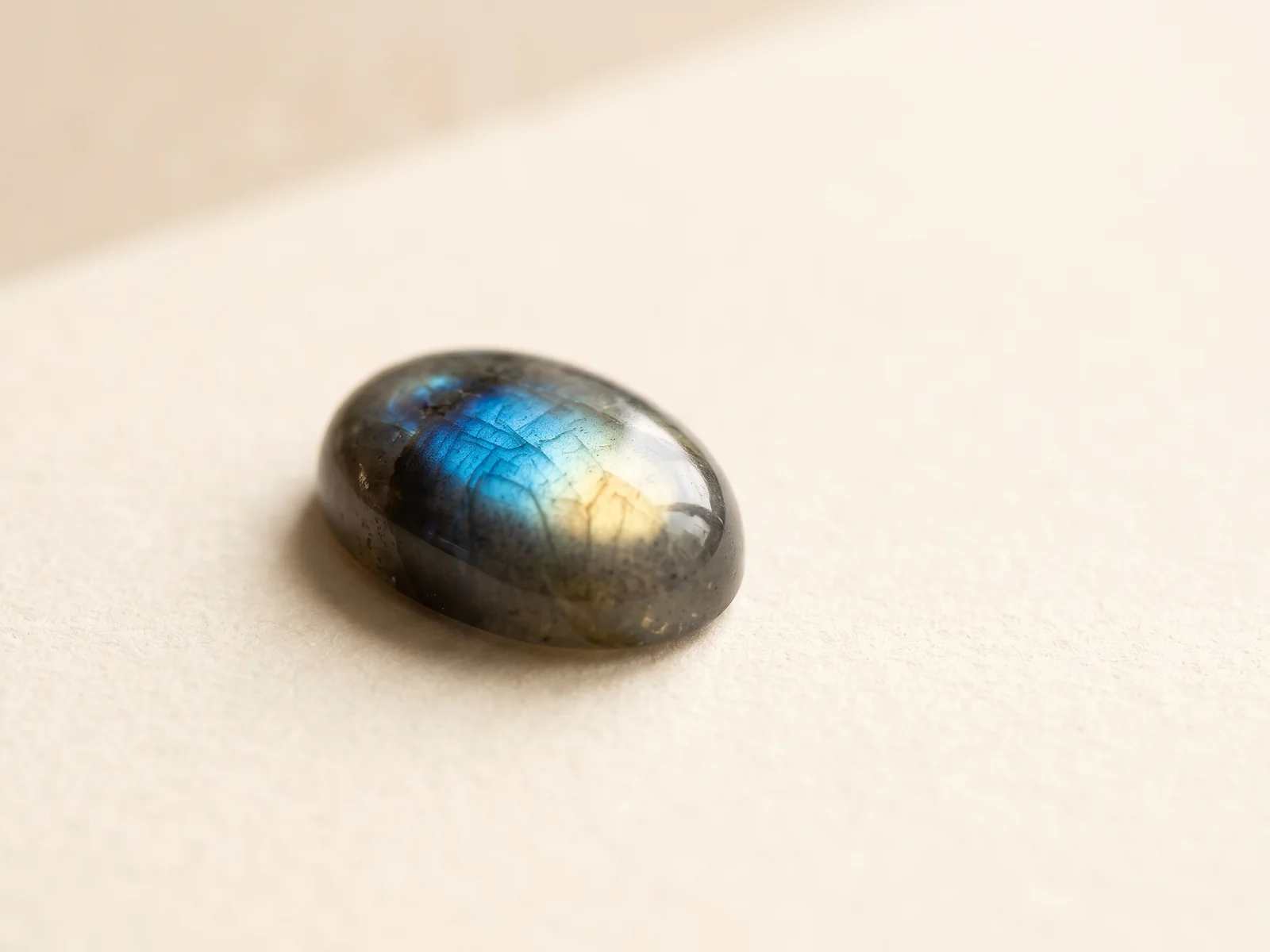
What makes labradorite a gemstone rather than just a rock-forming mineral is labradorescence: a sheet of metallic colour that seems to sit just under the surface and switches on and off as you tilt the stone. Most gem labradorite has a grey to near-black body colour and is cut as a cabochon (a smooth, domed stone with no facets) or as a polished freeform slab. A rarer transparent form, pale straw-yellow to colourless, is faceted like other clear gems.
| Property | Labradorite |
|---|---|
| Mineral group | Plagioclase feldspar |
| Mohs hardness | 6–6.5 |
| Toughness | Fair to poor (two cleavage directions) |
| Refractive index | about 1.56–1.57 |
| Birefringence | about 0.008–0.009 |
| Specific gravity | about 2.68–2.75 |
| Optical effect | Labradorescence (a type of schiller) |
| Typical cuts | Cabochon, freeform slab, beads; faceted if transparent |
If you are comparing labradorite with other coloured stones, our guide to coloured gemstones and birthstones sets out the main families side by side. Any unfamiliar word on this page, from cleavage to schiller, is also defined in our A–Z of jewellery and gem terms.
What causes labradorescence in labradorite?
As labradorite crystallises and cools slowly deep underground, its sodium and calcium can no longer stay evenly mixed. The crystal separates into extremely thin, alternating layers called lamellae, each a fraction of a micrometre thick and very slightly different in composition. Light entering the stone reflects off the boundaries between these layers. The reflected waves overlap, strengthening some colours and cancelling others. It is the same physics that colours a soap bubble or an oil film on a wet road.
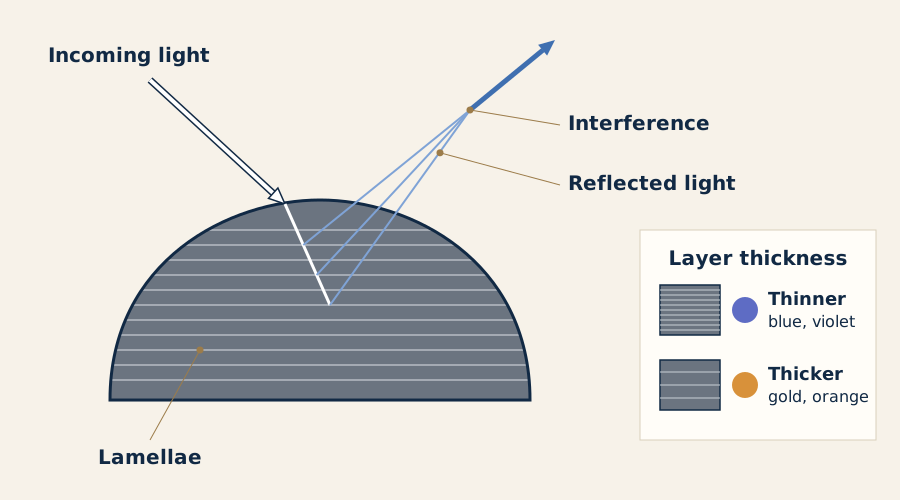
The thickness of the layers decides the colour you see. Thinner layers tend to return blue and violet; thicker layers return green, gold, orange and even red. Because the thickness changes across a crystal, one stone often shows patches of different colour side by side, which is why no two pieces look quite the same.
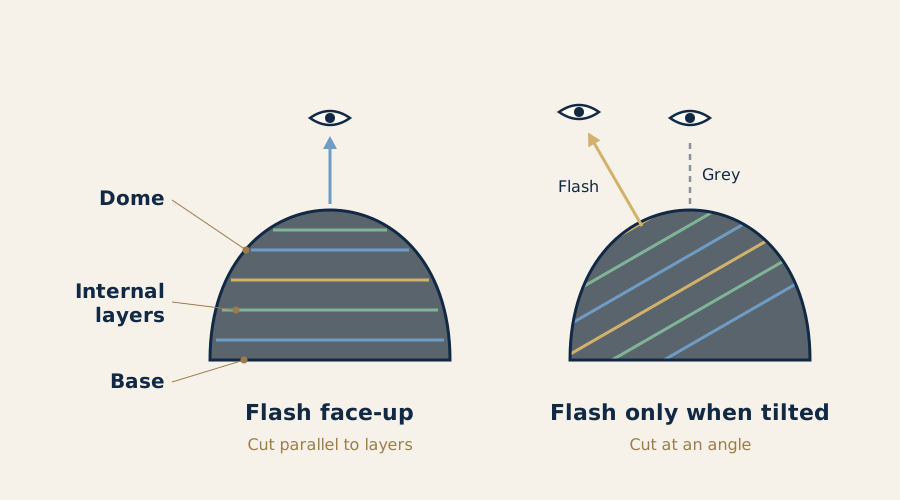
The layers are flat planes, so the effect is directional. Viewed at the right angle, the flash covers the face of the stone. Tilt it away and the same stone turns plain grey. A skilled cutter orients the rough so the base of the cabochon sits parallel to the layers, putting the strongest flash straight up towards the viewer.
Two other features are worth knowing. Labradorite usually shows polysynthetic twinning: repeated thin twin layers that appear as fine parallel lines in the stone or across the flash. And many pieces contain dark needles or plates of iron-titanium oxides such as magnetite and ilmenite. These darken the body colour, which actually makes the flash look more intense, in the same way a black background makes a projected image brighter.
What colours does labradorite come in?
Labradorite colours describe the flash, not the body, which is normally grey to black. From most to least common:
- Blue: the classic and most common flash, from steel blue to bright peacock.
- Green and teal: often mixed with blue in the same stone.
- Gold and yellow: warm, brassy flashes, usually in patches.
- Orange and copper-red: less common and usually smaller areas.
- Violet and purple: the rarest single colours.
- Full spectrum: several colours across one face, the most sought-after look.
Spectrolite is a trade name for labradorite from Ylämaa in south-eastern Finland, found in the 1940s. Finnish material is known for a very dark body and a full rainbow of flash colours. The name is now often used loosely for any multi-coloured labradorite, so spectrolite vs labradorite is really a question of origin and quality, not a different mineral.
Rainbow moonstone is another trade name worth understanding. Most of it is actually a pale, near-colourless labradorite with a blue flash, mined mainly in India and Madagascar. True moonstone is a different feldspar (orthoclase or a related species) with a soft, milky glow. Both names are used in the trade, but a careful seller should tell you which mineral you are buying.
Transparent labradorite is a separate look again: pale yellow to colourless, faceted, with little or no flash. Oregon sunstone is also a labradorite, coloured by tiny copper platelets that give a glittering sparkle and red to green body colours. If a warm golden faceted stone is what you are after, compare it with golden-orange imperial topaz, which is harder at 8 on the Mohs scale.
People drawn to labradorite's blue-green flash often like stones with saturated body colour too. The tourmaline family of gems covers a huge range, from deep blue indicolite and the neon-blue copper-bearing Paraíba to the two-tone pink-and-green watermelon slices.
Related guideTourmalineIs labradorite good for everyday wear in a ring?
Labradorite hardness is 6–6.5 on the Mohs scale. That is below quartz, which is 7, and household dust contains fine quartz grains. Over months of daily wear, the dome of a labradorite ring slowly loses its polish and picks up fine scratches, especially on the highest point.
Toughness, meaning resistance to chipping and breaking, is the bigger concern. Labradorite has two directions of cleavage (planes along which the crystal splits cleanly) at nearly right angles to each other. A sharp knock against a doorframe or bench top can open a cleavage crack, and the internal layers that create the flash can make some pieces more fragile again.
| Gemstone | Mohs hardness | Toughness | Everyday ring? |
|---|---|---|---|
| Labradorite | 6–6.5 | Fair to poor | Occasional wear, or protective bezel |
| Moonstone | 6–6.5 | Poor | Occasional wear |
| Opal | 5.5–6.5 | Poor to fair | Occasional wear, protective setting |
| Tanzanite | 6–7 | Fair | With care, protective setting |
| Tourmaline | 7–7.5 | Fair | Yes, with some care |
| Emerald | 7.5–8 | Poor to fair | With care, protective setting |
| Aquamarine / morganite | 7.5–8 | Good | Yes |
| Imperial topaz | 8 | Poor (one cleavage) | With care |
| Spinel | 8 | Good | Yes |
| Sapphire | 9 | Excellent | Yes |
| Diamond | 10 | Good | Yes |
So, is a labradorite ring a sensible choice? Yes, if you set it for its weaknesses. A full bezel setting (a metal rim around the whole stone) protects the edge from knocks. A low profile keeps it away from door handles. A thicker cabochon resists cracking better than a thin slice. Take it off for the gym, gardening, cleaning and any work with tools. Pendants and earrings take far fewer knocks, so labradorite is much less of a worry there.
If you want a coloured stone that copes with daily wear more easily, pink sapphire, at 9 on the Mohs scale and spinel, a hard and tough gem at 8 are the usual recommendations. Peachy-pink morganite and the stones in our aquamarine engagement ring guide sit at 7.5–8. Labradorite is closer in wear behaviour to tanzanite, which also needs a protective setting, and many of the same setting ideas in our emerald engagement ring settings page carry over to softer or more fragile stones.
Not sure which one is right?
Send us the stones you are looking at and our gemologist will tell you which to choose and why.
Is labradorite treated or enhanced?
Most labradorite on the market is untreated. Heating is not routinely used, because it does not improve the flash; our page on how heat treatment changes other gems explains why it matters so much for sapphire and so little here. That said, there are a few treatments and look-alikes to know about:
- Stabilising: fractured material can be impregnated with resin or wax to fill cracks and hold it together. Under magnification you may see a glassy filler in surface-reaching cracks.
- Backed slices: thin slices can be glued onto a black backing to deepen the flash, creating an assembled stone (a doublet). These should be sold as assembled.
- Coated and dyed beads: some inexpensive beads labelled labradorite are coated or dyed feldspar, quartz or glass.
- Copper diffusion: red and green feldspar sold as andesine in the 2000s was later shown in many cases to be pale yellow feldspar with copper diffused in at high temperature. This is different from natural Oregon sunstone.
- Glass imitations: iridescent glass can mimic the flash, but lacks twinning lines and often shows bubbles.
Synthetic (lab-created) labradorite is not commonly seen in the jewellery trade, because natural material is plentiful and inexpensive. The things to watch for are therefore assembled stones, fillers and imitations, not synthetics. Ask whether a stone is solid, untreated and natural, and expect a clear answer.
Where does labradorite come from?
| Source | Known for |
|---|---|
| Canada (Labrador) | The original locality; strong blue and green flash; limited commercial output |
| Finland (Ylämaa) | Spectrolite: dark body, full-spectrum flash |
| Madagascar | A large share of today's commercial labradorite, in a wide colour range |
| India | Rainbow moonstone (pale labradorite with blue flash) |
| USA (Oregon) | Oregon sunstone: transparent labradorite with copper platelets |
| Mexico and other US states | Transparent pale yellow labradorite for faceting |
| Russia, Norway and others | Smaller amounts of flashy and decorative material |
Labradorite is not a significant commercial Australian gem. Plagioclase feldspar is common in Australian rocks, but gem-quality flashing material has not been mined here in any real quantity, so most labradorite sold in Australia is Madagascan, with Finnish spectrolite and Canadian pieces at the collector end.
Origin is rarely stated on a gem report for labradorite, and for most stones it does not change the price much. The two exceptions are Finnish spectrolite and Oregon sunstone, where a documented origin can add value. For everyday commercial material, the look of the individual stone matters far more than where it came from.
How do gemmologists identify labradorite vs moonstone and opal?
In the lab, labradorite is usually straightforward to confirm. A gemmologist checks the refractive index on a refractometer (about 1.56–1.57 on a polished flat surface, or a spot reading on a cabochon), the specific gravity (about 2.70), the directional flash and the fine parallel twinning lines under magnification. Our overview of the refractometer, loupe and other gem-testing tools explains how each test works.
| Feature | Labradorite | Moonstone | Opal | Glass imitation |
|---|---|---|---|---|
| Effect | Metallic flash in sheets, strongly directional | Soft bluish-white glow that floats across the dome | Play-of-colour in patches that shift with movement | Even iridescence, often uniform across the stone |
| Body colour | Grey to black (or pale in rainbow moonstone) | Colourless to white, grey, peach | White, black, crystal, boulder | Any |
| Refractive index | about 1.56–1.57 | about 1.52–1.53 | about 1.37–1.47 | Varies, often 1.50–1.70 |
| Specific gravity | about 2.68–2.75 | about 2.56–2.59 | about 1.98–2.20 | Varies widely |
| Mohs hardness | 6–6.5 | 6–6.5 | 5.5–6.5 | 5–6 |
| Clues under a loupe | Twinning lines, dark needles | Centipede-like cleavage cracks | Colour patches with grain | Gas bubbles, swirl marks |
The labradorite vs moonstone question comes up most often. Moonstone's glow, called adularescence, is soft and milky and seems to roll across the stone like moonlight. Labradorite's flash is sharper, more metallic and comes in bands of distinct colour. Rainbow moonstone sits in between visually, but its refractive index and twinning identify it as labradorite.
What affects labradorite value and price in Australia?
Labradorite is an affordable gem, but quality varies enormously. These are the factors a gemmologist weighs, roughly in order of importance:
- Flash strength: a vivid, bright flash is worth far more than a dull, smoky one.
- Coverage: flash across the whole face beats a small patch in one corner.
- Colour: blue is common; gold, orange, violet and full-spectrum flashes cost more.
- Body colour: a dark body makes the flash look stronger.
- Orientation: strongest flash face-up, not only when tilted steeply.
- Cracks and inclusions: surface-reaching cracks reduce both value and durability; fine needles are normal.
- Size and thickness: larger, thicker stones with even flash are scarcer.
| Type of stone or piece | Approximate price range (AUD) |
|---|---|
| Commercial blue-flash cabochon, about 10–15 mm | about $20–$80 |
| Strong multi-colour or full-coverage cabochon, ring size | about $80–$300 |
| Finnish spectrolite, fine quality, ring size | about $150–$600+ |
| Faceted transparent labradorite, 1–3 ct | about $30–$150 |
| Labradorite set in a custom gold ring (metal and making included) | about $800–$2,500 |
These are broad guides only and labradorite price in Australia varies with size, quality and setting. In a finished ring, the metal and craftsmanship usually cost much more than the stone itself. That is a very different picture from gems like richly coloured rubellite, where the stone is usually the main cost.
Browse natural gemstones
How do you choose a labradorite ring? Step by step
- Look at it in motion. Ask for a video or view it in person, tilting the stone slowly under a single light.
- Check the face-up flash. The strongest colour should appear when you look straight down, not only at a steep angle.
- Judge coverage and colour. Note how much of the face lights up and which colours appear.
- Inspect for cracks. Use a loupe or zoomed photo to look for surface-reaching cracks, especially near the edge.
- Ask about treatment and assembly. Confirm the stone is solid, natural and not backed, filled or coated.
- Choose a protective setting. A full bezel and low profile suit a ring; claws are fine for pendants and earrings.
- Plan how you will wear it. Decide whether it is for daily or occasional wear, and pick the cabochon thickness to match.
How do you clean and care for labradorite?
How to clean labradorite is simple: warm water, a few drops of mild dishwashing liquid and a soft toothbrush. Rinse well and dry with a lint-free cloth. What to avoid matters more:
- No ultrasonic cleaners: vibration can extend cleavage cracks.
- No steam cleaning: sudden heat can crack the stone or loosen fillers.
- No harsh chemicals: acids, bleach and strong cleaners can etch feldspar and damage resin fillers.
- Store separately: keep it in a soft pouch away from diamonds and sapphires, which will scratch it.
- Take it off: for sport, gardening, cleaning and heavy lifting.
Every year or two, have a ring checked: the bezel should still sit firmly against the stone, and a jeweller can repolish a scratched dome to bring back its lustre. Repolishing removes a tiny amount of material, so it is something to do occasionally, not routinely.
Free consultation
Talk to a gemologist
Compare stones in person or online with Raj Sood, Graduate Gemologist (GIA), AJP (GIA).
Book a consultationShop this shape
FAQ
Common questions
Is labradorite a real gemstone?
Yes. Labradorite is a natural plagioclase feldspar mineral used as a gemstone for its metallic flash. Glass and coated imitations exist, but genuine labradorite is widely available and inexpensive.
Can you wear a labradorite ring every day?
You can, but at 6–6.5 on the Mohs scale with two cleavage directions it will scratch and can crack with hard knocks. A thick cabochon in a full bezel setting, removed for rough work, gives it the best chance.
What is the difference between spectrolite and labradorite?
Spectrolite is labradorite, traditionally from Ylämaa in Finland, known for a dark body and full-spectrum flash. The name is now used loosely for any multi-coloured labradorite.
Is rainbow moonstone really moonstone?
Usually not. Most rainbow moonstone is a pale labradorite with a blue flash; true moonstone is a different feldspar with a softer, milky glow. Both are natural feldspars.
Why does my labradorite look grey?
Labradorescence is directional, so the flash only appears at certain angles. If the stone looks grey face-up, it may have been cut with the internal layers at an angle to the base.
How much is labradorite worth in Australia?
Most commercial labradorite cabochons cost roughly AUD $20–$300 depending on flash, coverage and size. Fine Finnish spectrolite costs more, and in a gold ring the metal and making are usually the larger cost.

Ask a gemologist
Not sure which diamond to choose?
Raj Sood is a Graduate Gemologist (GIA) and master jeweller. Bring the stones you are considering, or send the reports, and he will tell you honestly which one is better and why.
Keep learning
Related guides
Explore more
More guides on this topic
Education