
- Education
- Buying Knowledge & Custom Process
- Diamond Buying Guide: How to Choose a Diamond in Australia
Buying Knowledge & Custom Process
Diamond Buying Guide: How to Choose a Diamond in Australia
This diamond buying guide puts the decisions in the right order, from the 4Cs and the grading report to the Australian rules on GST, the Tourist Refund Scheme and insurance that most guides skip.
 Reviewed by Raj Sood, Graduate Gemologist (GIA), AJP (GIA)Master jeweller and Graduate Gemologist (GIA) · reviewed 4 November 2026
Quick answer
Start with a budget and shape, then prioritise cut, choose colour and clarity that look clean to the eye, and buy carat last. Insist on an independent report from GIA or IGI, decide between natural and lab-grown on value rather than looks, and plan GST, Tourist Refund Scheme rules and insurance before you pay.
Diamond buying guide: where should you start?
Most people open a diamond website and go straight to the filters. It works better the other way round. Decide what the diamond is for, roughly what you want to spend and which shape you love, and only then let the 4Cs fill in the detail. This page covers how to choose a diamond, whether it is a loose stone for a custom ring or one already set, plus the Australian rules on GST, the Tourist Refund Scheme and insurance.
Four decisions come before any grade:
- Purpose: an engagement ring worn every day needs a secure setting and a stone that looks good from normal viewing distance, not under a microscope.
- Budget: a firm range (for example A$5,000–7,000) stops you comparing stones that were never real options.
- Shape: it changes the price per carat, how big the stone looks and which settings suit it.
- Natural or lab-grown: they look the same, but price, rarity and resale are very different, so decide early.
If you are choosing the band, metal and setting too, our guide to choosing the whole engagement ring picks up where this page ends. Any unfamiliar term here is defined in our A–Z jewellery glossary.
What are the 4Cs, and which one matters most?
The 4Cs are the four grades every diamond report gives: cut, colour, clarity and carat weight. Diamond is the hardest natural material (10 on the Mohs scale) and bends light strongly, with a refractive index of about 2.42. Cut decides how well a stone uses that light, which is why it comes first.
| C | What it measures | Where to land for value |
|---|---|---|
| Cut | How well the facets return light as brilliance, fire and sparkle; graded Excellent to Poor on rounds | Excellent or Very Good for rounds; judge fancy shapes by proportions, symmetry and video |
| Colour | How colourless the stone is, from D (colourless) to Z (light yellow or brown) | G–H in white gold or platinum; I–J often looks white in yellow or rose gold |
| Clarity | Inclusions (internal marks) and blemishes (surface marks), from FL to I3 | VS2 or a carefully chosen SI1 that is eye-clean |
| Carat | Weight; one carat is 0.20 g | Just under round numbers, such as 0.90 or 1.40 ct |
Cut is the one to protect. A well-cut G SI1 often looks livelier than a poorly cut E VVS1 that costs more. GIA and IGI give an overall cut grade to round brilliants; most fancy shapes have no cut grade, so you judge them on proportions, symmetry and a video. Polish and symmetry grades describe the finish and facet alignment, and Very Good or better is a sensible floor.
Colour steps are tiny face-up: most people cannot pick G from H once the stone is set. Clarity runs from Flawless (FL) and Internally Flawless (IF) through VVS and VS to SI and Included (I). What matters is whether the stone is eye-clean, meaning no inclusion is visible to the naked eye at about 25–30 cm. Carat is weight, not size, so two 1 carat stones can face up quite differently.
Two extras on the report also move price. Fluorescence is a glow some diamonds give under ultraviolet light; faint or medium is rarely visible and can lower the price a little, while strong blue occasionally makes a stone look slightly hazy. And prices step up at round weights such as 0.50, 1.00 and 1.50 carat, so a 0.90 carat stone can look almost identical to a 1.00 for noticeably less. Our guide to building a diamond shortlist without drowning in filters turns these grades into a working search.
How do you choose a diamond shape and size?
Shape is the outline seen from above. The round brilliant returns the most light and costs the most per carat, partly because cutting a round wastes more of the rough crystal. Fancy shapes such as oval, pear, emerald and cushion-cut diamonds usually cost less per carat than a round of the same grades, and elongated shapes look larger for their weight.
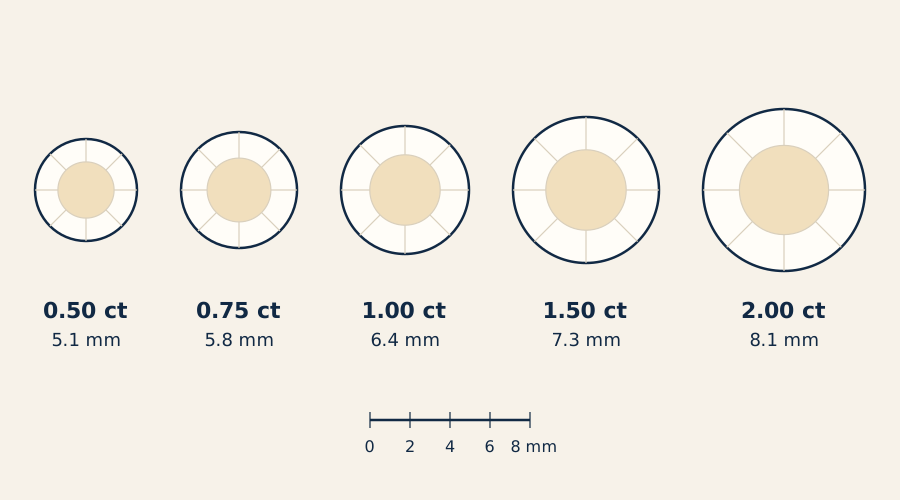
As a guide, a well-cut round measures about 5.1 mm across at 0.50 carat, 5.8 mm at 0.75, 6.4–6.5 mm at 1.00, 7.3 mm at 1.50 and 8.1 mm at 2.00. A stone cut too deep hides weight underneath and looks smaller face-up, so compare millimetres, not only carats. The diamond size visualiser shows each shape and weight to scale.
Finger size changes the look too. The same 1 carat stone looks larger on a size J than on a size Q, so check the wearer's size with our ring size converter before you settle on a carat target.
Which diamond grading report should you trust?
A diamond grading report (often called a certificate) is an independent laboratory's description of the stone: measurements, 4Cs, fluorescence, any treatments and, for lab-grown stones, how it was grown. It is what lets you compare two diamonds you have never seen side by side.
| Laboratory | Where you usually see it | Notes |
|---|---|---|
| GIA (Gemological Institute of America) | Natural diamonds; some lab-grown | The most widely recognised standard for natural diamonds, with consistent colour and clarity grading |
| IGI (International Gemological Institute) | Most lab-grown diamonds sold in Australia; many natural | Widely used and recognised, especially for lab-grown stones |
| HRD Antwerp | Natural diamonds, mainly European stock | Recognised European laboratory; less common in Australia |
| In-house or unbranded certificate | Some retail and online stock | Not independent; treat the grades as the seller's opinion and ask for a recognised report |
Check three things. The report number should be laser-inscribed on the girdle (the thin outer edge of the stone) and match the paperwork. The report should verify on the laboratory's website. And the measurements should match the stone you are shown. A report is not a valuation: it describes quality, not price.
Not sure which one is right?
Send us the stones you are looking at and our gemologist will tell you which to choose and why.
Natural vs lab-grown diamond: what is the real difference?
A lab-grown diamond (laboratory-grown diamond) is real diamond, grown from carbon in a reactor by the CVD or HPHT method rather than formed deep in the earth over billions of years. It has the same hardness, sparkle and chemistry as a natural diamond. The difference is origin, and with origin comes price and rarity.
| Natural diamond | Lab-grown diamond | |
|---|---|---|
| Origin | Formed in the earth and mined | Grown in a laboratory over weeks |
| Material | Carbon, Mohs 10, RI about 2.42 | Same: carbon, Mohs 10, RI about 2.42 |
| Looks | Identical to the eye | Identical to the eye; only lab instruments tell them apart |
| Typical price, 1 ct round, G–H, VS, excellent cut | About A$7,000–15,000 | About A$1,000–3,000 |
| Price trend | Has eased in recent years, but far less than lab-grown | Has fallen as production has grown |
| Resale | Well below retail, but a trade market exists | Very little resale market at present |
| Report | Usually GIA or IGI | Usually IGI or GIA, stated as laboratory-grown and usually laser-inscribed |
Neither is right for everyone. Lab-grown gives you much more size and quality for the money; natural gives you a stone that is rare and formed by the earth. Neither should be bought as a store of value: how diamond resale value really works explains what the trade pays for diamonds, and if you are leaning lab-grown, read the resale questions to ask about lab-grown first. Australian Consumer Law bans misleading descriptions, so a lab-grown diamond should always be clearly disclosed as lab-grown on the listing, report and invoice.
Browse natural and lab-grown diamonds in our stock
How much should you spend on a diamond in Australia?
There is no rule. The idea behind the three-month salary rule came from diamond advertising, not etiquette; spend what you are comfortable with. For what partners and families tend to expect today, see our notes on modern engagement ring etiquette. Approximate Australian retail ranges for loose stones:
- 0.50 ct round, natural: roughly A$1,500–4,000, depending on colour, clarity and cut.
- 1.00 ct round, natural: roughly A$7,000–15,000 for G–H, VS, excellent cut; more for D–F or very high clarity.
- 1.00 ct round, lab-grown: roughly A$1,000–3,000 for similar grades.
- 2.00 ct round, lab-grown: roughly A$2,500–6,000, which is why many lab-grown buyers go larger.
Australian prices include 10% GST, and the setting is extra. Our Australian diamond price guide breaks natural prices down grade by grade, and the lab-grown price guide for Australia does the same for laboratory-grown stones. If the timing or budget is not right yet, a simple proposal ring now and the diamond later is a common way through.
Can you claim GST back on a diamond with the Tourist Refund Scheme?
GST (goods and services tax) is 10% and is included in the price of a diamond bought in Australia. The Tourist Refund Scheme (TRS) lets travellers leaving Australia claim back the GST on goods they take with them. It covers diamonds and jewellery, and Australian residents can use it, but the conditions are strict:
- You spend at least A$300 (including GST) with one business, under one ABN, in one or more purchases.
- You buy within 60 days before you leave Australia.
- You keep the original tax invoice showing the business's ABN, the items and the price.
- You carry the jewellery in hand luggage or wear it, and can show it to the TRS officer.
- You claim at the TRS facility at the international airport after passport control, no later than 30 minutes before departure. The TRS app lets you enter details beforehand.
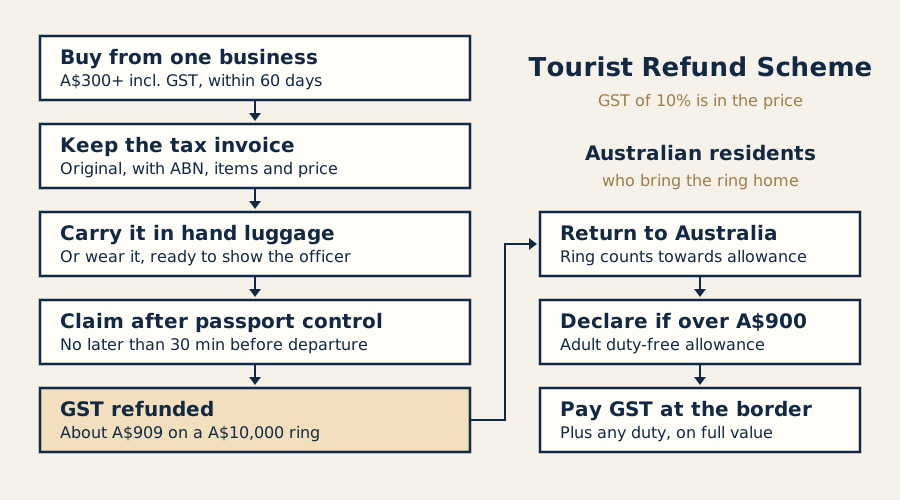
The refund is the GST component, which is one-eleventh of the GST-inclusive price: about A$909 on a A$10,000 ring. The catch for Australians is coming home. If you claim a TRS refund and bring the ring back, it counts towards your duty-free allowance (A$900 for adults), and if it takes you over that it must be declared, with GST (and any duty) payable on the item's full value at the border. TRS genuinely helps overseas visitors and Australians moving or gifting abroad; it is not a way for residents to buy GST-free.
| Buy in Australia | Buy in Australia with TRS | Buy overseas and bring home | |
|---|---|---|---|
| GST | 10% included | GST refunded at departure if conditions are met | Local taxes overseas; 10% GST at the border above the allowance |
| Consumer protection | Australian Consumer Law | Australian Consumer Law | Foreign law; hard to enforce from here |
| After-sales care | Local resizing, claw checks and repairs | Local if you return to Australia | Ship it back or pay a local jeweller |
| Main catch | None beyond price | Residents must declare it on return if over A$900 | Possible customs duty on set jewellery, import charges, exchange rates |
Buying overseas has other costs too: set jewellery may attract customs duty depending on where it was made, reports from unfamiliar laboratories are hard to check, and you lose the jeweller who would normally resize the ring and check its claws. Our guide to buying a diamond overseas versus at home runs the full numbers.
Related guideBuying a Diamond Overseas vs in AustraliaShould you buy a diamond online or in a showroom?
You can buy a good diamond either way. Online gives wider choice and quick comparison; a showroom lets you see colour, sparkle and size on the hand. Our comparison of buying a ring online versus in a store covers the trade-offs, and for laboratory-grown stones see lab-grown diamonds online or in a showroom.
If you are learning how to choose a loose diamond you cannot see in person, the video does the work. Ask for a 360° video under ordinary light and a tweezer video, where the stone is turned by hand so you can watch it move. Our guide to reading a loose diamond tweezer video shows what dark zones, inclusions and dull patches look like.
Whichever way you buy, ask the same things: which laboratory graded the stone, whether the report number is inscribed, what the returns and exchange policy is, and who sets and services the ring. Our list of questions to put to a jeweller about lab-grown diamonds works for natural stones too.
How does diamond insurance in Australia work?
Insure the ring from the day you collect it. Most Australians either add it to a home and contents policy or take a specialist jewellery policy. Either way:
- Specify the item. Contents policies usually cap unspecified jewellery at a modest amount per item, often around A$1,000–2,500. Name the ring on the policy with its value.
- Get a valuation. Insurers ask for a written valuation from a qualified valuer, recording the stone's grades, measurements and report number, the metal and setting, and a replacement value.
- Know how claims are paid. Some policies replace the ring through a nominated supplier rather than paying cash; agreed-value cover pays the stated amount.
- Check cover away from home. Make sure the ring is covered while you wear it and when you travel, not only at your address.
- Revalue every two to three years. Natural prices drift and lab-grown replacement costs have fallen, so an old valuation can leave you over- or under-insured.
- Read the wear-and-tear exclusion. A stone lost because a worn claw gave way may not be covered, so have the claws checked once a year.
Australian Consumer Law covers diamonds bought from Australian businesses, in store or online. The stone must be of acceptable quality and match its description, including the grades on its report; if it does not, you are entitled to a repair, replacement or refund. The law does not require refunds for a change of mind, so ask about the store's policy before you pay, especially when a loose stone is being set into a custom ring.
Diamond buying guide step by step: how do you choose a loose diamond?
- Set the brief. Decide the budget range, the shape and natural or lab-grown.
- Fix the cut first. Excellent or Very Good for rounds; for fancy shapes, check proportions, symmetry and video.
- Choose colour and clarity. Start at G–H and VS2–SI1, and move up only if you can see the difference.
- Pick the carat last. Compare millimetres and consider weights just under 0.50, 1.00 and 1.50 carat.
- Check the report. GIA or IGI, verified online, with the laser inscription and measurements matching.
- Watch the stone. Review 360° and tweezer videos, or compare stones side by side in person.
- Plan the money. Confirm the price includes GST, read the returns policy, and look at TRS only if the ring is leaving the country with you.
- Insure it. Get a valuation and specify the ring on your policy before you wear it out.
Once the diamond is chosen, the setting is designed around it. At GemTrove, making jewellery in Melbourne since 2008 from a family trade that goes back to 1984, a loose stone becomes a ring like this:
Free consultation
Talk to a gemologist
Compare stones in person or online with Raj Sood, Graduate Gemologist (GIA), AJP (GIA).
Book a consultationShop this shape
FAQ
Common questions
Which of the 4Cs is most important when buying a diamond?
Cut, because it decides how much the diamond sparkles. After that, choose colour and clarity that look clean to the eye, and let carat weight be whatever your budget allows.
Can I avoid GST on a diamond with the Tourist Refund Scheme?
Travellers can claim the GST back if they spend A$300 or more with one business within 60 days of departure and carry the jewellery out. Australian residents who bring it back must declare it and pay the GST if it is over the A$900 allowance.
Is it cheaper to buy a diamond overseas?
Sometimes the ticket price is lower, but GST is charged at the Australian border above the allowance, duty can apply to set jewellery, and you lose easy access to Australian Consumer Law and local servicing.
Is a lab-grown diamond a real diamond?
Yes. A lab-grown diamond is carbon with the same hardness, sparkle and chemistry as a natural diamond; only its origin differs, and it should always be sold as lab-grown.
Do I need a GIA certificate for my diamond?
You need an independent report from a recognised laboratory, usually GIA or IGI. Do not rely on in-house certificates, and check the report number online and against the laser inscription.
How do I insure an engagement ring in Australia?
List it as a specified item on your contents insurance or take a specialist jewellery policy, using an independent valuation. Check it is covered away from home and revalue it every two to three years.

Ask a gemologist
Not sure which diamond to choose?
Raj Sood is a Graduate Gemologist (GIA) and master jeweller. Bring the stones you are considering, or send the reports, and he will tell you honestly which one is better and why.
Keep learning
Related guides
 Buying Knowledge & Custom ProcessDiamond Price Guide AustraliaBuying Knowledge & Custom ProcessBuying a Diamond Overseas vs in AustraliaBuying Knowledge & Custom ProcessHow to Build a Diamond Shortlist Without Getting Lost in Filters
 Buying Knowledge & Custom ProcessBuying an Engagement Ring Online vs In-Store
 Lab-Grown DiamondsBuying a Lab-Grown Diamond Online vs in a Showroom
 Lab-Grown DiamondsQuestions to Ask a Jeweller Before Buying a Lab-Grown Diamond
 Lab-Grown DiamondsLab-Grown Diamond Resale Value: Questions to Ask Before Buying
Explore more
More guides on this topic
Education