
- Education
- Diamond Shapes
- Marquise vs Moval Diamonds: How the Two Shapes Compare
Diamond shapes
Marquise vs Moval Diamonds: How the Two Shapes Compare
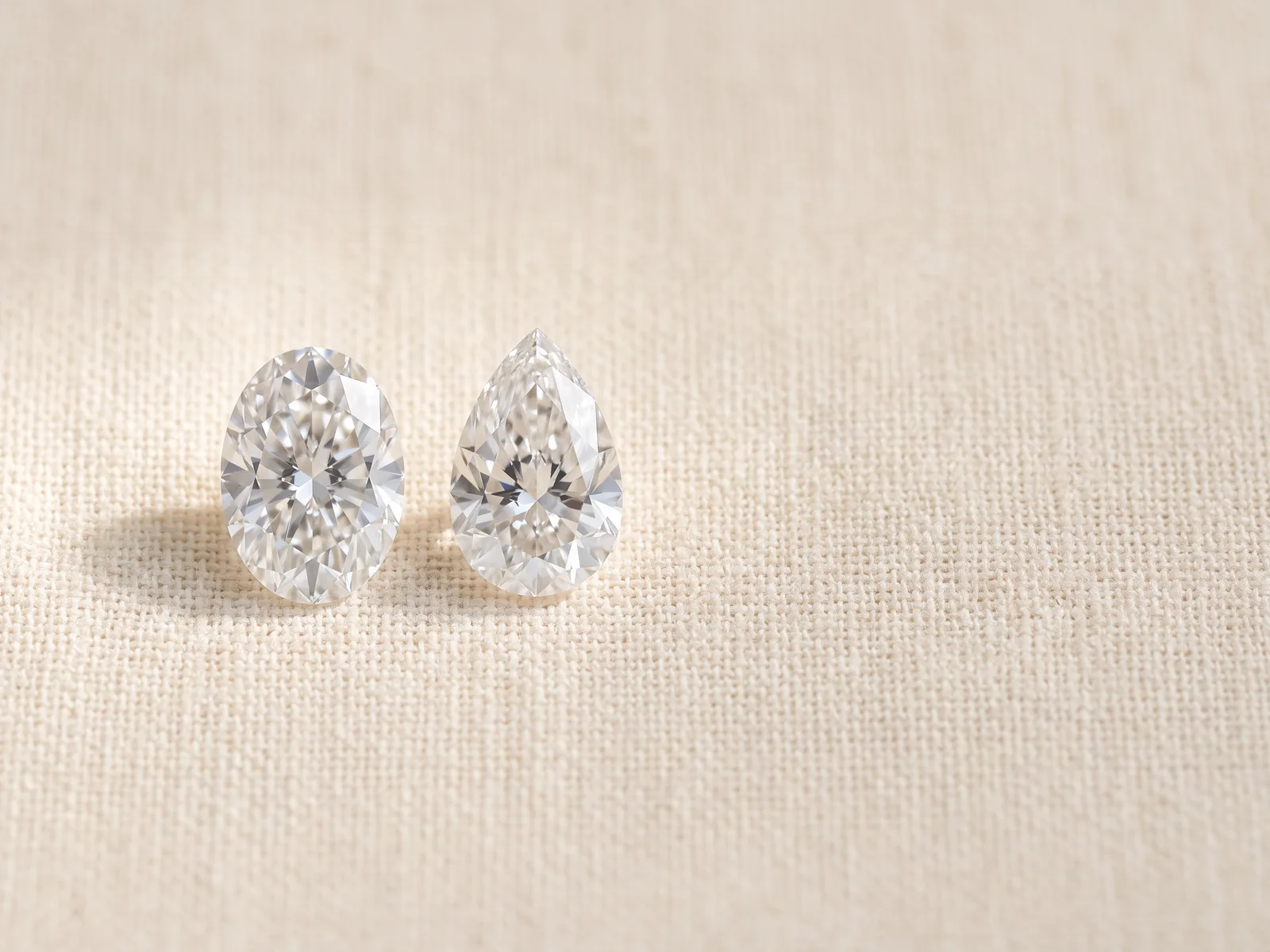
Marquise vs moval is one of the closest calls in diamond shapes: both are long and slim, but one has two sharp points and the other softens them. Here is how they differ on the hand, in size, sparkle, durability and price.
 Reviewed by Raj Sood, Graduate Gemologist (GIA), AJP (GIA)Master jeweller and Graduate Gemologist (GIA) · reviewed 4 November 2026
Quick answer
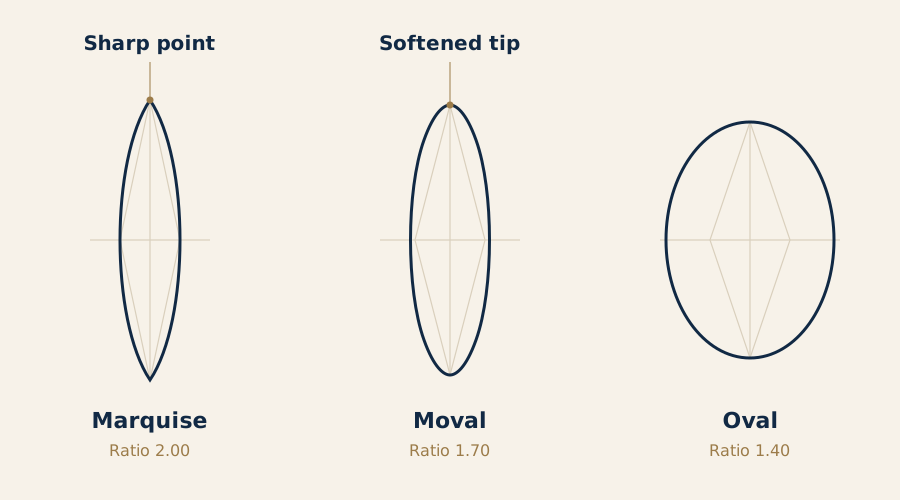
A marquise is a long, boat-shaped brilliant with two sharp points, usually 1.85–2.10 in ratio. A moval blends marquise and oval: a slightly shorter outline with softer, rounded tips. The marquise faces up longer per carat and reads more dramatic; the moval is easier to set, less prone to chipping and looks softer on the hand.
What is the difference between a marquise vs moval diamond?
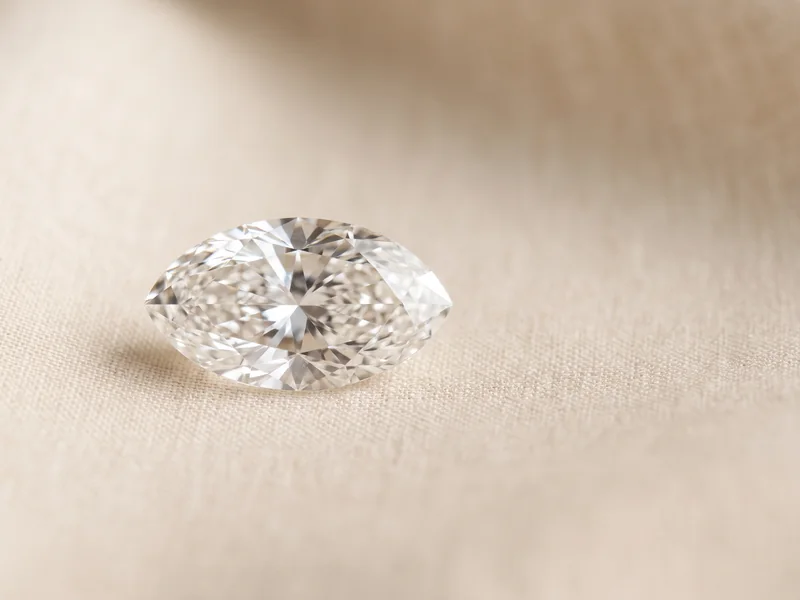
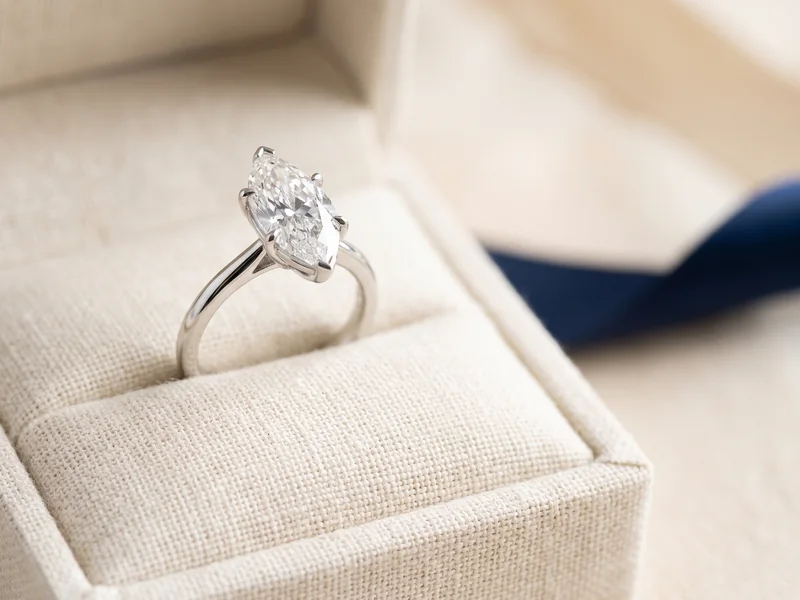
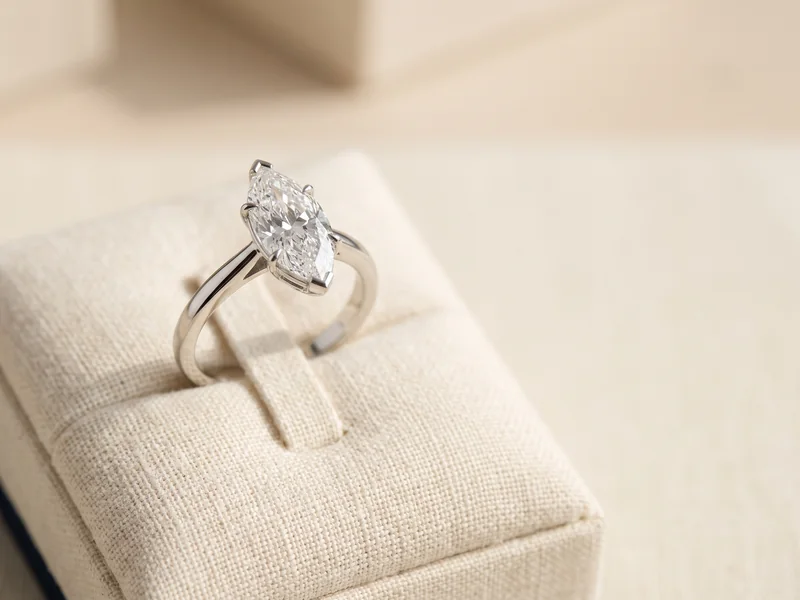
A marquise is a long, narrow diamond with curved sides that meet in a sharp point at each end, a bit like a boat seen from above. It is a modified brilliant: it uses the same triangular and kite-shaped facets as a round brilliant, rearranged to suit the elongated outline, usually around 56–58 facets. Our full marquise cut guide covers its history and grading in depth.
A moval is a newer hybrid, and the name says it all: marquise plus oval. It keeps the slim, tapering look of a marquise but rounds off the tips, so the ends look like a softened point rather than a needle. Some movals lean towards the marquise, with a small visible tip; others are closer to a long oval with slightly drawn-out ends. That variation is normal, because the moval is not a strictly defined shape and each cutter interprets it a little differently. For the full background, see everything about the moval cut.
Both are real diamond, 10 on the Mohs hardness scale with a refractive index of about 2.42, and both can be natural or laboratory-grown. Most movals on the market today are lab-grown, because the shape became popular recently and lab-grown cutters can produce new shapes from rough to order. Both belong to the wider family of elongated diamond cuts, and any unfamiliar term here is explained in our GemTrove jewellery glossary.
What ratio should a marquise or moval diamond have?
The length-to-width ratio is the stone's length divided by its width, both taken from the grading report. It is the single quickest way to tell how slim a stone will look. A marquise is usually the longer and slimmer of the two; a moval usually sits a little shorter and fuller, closer to a long oval.
| Marquise | Moval | |
|---|---|---|
| Typical ratio | 1.85–2.10 | 1.55–1.85 |
| Below the range | Looks short and wide, points can look stubby | Starts to look like an ordinary oval |
| Above the range | Very thin, points more exposed | Starts to look like a marquise |
| Ends | Two sharp points | Two softened, rounded tips |
| Outline consistency between cutters | Well established | Varies; check photos of each stone |
Within those ranges it is personal taste. A marquise at 1.85 looks fuller and more traditional; at 2.10 it is very elegant but the points become longer and thinner. Our page on marquise ratios in more detail shows how each step changes the look. For a moval, decide first whether you want it to read as a softened marquise (around 1.75–1.85) or as a stretched oval (around 1.55–1.65).
Symmetry matters for both. The two halves should mirror each other along the length and across the middle, and the tips should line up on the same centre line. A marquise with one point slightly off-centre looks bent on the hand; a moval with one end rounder than the other looks lopsided. Our guide to checking marquise symmetry by eye applies to movals too.
How do marquise and moval diamonds look on the hand?
Set north-south (lengthways along the finger), both shapes make the finger look longer and slimmer. The difference is in character:
- Marquise: crisp, graphic and a little vintage. The points draw the eye to each end, and the outline is recognisable from across a room. It suits people who like a distinctive, deliberate shape.
- Moval: softer and more modern. It still elongates the finger, but the rounded tips make it read as gentle rather than sharp. It suits people who like the marquise's length but find the points too pointy, or who want something less common than an oval.
- East-west: both can be set across the finger. A marquise set east-west looks bold and architectural; a moval set east-west looks like a sleek, low-key bar of light.
If you are torn between the marquise and other pointed shapes, it helps to see how a marquise compares with a pear: the pear keeps one point and rounds the other, a different way of softening the same idea.
Marquise vs moval size: which looks bigger per carat?
The marquise is famous for looking large for its weight. Because it is long and shallow-spreading, more of its weight sits in the outline you see from above (the face-up size) rather than hidden underneath. A moval of the same carat is usually a little shorter but a little wider, so its face-up area is similar while its length is less.
| Carat weight | Marquise (approx. length × width, ratio ~2.00) | Moval (approx. length × width, ratio ~1.70) |
|---|---|---|
| 0.50 ct | about 8.0 × 4.0 mm | about 7.2 × 4.3 mm |
| 0.75 ct | about 9.0 × 4.5 mm | about 8.2 × 4.8 mm |
| 1.00 ct | about 10.0 × 5.0 mm | about 9.0 × 5.3 mm |
| 1.50 ct | about 11.5 × 5.8 mm | about 10.3 × 6.1 mm |
| 2.00 ct | about 12.5 × 6.3 mm | about 11.3 × 6.7 mm |
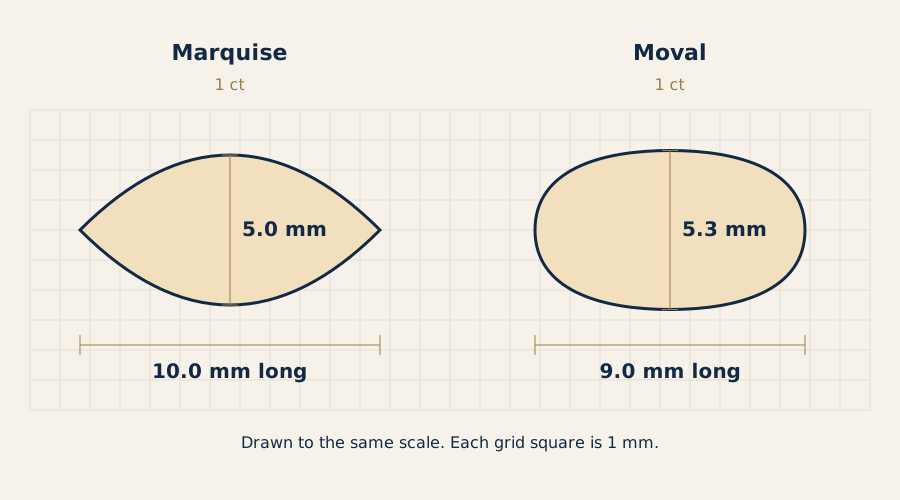
These are typical figures only. Depth makes a big difference: a stone cut deep carries hidden weight and looks smaller face-up, while a very shallow stone spreads wider but can look glassy. Always compare millimetre measurements, not just carat weight. The length is what most people notice on the finger, which is why a marquise often looks like the bigger stone even when the areas are close. For the full picture across every shape, see which shapes look largest for their weight.
Not sure which one is right?
Send us the stones you are looking at and our gemologist will tell you which to choose and why.
Which sparkles more, a marquise or a moval?
Both are brilliant-faceted, so both give the bright, scattered sparkle of a round brilliant, broken into longer flashes by the elongated shape. Neither has an overall cut grade from GIA, because GIA only gives cut grades to round brilliants, so you judge the cut from proportions, symmetry and, above all, how the stone looks in a video.
The main thing to watch in both is the bow-tie: a dark band across the middle where light leaks out instead of returning to your eye. It is common in marquise diamonds and also appears in many movals. A faint bow-tie that flickers as the stone moves adds contrast and is fine. A dark band that stays put in every position means the proportions are off. As a rough guide, many well-cut marquise and moval diamonds sit at a total depth of about 58–64% and a table (the large top facet) of about 53–63% of the width, but the look matters more than the numbers.
- Ends: a marquise's sharp points can show a little more body colour, because the stone is thin and the facets are crowded there. A moval's rounded tips hold colour a little less visibly.
- Colour choice: in white gold or platinum most people are happy from G–H in either shape; in yellow or rose gold, I–J often looks white.
- Clarity: aim for eye-clean, usually VS2 or a carefully chosen SI1. Avoid inclusions at the tips, where they are easier to see and can weaken the stone.
If you love an elongated outline but want a quieter, glowing look rather than fire, a marquise-shaped flat-based rose cut is worth seeing. And for something rarer again in the fancy-shape world, the unusual calf's head cut shows how far cutters push outlines.
Is a moval diamond more durable than a marquise?
Diamond is the hardest natural material, but hardness is not toughness. Diamond can still chip along its cleavage planes (natural lines of weakness in the crystal) if a thin edge takes a hard knock. A marquise has two thin, exposed points, which are its most vulnerable areas. A moval rounds those points off, so the ends are thicker and less likely to chip.
That does not make a marquise fragile in everyday wear. With each point protected by a V-claw (a V-shaped claw that wraps the tip) or a bezel, a marquise wears well for decades. It simply needs that protection from the start, and a little care around door frames and gym equipment. Our guide to ways to keep marquise points safe goes through the options.
Movals with a small visible tip still benefit from claws placed at the ends. Movals that are almost round at the ends can be held safely by four or six ordinary claws, much like an oval.
What settings suit a marquise or moval engagement ring?
The setting is where the two shapes differ most in practice. The usual options for a marquise engagement ring and a moval engagement ring:
- Six claws with V-claws (marquise): two V-claws cover the points and four claws hold the sides. This is the traditional and most protective claw setting.
- Four or six claws (moval): because the tips are softer, standard rounded claws often work, placed at or near each end.
- Bezel or half-bezel: a thin rim of metal around the stone, or just around the ends. Very secure for both shapes and modern in look.
- Halo: small diamonds around the centre stone frame the outline and shield the edge.
- Side stones: tapered baguette side stones give clean, straight lines either side of a long centre stone.
- Toi et moi and east-west: both shapes work in two-stone designs and set across the finger.
For side-by-side examples, see setting styles that suit a marquise. Think about the wedding band early too. A marquise's points stick out past the band line and can stop a straight band sitting flush, so contoured or notched bands are common. A moval usually sits more comfortably beside a straight band. Our guide to wedding bands shaped to sit beside a marquise shows the options.
How much do marquise vs moval diamonds cost in Australia?
Both shapes are cut from natural and laboratory-grown diamond, and the two look identical to the eye. Lab-grown diamonds are real diamond grown in a laboratory rather than mined; they cost much less and are easy to find in larger sizes. Natural diamonds are rarer. Both should come with an independent grading report from a lab such as GIA or IGI, and the report will say whether the stone is natural or lab-grown.
| 1 ct, G–H colour, VS clarity | Approximate price range (AUD) |
|---|---|
| Lab-grown marquise | about $1,000–$3,000 |
| Lab-grown moval | about $1,000–$3,500 |
| Natural marquise | about $6,000–$14,000 |
| Natural moval | limited supply; price varies widely by stone |
These are broad ranges only, and prices move with the market and the exact grades. A marquise usually costs less per carat than a round of the same weight, colour and clarity. Lab-grown movals are priced much like other lab-grown fancy shapes. Natural movals are uncommon, partly because a cutter has to choose that shape from the rough, so there are fewer to compare and prices are less predictable.
Browse marquise and oval diamonds: natural and lab-grown
If you are weighing up a moval against its other parent shape, our comparison of how a moval compares with an oval sets out the differences. To see every shape side by side, start with our overview of all the main diamond shapes.
Marquise or moval: how do you choose? Step by step
In short: choose a marquise if you want the most length for your carat, a classic and distinctive outline, and you are happy to protect the points. Choose a moval if you want an elongated look with softer ends, a simpler setting and a band that sits flush more easily.
- Decide on the look. Sharp and graphic (marquise) or soft and modern (moval). Look at both on a hand, not just loose.
- Read the report. Confirm the shape description, measurements, colour, clarity, polish, symmetry and whether the diamond is natural or lab-grown.
- Work out the ratio. Divide length by width. Aim for about 1.85–2.10 for a marquise and about 1.55–1.85 for a moval.
- Check symmetry. Both halves should mirror each other, and the tips should sit on one centre line.
- Watch a 360° video. Look for a bow-tie that stays dark and any inclusions near the tips.
- Compare millimetres. Check face-up length and width, not just carat weight.
- Plan the setting and band together. V-claws or a bezel for a marquise's points; check how the wedding band will sit beside either shape.
Free consultation
Talk to a gemologist
Compare stones in person or online with Raj Sood, Graduate Gemologist (GIA), AJP (GIA).
Book a consultationFAQ
Common questions
What is a moval diamond?
A moval is a hybrid of the marquise and oval shapes. It has the long, tapering outline of a marquise but with softer, rounded tips instead of sharp points.
Moval vs marquise diamond: which looks bigger?
At the same carat weight, a marquise is usually longer, so it tends to look bigger on the finger. A moval is a little shorter but slightly wider, so the face-up areas are often similar.
Is a moval diamond durable?
Generally, yes. Because its tips are rounded, a moval's ends are thicker and less prone to chipping than a marquise's points, so it is more forgiving and can often be held by ordinary claws. Movals with a small visible tip still benefit from claws at the ends.
Do marquise diamonds chip easily?
The two points are the thinnest parts, so they are more exposed than the edge of a round. Protected by V-claws or a bezel, a marquise is fine for everyday wear.
Can you get a lab-grown moval diamond?
Yes. Most movals available today are lab-grown, and they are graded by labs such as IGI on the same colour and clarity scales used for natural diamonds. Natural movals exist but are less common.
Is a moval more expensive than a marquise?
Not usually in lab-grown, where the two are priced similarly. Natural movals are uncommon, so prices vary more from stone to stone.

Ask a gemologist
Not sure which diamond to choose?
Raj Sood is a Graduate Gemologist (GIA) and master jeweller. Bring the stones you are considering, or send the reports, and he will tell you honestly which one is better and why.
Keep learning
Related guides
 Diamond ShapesMoval Cut Diamonds
 Diamond ShapesMarquise Cut Diamonds Melbourne
 Diamond ShapesOval vs Moval Diamonds
 Engagement Rings & SettingsBest Settings for Marquise DiamondsDiamond ShapesUnderstanding Diamond Shapes
 Diamond ShapesMarquise Diamond Length-to-Width RatioDiamond ShapesProtecting Marquise Diamond PointsDiamond ShapesMarquise vs Pear Diamonds
Explore more
More guides on this topic
Education