
- Education
- Diamond Shapes
- Moval Cut Diamond Guide: Shape, Ratio, Settings and Price
Diamond shapes
Moval Cut Diamond Guide: Shape, Ratio, Settings and Price
The moval cut diamond sits between two classic shapes, the soft oval and the pointed marquise. Because it is so new, there are few agreed standards, so here is what to check before you choose one.
 Reviewed by Raj Sood, Graduate Gemologist (GIA), AJP (GIA)Master jeweller and Graduate Gemologist (GIA) · reviewed 4 November 2026
Quick answer
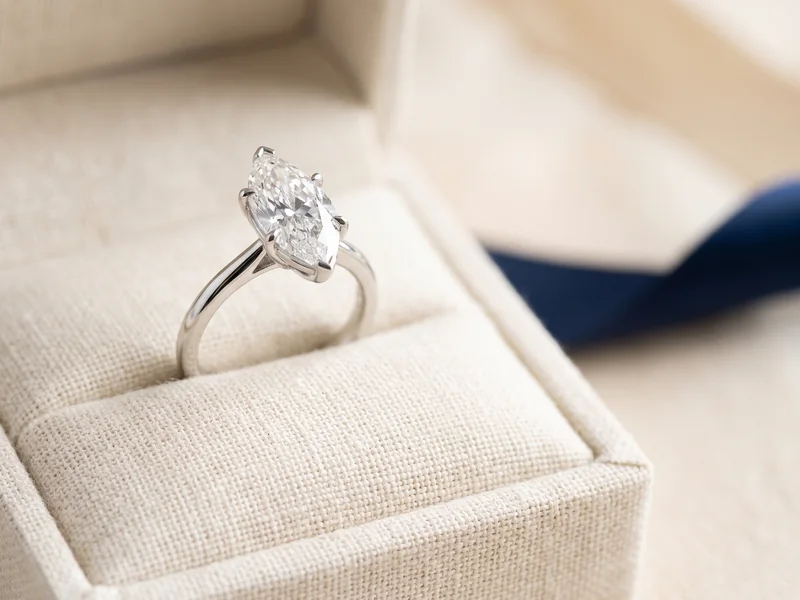
A moval cut diamond is a modified brilliant that blends a marquise and an oval: a long, curved outline with gently tapered ends that are softer than a marquise's points. Look for a length-to-width ratio of about 1.60–1.90, even shoulders, a faint bow-tie at most, and claws or V-claws that protect the ends.
What is a moval cut diamond?
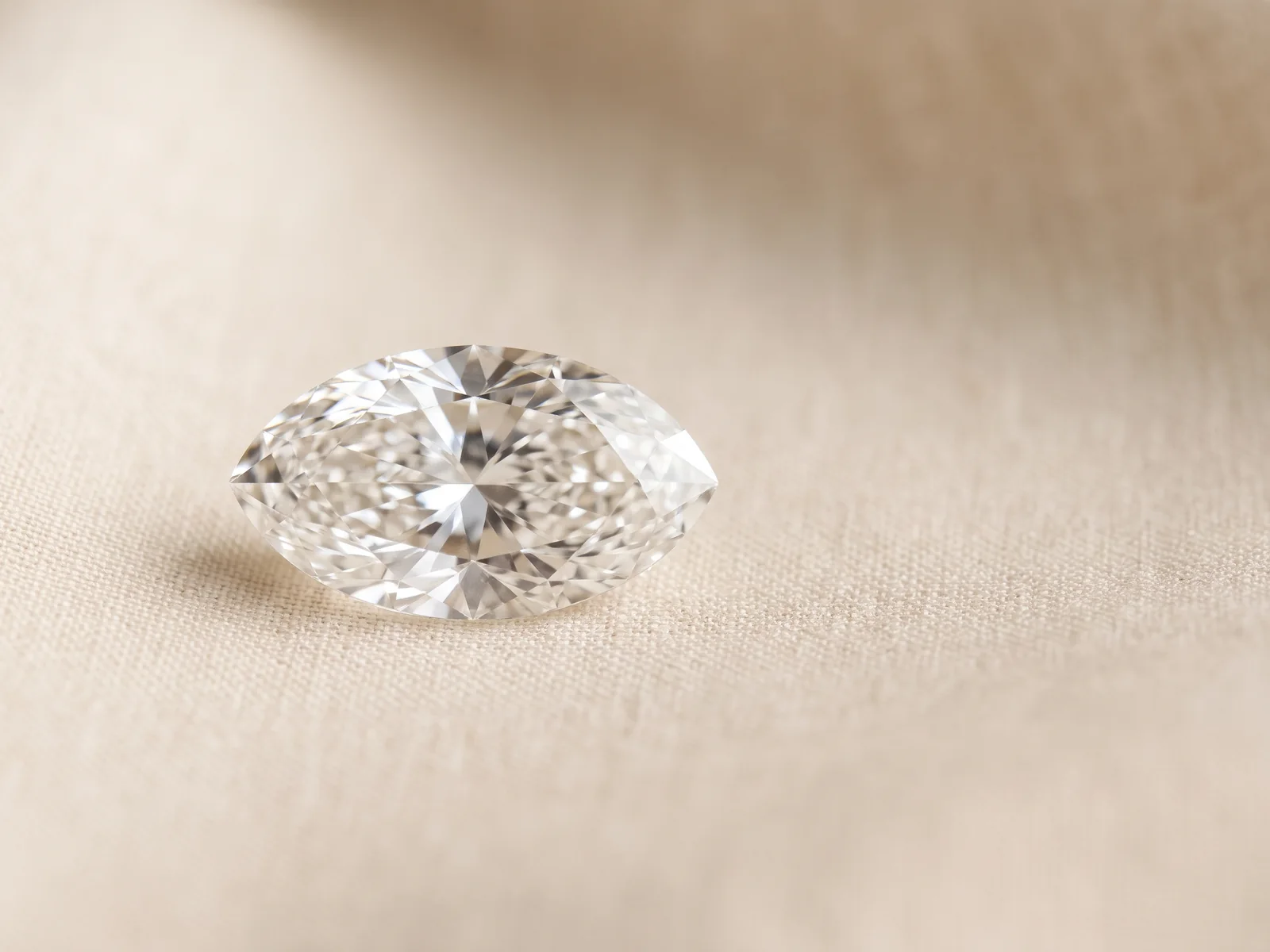
A moval cut diamond is an elongated diamond whose outline sits between a marquise (long, with two sharp points) and an oval (long, with two rounded ends). The name simply joins the two words. Picture an oval that has been gently pinched at each end, or a marquise whose points have been softened and whose sides have been filled out. The result is a slim, curved stone with tapered ends that are neither fully round nor fully pointed.
It is a modified brilliant cut. That means it uses the same kind of triangular and kite-shaped facets as a round brilliant, rearranged to suit a long outline. The aim of brilliant faceting is sparkle: bright white flashes (brilliance) and small rainbow flashes (fire). The moval belongs to the family of long, slender diamond cuts and is one of the newer shapes in our guide to every diamond cut, explained and compared.
Moval is a trade nickname rather than a formal grading term, and it has only become common in the last few years, largely through laboratory-grown diamonds. Cutters do not all agree on exactly where an oval ends and a moval begins, so two stones sold as movals can look quite different. That is the main reason this guide focuses on what to look at, rather than on fixed numbers.
Diamond itself is 10 on the Mohs hardness scale, with a refractive index of about 2.42, which is what gives brilliant cuts their strong sparkle. Hardness is not the same as toughness, though. A thin, tapered end can still chip if it takes a knock, which shapes the setting advice below. If any term is new to you, our plain-English jewellery glossary explains it, and if you enjoy unusual outlines generally, the triangular cut and six-sided hexagonal cut are two more geometric options worth knowing.
How is a moval diamond faceted and what makes it look different?
Like its two parent shapes, a moval has a table (the large flat facet on top), a crown (the angled facets above the girdle), a girdle (the thin outer edge) and a pavilion (the deeper facets underneath that return light to your eye). Face-up, it has four regions that matter for its look:
- Ends (tips): tapered and narrower than an oval's, but blunter than a marquise's points. Some cutters leave a very slightly rounded tip; others bring it close to a point.
- Shoulders: the curves running from the widest part of the stone towards each end. In a moval these are flatter and longer than an oval's, which is what creates the tapered look.
- Belly: the widest part across the middle. A moval's belly is fuller than a marquise's, so it carries more brightness through the centre.
- Keel line: the line of facets running down the length of the pavilion, which affects how light moves along the stone.
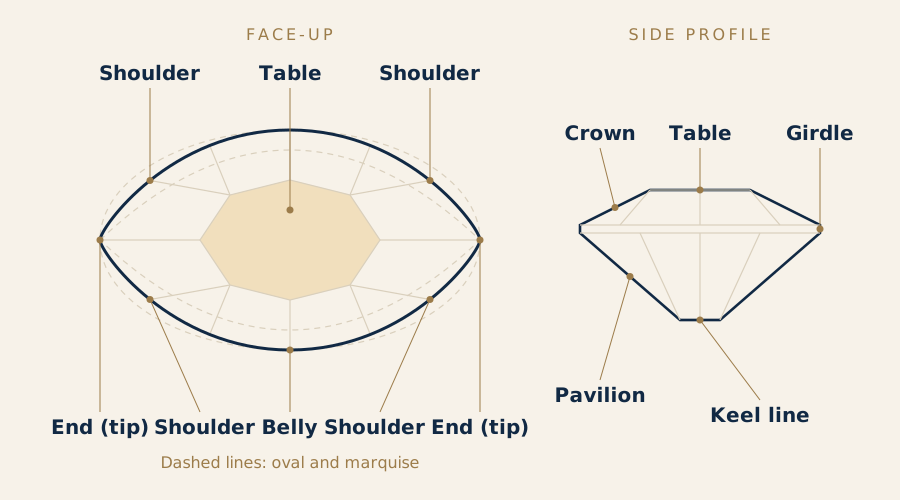
The facet arrangement usually follows the oval and marquise cut pattern, with main pavilion facets radiating from the centre and smaller facets around the girdle. Facet counts vary by cutter, commonly somewhere in the mid-50s. If you compare a moval with an oval diamond of the same weight, the moval usually looks longer and a little more dramatic, with more of its sparkle drawn out towards the ends.
Do not confuse it with the lozenge cut, which also has two tapered ends but straight sides and is usually step cut (with long, parallel facets like steps) rather than brilliant cut.
What is the best length-to-width ratio for a moval cut diamond?
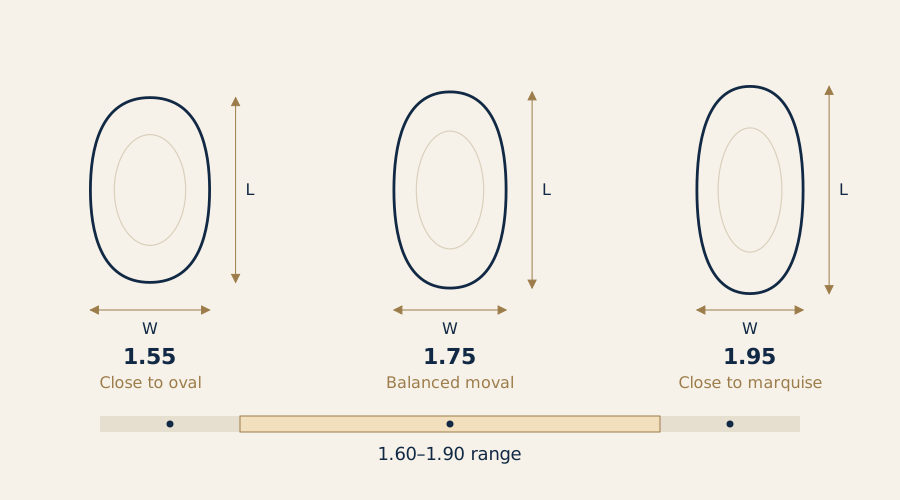
The length-to-width ratio compares how long the stone is with how wide it is. Divide the length by the width from the grading report's measurements. A ratio of 1.75 means the diamond is 1.75 times as long as it is wide. Because the moval is defined by being longer and more tapered than an oval, its ratio sits above the usual oval range and below the usual marquise range.
| Ratio | How it looks | Notes |
|---|---|---|
| Below 1.55 | Reads mostly as a slim oval | May not look like a moval at all unless the ends are clearly tapered |
| 1.60–1.75 | Balanced moval, soft taper | A popular range for engagement rings |
| 1.75–1.90 | Long and slender, more marquise-like | Looks elegant on longer fingers; ends are thinner |
| Above 1.95 | Very narrow, close to a marquise | Check the ends are protected and the belly still looks bright |
There is no standard ideal for a moval. GIA gives an overall cut grade only to round brilliants, so for fancy shapes like this you judge the cut from the proportions, polish, symmetry and, above all, how the stone looks. Our comparison of what ideal and excellent cut grades really mean explains why those labels only apply neatly to rounds. As a rough starting point, many well-cut elongated brilliants sit at a total depth of about 58–64% and a table of about 53–63% of the width.
Most movals show some bow-tie effect: a darker band across the belly where light escapes instead of returning to your eye. All long brilliant shapes have it to some degree. A faint bow-tie that shifts as the stone moves adds contrast and is normal. A dark band that stays put in every position suggests the pavilion angles are off. Photos often hide this, so watch a 360° video and keep your eye on the middle of the stone.
What colour and clarity should a moval diamond be?
Elongated fancy shapes show body colour more than rounds do, and in a moval any warmth tends to collect towards the ends, where the stone is thinnest and the facets are crowded together. In white gold or platinum, most people are happy from H colour or better; if you are sensitive to a warm tint, look at G or higher. In yellow or rose gold, I or J can look just as white, because the metal warms everything around it.
For clarity, aim for an eye-clean stone, meaning no inclusions (internal features) you can see without magnification at normal viewing distance. Brilliant faceting hides small inclusions well, so VS2 or a carefully chosen SI1 is usually enough. Look closely at the ends: an inclusion near a tip is easier to see and, if it reaches the surface, can weaken the thinnest part of the stone. Ask to see the plotting diagram on the report, which maps where each inclusion sits.
- White metal: G–H colour, VS2–SI1 eye-clean.
- Yellow or rose gold: I–J colour can look white, VS2–SI1 eye-clean.
- Avoid: feathers (small internal cracks) near either end, and inclusions sitting directly under the table, where the eye goes first.
Lab-grown movals graded by labs such as IGI use the same colour and clarity scales as natural diamonds, while GIA now describes lab-grown colour and clarity in broader terms. Because lab-grown stones cost much less, many people choose a higher colour, such as E or F, at a price that would buy a much lower grade in a natural moval.
Not sure which one is right?
Send us the stones you are looking at and our gemologist will tell you which to choose and why.
How big does a moval cut diamond look for its weight?
Long shapes spread their weight over a larger face-up area (the size you see from above) than a round of the same carat weight, and the moval is no exception. Its length also makes the finger look slimmer. The figures below are approximate for a moval around 1.65–1.70 in ratio with average depth.
| Carat weight | Typical size (length × width) |
|---|---|
| 0.50 ct | about 7.0 × 4.2 mm |
| 0.75 ct | about 8.0 × 4.8 mm |
| 1.00 ct | about 8.8 × 5.3 mm |
| 1.50 ct | about 10.1 × 6.1 mm |
| 2.00 ct | about 11.1 × 6.7 mm |
For comparison, a 1 carat round brilliant is about 6.4 mm across. Because movals are not standardised, two 1 carat stones can differ by a millimetre or more in length, so always compare the millimetre measurements on the report rather than relying on carat weight. A deeper stone carries more weight underneath and faces up smaller; a very shallow stone spreads wider but can look glassy and dull through the belly.
What is the best setting for a moval diamond ring?
The ends are the most exposed part of a moval, so the setting's first job is to protect them while showing off the long outline. The usual options for a moval engagement ring:
- Four or six claws: four claws placed at the shoulders show the most diamond; six claws add one at each end for extra security.
- V-claws at the ends: a V-shaped claw wraps each tip. This suits movals cut with sharper ends, and is the same approach used for marquise and pear shapes.
- Bezel or half-bezel: a thin rim of metal around the edge, or just around the ends. Very secure for an active lifestyle, though it hides a little of the outline.
- Halo: a ring of small diamonds around the moval makes it look larger and shields the edge. Because the ends taper, the halo needs careful shaping so it follows the outline rather than rounding it into an oval.
- Side stones: bullet cut side stones, tapered baguettes or small pears either side give a clean, pointed line that echoes the moval's ends.
- East-west: setting the moval sideways across the finger is a modern option that suits its length, and can be set lower for everyday wear.
For the wedding band, a moval set reasonably low will often sit beside a straight band, because its narrow width leaves room either side. If the ring has a halo or a wide gallery (the metalwork under the stone), a contoured or slightly curved band sits closer. Try the engagement ring and band together before you finalise either.
Related guideOval vs Moval DiamondsHow does a moval compare with oval, marquise and pear diamonds?
| Moval | Oval | Marquise | Pear | Round | |
|---|---|---|---|---|---|
| Outline | Long curve, tapered ends | Smooth curve, round ends | Long curve, two sharp points | One round end, one point | Circle |
| Typical ratio | 1.60–1.90 | 1.30–1.50 | 1.85–2.10 | 1.45–1.75 | 1.00 |
| Bow-tie | Common | Common | Common | Common | No |
| Exposed ends | Two, softer than marquise | None | Two sharp points | One point | None |
| Availability | Limited, mostly lab-grown | Wide | Moderate | Wide | Widest |
| Price per carat | Usually below a round | Usually below a round | Usually below a round | Usually below a round | Highest |
If you are torn between the moval and its softer parent, our side-by-side oval and moval comparison shows how the two differ at the same weight. If you are drawn to drama, the marquise versus moval guide explains how much point you are trading for durability. A pear cut diamond is another long shape, with one round end and one point, and the heart shaped diamond takes the pear idea a step further with two lobes.
For something less curved, a shield cut offers straight-edged geometry, while the classic square princess cut gives a crisp, modern look on a ring. To see every outline together and narrow down what suits your hand, start with our introduction to diamond shapes.
How much does a moval cut diamond cost in Australia?
Movals are cut from both natural and laboratory-grown diamond, and the two look identical to the eye. Lab-grown diamonds are real diamond, with the same hardness and refractive index, grown in a laboratory rather than mined; they cost much less. Because the moval is a new shape and cutters prefer to keep as much weight as possible from natural rough, natural movals are scarce, and most movals you will see are lab-grown. Both should come with an independent grading report from a lab such as GIA or IGI that states clearly whether the stone is natural or lab-grown.
| 1 ct moval, G–H, VS | Approximate price range (AUD) |
|---|---|
| Lab-grown | about $800–$2,500 |
| Natural | about $6,000–$14,000 |
These are broad ranges only; prices move with the market and with the exact grades and measurements. Like other elongated shapes, a moval usually costs less per carat than a round of the same weight, colour and clarity, partly because demand is lower and partly because more of the rough crystal can be kept during cutting. Within movals, carat weight, colour, clarity and how well the outline is balanced move the price most. Because natural movals are rare, you may find a wider choice in natural ovals if a mined diamond matters to you.
Shop moval and oval diamonds: natural and lab-grown
How do you choose a moval cut diamond? Step by step
- Read the report. Confirm the shape description, measurements, colour, clarity, polish and symmetry, and whether the diamond is natural or lab-grown.
- Work out the ratio. Divide length by width; most people settle on about 1.60–1.90, depending on how long and tapered they want it.
- Check the outline by eye. Both ends should taper evenly, the shoulders should match, and the stone should not look like an oval at one end and a marquise at the other.
- Watch a 360° video. Look for a bow-tie that stays dark and for inclusions near either end.
- Compare face-up size. Use the millimetre measurements, not just carat weight, because movals vary widely.
- Plan the setting. Decide how the ends will be protected, with claws, V-claws, a bezel or a halo, before you commit to the stone.
- Try it with a band. Check the wedding band you want sits comfortably beside the setting.
Free consultation
Talk to a gemologist
Compare stones in person or online with Raj Sood, Graduate Gemologist (GIA), AJP (GIA).
Book a consultationFAQ
Common questions
What is the difference between a moval and an oval diamond?
A moval is longer and has tapered ends, while an oval has evenly rounded ends. Movals usually sit at a length-to-width ratio of about 1.60–1.90, compared with roughly 1.30–1.50 for an oval.
Is a moval the same as a marquise?
No. A marquise has two sharp points and narrower sides, while a moval has softer, slightly blunted ends and a fuller belly. That makes a moval a little less exposed at the tips than a marquise.
Are moval cut diamonds natural or lab-grown?
Both exist, but most movals on the market are lab-grown, because the shape is new and cutters of natural rough tend to choose established shapes. The grading report will state whether the diamond is natural or lab-grown.
Do moval diamonds have a bow-tie?
Most do, as with all long brilliant shapes. A faint bow-tie that moves as the stone turns is normal; a dark band that stays put in every position points to weaker proportions.
Is a moval diamond good for an engagement ring?
Yes, as long as the setting protects the ends with claws, V-claws, a bezel or a halo. Its length makes it look large for its weight and slims the finger.
Are moval diamonds cheaper than round diamonds?
Usually, yes. Like other elongated shapes, a moval generally costs less per carat than a round brilliant of the same weight, colour and clarity.

Ask a gemologist
Not sure which diamond to choose?
Raj Sood is a Graduate Gemologist (GIA) and master jeweller. Bring the stones you are considering, or send the reports, and he will tell you honestly which one is better and why.
Keep learning
Related guides
 Diamond ShapesOval vs Moval Diamonds
 Diamond ShapesMarquise vs Moval DiamondsDiamond ShapesElongated Diamond Cuts: Oval, Pear, Marquise, Moval and More
 Diamond ShapesOval DiamondsDiamond ShapesUnderstanding Diamond Shapes
 Diamond ShapesAll 34 Diamond Cuts: Every Shape Explained and Compared
 Diamond ShapesPear Cut Diamonds
 Diamond ShapesMarquise Cut Diamonds Melbourne
Explore more
More guides on this topic
Education