
- Education
- Diamond Shapes
- Square Cut Diamond (Carré) Guide: Facets, Ratio, Colour and Settings
Diamond shapes
Square Cut Diamond (Carré) Guide: Facets, Ratio, Colour and Settings
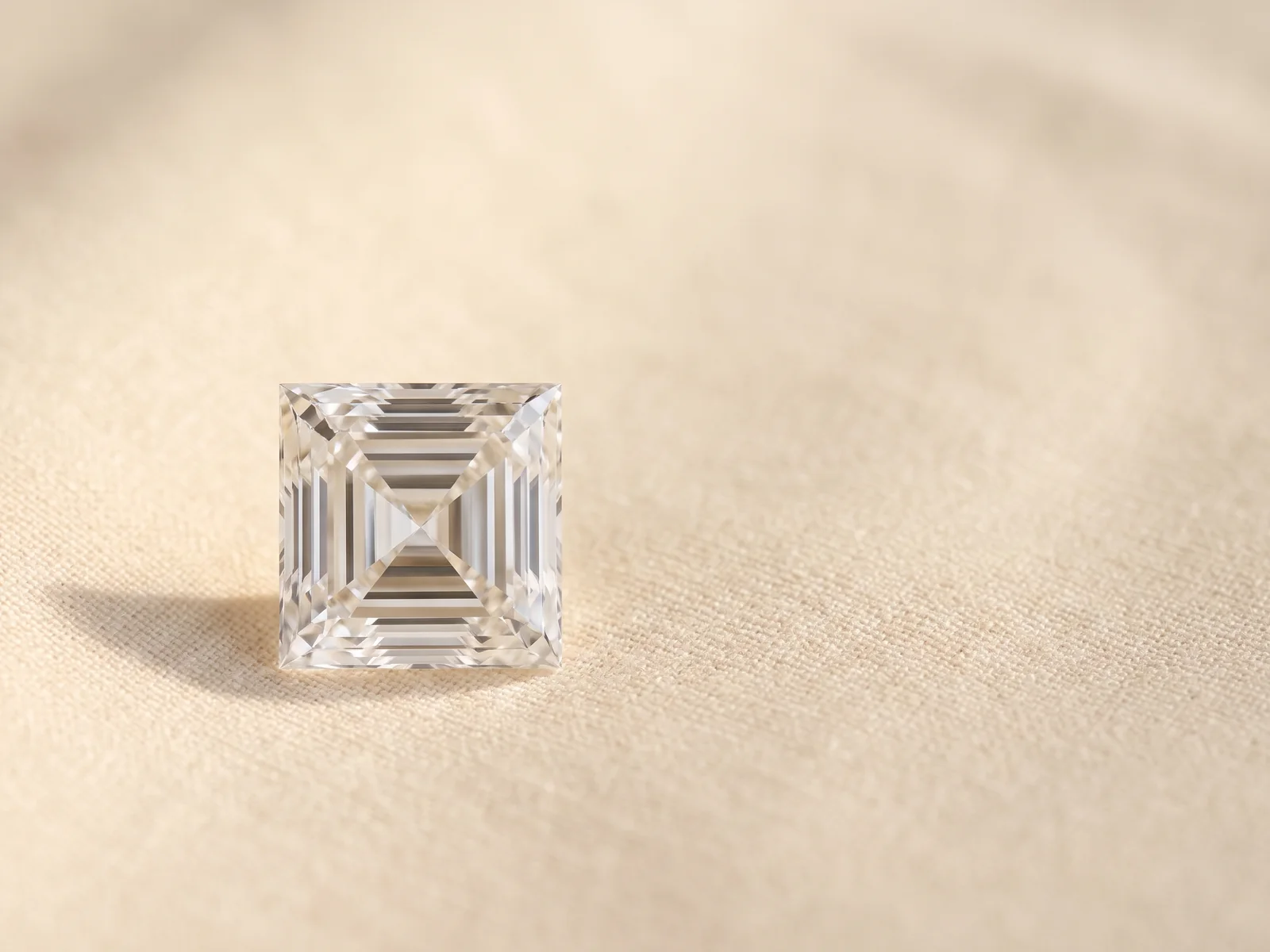
The carré is the purest square diamond cut: clean lines, sharp corners and a large window of a table. That simplicity hides nothing, so it pays to know exactly what to check before choosing one.
 Reviewed by Raj Sood, Graduate Gemologist (GIA), AJP (GIA)Master jeweller and Graduate Gemologist (GIA) · reviewed 4 November 2026
Quick answer
A square cut diamond, or carré, is a square step cut: parallel rows of long facets running round a flat table, with sharp or barely trimmed corners. Look for a ratio of 1.00–1.05, G colour or better and VS2 clarity or higher, because step cuts show colour and inclusions, and choose claws or a bezel that protect the corners.
What is a square cut diamond (carré)?
A carré (French for "square", said kar-RAY) is a square diamond cut in the step-cut style. Instead of the triangular and kite-shaped facets of a brilliant, it has long, flat facets arranged in parallel rows, like the steps of a staircase, around a large flat table (the top facet). The corners are left sharp or trimmed only very slightly, which gives the outline a crisp, architectural square. It belongs to the same family as the emerald, Asscher and baguette, all covered in our guide to step cut diamonds and how they reflect light.
In everyday Australian jewellery talk, "square cut diamond" is used loosely. Many people mean a princess cut, which is square but faceted as a brilliant. Others mean an Asscher, which is square with large cut corners. When a jeweller says carré, they mean something narrower: a square step cut with square, or nearly square, corners. Grading reports usually describe it as a square step cut, so read the shape line on the report rather than relying on the trade name.
Small carrés were a favourite of Art Deco jewellers in the 1920s and 1930s, set edge to edge in lines and geometric patterns. Today they turn up in two main ways: as small calibrated stones (cut to exact millimetre sizes so they sit evenly side by side) in bands and halos, and, less often, as the centre stone of a solitaire or three-stone ring. A large carré centre stone is genuinely uncommon, which is why so few guides cover it.
Diamond is 10 on the Mohs hardness scale and has a refractive index of about 2.42, so a carré's facets take a very high polish and return light strongly. Hardness is not toughness, though. Diamond can chip along its cleavage planes, and a carré has four sharp corners where the stone is thinnest. To see where the carré sits among the other shapes, start with our introduction to diamond shapes or the full list of all 34 diamond cuts compared. Any term you have not met before is explained in the GemTrove jewellery glossary.
How is a carré diamond faceted?
Look down on a carré and you see a series of squares nested inside one another. On the crown (the top half, above the girdle), the table is surrounded by one to three rows of step facets. On the pavilion (the lower half), three or four rows step down towards a point or a very small culet (a tiny flat facet at the bottom). There is no fixed standard, so the total facet count varies with the cutter, commonly somewhere around 25 to 50.
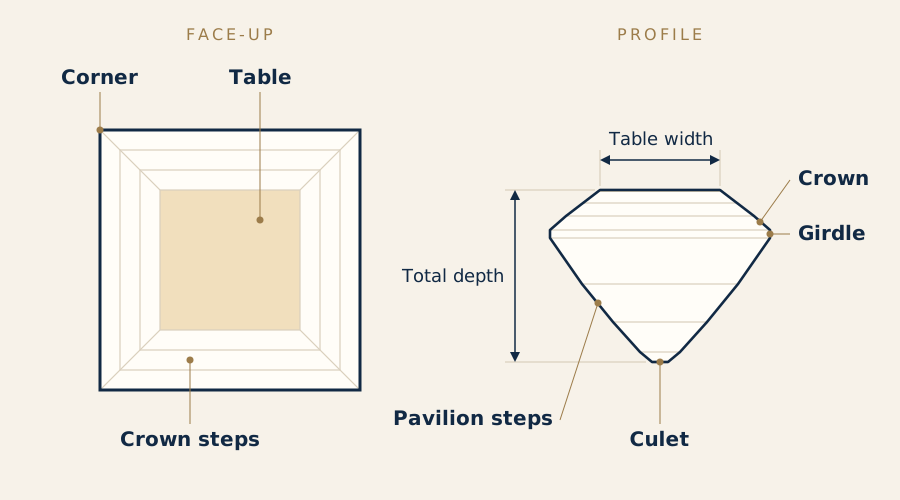
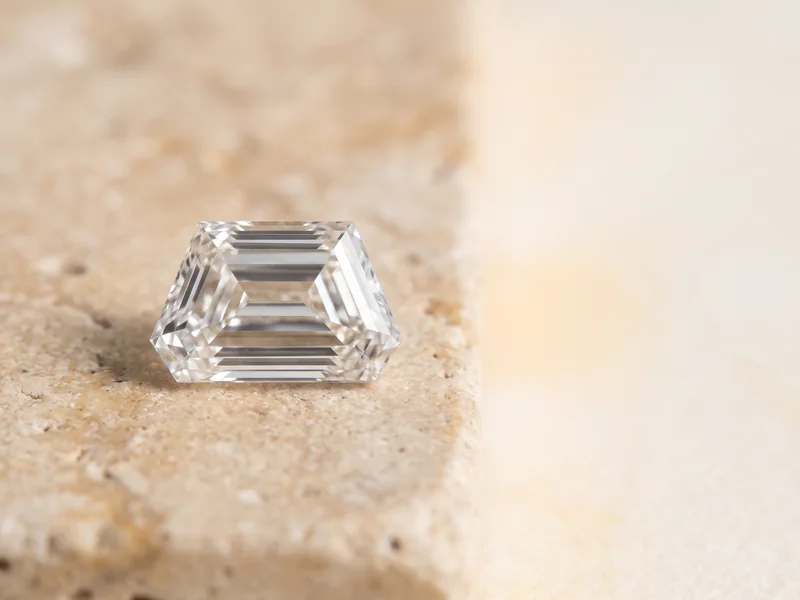
Step faceting changes how the stone behaves in light. A brilliant breaks light into many small sparkles; a step cut returns it in broad flashes, alternating light and dark as the stone moves. Gemmologists often call this the hall-of-mirrors effect. The carré is essentially a square version of the emerald cut, its rectangular cousin, and it shares its faceting with the narrow baguette, the classic rectangular side stone and the tapered trapezoid side stones used beside a centre diamond.
What step faceting means for you:
- Clarity shows more. The open table and long facets act like a window, so inclusions (internal features) are easier to see than in a brilliant.
- Colour shows more. There are fewer small facets to scatter light and mask a warm tint.
- Less fire, more lustre. You get fewer flashes of rainbow colour and more of a bright, glassy shine.
- The outline does the work. Clean, straight lines are the whole point, so the squareness and symmetry need to be accurate.
A close relative, the French cut, is also square, but its crown has triangular facets that meet in a cross or star pattern instead of steps. The two are sometimes sold side by side in antique and Art Deco pieces, so it is worth checking which one you are looking at.
Carré vs Asscher vs princess: what is the difference?
These are the shapes most often called "square cut", and they look quite different once you know what to watch for. The main differences are the faceting style and what happens at the corners.
| Carré | Asscher | Princess | Square radiant | Square cushion | |
|---|---|---|---|---|---|
| Faceting | Step cut | Step cut | Modified brilliant | Mixed / brilliant | Modified brilliant |
| Corners | Sharp or barely trimmed | Large cut corners (octagonal) | Sharp | Cut corners | Rounded |
| Typical facets | About 25–50 | About 58 | About 57–76 | About 70 | About 58–64 |
| Look | Clean flashes, open table | Windmill pattern, high crown | Bright, busy sparkle | Crushed-ice sparkle | Soft, chunky sparkle |
| Typical ratio | 1.00–1.05 | 1.00–1.05 | 1.00–1.05 | 1.00–1.05 | 1.00–1.10 |
| Shows inclusions | Most | A lot | Less | Less | Less |
| Corner risk | High | Low | High | Low | Low |
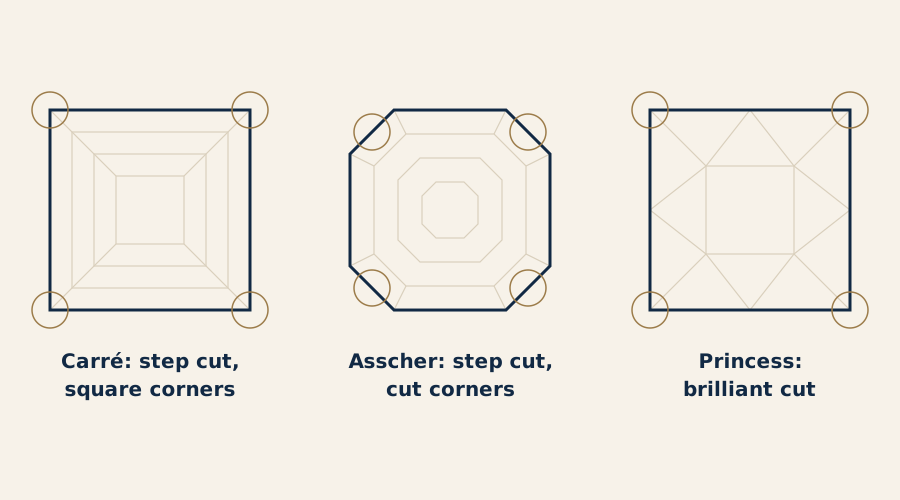
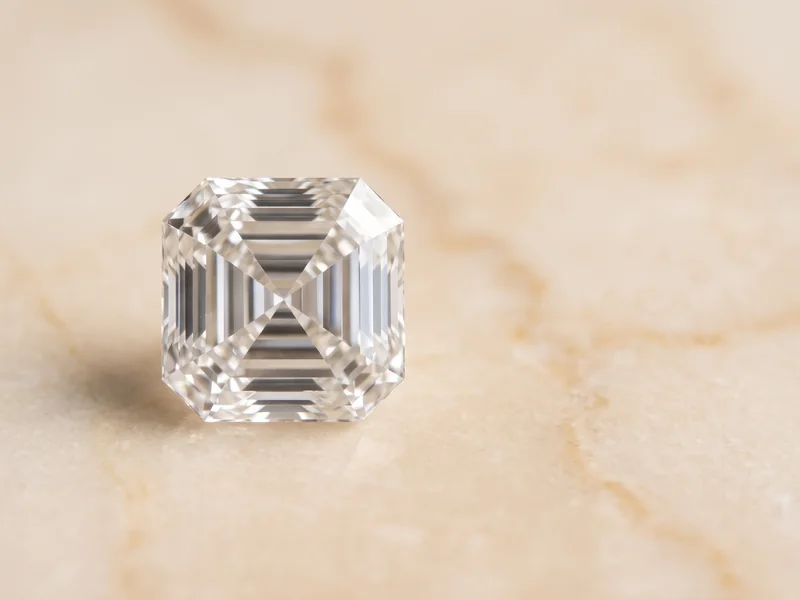
Carré vs Asscher: both are square step cuts, but the Asscher has large cut corners that make it a squared octagon, plus a higher crown and smaller table that produce its windmill pattern. The carré is flatter-looking and more open. Cut the corners further still and you reach the octagonal step cut.
Square cut diamond vs princess cut: a princess has the same sharp-cornered outline as a carré but brilliant faceting, so it sparkles more and hides inclusions and colour better. If you like the square outline but want sparkle, a princess or radiant will suit better; our guide to princess, radiant, cushion and Flanders cuts covers them together. For cut corners with brilliant sparkle, see square radiant diamonds and the side-by-side Asscher vs square radiant comparison. If you prefer a softer square with rounded corners, read how square cushions compare with elongated ones.
Related guideAsscher Cut DiamondsWhat are the ideal proportions for a square cut diamond?
The length-to-width ratio compares the stone's length with its width: divide one by the other using the measurements on the grading report. For a carré to look square, aim for 1.00–1.05. At 1.06 to 1.10 most people start to notice it looks slightly rectangular, especially when it sits beside a straight band.
| Measurement | Guide range for a carré | Why it matters |
|---|---|---|
| Length-to-width ratio | 1.00–1.05 | Above about 1.05 the square starts to look rectangular |
| Total depth | about 60–70% | Too shallow causes a see-through window; too deep looks small and dark |
| Table | about 60–70% of width | A larger table is normal for step cuts, but very large tables lose brightness |
| Girdle | Thin to slightly thick | A very thin girdle at the corners is a chipping risk |
| Culet | None to very small | A large culet shows as a dark dot through the table |
| Polish and symmetry | Excellent or Very Good | Step cuts show uneven rows and misaligned facets clearly |
GIA does not give an overall cut grade to square step cuts the way it does to round brilliants, so you have to judge the cut yourself from the proportions, the polish and symmetry grades and, most of all, the stone's appearance. Our page on how diamond cut grades work explains what reports do and do not grade, and ideal cut vs excellent cut explains why those labels apply mainly to rounds.
Two faults matter most in a carré. Windowing is a washed-out, see-through area in the centre, caused by a pavilion that is too shallow to reflect light back up. Extinction is the opposite: dark areas, often in the corners, where light leaks out because the stone is cut too deep. A good carré shows lively steps that flash on and off across the whole stone as it moves.
Not sure which one is right?
Send us the stones you are looking at and our gemologist will tell you which to choose and why.
How big does a carré diamond look for its carat weight?
Step cuts carry a fair amount of weight in their depth, so a carré faces up (the size you see from above) slightly smaller than a round of the same weight, and a little smaller than a shallow princess. Because it is square, though, it measures longer corner to corner: a 1 carat carré is about 5.5 mm along each side but close to 7.8 mm across the diagonal.
| Carat weight | Typical size (side × side) | Common use |
|---|---|---|
| 0.05 ct | about 2.0 × 2.0 mm | Channel-set bands, halos |
| 0.10 ct | about 2.5 × 2.5 mm | Bands, side stones |
| 0.15 ct | about 3.0 × 3.0 mm | Side stones, studs |
| 0.25 ct | about 3.5 × 3.5 mm | Studs, small pendants |
| 0.50 ct | about 4.4 × 4.4 mm | Small solitaires, three-stone rings |
| 1.00 ct | about 5.5 × 5.5 mm | Solitaire centre stone |
| 1.50 ct | about 6.3 × 6.3 mm | Solitaire centre stone |
| 2.00 ct | about 7.0 × 7.0 mm | Solitaire centre stone |
Use this square cut diamond size chart as a guide only. A stone cut deeper looks smaller face-up for its weight, while a shallower one spreads wider but risks windowing. Always compare the millimetre measurements on the report, not the carat weight alone. Small calibrated carrés are usually matched by size in millimetres, so a band of 2.0 mm carrés will have stones that line up edge to edge with almost no gaps.
What colour and clarity suit a square cut diamond?
Because a carré has an open table and fewer small facets, it shows both body colour and inclusions more than a brilliant of the same grade. Colour tends to collect in the corners, where light travels through the most diamond. In white gold or platinum, most people are happy from G colour or better; if you are sensitive to a warm tint, look at F or higher. In yellow or rose gold, H or I can look white, because the warm metal colours the reflections anyway.
For clarity, aim for an eye-clean stone, meaning no inclusions visible without magnification at normal viewing distance. In a carré that usually means VS2 or better, and in larger stones many people prefer VS1. A small inclusion that would disappear in a princess can sit in plain view under a carré's table. Check the plotting diagram on the report, which maps where each inclusion sits, and pay attention to anything near the corners.
- White metal: F–G colour, VS1–VS2 clarity.
- Yellow or rose gold: G–I colour can look white, VS2 clarity.
- Small calibrated stones (under 0.10 ct): usually sold in matched colour and clarity ranges; consistency across the row matters more than the exact grade.
- Avoid: feathers (small internal cracks) or chips reaching the corners, and inclusions sitting under the table.
What setting and wedding band suit a carré diamond?
The four sharp corners are a carré's weak points, so the setting's first job is to protect them. The usual choices for a square cut diamond ring:
- Four V-claws: a V-shaped claw wraps each corner. This is the classic solitaire setting for square cuts and shows the most of the stone.
- Bezel or half-bezel: a thin rim of metal around the edge. Very secure and suits the carré's clean lines.
- Channel setting: small carrés sit edge to edge between two metal walls, with no claws in between. This is how most carrés are used in bands.
- Three-stone: a carré centre with smaller carrés, baguettes or trapezoids either side keeps every stone in the step-cut family.
- Halo: a row of small stones around the centre protects the corners and makes the stone look larger, though it softens the strict square look.
For side stones with a more unusual outline, step-cut shield cut side stones and bullet cut diamonds that point towards the centre pair well with a carré, and the six-sided hexagonal cut is another geometric option for a modern design.
A carré solitaire usually sits beside a straight band with no gap, because its sides are flat. If the claws or bezel sit low, a plain band can sit flush against it; with a high setting, check the band clears the claws. Channel-set carré bands are a popular choice as wedding or eternity bands in their own right, and they match a carré or princess engagement ring well. Keep in mind that a full eternity band cannot easily be resized, so confirm the finger size first.
How much does a square cut diamond cost, natural or lab-grown?
Carrés are cut from both natural and laboratory-grown diamond, and the two look the same to the eye. Lab-grown diamonds are real diamond, with the same hardness and refractive index, grown in a laboratory rather than mined; they cost much less and are easier to find in larger sizes. Natural carrés of a carat or more are uncommon. Either way, look for an independent grading report from a lab such as GIA or IGI, which will state whether the stone is natural or lab-grown.
| 1 ct carré, G colour, VS clarity | Approximate price range (AUD) |
|---|---|
| Lab-grown | about $800–$2,500 |
| Natural | about $5,000–$12,000 |
These are broad ranges only, and prices move with the market and with the exact grades. As a rule, square step cuts cost less per carat than round brilliants of the same weight, colour and clarity, because demand is lower and more of the rough crystal can be kept. Higher colour and clarity, which matter more in a carré, push the price up. Small calibrated carrés for bands are priced by the carat for the whole set of stones, and cutting many to an exact matching size adds labour.
Square carré centre stones are rarely held as loose stock by any jeweller, so it is normal to compare reports and videos of stones sourced to order. Browse what is available now to see how step cuts and other shapes compare in real measurements and prices.
Browse all diamonds: natural and lab-grown
How do you choose a carré diamond? Step by step
- Confirm the shape. Check the report says square step cut (not square modified brilliant, which is a princess), and whether the diamond is natural or lab-grown.
- Work out the ratio. Divide length by width from the report's measurements; aim for 1.00–1.05.
- Check depth and table. Look for a total depth around 60–70% and a table around 60–70%, with a thin to slightly thick girdle and no large culet.
- Watch a video in daylight. Look for even, lively steps, no grey window in the centre and no dark corners.
- Check clarity and colour closely. Aim for VS2 or better and G or better in white metal, and make sure no inclusions sit under the table or near the corners.
- Plan the setting. Choose V-claws, a bezel or a channel that protects all four corners, and check how your wedding band will sit beside it.
Free consultation
Talk to a gemologist
Compare stones in person or online with Raj Sood, Graduate Gemologist (GIA), AJP (GIA).
Book a consultationShop this shape
FAQ
Common questions
Is a square cut diamond the same as a princess cut?
Not quite. People often say square cut when they mean a princess, but a princess is a brilliant cut with sparkly triangular facets, while a carré is a step cut with long parallel facets. Both have sharp square corners.
What is the difference between a carré and an Asscher cut?
Both are square step cuts. An Asscher has large cut corners, a higher crown and a windmill pattern, while a carré has square or barely trimmed corners and a flatter, more open look.
Do carré diamonds show inclusions?
Yes, more than most shapes, because the open table and long step facets work like a window. Most people choose VS2 clarity or better so the stone is eye-clean.
Are carré diamonds good for engagement rings?
Yes, as long as the four corners are protected by V-claws, a bezel or a halo. With a protective setting, a carré is fine for everyday wear.
Can you get a lab-grown square cut diamond?
Yes. Lab-grown carrés are available, cost much less than natural ones and are usually graded by IGI on the same colour and clarity scales as natural diamonds; GIA now uses simpler descriptive grades for lab-grown stones.
How big is a 1 carat carré diamond?
About 5.5 × 5.5 mm face-up, depending on how deep it is cut. Across the corners it measures close to 7.8 mm.

Ask a gemologist
Not sure which diamond to choose?
Raj Sood is a Graduate Gemologist (GIA) and master jeweller. Bring the stones you are considering, or send the reports, and he will tell you honestly which one is better and why.
Keep learning
Related guides
 Diamond ShapesAsscher Cut Diamonds
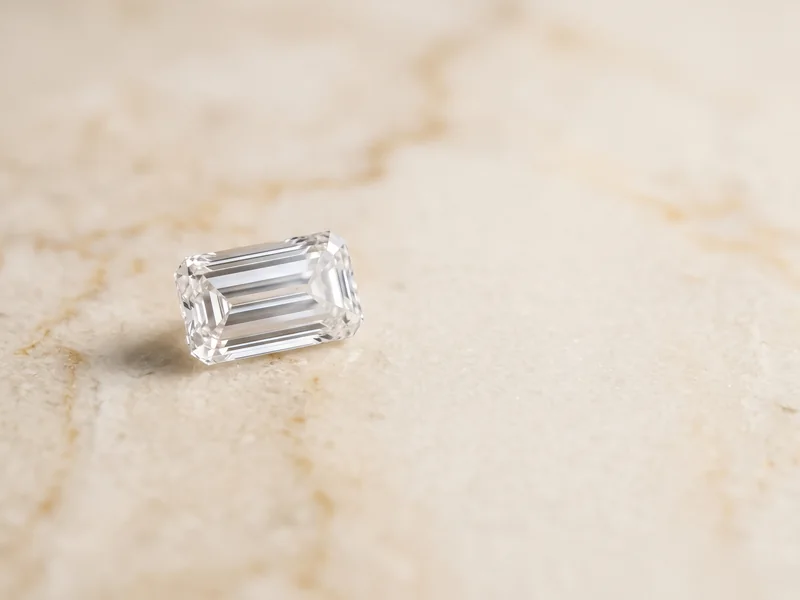 Diamond ShapesStep Cut Diamonds: Emerald, Asscher, Baguette, Carré and More
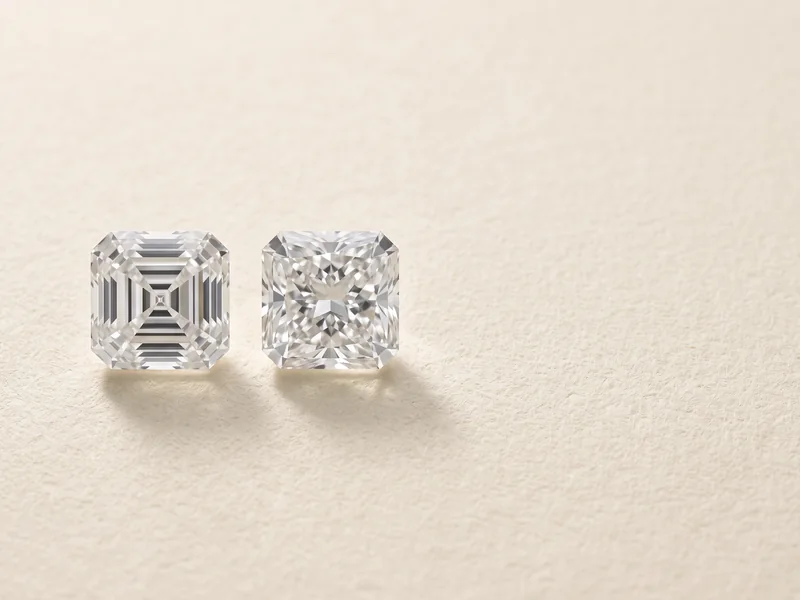 Diamond ShapesSquare Radiant Cut Diamonds
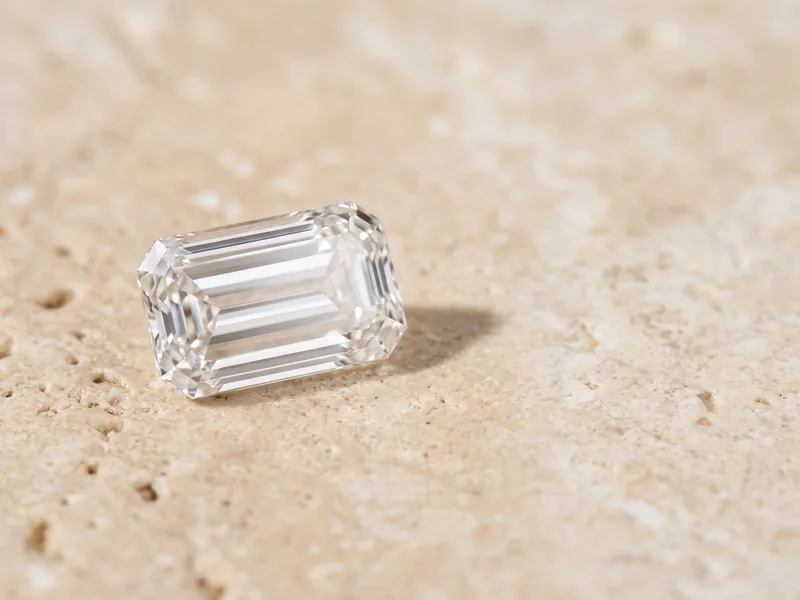 Diamond ShapesEmerald Cut DiamondsDiamond ShapesUnderstanding Diamond Shapes
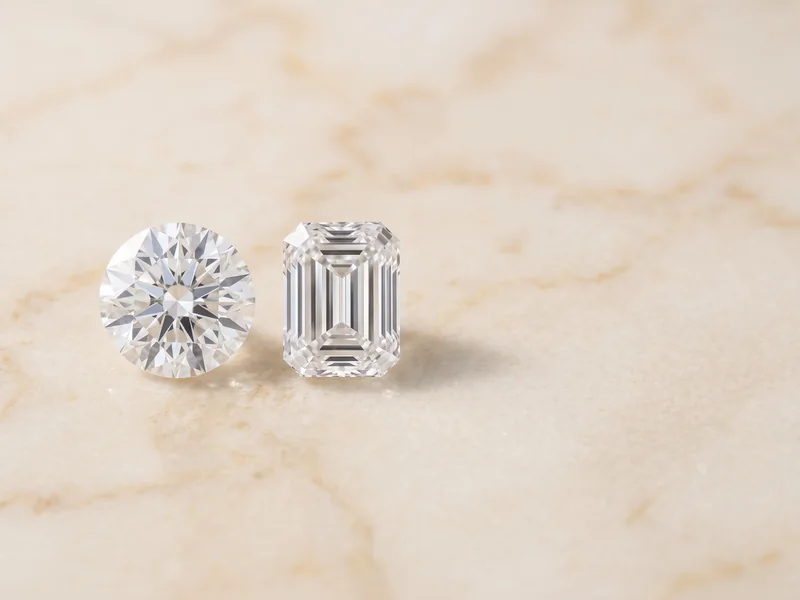 Diamond ShapesAll 34 Diamond Cuts: Every Shape Explained and ComparedDiamond ShapesBaguette Cut Diamonds
 Diamond ShapesTrapezoid Cut Diamonds
Explore more
More guides on this topic
Education