
- Education
- Diamond Shapes
- Octagonal Cut Diamond Guide: Facets, Ratio, Colour and Settings
Diamond shapes
Octagonal Cut Diamond Guide: Facets, Ratio, Colour and Settings
An octagonal cut diamond is one of the rarest shapes you will find, and few guides explain it properly. Here is what makes the eight-sided outline different, and what to check before you choose one.
 Reviewed by Raj Sood, Graduate Gemologist (GIA), AJP (GIA)Master jeweller and Graduate Gemologist (GIA) · reviewed 4 November 2026
Quick answer
An octagonal cut diamond has an eight-sided outline, usually with equal sides, and is most often step cut, giving broad, mirror-like flashes rather than sparkle. Look for a ratio of 1.00–1.05, a depth of about 60–68%, VS2 or better clarity, G–H colour in white metal and an eight-claw or bezel setting that follows the outline.
What is an octagonal cut diamond?
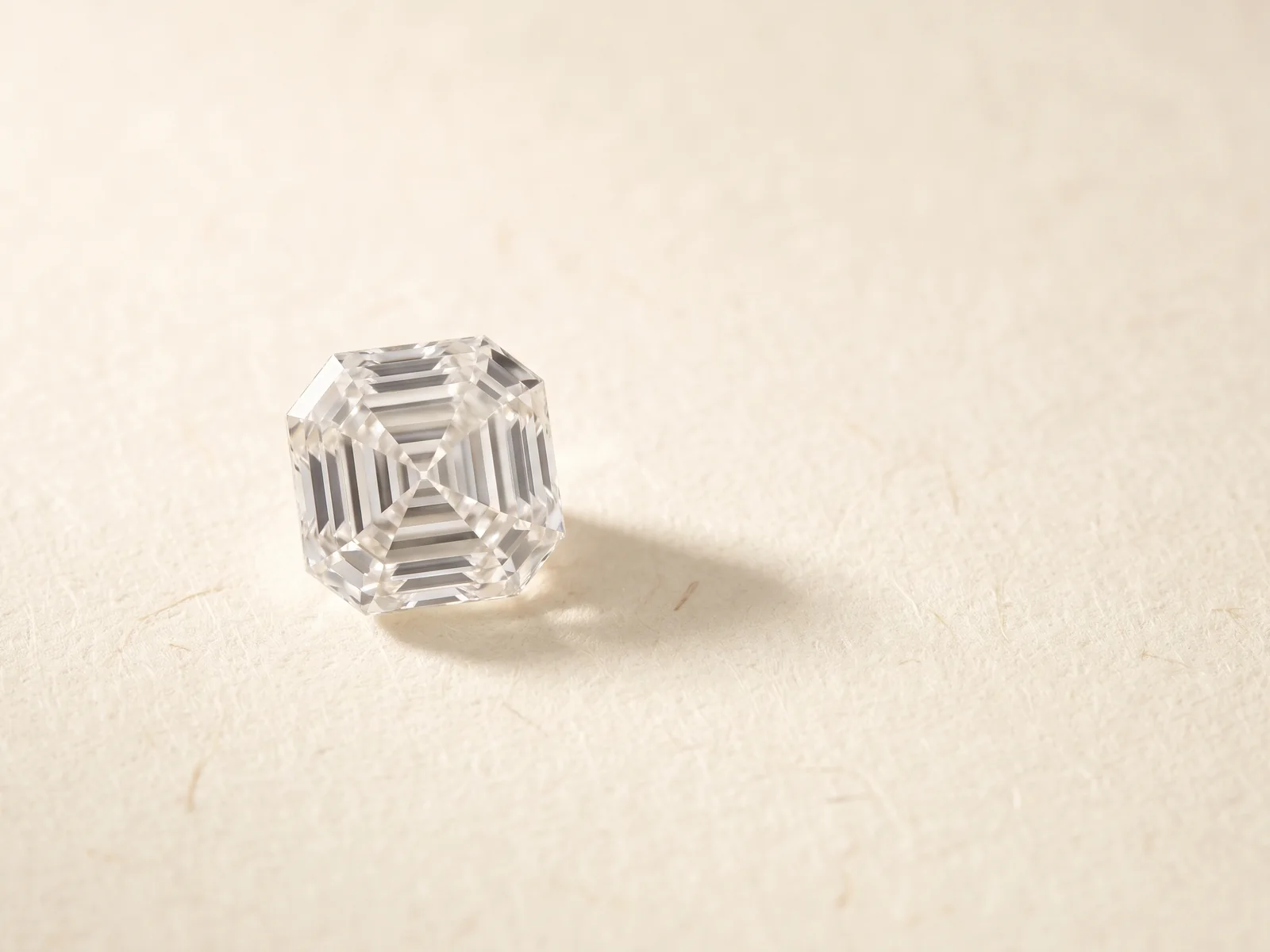
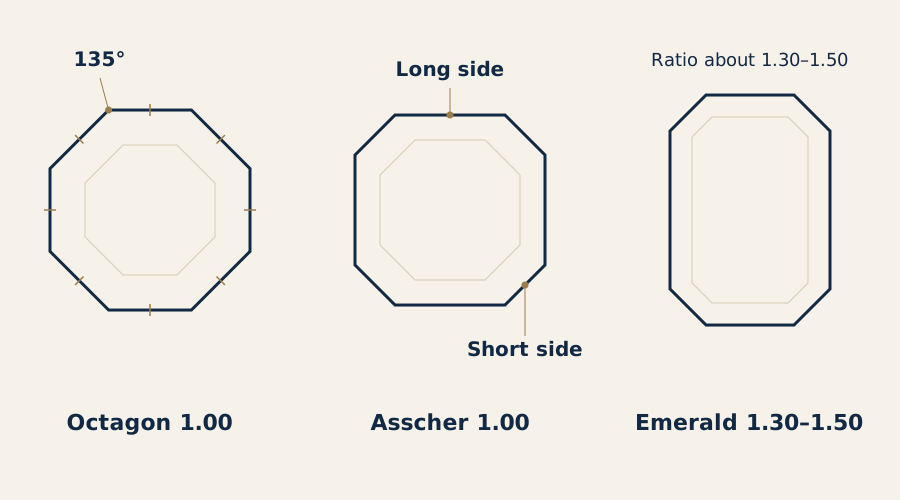
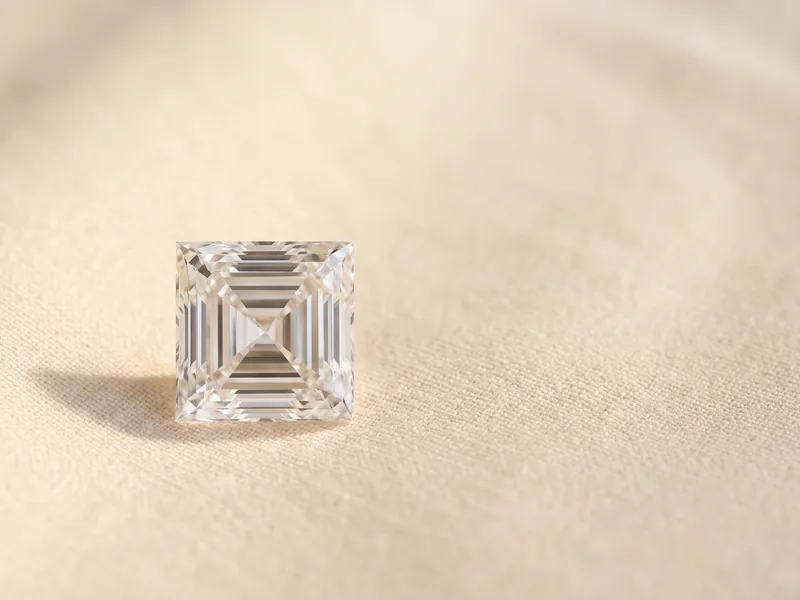
An octagonal cut diamond is a diamond cut with an eight-sided outline. In its classic form, called a regular octagon, all eight sides are the same length and every corner sits at 135°. Seen from above it looks like a square with its corners trimmed so evenly that the corners become sides in their own right.
That last detail is what separates it from its close relatives. An Asscher cut is also eight-sided, but it has four long sides and four short cut corners, so it still reads as a square. An emerald cut has eight sides too, but stretched into a rectangle. A true octagon has no long and short sides; it reads as an octagon from across the room. Our overview of how diamond shapes are grouped and named shows where each one sits.
The octagon is one of the rarer shapes on the market, which is why it barely appears in most shape guides. It sits in the family of geometric diamond cuts such as shields, kites and hexagons, and it is one of the shapes listed in our guide to all 34 diamond cuts compared. Octagonal step cuts were especially popular in Art Deco jewellery of the 1920s and 1930s, when clean, architectural lines were the fashion, and they are back in demand with people who want a vintage look that is not a round or an oval.
Diamond itself is 10 on the Mohs hardness scale, with a refractive index (how strongly it bends light) of about 2.42. Hardness is not the same as toughness: diamond can still chip along its cleavage planes if a thin edge or sharp corner takes a knock. The octagon's wide 135° corners are a real advantage here, as you will see below. If any word in this guide is new to you, our plain-English jewellery glossary explains it.
What facet patterns do octagonal diamonds use?
The outline tells you the shape; the facets (the small flat polished surfaces) tell you how it will behave in light. Octagonal diamonds come in three main facet styles.
- Octagonal step cut: the most common. Long, narrow facets run parallel to the edge in concentric rows, like steps down into a pool. This gives broad flashes of light and dark, often described as a hall-of-mirrors effect, rather than scattered sparkle.
- Octagonal modified brilliant: triangular and kite-shaped facets, like a round brilliant, arranged around the eight-sided outline. More sparkle, less of the clean, glassy look.
- Mixed cut: a step-cut crown (top) with a brilliant-style pavilion (bottom), or the other way round. It aims for the octagon's clean outline with more brightness from below.
If you like the calm, architectural look of the octagonal step cut diamond, our guide to step cuts from emerald to carré explains how this faceting style handles light. If you would rather have sparkle, compare the facet styles in rose cut vs brilliant cut faceting; heavily faceted designs such as the many-faceted Portuguese cut sit at the far sparkly end of the range.
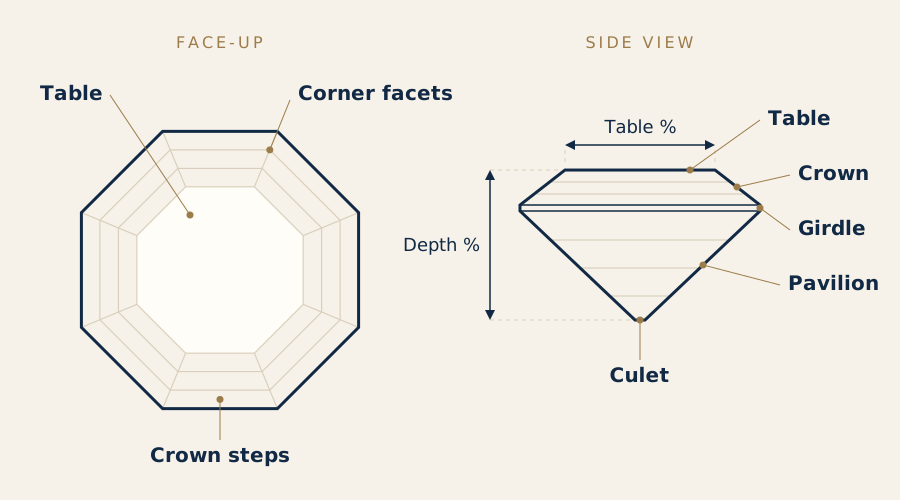
Facet counts vary with the cutter and the number of rows. Many octagonal step cuts have roughly 50–60 facets, but it is the evenness of the rows, not the total, that matters. Look for steps that are evenly spaced on all eight sides, with no row that suddenly narrows or bends.
One point of confusion: the single cut (also called the eight cut) is a small round diamond with an octagonal table and only 17 or 18 facets, used for tiny accent stones in older jewellery. It has an octagonal top facet, but it is not an octagonal cut diamond, because its outline is round.
What are the ideal proportions and ratio for an octagonal cut diamond?
The length-to-width ratio compares how long a stone is with how wide it is. Divide the length by the width from the measurements on the grading report. A regular octagon should be close to 1.00, meaning it is as long as it is wide.
| Ratio | How it looks | Notes |
|---|---|---|
| 1.00–1.05 | Regular octagon, all sides balanced | The classic shape most people mean by an octagon |
| 1.05–1.15 | Very slightly elongated | Hard to see by eye; fine for most rings |
| 1.15–1.35 | Clearly elongated octagon | Sits between an octagon and an emerald cut |
| Above 1.35 | Rectangular with cut corners | Usually described as an emerald cut |
Beyond about 1.35 the stone is really an emerald cut, the elongated eight-sided step cut, and it will often be graded and priced as one. Below 1.05, check the sides as well as the ratio: a stone can measure 1.00 and still have four long and four short sides, which makes it an Asscher-style square rather than a regular octagon.
For a step-cut octagon, a total depth of about 60–68% and a table (the large flat top facet) of about 58–68% of the width are common working ranges. Too shallow and the stone shows windowing: a washed-out, see-through patch in the centre where light passes straight through instead of bouncing back. Too deep and the stone looks small for its weight and can go dark in the middle. GIA does not give fancy shapes an overall cut grade, so judge the stone on polish and symmetry grades, the proportions above and how it actually looks on video.
Related guideAsscher Cut DiamondsHow big does an octagon diamond look for its carat weight?
Step cuts keep a lot of their weight below the girdle (the outer edge), so an octagon faces up (looks from above) a little smaller than a round of the same carat weight. These are typical face-up sizes for a step-cut octagon at a ratio near 1.00 and a depth of around 64%:
| Carat weight | Approximate size (across the flats) |
|---|---|
| 0.50 ct | about 4.6 mm |
| 0.75 ct | about 5.2 mm |
| 1.00 ct | about 5.7 mm |
| 1.50 ct | about 6.5 mm |
| 2.00 ct | about 7.2 mm |
For comparison, a 1 carat round brilliant is usually about 6.4 mm across. Measure an octagon across the flats (side to side) and across the corners; the corner-to-corner figure is slightly larger, by about 8% on a regular octagon. A deeper stone will be smaller again for its weight, so always compare millimetres rather than carats.
Because step cuts show their facets so clearly, the shape reads well from about 0.50 carat. Smaller octagons work beautifully as studs or side stones, and pair naturally with square carré cut diamonds in vintage-style designs.
Not sure which one is right?
Send us the stones you are looking at and our gemologist will tell you which to choose and why.
What colour and clarity should you choose for an octagonal diamond?
Step cuts are honest stones. With fewer, larger facets and a broad open table, they hide less than a brilliant does, both in colour and in clarity.
Colour: a warm tint tends to gather in the corners of a step cut, and the broad, open facets do little to mask it. In white gold or platinum, most people are happy from G–H colour; if you are sensitive to warmth, choose F or better. In yellow or rose gold, I or J can look white, because the metal warms everything around it. Brilliant-faceted octagons hide colour a little better, so you can often drop one grade.
Clarity: the aim is an eye-clean stone, meaning no inclusions (internal features) you can see without magnification at normal viewing distance. In a step cut, an inclusion sitting under the table is easy to see, because the long facets act like windows. Plan on VS2 or better, and treat SI1 as a case-by-case choice after you have seen the stone on video.
- Step-cut octagon, white metal: G–H colour, VS1–VS2 clarity.
- Step-cut octagon, yellow or rose gold: I–J colour, VS2 clarity.
- Brilliant octagon: one grade lower in colour and clarity is often fine.
- Check the report's plot: avoid dark inclusions under the table and feathers (small internal cracks) that reach a corner.
What is the best setting and wedding band for an octagonal cut diamond?
The octagon's 135° corners are far gentler than the 90° points of a princess cut with its sharp square corners, so it does not need corner protection in the same way. The setting's job is mainly to follow the outline and show off those eight clean sides. The usual options for an octagonal engagement ring:
- Eight claws: one at every corner. This frames the outline perfectly and is very secure, though eight claws cover more of a small stone.
- Four claws: on alternate corners. Shows more of the diamond, but the uncovered corners turn the look slightly towards a square.
- Bezel: a thin rim of metal following all eight sides. Very secure, low-profile and strongly Art Deco in feel.
- Octagonal halo: a ring of small diamonds that repeats the outline and makes the centre look larger.
- Side stones: slim baguette side stones, trapezoid shoulders or bullet cut accents keep the clean, geometric lines of the step cut.
Bands are where the octagon is easy. Because it has a flat side at the base rather than a point or a curve, a straight wedding band can usually sit flush against the ring, especially with a low bezel or a setting where the claws do not overhang the edge. A channel-set band of small step cuts suits the look; so does a plain band with a knife edge or a flat profile. Ask for the setting height to be checked with your chosen band before it is finished.
Octagon vs Asscher cut: how does it compare with other shapes?
| Octagon | Asscher | Emerald | Princess | Round | |
|---|---|---|---|---|---|
| Outline | Eight equal sides | Square, four cut corners | Rectangle, four cut corners | Square, sharp corners | Circle |
| Typical ratio | 1.00–1.05 | 1.00–1.05 | 1.30–1.50 | 1.00–1.05 | 1.00 |
| Usual facets | Step cut | Step cut | Step cut | Brilliant | Brilliant |
| Light effect | Broad flashes | Broad flashes | Broad flashes | Bright sparkle | Most sparkle |
| Corner angle | 135° | 135° at cut corners | 135° at cut corners | 90° | None |
| Clarity advice | VS2+ | VS2+ | VS2+ | SI1 often fine | SI1 often fine |
| Availability | Rare | Common | Very common | Very common | Most common |
The closest relative is the Asscher. If you like the octagon but want more stones to choose from, our guide to Asscher cut proportions and settings is the natural next step. If you are drawn to unusual outlines generally, the octagon sits alongside the six-sided hexagonal cut and the five-sided pentagonal cut; for a more directional shape, look at the shield cut, the kite-shaped cut or triangular and trillion cuts.
Rarity cuts both ways. You will have fewer octagons to compare, so matching a pair for earrings or finding exact sizes takes longer. On the other hand, an octagon is distinctive without being fragile, and it suits everyday wear better than most sharp-cornered geometric shapes.
How much does an octagonal cut diamond cost in Australia?
Octagonal diamonds are cut from both natural and laboratory-grown diamond, and the two look identical to the eye. Lab-grown diamonds are real diamond, grown in a laboratory rather than mined; they cost much less and are easier to find in unusual shapes, because cutters can grow and cut to order. Natural octagons are rarer still, as cutters usually choose shapes that keep more weight from a given rough crystal. Both should come with an independent grading report from a lab such as GIA or IGI, which will state clearly whether the stone is natural or lab-grown.
| 1 ct octagon, G–H, VS | Approximate price range (AUD) |
|---|---|
| Lab-grown | about $1,000–$3,000 |
| Natural | about $5,000–$12,000 |
These are broad ranges only; prices move with the market and with the exact grades. Step cuts usually cost less per carat than a round of the same weight, colour and clarity. Against that, the octagon's rarity means a well-matched, well-cut stone can cost more than a comparable Asscher or emerald cut, simply because there are fewer to choose from. Carat, colour, clarity and the evenness of the eight sides move the price most.
Shop octagonal cut diamonds: natural and lab-grown
How do you choose an octagonal cut diamond? Step by step
- Read the report. Confirm the shape description, measurements, colour, clarity, polish and symmetry, and whether the diamond is natural or lab-grown.
- Work out the ratio. Divide length by width; aim for about 1.00–1.05 for a regular octagon.
- Check the sides. All eight should look the same length; four long and four short means an Asscher-style square.
- Check depth and table. Around 60–68% depth and 58–68% table for a step cut; watch for windowing in the centre.
- Watch a 360° video. Look for even step rows on every side and inclusions under the table.
- Compare face-up size. Use millimetres across the flats, not just carat weight.
- Plan the setting and band together. Choose eight claws, four claws or a bezel, and confirm your wedding band sits flush.
Free consultation
Talk to a gemologist
Compare stones in person or online with Raj Sood, Graduate Gemologist (GIA), AJP (GIA).
Book a consultationShop this shape
FAQ
Common questions
What is the difference between an octagonal and an Asscher cut diamond?
Both are eight-sided step cuts, but an Asscher has four long sides and four short cut corners, so it reads as a square. A regular octagon has eight sides of equal length, so it reads as an octagon.
Is an octagon diamond the same as an emerald cut?
Not quite. An emerald cut is an elongated octagon with a ratio of about 1.30–1.50, while a regular octagon is close to 1.00, as long as it is wide.
Do octagonal diamonds sparkle?
A step-cut octagon gives broad flashes of light rather than the fine sparkle of a round brilliant. If you want more sparkle, look for an octagonal modified brilliant or mixed cut.
Are octagonal cut diamonds durable for everyday wear?
Yes. Their 135° corners are much less exposed than the 90° corners of a princess cut, and an eight-claw or bezel setting gives good protection.
Can you get a lab-grown octagonal diamond?
Yes. Lab-grown octagons are easier to find than natural ones, cost much less and are graded by labs such as IGI on the same colour and clarity scales as natural diamonds; GIA now uses simpler descriptive grades for lab-grown stones.
What clarity should an octagonal step cut diamond be?
VS2 or better is a safe starting point, because step cuts show inclusions clearly through the open table. A carefully chosen SI1 can work if you have checked it on video.

Ask a gemologist
Not sure which diamond to choose?
Raj Sood is a Graduate Gemologist (GIA) and master jeweller. Bring the stones you are considering, or send the reports, and he will tell you honestly which one is better and why.
Keep learning
Related guides
 Diamond ShapesAsscher Cut Diamonds
 Diamond ShapesStep Cut Diamonds: Emerald, Asscher, Baguette, Carré and More
 Diamond ShapesGeometric Diamond Cuts: Shield, Kite, Hexagon, Pentagon and More
 Diamond ShapesEmerald Cut DiamondsDiamond ShapesUnderstanding Diamond Shapes
 Diamond ShapesAll 34 Diamond Cuts: Every Shape Explained and ComparedDiamond ShapesBaguette Cut Diamonds
 Diamond ShapesSquare Cut Diamonds (Carré)
Explore more
More guides on this topic
Education