
- Education
- Diamond Shapes
- Trapezoid Cut Diamond Guide: Facets, Ratio, Side Stones and Settings
Diamond shapes
Trapezoid Cut Diamond Guide: Facets, Ratio, Side Stones and Settings
A trapezoid cut diamond is rarely the star of a ring, but it decides whether a three-stone design looks seamless or pieced together. Here is what to check in the cut, the pairing and the setting.
 Reviewed by Raj Sood, Graduate Gemologist (GIA), AJP (GIA)Master jeweller and Graduate Gemologist (GIA) · reviewed 4 November 2026
Quick answer
A trapezoid cut diamond is a four-sided step cut with one long and one short parallel edge and two sloping sides. It is mostly used as a matched pair of side stones beside an emerald, Asscher or radiant centre. Choose an eye-clean pair, matched in colour and size, with corners protected by claws or a bezel.
What is a trapezoid cut diamond?
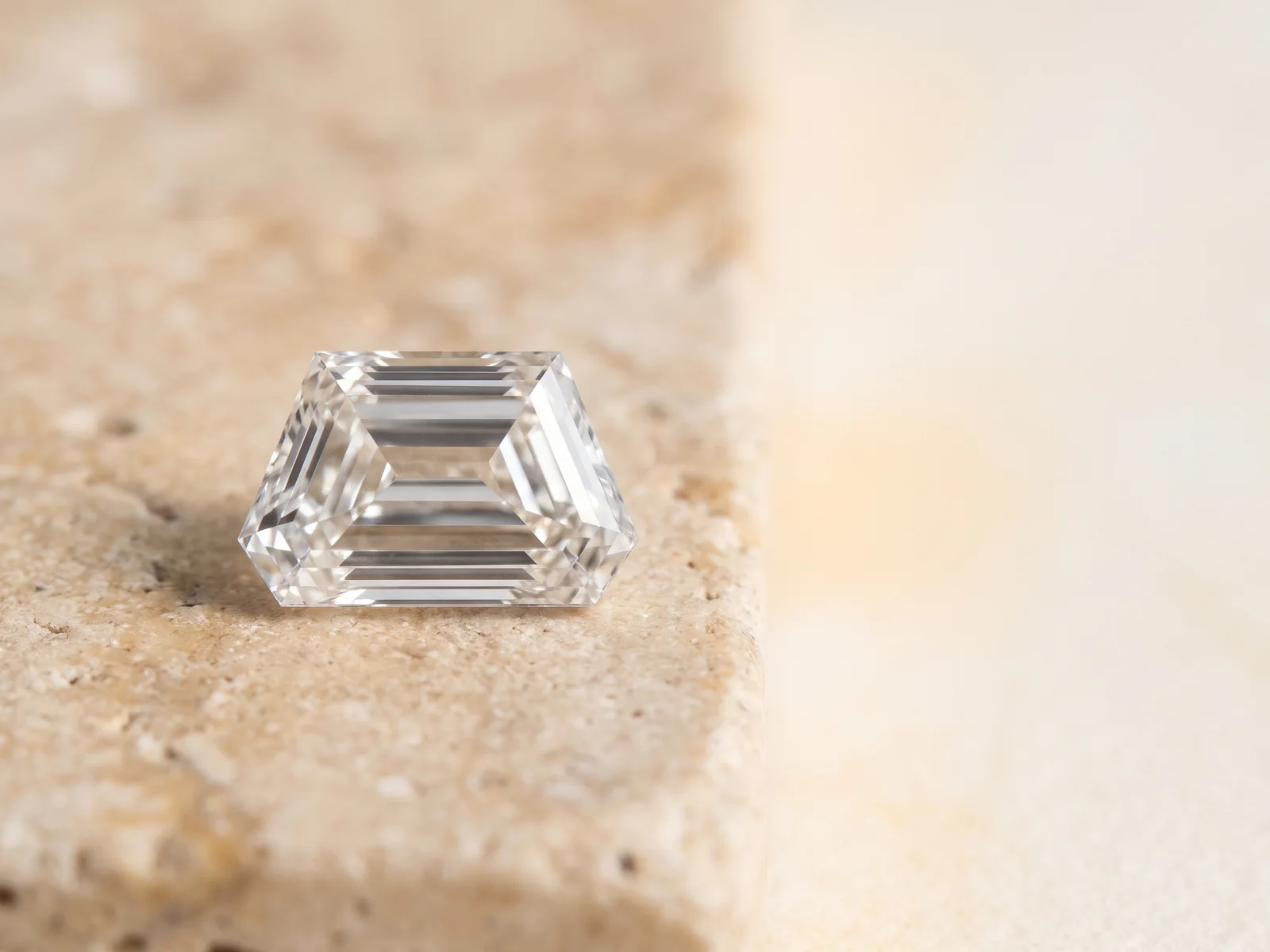
A trapezoid cut diamond takes its name from the geometry: a four-sided outline with two parallel edges of different lengths and two sloping sides joining them. Picture a rectangle with its top corners pulled in. The long edge is called the long base, the short edge the short base, and the distance between them the height.
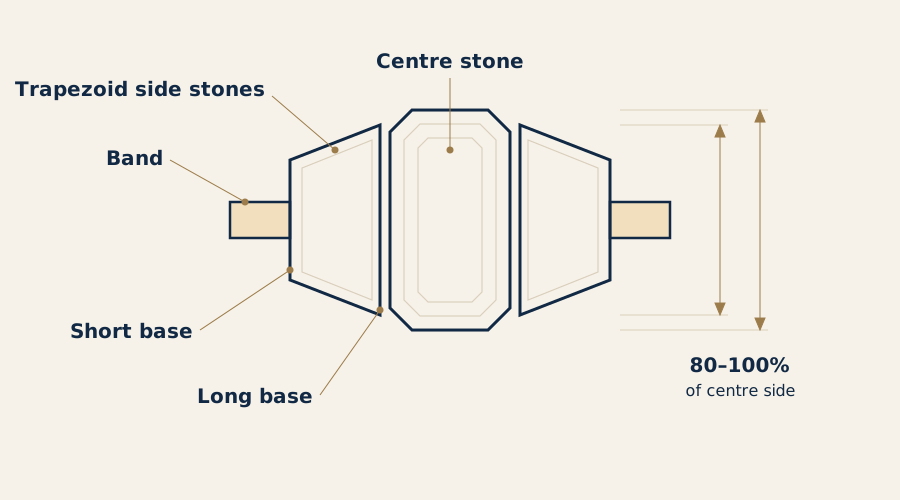
Almost all trapezoids are cut in matched pairs and set either side of a larger centre diamond. The long base sits against the centre stone and the short base points outwards along the band, so the three stones read as one tapering shape. It sits within the side stone family in our overview of how diamond shapes differ, and you will find it alongside every other outline in our guide to all 34 diamond cuts compared.
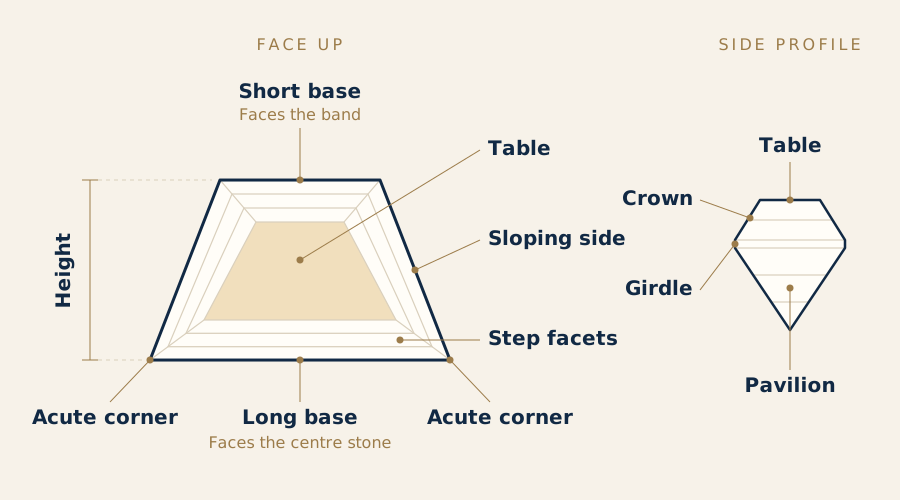
Diamond is 10 on the Mohs hardness scale, with a refractive index of about 2.42. Hardness is not toughness, though. A trapezoid has two acute corners (sharper than 90°) where the long base meets the sloping sides, and those thin points are where a knock is most likely to cause a chip. That shapes the setting advice further down. Any unfamiliar term in this guide is also defined in our plain-English jewellery glossary.
How is a trapezoid cut diamond faceted?
Most trapezoids are step cuts. Instead of the triangular and kite-shaped facets of a brilliant, a step cut has long, flat facets that run parallel to the outline, stepping down from a large flat table on top like the steps of a pyramid. The look is cool and architectural: broad flashes of light and dark rather than a scatter of sparkle. Our guide to step cut shapes from emerald to carré explains the whole family.
A step-cut trapezoid typically has about 13 to 25 facets, depending on its size and how many rows of steps the cutter adds. Larger trapezoids usually get more rows, which gives them more depth to the reflections.
You can also find brilliant cut trapezoids, faceted with triangles and kites. They sparkle more, hide small inclusions better and suit brilliant centre stones such as a radiant or cushion. The trade-off is that they lose the clean, mirrored look that makes step-cut trapezoids pair so neatly with step-cut centres. If you are weighing the two looks more generally, our comparison of how different faceting styles handle light is a useful primer.
- Step-cut trapezoid: long parallel facets, crisp lines, shows clarity and colour more openly. Matches emerald, Asscher and carré centres.
- Brilliant cut trapezoid: more sparkle, more forgiving of inclusions. Matches radiant, cushion and some princess centres.
- Mixed: a step-cut crown with a brilliant pavilion (the lower half). Less common, but a good compromise when sparkle and clean lines both matter.
What is the ideal trapezoid diamond ratio and proportions?
Unlike a round or an oval, a trapezoid has no single length-to-width ratio, because it has three key measurements rather than two. Most suppliers list them as long base × short base × height in millimetres, followed by depth. There is no industry standard for an ideal trapezoid, so the proportions are judged by how well the pair suits the centre stone.
| Measurement | Rough working range | What it changes |
|---|---|---|
| Short base ÷ long base (taper) | about 0.45–0.75 | Lower numbers give a sharper taper and a more pointed, tailored look; higher numbers look squarer and blockier |
| Height ÷ long base | about 0.55–0.85 | Taller stones spread the design wider across the finger |
| Long base vs centre stone side | about 80–100% of the side it touches | Too short looks undersized; longer than the centre's side overhangs it |
| Total depth | about 60–70% | Too deep looks dark and small face-up; too shallow leaks light and looks glassy |
| Table | about 60–75% of the height | A very large table can look flat and lifeless in a step cut |
These are working ranges, not grades, and a good-looking pair can fall slightly outside them. What matters most is matching: the two trapezoids should be mirror images, with the same taper, the same long base length and the same depth, so that they sit at the same height beside the centre. A difference of 0.1–0.2 mm is often visible once the stones are set side by side under a step-cut centre.
The taper also changes the overall shape of a ring. A sharp taper narrows the design quickly towards the band, much like the tapered step cuts in our baguette diamond guide, while a gentle taper keeps the three stones looking broad and bold.
What size trapezoid side stones suit your centre stone?
Trapezoids are the classic partner for an emerald cut, because both are step cuts with straight sides, so the facet lines carry on from the centre into the side stones. An emerald cut with trapezoid side stones is the most common combination; see our emerald cut diamond guide for the centre stone itself. They also sit well beside an Asscher cut centre with its cropped corners, an eight-sided octagonal diamond or a square carré step cut.
| Centre stone (approximate size) | Long base of each trapezoid | Typical pair weight |
|---|---|---|
| 1.00 ct emerald cut, about 7.0 × 5.0 mm | about 5.5–6.5 mm | about 0.40–0.60 ct total |
| 1.50 ct emerald cut, about 7.8 × 5.7 mm | about 6.5–7.5 mm | about 0.60–0.90 ct total |
| 2.00 ct emerald cut, about 8.5 × 6.3 mm | about 7.0–8.0 mm | about 0.80–1.20 ct total |
| 1.00 ct Asscher cut, about 5.8 × 5.8 mm | about 4.5–5.5 mm | about 0.30–0.50 ct total |
The table assumes the centre is set north–south (its length running along the finger) with the trapezoids against its long sides. If the centre is set east–west, the trapezoids sit against the shorter sides and will be smaller. As a rule of thumb, most people want the side pair to weigh roughly a third to half of the centre stone, so the centre stays clearly dominant.
Trapezoids also work with a princess cut centre with square corners, though the brilliant faceting of a princess usually pairs better with brilliant cut trapezoids than step-cut ones.
Not sure which one is right?
Send us the stones you are looking at and our gemologist will tell you which to choose and why.
What colour and clarity should trapezoid diamonds be?
Step cuts have open, flat facets, so they show both body colour and inclusions (internal features) more clearly than brilliants do. That matters even for small side stones, because the eye moves straight from the centre into them. Two rules:
- Colour: match the centre within one grade, and keep both trapezoids the same grade. In white gold or platinum a G centre with G or H sides looks seamless; a G centre with J sides will look warmer at the edges.
- Clarity: aim for eye-clean, meaning nothing visible without magnification at normal viewing distance. In a step-cut trapezoid that usually means VS2 or better; SI1 can work in a brilliant cut trapezoid.
- Corners: avoid feathers (small internal cracks) near the acute corners, where they can weaken the thinnest part of the stone.
- Yellow or rose gold: warmer metal hides a little tint, so H–I side stones can sit comfortably beside an H centre.
Small trapezoids, especially those under about 0.30 carat each, are often sold without a full individual grading report. In that case the supplier should still state the colour and clarity range of the pair, and whether the stones are natural or lab-grown. Ask to see the pair in daylight beside the centre stone before anything is set; tint differences show up far more clearly side by side than on paper.
What is the best setting for a trapezoid diamond ring?
The setting has two jobs: hold each trapezoid tight against the centre so there is no visible gap, and protect the acute corners. The usual options for a trapezoid diamond ring:
- Claws: usually four per trapezoid, often sharing one claw with the centre stone at each meeting point. Light and open, but the claws must sit right over the corners.
- Bezel or half-bezel: a thin rim of metal around the outer edges. The most protective option and a natural match for the clean lines of a step cut.
- Channel or tension-style seats: the trapezoids slot into a metal channel either side of the centre. Secure and modern, with no claws to catch.
- Pavé band: small diamonds set into the shoulders beyond the trapezoids extend the sparkle; our guide to micro-pavé, bead and bright cut pavé explains the styles.
The corner problem is the same one princess cuts face, and the solutions carry over directly. Our page on protecting sharp diamond corners in a setting shows how claws and bezels are shaped to cover a point.
Wedding bands need some planning. A three-stone trapezoid design is wider than a solitaire, so a straight band may only sit flush if the side stones are set low enough to clear it. A slightly contoured band, or a straight band with the head of the ring raised just enough, are the common solutions. It is worth designing the engagement ring and the band together.
How do trapezoids compare with baguette, half moon and bullet side stones?
Trapezoids are one of several side stone shapes, each with its own look. Our guide to choosing side stones for a centre diamond covers the group, and this table sets out the main differences in trapezoid vs baguette side stones and the rest.
| Trapezoid | Baguette | Half moon | Bullet | Trilliant | Kite | |
|---|---|---|---|---|---|---|
| Outline | Four sides, tapered | Long rectangle | Straight edge, curved outer edge | Rectangle with a pointed end | Triangle with curved or straight sides | Four sides, diamond-kite shape |
| Usual faceting | Step cut (some brilliant) | Step cut | Step or brilliant | Step cut | Brilliant | Step or brilliant |
| Look beside centre | Widens the centre, tapers to the band | Slim, linear | Softens and rounds the outline | Arrow-like, Art Deco | Bright, sparkly, triangular | Angular, distinctive |
| Fragile corners | Two acute corners | Square corners | Two points on the straight edge | One point | Three points | Two or more points |
| Best centre partners | Emerald, Asscher, carré | Emerald, round, oval | Oval, cushion, round | Emerald, Asscher | Round, princess, radiant | Emerald, Asscher, princess |
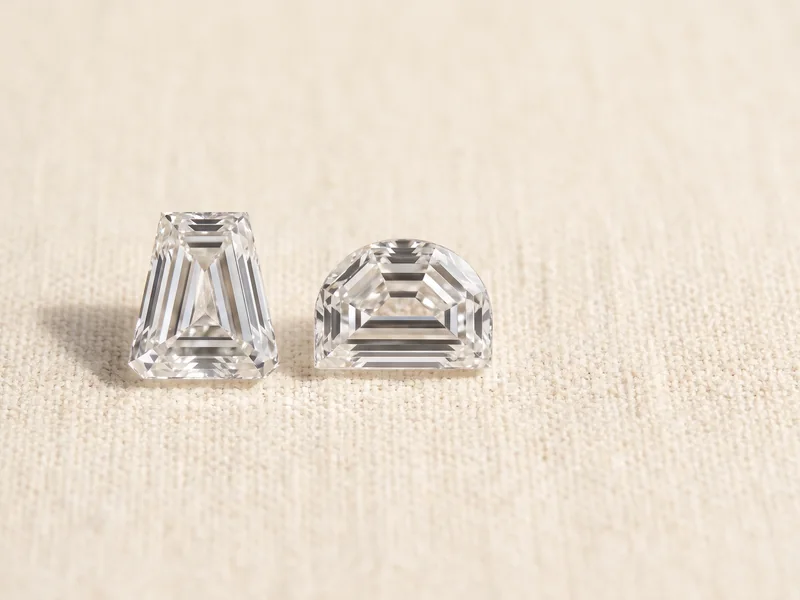
For a softer look, read about half moon side stones and their curved edge, or for a slimmer one the pointed bullet cut. For more sparkle, the triangular trilliant cut is the usual choice. If you want something bolder, the faceted shield cut and the angular kite cut both give a more individual outline.
Related guideSide Stone Diamond Cuts: Trapezoid, Half Moon, Bullet, Baguette, TrilliantHow much does a trapezoid cut diamond cost, natural or lab-grown?
Trapezoids are cut from both natural and laboratory-grown diamond, and the two look identical to the eye. A lab-grown trapezoid diamond is real diamond, with the same hardness and refractive index, grown in a laboratory rather than mined. It costs much less than a natural stone of the same size and grade. Natural trapezoids are made from rough that suits the shape, so well-matched natural pairs take longer to source.
| Matched pair, about 0.50 ct total, F–G, VS | Approximate price range (AUD) |
|---|---|
| Lab-grown | about $500–$1,500 |
| Natural | about $2,000–$5,000 |
These are broad ranges only, and the trapezoid diamond price in Australia moves with the market and the exact grades. Per carat, trapezoids usually cost less than a centre stone of similar quality, because they are small. What pushes the price up is matching: a cutter may work through many stones to find two with identical measurements, taper, colour and clarity, so a perfectly matched pair often costs more than two similar single stones.
Shop trapezoid diamonds: natural and lab-grown
How do you choose a trapezoid cut diamond? Step by step
- Choose the centre first. The trapezoids are sized to the centre stone, not the other way round.
- Measure the side they will touch. Aim for a long base about 80–100% of that side of the centre stone.
- Pick the taper. A sharp taper looks tailored and slim; a gentle taper looks broader and bolder.
- Match colour and clarity. Within one colour grade of the centre, both stones the same, and eye-clean.
- Check the pair side by side. Same measurements, same depth, no visible difference in tint, and confirm whether they are natural or lab-grown.
- Plan the setting and band together. Make sure claws or a bezel cover the acute corners and that your wedding band will sit comfortably.
Free consultation
Talk to a gemologist
Compare stones in person or online with Raj Sood, Graduate Gemologist (GIA), AJP (GIA).
Book a consultationFAQ
Common questions
What is a trapezoid cut diamond used for?
Mostly as a matched pair of side stones either side of a larger centre diamond in a three-stone ring. They are especially common beside emerald and Asscher cuts.
Are trapezoid diamonds step cut or brilliant cut?
Most are step cut, with long parallel facets that match emerald and Asscher centres. Brilliant cut trapezoids also exist and suit brilliant centres such as radiants and cushions.
What is the difference between trapezoid and baguette side stones?
A baguette is a long rectangle, so it looks slim and linear. A trapezoid tapers from a long edge against the centre to a shorter outer edge, so it widens the design and leads the eye to the band.
Do trapezoid diamonds chip easily?
Their two acute corners are the thinnest points and more exposed than a square edge. Claws over the corners or a bezel protect them well for everyday wear.
Should trapezoid side stones match the centre diamond's colour?
Ideally they are within one colour grade of the centre and identical to each other. Step cuts show colour openly, so a bigger gap is easy to see.
Can you get lab-grown trapezoid diamonds?
Yes. Lab-grown trapezoids are available in matched pairs, cost much less than natural pairs and are real diamond, so they can sit beside either a natural or a lab-grown centre if that is disclosed.
Terms in this guide

Ask a gemologist
Not sure which diamond to choose?
Raj Sood is a Graduate Gemologist (GIA) and master jeweller. Bring the stones you are considering, or send the reports, and he will tell you honestly which one is better and why.
Keep learning
Related guides
 Diamond ShapesSide Stone Diamond Cuts: Trapezoid, Half Moon, Bullet, Baguette, Trilliant
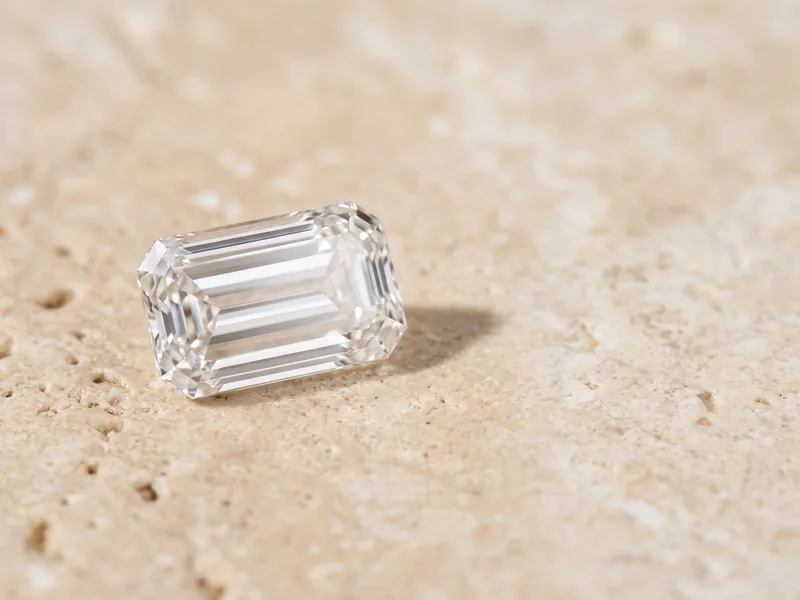 Diamond ShapesEmerald Cut Diamonds
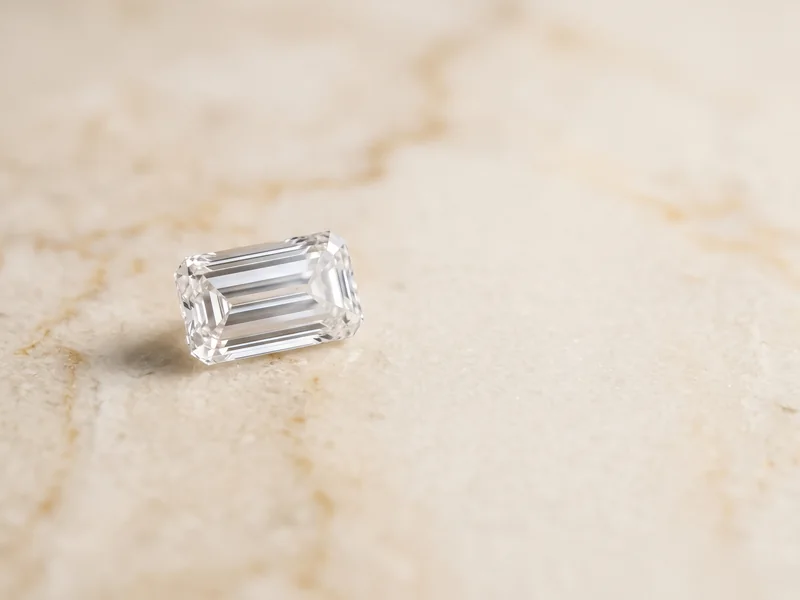 Diamond ShapesBaguette Cut DiamondsDiamond ShapesStep Cut Diamonds: Emerald, Asscher, Baguette, Carré and MoreDiamond ShapesUnderstanding Diamond Shapes
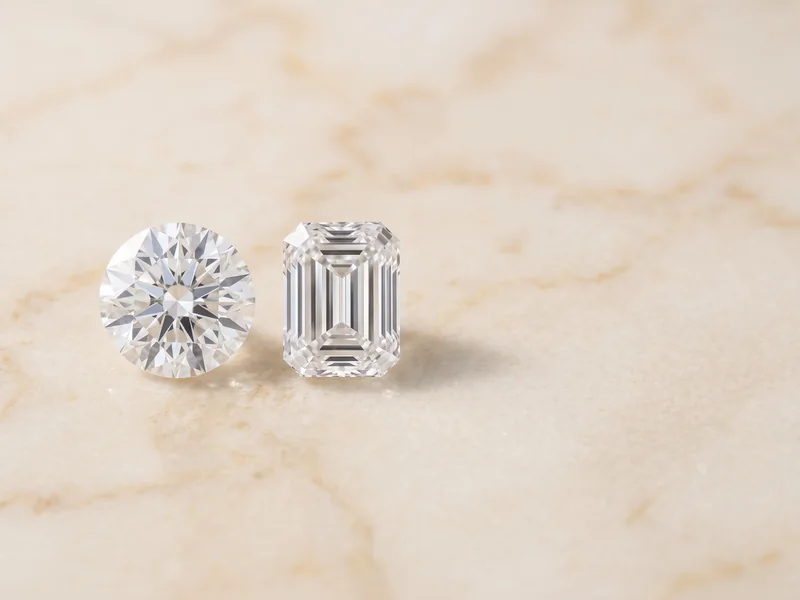 Diamond ShapesAll 34 Diamond Cuts: Every Shape Explained and Compared
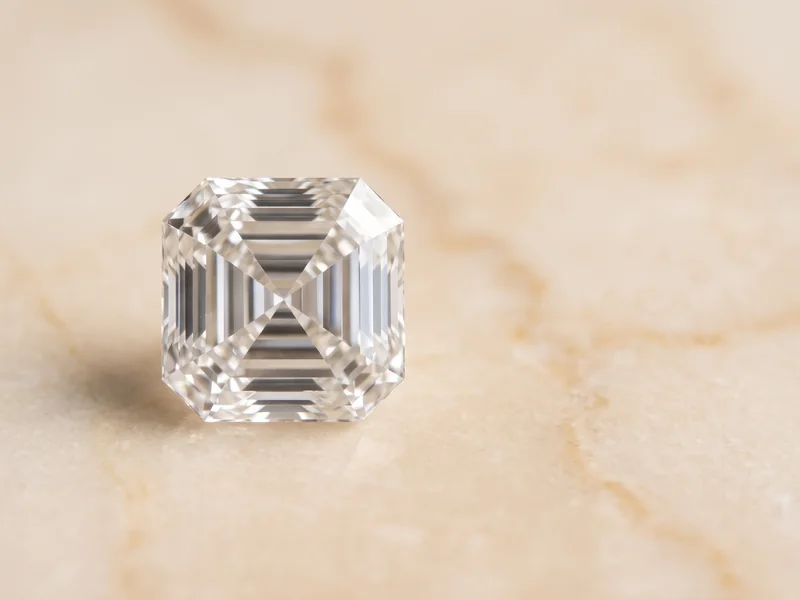 Diamond ShapesAsscher Cut Diamonds
 Diamond ShapesSquare Cut Diamonds (Carré)
Explore more
More guides on this topic
Education