
- Education
- Diamond Shapes
- Baguette Cut Diamond Guide: Facets, Ratio, Sizes and Settings
Diamond shapes
Baguette Cut Diamond Guide: Facets, Ratio, Sizes and Settings
The baguette cut diamond is the straight line of the diamond world, small, clean and architectural. Because it is a step cut, it shows everything, so here is exactly what to check before one goes beside your centre stone or into a band.
 Reviewed by Raj Sood, Graduate Gemologist (GIA), AJP (GIA)Master jeweller and Graduate Gemologist (GIA) · reviewed 4 November 2026
Quick answer
A baguette cut diamond is a long, narrow rectangular step cut, usually with 14 facets arranged in parallel rows. It is used mostly as a side stone or in bands. Look for a length-to-width ratio of about 2:1 to 4:1, VS2 clarity or better because step cuts show inclusions, matched colour, and a channel or bezel setting protecting the corners.
What is a baguette cut diamond?
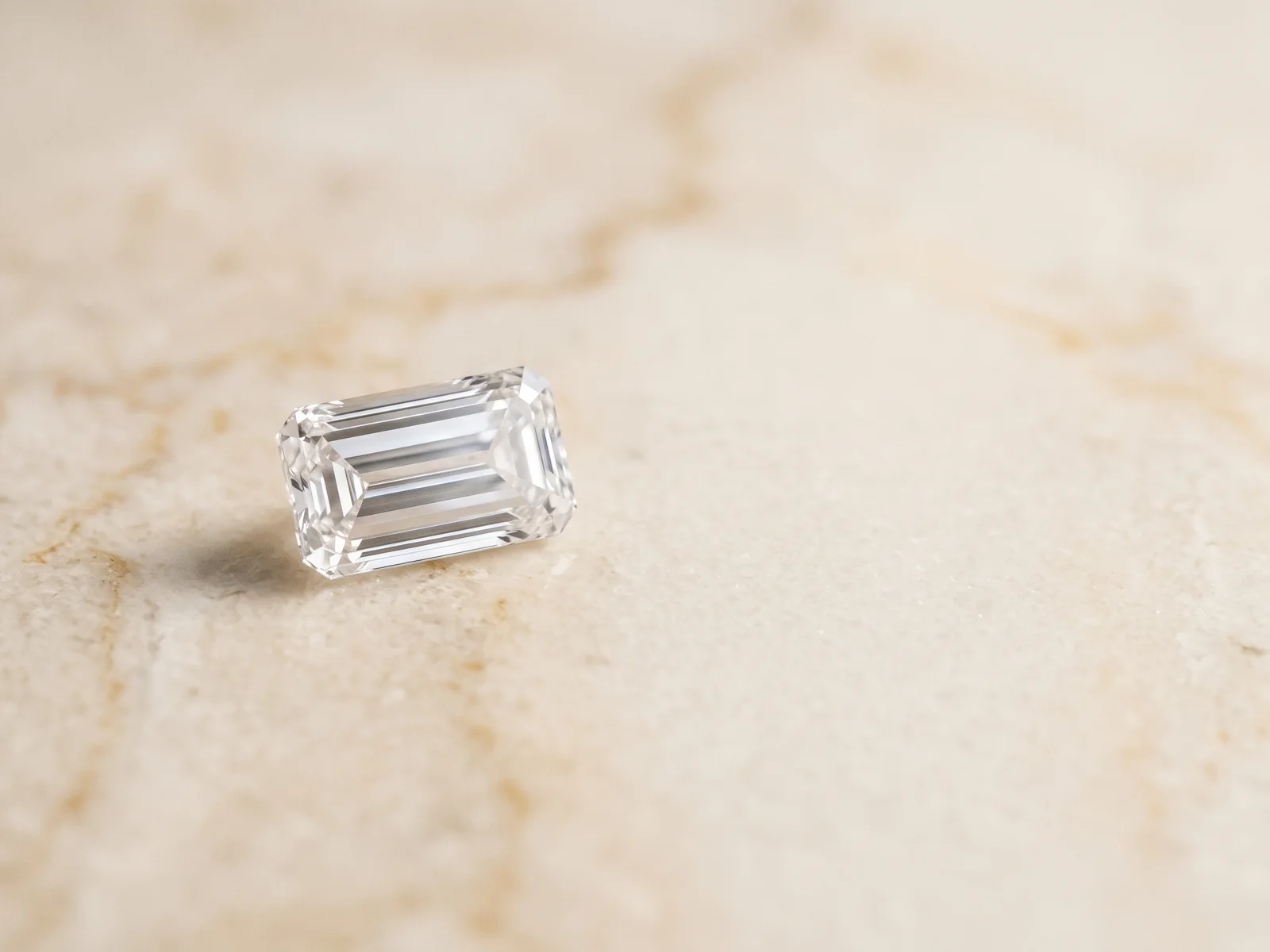
A baguette cut diamond is a long, narrow rectangle with straight sides and square corners, faceted as a step cut. Step cutting means the facets are long, flat strips running parallel to the edges, stepping down from the top like the sides of a stepped pyramid, rather than the triangular and kite-shaped facets of a brilliant. The name comes from the French word for a rod or stick, the same word used for the long French loaf. It is one of the shapes covered in our guide to all 34 diamond cuts, explained and compared, and it belongs to the step cut family alongside emerald, Asscher and carré.
Baguettes became popular in the 1920s and 1930s, when Art Deco jewellery favoured straight lines and geometric patterns. Today they are used mostly as side stones (smaller diamonds either side of a centre stone), in channel-set wedding and eternity bands, and in clusters, earrings and watch bezels. A baguette as the centre stone of an engagement ring is less common but has a loyal following, usually set east-west (lying sideways across the finger) or in a bezel.
Diamond is 10 on the Mohs hardness scale and has a refractive index of about 2.42, so a baguette resists scratching as well as any other diamond. Hardness is not toughness, though. A baguette has four sharp 90° corners, and a corner is where a diamond is most likely to chip if it takes a knock. Protecting those corners shapes most of the setting advice below. Any unfamiliar word on this page is also explained in our A to Z jewellery glossary.
How many facets does a baguette cut diamond have?
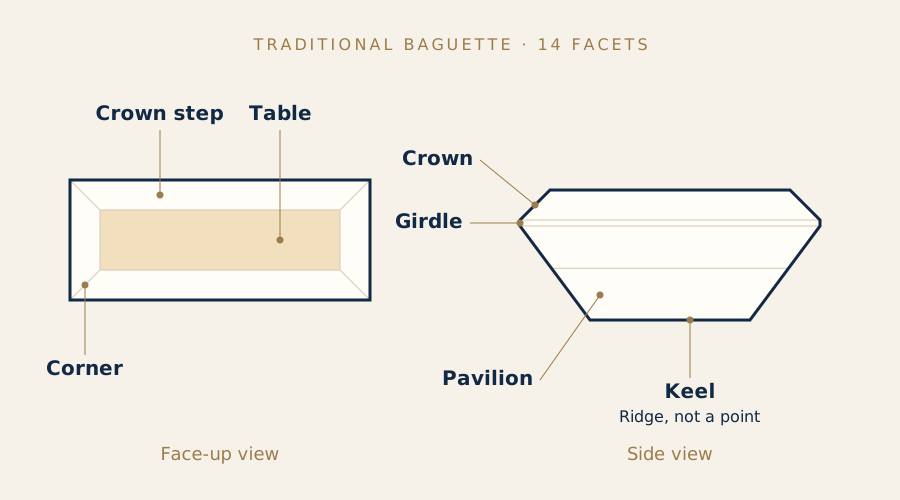
A traditional baguette has 14 facets: a large flat table on top, a single row of four sloping facets around it on the crown (the upper part), and two rows of long facets on the pavilion (the lower part) that meet in a ridge called the keel rather than a point. Some cutters add an extra row of steps, so you will see baguettes with a few more facets, but the look is the same: parallel bands of light and dark.
That banded look is called the hall-of-mirrors effect. Instead of the scattered, pinpoint sparkle of a round brilliant, a step cut gives broad flashes of light that switch on and off as the stone moves. A baguette is essentially a slim, small version of the emerald cut and its hall-of-mirrors look, without the emerald's clipped corners, and a stretched relative of the square, deep-cut Asscher. If you want to see how this differs from other faceting styles, our page on how rose and brilliant faceting handle light is a useful companion.
Two variations are worth knowing. A brilliant baguette (sometimes called a modified baguette) has extra triangular facets on the pavilion for more sparkle, which also helps hide small inclusions. A cut-corner baguette has tiny bevels at the corners, which reduces the chance of chipping. Neither is better; they simply look slightly different, so if you are matching new stones to an existing ring, match the facet style as well as the size.
Grading labs do not give baguettes an overall cut grade the way GIA does for round brilliants, so you judge the cut yourself: straight, truly parallel long sides, crisp square corners, even steps and good polish and symmetry grades. Our explainer on what Ideal and Excellent cut grades actually measure shows why those grades apply to rounds but not to step cuts like this one.
What is the ideal length-to-width ratio for a baguette diamond?
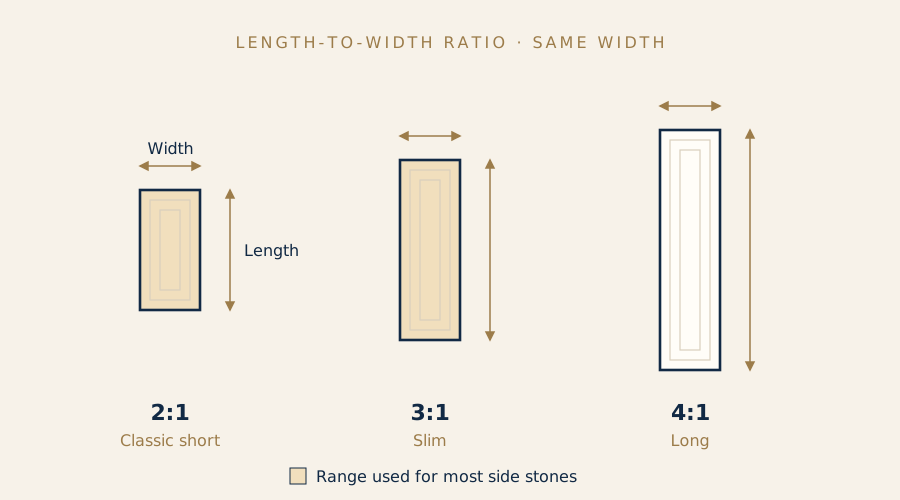
The length-to-width ratio compares how long the stone is with how wide it is. Divide the length by the width: a baguette measuring 5.0 × 2.5 mm has a ratio of 2.0, often written 2:1. Baguettes are the most elongated of the common shapes, and the ratio decides whether they look like neat small rectangles or slim bars of light.
| Ratio | How it looks | Suits |
|---|---|---|
| Below 2:1 | Short rectangle, close to a carré or emerald outline | Clusters, alternating bands, small accents |
| 2:1–3:1 | The classic baguette | Side stones and channel-set bands |
| 3:1–4:1 | Long and slender | Elegant side stones, east-west centre stones |
| Above 4:1 | Very long, sometimes called a long or stick baguette | Bar pendants, Art Deco designs; more fragile |
For side stones, the ratio should suit the centre stone. As a rule of thumb, the length of each baguette works well at about half to two-thirds of the centre stone's width, so the side stones frame it without competing. As a rough guide to proportions, many well-cut baguettes have a table of about 60–75% of the width and a total depth of about 60–75%, but at these small sizes the way the stone looks matters more than any number. Too shallow and the centre of the stone goes glassy and see-through; too deep and it looks dark.
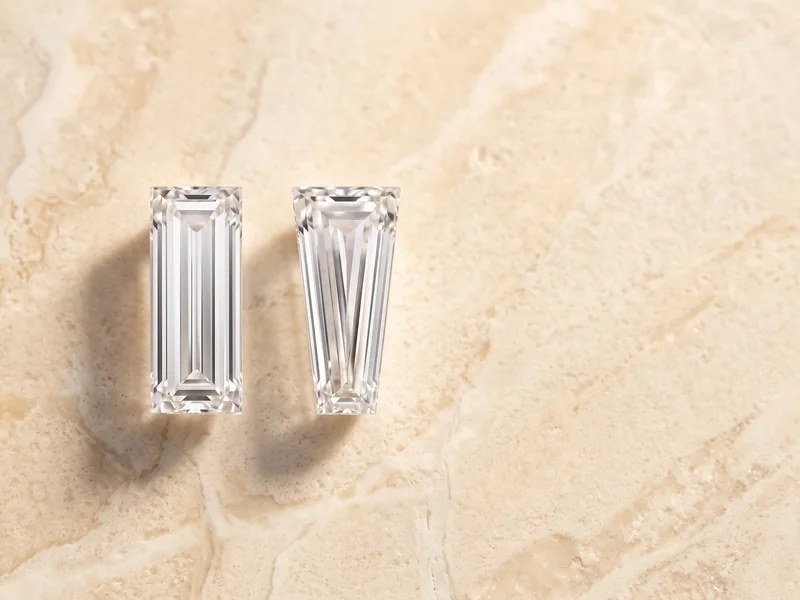
Baguettes come in two outlines: straight, with parallel long sides, and tapered, narrower at one end so a pair points in towards the centre stone. Our comparison of straight versus tapered baguettes goes into which suits which centre shape.
Related guideBaguette vs Tapered Baguette DiamondsWhat sizes do baguette diamonds come in?
Most baguettes are small. Side stones usually weigh about 0.05–0.25 carat each, and stones over half a carat are uncommon because a long, thin crystal of rough is needed to cut them. The table below is a baguette diamond size chart for stones at about a 2:1 ratio and normal depth.
| Size (length × width) | Approximate weight each |
|---|---|
| 3.0 × 1.5 mm | about 0.03–0.04 ct |
| 4.0 × 2.0 mm | about 0.07–0.09 ct |
| 5.0 × 2.5 mm | about 0.14–0.17 ct |
| 6.0 × 3.0 mm | about 0.25–0.30 ct |
| 7.0 × 3.5 mm | about 0.40–0.45 ct |
| 8.0 × 4.0 mm | about 0.60–0.70 ct |
With baguettes, the millimetre size matters more than the carat weight. In a channel setting, the groove is cut to an exact width, so every stone has to match it to within about a tenth of a millimetre. Jewellers buy side baguettes as calibrated stones (cut to standard sizes) and in matched pairs or parcels, where each stone has the same width, depth, colour and clarity. A well-matched pair costs more than two random stones of the same weight, and it is worth it, because a mismatch is obvious when the stones sit side by side.
Larger baguettes, from about 0.50 to 2 carats, are used as east-west centre stones and in bar pendants. They are graded individually and come with their own report; small side stones are usually sold without individual reports and are described by the jeweller.
Not sure which one is right?
Send us the stones you are looking at and our gemologist will tell you which to choose and why.
What colour and clarity should a baguette diamond be?
Clarity matters more in a baguette than in almost any other shape. A step cut has a large, open table and long flat facets, so it works like a window: an inclusion (an internal feature such as a crystal or feather) that a brilliant would scatter and hide sits in plain view. Compare that with a brilliant-faceted princess cut, whose busy sparkle masks small marks. For baguettes, aim for VS2 or better; an SI1 can work only if you have checked it is eye-clean, meaning nothing is visible without magnification at normal viewing distance.
Colour is the opposite story. In small baguettes, body colour is hard to see face-up. What you will see is a difference between stones: a side baguette that is warmer than the centre diamond, or one stone in a band that is a shade yellower than its neighbours. Match side stones to within one or two colour grades of the centre stone, and ideally the same grade or slightly whiter.
- Beside a white centre stone in platinum or white gold: F–H colour, VS2 or better.
- In yellow or rose gold: H–J can look white against the warm metal, but keep clarity at VS2 or better.
- In a band: every stone the same colour grade, from one matched parcel.
- Avoid: feathers (small internal cracks) reaching a corner, where they can weaken the stone.
What is the best setting for baguette diamond side stones and bands?
The setting's job is to hold four straight edges flat and to guard four sharp corners. The main options for a baguette diamond ring:
- Channel setting: the stones sit in a row in a groove between two walls of metal, which grip their edges (in most baguette bands the stones lie across the band, side by side, with the walls holding their ends). It is the classic choice for baguette side stones and bands, and the most protective.
- Bezel or half-bezel: a thin rim of metal around the whole stone or its ends. Ideal for a baguette centre stone, an east-west solitaire or a bar pendant.
- Four corner claws: V-shaped or square claws over each corner. They show more of the stone but must cover every corner fully.
- Bar setting: short metal bars between stones, leaving the long sides open for more light.
- Three-stone rings: a baguette either side of a round, oval, emerald or Asscher centre, often tapered to point inwards.
Baguette eternity bands are popular as wedding bands and anniversary rings. A full eternity band, with stones all the way around, is very hard to resize because there is no plain metal to cut, so many people choose a half-eternity band with stones across the top. Alternating round and baguette bands mix flash and sparkle, and they sit neatly beside most engagement rings.
Baguettes are only one of several shapes cut specially to flank a centre stone. Our guide to side stone cuts compared shape by shape sets them side by side, with separate pages on trapezoid side stones with angled ends, half moon pairs that curve around an oval, bullet cuts with a pointed end and triangular trilliant side stones.
How does a baguette compare with emerald, carré and other step cuts?
| Baguette | Tapered baguette | Emerald | Carré | Princess | |
|---|---|---|---|---|---|
| Faceting | Step cut | Step cut | Step cut | Step cut | Brilliant |
| Outline | Long rectangle, square corners | Rectangle narrowing at one end | Rectangle, cut corners | Square, square corners | Square, pointed corners |
| Typical ratio | 2:1–4:1 | 2:1–3:1 (longest side) | 1.30–1.50 | 1.00 | 1.00–1.05 |
| Main use | Side stones, bands | Side stones pointing inwards | Centre stones | Bands, clusters, centre stones | Centre stones, bands |
| Hides inclusions | Poorly | Poorly | Poorly | Poorly | Well |
| Fragile points | Four corners | Four corners | Protected corners | Four corners | Four sharp corners |
The closest relative is the carré, which is essentially a square baguette; see our page on square carré cut diamonds. Corner-clipped and eight-sided step cuts are covered under octagonal cut diamonds. For side stones with more personality, shield cuts and kite cut diamonds give a bolder geometric outline. To see where the baguette fits among every shape, start with our overview of diamond shapes and how they differ.
On the baguette vs emerald cut question: they share the same faceting, but an emerald is much shorter and wider, with cut corners, and is designed as a centre stone. A baguette's long, narrow outline gives less room for the hall-of-mirrors effect, so it reads more as a line of light than a deep window.
How much does a baguette cut diamond cost, natural or lab-grown?
Baguettes are cut from both natural and laboratory-grown diamond, and the two look identical to the eye. Lab-grown diamonds are real diamond, grown in a laboratory rather than mined; they cost much less than natural. Natural baguettes are mined and rarer, especially in larger sizes. Any baguette large enough to carry its own report should come with an independent grading report from a lab such as GIA or IGI stating whether it is natural or lab-grown.
| Baguettes, G–H, VS | Natural (approx. AUD) | Lab-grown (approx. AUD) |
|---|---|---|
| Matched pair, 0.10 ct each | about $500–$1,500 | about $150–$500 |
| Single 0.50 ct | about $1,500–$4,000 | about $400–$1,200 |
| Single 1.00 ct | about $4,000–$10,000 | about $800–$2,500 |
These are broad ranges only; prices move with the market and the exact grades. Per carat, a baguette usually costs less than a round brilliant of the same colour and clarity, because demand for large baguettes is lower and step cuts keep a good share of the rough. Against that, precise calibration and matching add cost to side-stone pairs and bands, and the high clarity a step cut needs pushes the price up. In a finished ring, the price depends as much on the setting labour, especially channel work, as on the stones.
Browse baguette diamonds: natural and lab-grown
How do you choose a baguette cut diamond? Step by step
- Decide the role. Side stones, a band or a centre stone: this sets the size, ratio and whether you need individual reports.
- Confirm natural or lab-grown. Check the report or the jeweller's written description, and keep side stones the same origin as the centre if that matters to you.
- Measure in millimetres. Choose length and width to suit the centre stone or the band width; aim for a ratio of about 2:1 to 3:1 for side stones.
- Check clarity closely. VS2 or better, and look through the table for anything visible, especially near the corners.
- Match colour and cut. Side stones within one or two grades of the centre, and every stone in a pair or band from one matched parcel with the same facet style.
- Protect the corners. Choose a channel, bezel or full corner claws, and check the tables sit level before you take the ring home.
Free consultation
Talk to a gemologist
Compare stones in person or online with Raj Sood, Graduate Gemologist (GIA), AJP (GIA).
Book a consultationFAQ
Common questions
What is a baguette cut diamond?
It is a long, narrow rectangular diamond with a step cut, usually 14 facets arranged in parallel rows. It gives flashes of light rather than sparkle and is used mostly as side stones and in bands.
Are baguette diamonds more expensive than round diamonds?
Per carat, usually not. Baguettes generally cost less than rounds of the same colour and clarity, although matched, calibrated pairs and the higher clarity they need add to the price.
Do baguette diamonds sparkle?
They sparkle differently. Their long step facets give broad flashes of light, the hall-of-mirrors effect, rather than the fiery pinpoint sparkle of a round brilliant. Brilliant baguettes add extra facets for more sparkle.
What clarity should a baguette diamond be?
VS2 or better is the safe choice, because the open table of a step cut shows inclusions clearly. An SI1 can work only if you have checked it is eye-clean.
Can a baguette eternity band be resized?
A full eternity band is very hard to resize because stones run all the way around. A half-eternity band, with plain metal underneath, can usually be resized by a size or so.
Can you get lab-grown baguette diamonds?
Yes. Lab-grown baguettes are widely available in calibrated side-stone sizes and larger, cost much less than natural baguettes and are real diamond with the same hardness and refractive index.

Ask a gemologist
Not sure which diamond to choose?
Raj Sood is a Graduate Gemologist (GIA) and master jeweller. Bring the stones you are considering, or send the reports, and he will tell you honestly which one is better and why.
Keep learning
Related guides
 Diamond ShapesBaguette vs Tapered Baguette Diamonds
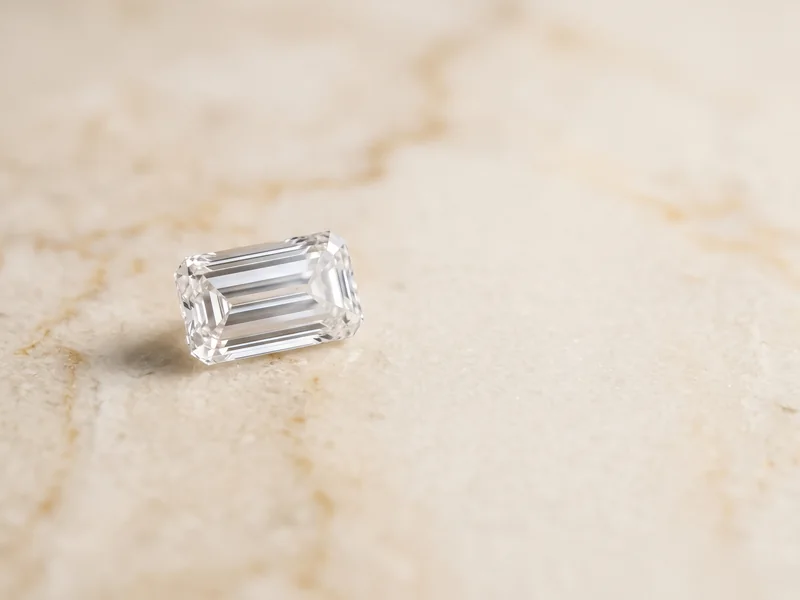 Diamond ShapesStep Cut Diamonds: Emerald, Asscher, Baguette, Carré and More
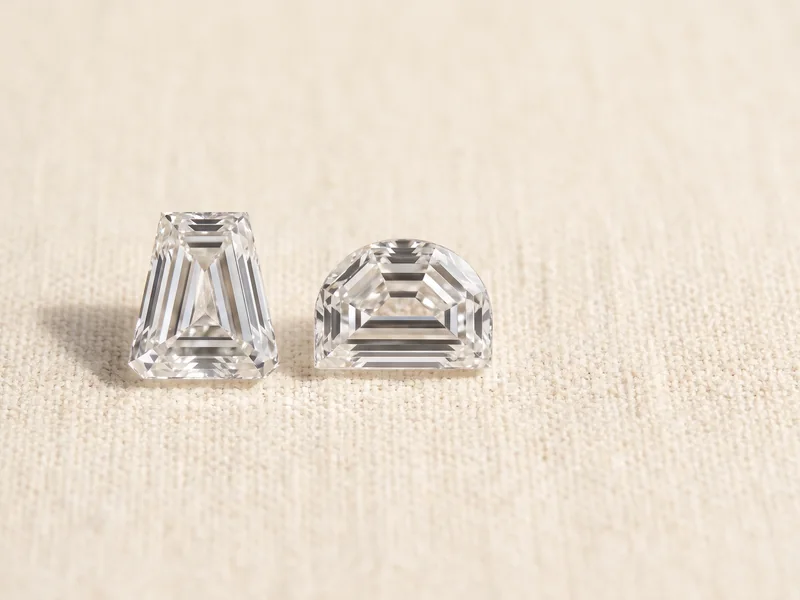 Diamond ShapesSide Stone Diamond Cuts: Trapezoid, Half Moon, Bullet, Baguette, Trilliant
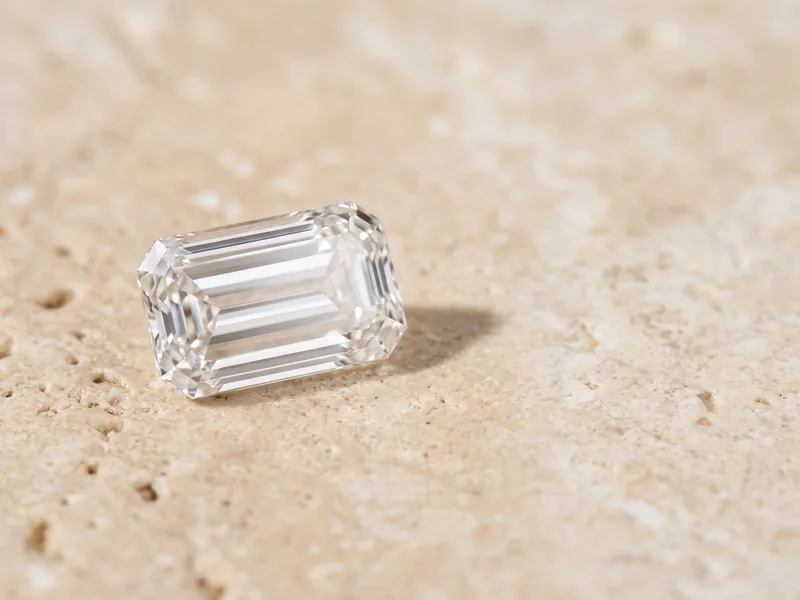 Diamond ShapesEmerald Cut DiamondsDiamond ShapesUnderstanding Diamond Shapes
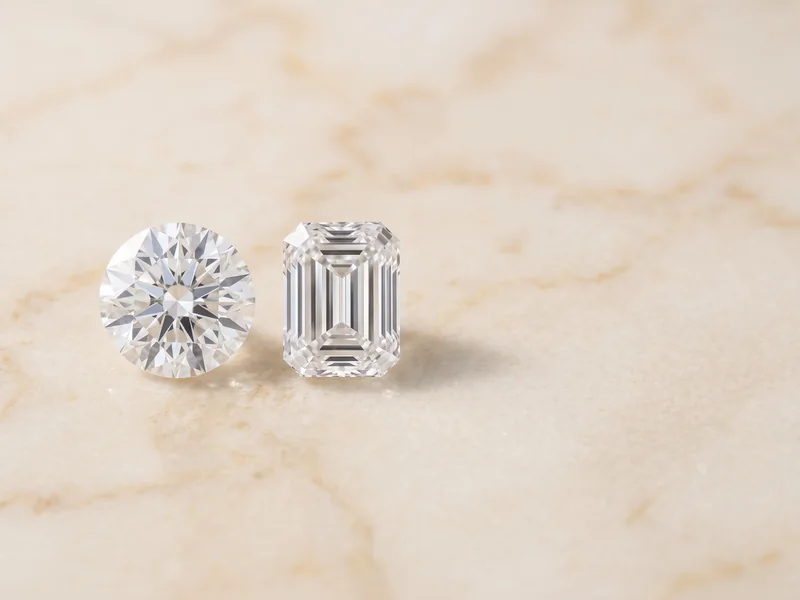 Diamond ShapesAll 34 Diamond Cuts: Every Shape Explained and Compared
 Diamond ShapesAsscher Cut Diamonds
 Diamond ShapesSquare Cut Diamonds (Carré)
Explore more
More guides on this topic
Education