
- Education
- Diamond Shapes
- Half Moon Cut Diamond Guide: Ratio, Matching Pairs, Settings and Price
Diamond shapes
Half Moon Cut Diamond Guide: Ratio, Matching Pairs, Settings and Price
A half moon cut diamond is a supporting act. It is chosen for the centre stone it sits beside. Getting the pair right, in size, ratio, colour and setting, decides whether a three-stone ring looks balanced or awkward.
 Reviewed by Raj Sood, Graduate Gemologist (GIA), AJP (GIA)Master jeweller and Graduate Gemologist (GIA) · reviewed 4 November 2026
Quick answer
A half moon cut diamond is a semicircular side stone with one straight edge and one curved edge, usually step cut. It is sold in matched pairs to sit either side of a centre diamond. Look for a ratio of about 1.7–2.1, the straight edge sized to the centre stone, colour within one grade and VS clarity or better.
What is a half moon cut diamond?
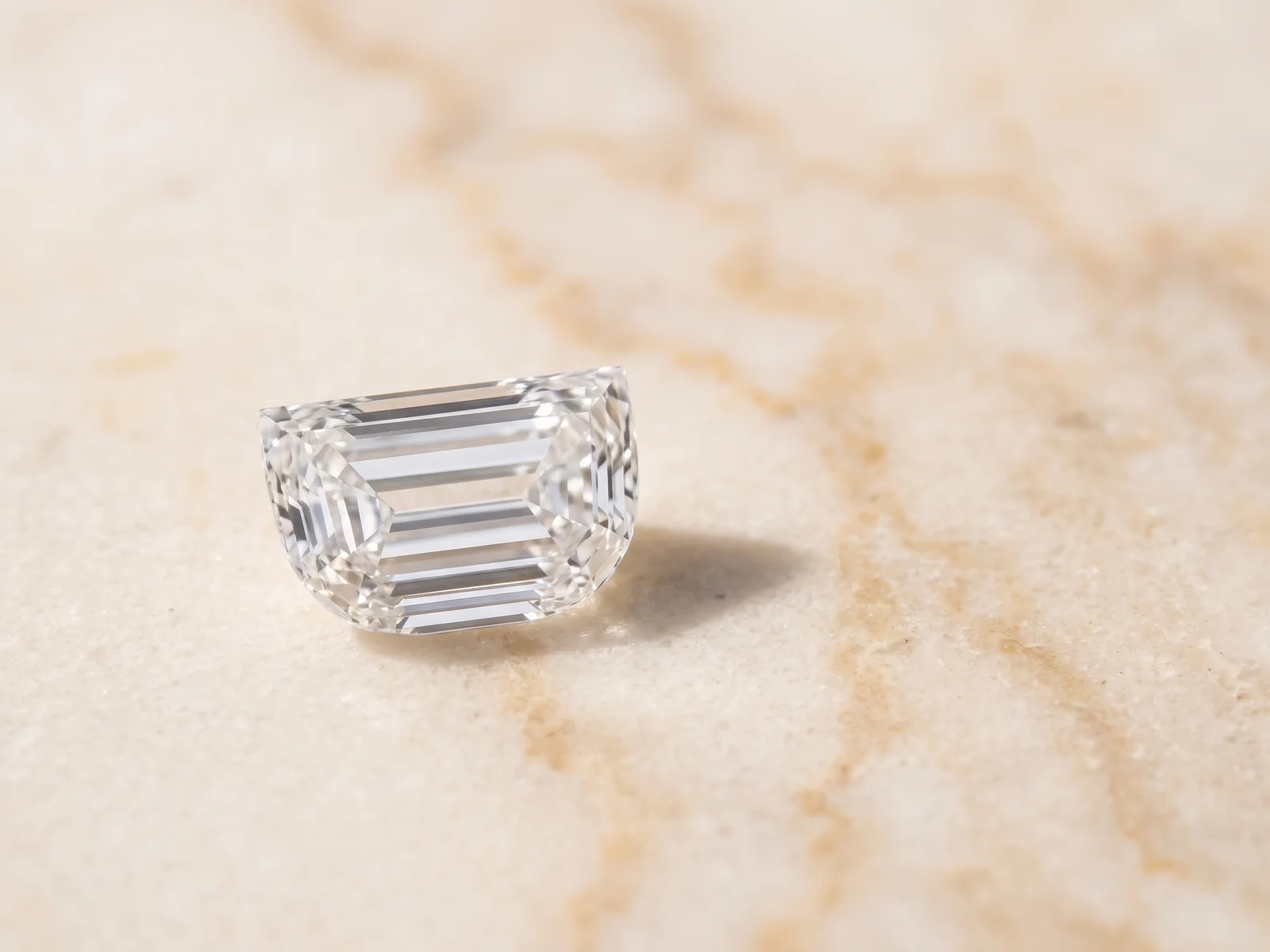
A half moon cut diamond is shaped like a semicircle: one long straight edge, one curved edge, and a sharp corner at each end of the straight side. It is almost never worn on its own. Half moons are cut and sold as matched pairs, meaning two stones cut to mirror each other in size, proportions and colour, so they can sit either side of a larger centre diamond. They belong to the small family of shapes cut specifically as side stones, and you will find them with every other shape in our guide to all 34 diamond cuts compared.
The appeal is simple. The straight edge sits neatly against the centre stone and the curved edge rounds off the outside of the ring, so the three stones read as one soft, continuous shape. Half moons echo the curves of a round or oval, add width across the top of the finger and do not compete with the centre for attention. If you are still deciding on that centre stone, our introduction to how diamond shapes differ is the place to start.
Diamond is 10 on the Mohs hardness scale, the hardest natural material, with a refractive index of about 2.42. Hardness is not the same as toughness, though. A diamond can still chip along its cleavage planes if a thin edge takes a knock, and a half moon has two thin, exposed corners at the ends of its straight edge. Protecting those corners shapes most of the setting advice below. Any term you have not met before is also explained in our A–Z jewellery glossary.
How is a half moon diamond faceted?
Most half moons are step cuts. Their facets are long and flat, running parallel to the outline in rows, like the steps of a staircase. It is the same faceting style used in emerald cuts and in the classic baguette side stone. A step-cut half moon has a large flat table (the top facet), two or three rows of steps on the crown (the top half) and several rows on the pavilion (the lower half). Depending on the cutter, that adds up to roughly 20 to 40 facets.
Step cuts do not glitter the way brilliants do. They give broad, slow flashes of light, often described as a hall-of-mirrors effect, and they show the clarity and colour of the stone quite openly. That calm look is exactly why half moons suit step-cut centre stones such as emerald cuts, and why they also make a quiet frame for a sparkly round or oval.
Some cutters also make brilliant-style half moons, with triangular and kite-shaped facets instead of steps. These scintillate more (scintillation is the flicker of small sparkles as the stone moves) and hide small inclusions better. They sit comfortably beside brilliant centres, including a square princess cut centre. For background on why brilliant and older faceting styles handle light so differently, see how brilliant faceting compares with the rose cut.
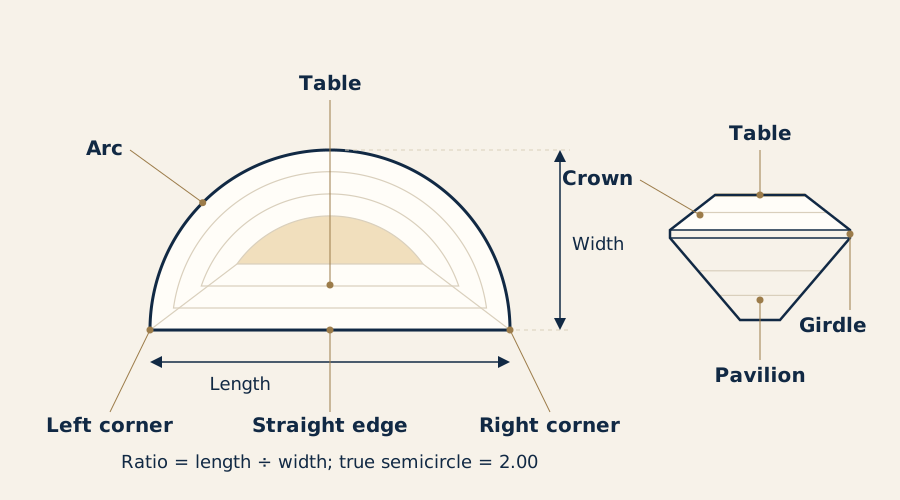
- Straight edge: the long, flat side that faces the centre stone.
- Arc: the curved outer edge that faces away from the centre.
- Corners: the two points where the straight edge meets the arc; the thinnest, most exposed parts.
- Girdle: the thin band around the widest edge of the stone, where it is held by the setting.
- Table, crown and pavilion: the top facet, the upper section and the lower section.
Watch for a window in step-cut half moons. A window is a washed-out, see-through patch in the middle of the stone, caused by a pavilion that is cut too shallow, so light passes straight through instead of bouncing back. In a small side stone it is easy to miss in photos but obvious on the hand, especially next to a lively centre diamond.
What is the ideal ratio for a half moon cut diamond?
For a half moon, the length-to-width ratio compares the length of the straight edge with the width, measured from the straight edge out to the top of the arc. A perfect semicircle has a ratio of exactly 2.00, because its straight edge is the diameter and its width is the radius. In practice, half moons are cut either side of that figure.
| Ratio | How it looks | Suits |
|---|---|---|
| Below 1.70 | Tall, D-shaped arc; almost a rounded rectangle | Larger centres where you want more side-stone presence |
| 1.70–1.90 | Full arc, slightly taller than a true semicircle | Rounds and ovals; reads clearly at small sizes |
| 1.90–2.10 | Close to a true semicircle, the classic half moon | Most three-stone rings |
| Above 2.10 | Flatter, shallower arc | Low-profile designs and smaller, subtler sides |
There is no single right ratio, and GIA does not give half moons an overall cut grade. What matters most is that the two stones in a pair share the same ratio, so the ring looks balanced from both sides. A half moon with a very low ratio starts to look less like a semicircle and more like a bullet-cut side stone, so check the outline if you are looking at anything below about 1.70.
Depth matters too. As a rough guide, many half moons have a total depth of about 55–75% of their width. Too shallow and the stone windows; too deep and it carries hidden weight, faces up smaller and sits higher than the centre. In a pair, the depths should be within a few tenths of a millimetre of each other so both stones sit at the same height in the setting.
| Weight of each stone | Typical size (straight edge × width) |
|---|---|
| 0.15 ct | about 4.5 × 2.3 mm |
| 0.25 ct | about 5.5 × 2.8 mm |
| 0.35 ct | about 6.0 × 3.1 mm |
| 0.50 ct | about 7.0 × 3.5 mm |
These figures assume a ratio close to 2.00 and an average depth. Always compare the millimetre measurements, not just the carat weight, because two half moons of the same weight can face up quite differently.
How do you match half moon side stones to a centre diamond?
Half moons are sized to the centre stone, not the other way around. The straight edge should sit comfortably against the side of the centre diamond without overhanging it. As a general guide, the straight edge is often about 60–85% of the length of the centre stone's side that it faces. Go much shorter and the sides look like an afterthought; go longer and they crowd the centre.
| Centre stone | Typical centre size | Each half moon (approx.) | Straight edge (approx.) |
|---|---|---|---|
| 1.00 ct round | about 6.4 mm | 0.15–0.25 ct | 4.5–5.5 mm |
| 1.50 ct oval, north–south | about 9.0 × 7.0 mm | 0.25–0.35 ct | 5.5–6.5 mm |
| 2.00 ct oval, north–south | about 10.0 × 7.5 mm | 0.30–0.50 ct | 6.0–7.0 mm |
| 1.50 ct emerald, north–south | about 8.0 × 6.0 mm | 0.25–0.40 ct | 5.5–6.5 mm |
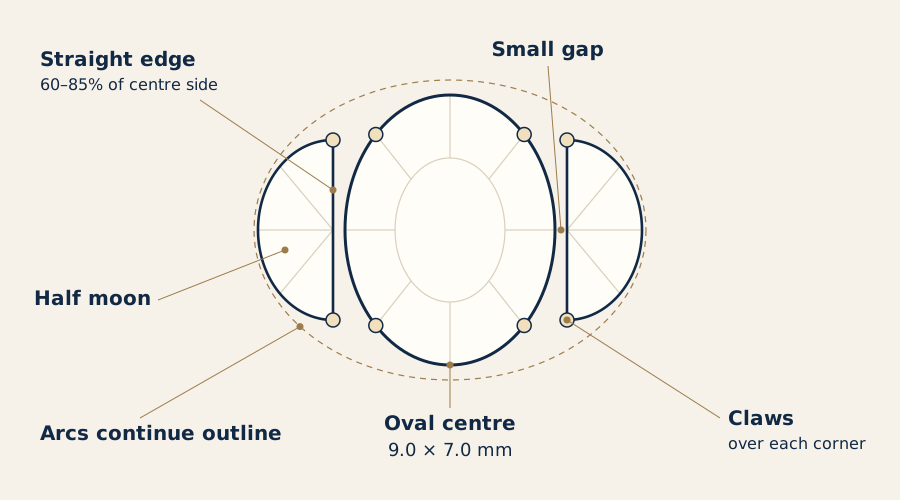
An oval with half moon side stones is one of the most popular combinations, because the curved arcs continue the oval's outline. Rounds and cushions work for the same reason. Emerald and other step-cut centres pair well with step-cut half moons, since the faceting styles match, though the curved outline softens the emerald's straight lines. Square centres such as princess and Asscher cuts can take half moons, but the contrast between square and curve is more pronounced.
Ask how the pair was matched. A well-matched half moon diamond pair should agree in ratio, depth, colour, clarity appearance and faceting pattern, ideally cut from the same piece of rough or carefully sorted from a larger parcel.
Related guideTrapezoid Cut DiamondsNot sure which one is right?
Send us the stones you are looking at and our gemologist will tell you which to choose and why.
What colour and clarity should half moon diamonds be?
Side stones should match the centre, not outdo it. Keep the half moons within one colour grade of the centre diamond. If the centre is G, half moons graded F to H will usually look the same on the hand; a side stone two or three grades warmer can make a white centre look slightly yellow by comparison, or the other way round.
Step cuts show inclusions (internal features) more readily than brilliants, because the large open table and long flat facets act like a window into the stone. For a step-cut half moon, aim for an eye-clean stone, one with no inclusions visible without magnification at normal viewing distance. That usually means VS2 or better. A brilliant-style half moon can often be eye-clean at SI1. Pay close attention to the corners: a feather (a small internal crack) reaching the surface near a corner weakens the thinnest part of the stone.
- White gold or platinum: match the centre within one grade; G–H sides beside a G centre.
- Yellow or rose gold: H–J can look white, but still match the centre within a grade.
- Step-cut half moons: VS2 or better, checked for windows.
- Brilliant-style half moons: a carefully chosen SI1 can be eye-clean.
- Avoid: feathers or chips at either corner of the straight edge.
Small half moons are often sold without individual grading reports, especially under about 0.30 carat each. In that case, ask for the colour and clarity range of the pair, the measurements of each stone, and whether they are natural or lab-grown. Mixing a lab-grown centre with natural sides, or the reverse, is possible, but each stone should be described accurately on the ring's paperwork.
What is the best setting for half moon side stones?
A half moon three stone ring has to do two jobs: protect the corners of each side stone and keep a small, safe gap between the side stones and the centre. Diamonds should not rub against each other, because a diamond can chip another diamond. Common setting options:
- Claw setting: usually two or three claws on each half moon, with claws placed over the corners. Shows the most diamond and lets light in.
- Shared claws: claws that hold both the centre and a side stone, bringing the stones closer together for a seamless look.
- Bezel or half-bezel: a thin rim of metal around the arc, or around the whole stone. Very secure and protects the corners fully, at the cost of a little visible diamond.
- Basket or cathedral under-gallery: lifts the stones and lets light reach the pavilions, though no setting will hide a window in a shallow-cut stone.
Half moons are one of several options for a three-stone layout. Some people prefer angular sides such as six-sided hexagonal side stones, which give a more geometric look against the same centre. Because the side stones are sized to a specific centre, a custom design usually starts with the centre stone's exact measurements.
For the wedding band, a three-stone ring with half moons is wide across the top. If the setting sits high, a straight band will often sit flush underneath it. If the side stones sit low, a contoured or notched band may be needed so the arcs do not stop the band from sitting close. Try both rings together before finalising the design.
Half moon vs trapezoid, baguette and trilliant: which side stone suits you?
| Half moon | Trapezoid | Baguette | Trilliant | |
|---|---|---|---|---|
| Outline | Semicircle | Four sides, two parallel | Long, narrow rectangle | Triangle, straight or curved sides |
| Usual faceting | Step (some brilliant) | Step | Step | Brilliant |
| Look in a three-stone ring | Soft and rounded | Tapered and architectural | Straight and linear | Bright and sparkly |
| Exposed corners | Two | Four | Four | Three |
| Pairs well with | Round, oval, cushion, emerald | Emerald, radiant, oval | Most shapes | Round, cushion, princess |
| Sold in pairs? | Almost always | Almost always | Pairs or rows | Usually pairs |
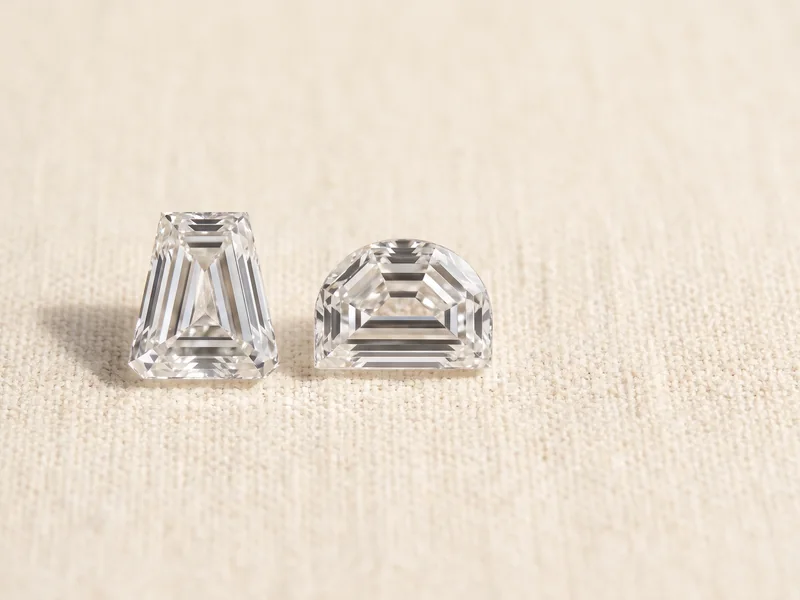
The choice between half moon vs trapezoid side stones usually comes down to curves or lines. A half moon softens the ring; a trapezoid cut side stone tapers towards the edge and gives a sharper, more tailored look, especially beside an emerald. A trilliant adds the most sparkle of the four; our guide to trilliant side stones and solitaires explains their curved and straight-sided versions.
Some shapes sit between these options. Shield cut diamonds combine straight and angled sides for a bolder frame, the four-sided kite cut points outward like an arrow, and the slim lozenge shape works as a long, diamond-shaped accent. The wider family of angular shapes is covered in our overview of geometric diamond cuts from shields to pentagons.
How much does a half moon cut diamond cost, natural or lab-grown?
Half moons are cut from both natural and laboratory-grown diamond, and the two look identical to the eye. Lab-grown half moon diamonds are real diamond, grown in a laboratory rather than mined, and they cost much less than natural. Natural half moons are rarer, and well-matched natural pairs take time to find.
Half moons are priced per pair. A matched pair usually costs more per carat than two unmatched stones of the same total weight, because the cutter gives up weight to make the two stones mirror each other, and because few cutters produce the shape. Within a pair, the price moves most with total carat weight, colour, clarity and how closely the stones match.
| Pair, G–H colour, VS clarity | Lab-grown (approx. AUD) | Natural (approx. AUD) |
|---|---|---|
| 0.30 ct total (2 × 0.15 ct) | about $200–$600 | about $800–$2,000 |
| 0.50 ct total (2 × 0.25 ct) | about $300–$900 | about $1,500–$3,500 |
| 0.80 ct total (2 × 0.40 ct) | about $450–$1,400 | about $2,800–$6,000 |
These are broad ranges only; half moon diamond prices in Australia move with the market and with the exact grades, and setting and metal are extra. Because the side stones are small, a three-stone ring's overall cost is still driven mainly by the centre diamond.
Shop half moon diamonds: natural and lab-grown
How do you choose half moon side stones? Step by step
- Measure the centre first. Note the exact length and width of the centre diamond in millimetres.
- Size the straight edge. Aim for a straight edge of roughly 60–85% of the centre side it faces.
- Check the ratio. Divide the straight edge by the width; about 1.70–2.10 for most rings, and the same for both stones.
- Confirm the match. Both stones within one colour grade of the centre, similar clarity appearance and depth within a few tenths of a millimetre.
- Look for windows and corner flaws. View the pair in a video or in person, checking the middle for see-through patches and each corner for feathers or chips.
- Confirm natural or lab-grown. Make sure the paperwork states the origin of every stone in the ring.
- Plan the setting and band. Choose claws or a bezel that cover the corners, leave a small gap to the centre and try the wedding band alongside.
Free consultation
Talk to a gemologist
Compare stones in person or online with Raj Sood, Graduate Gemologist (GIA), AJP (GIA).
Book a consultationFAQ
Common questions
What is a half moon cut diamond used for?
Almost always as side stones. Half moons are cut in matched pairs to sit either side of a centre diamond in a three-stone ring, with the straight edge facing the centre.
What centre stone goes best with half moon side stones?
Ovals, rounds and cushions suit them most naturally, because the curved arcs continue the centre's outline. Emerald cuts also work well with step-cut half moons, since the faceting styles match.
What is the ideal half moon diamond ratio?
A true semicircle is 2.00, and most half moons sit between about 1.70 and 2.10. The most important thing is that both stones in the pair share the same ratio.
Are half moon diamonds sold individually?
Rarely. They are cut and priced as matched pairs so both sides of the ring look the same, and a pair usually costs more per carat than single unmatched stones.
Can you get lab-grown half moon diamonds?
Yes. Lab-grown half moons are real diamond and cost much less than natural pairs. The ring's paperwork should state whether each stone is natural or lab-grown.
Do half moon diamonds chip easily?
The two corners at the ends of the straight edge are the thinnest parts and the most exposed. Claws over the corners or a bezel protect them, and the side stones should not touch the centre diamond.

Ask a gemologist
Not sure which diamond to choose?
Raj Sood is a Graduate Gemologist (GIA) and master jeweller. Bring the stones you are considering, or send the reports, and he will tell you honestly which one is better and why.
Keep learning
Related guides
 Diamond ShapesSide Stone Diamond Cuts: Trapezoid, Half Moon, Bullet, Baguette, Trilliant
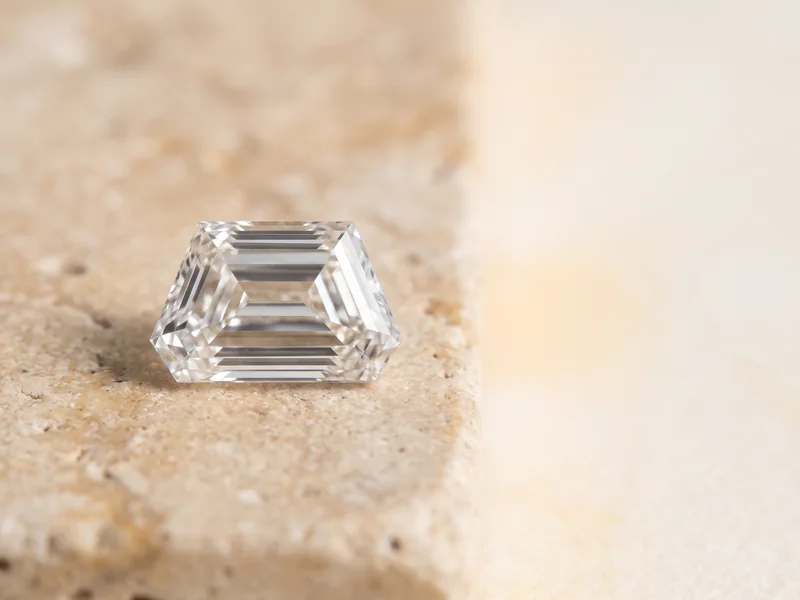 Diamond ShapesTrapezoid Cut Diamonds
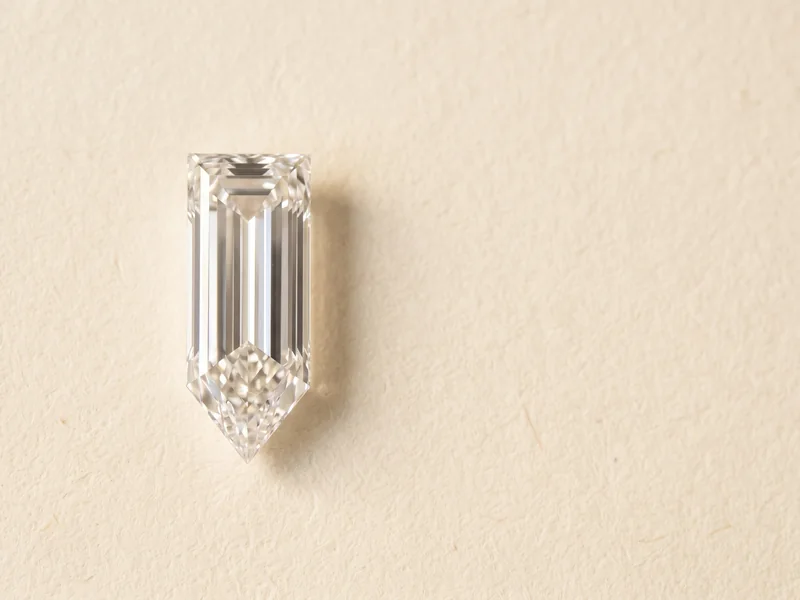 Diamond ShapesBullet Cut Diamonds
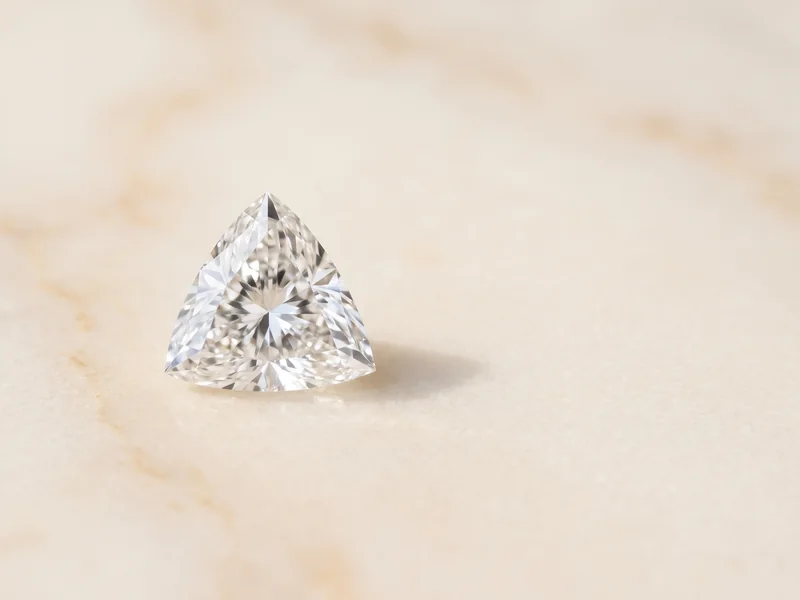 Diamond ShapesTrilliant Cut DiamondsDiamond ShapesUnderstanding Diamond Shapes
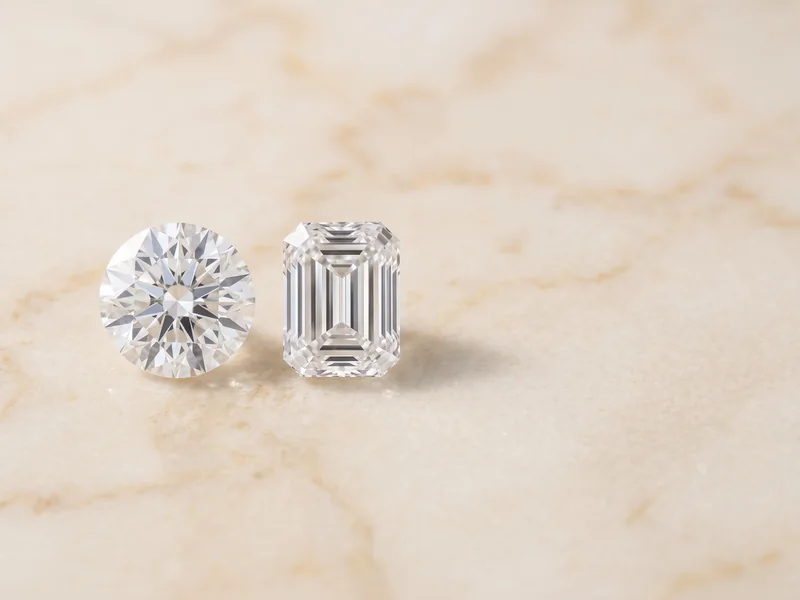 Diamond ShapesAll 34 Diamond Cuts: Every Shape Explained and Compared
 Diamond ShapesBaguette Cut Diamonds
 Diamond ShapesShield Cut Diamonds
Explore more
More guides on this topic
Education